Provoleta
A thick disc of provolone grilled until the outside crusts and the middle collapses. Oregano, ají molido, a film of oil, and you eat it fast.
- Prep
- 25 min
- Cook
- 10 min
- Serves
- 1 disc — a starter for 2 to 4
- Difficulty
- Easy
Kitchen-tested
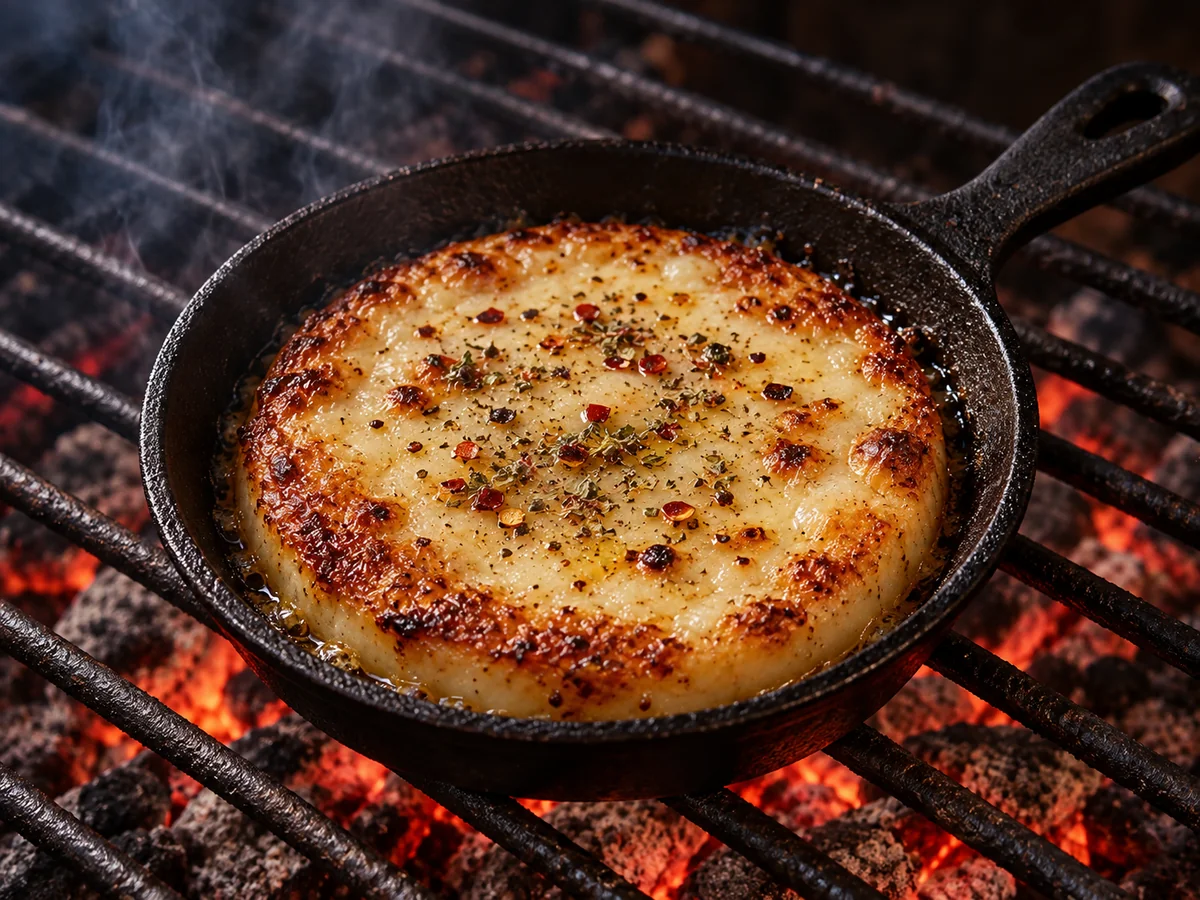
Provoleta is a disc of provolone grilled until the outside crusts and the middle collapses. Oregano, ají molido or chilli flakes, a film of olive oil. You eat it fast, with bread, because as it cools the fat sets and the molten puddle becomes a rubbery puck. That is the dish. It is the asado starter while the meat is still working: cheese on the fire, not a cheese board, not nachos, not a baked dip.
The mistake is thickness, or temperature. Too thin and the disc becomes a puddle and falls through the grate. Too cold going on and it sweats, sticks, and tears when you try to move it. You want a slab 1.5–2 cm thick, brought toward room temperature, onto a hot oiled iron, left alone until a crust exists. Then you turn it once, if you turn it at all.
Italian-Argentine Sunday cooking put provolone on the parrilla because the fiambrería already had it and the fire was already lit. Serve it with crusty bread and chimichurri.
- 250–350 g9–12 ozProvolone disc (provoleta)1.5–2 cm / ⅝–¾ in thick, about 10–12 cm / 4–5 in across, brought toward room temperature
- 10–15 ml2–3 tspExtra-virgin olive oilfor filming the cheese and the iron
- 2 g1 tspDried oreganosome discs want a heavier snow
- 1 g½ tspAjí molido, or crushed chilli flakes
- 0.5 ga pinchCoarse saltonly if the cheese is mild
- 150–200 g5–7 ozCrusty bread, sliced, to serve
- 40–80 ml3–5 tbspChimichurri, at room temperaturethe house batch, or leftover
Yield
One disc — a starter for 2 to 4 people at an asado.
On the cheese
You want a firm provolone sold as a disc, or a piece you can cut into one. In Argentina it is provoleta: a round for the grill, often a slightly drier paste than sandwich slices. Pasta filata — stretched-curd cheese — is what lets a crust form while the interior flows. Wet mozzarella puddles. A hard aged cheese barely melts. If your deli only has a log, cut a 1.5–2 cm round or square of the same thickness, and trim thin wings that will melt off first. Smoky or bland deli provolone both work if you are generous with oregano and ají. Do not use pre-shredded anything.
On the thickness
1.5–2 cm is the canonical range. Thinner than 1 cm and you have no structure once the fat melts; the disc slumps through the bars. Thicker than 2.5 cm and the centre stays cool while the outside overbrowns, unless you finish with a lid. A diameter of 10–12 cm feeds a small table; a 15 cm disc wants a provoletera or a skillet more than a wide-open grate.
On oregano and ají molido
Dried oregano, not a heap of fresh leaves that will scorch. Ají molido is crushed dried chilli, more rust than cayenne heat; chilli flakes stand in. Spices go on the oiled face before it hits the iron, and again on the molten top. Salt only if the raw cheese is dull. Lemon on top is a known departure I do not make at home. If you want acid, that is what the chimichurri is for.
On the oil, and the heat
A film. You are not frying. Oil is a release layer and a heat-transfer film, and it helps the oregano stick. Too much and the crust goes greasy instead of toasted. Do not oil a cold pan and wait — the oil turns to varnish. The iron has to be hot. Not a wok-scream, but properly hot: 220–250 °C / 430–480 °F at the pan surface, or a grate over medium-hot coals where you can hold your hand two seconds, not five. The heat of the iron builds the crust that keeps the disc in one piece. A timid pan welds protein to metal. A blast-furnace grate burns the outside while the middle stays cold.
Equipment
- A parrilla with a reasonably tight grate, or a small cast-iron skillet — a provoletera if you have one
- A wide, thin-edged metal spatula
- A pastry brush, or clean fingers, for the oil film
What not to use: a wide-gap grate with a thin disc and nothing underneath; a cold pan; nonstick, which will not crust; a microwave; a fork for flipping; a lid clamped on from the start, which steams the face you need dry. The traditional anti-stick is not a product: hot iron, light oil, correct thickness, cheese that is not fridge-cold, and not flipping early. A foil ring on a wide grate is a cheat that works, and it tastes like foil if you are sloppy. I would rather use the skillet.
Method
Temper the cheese20–30 min on the counter
Take the disc out of the fridge and leave it on a plate until the chill is off — the surface should not feel like a refrigerator door. Twenty to thirty minutes in a normal kitchen, longer if the room is cold.
You are not warming it through; you are stopping condensation. A fridge- cold disc sweats, and water plus protein on metal is glue. The cheese sticks, then tears.
Use a firm provolone disc 1.5–2 cm thick. Leave it on a plate for 20–30 minutes to lose its refrigerator chill; do not let condensation remain on the surface.
Get the iron hot20–30 min coals · 5 min for a pan
Parrilla: medium-hot coals, grate hot, a little oil wiped on the bars if they are dry. Surface around 220–250 °C / 430–480 °F.
Cast iron: medium-high until a drop of water skitters, then film with oil.
Broiler: rack 10–12 cm from the element, pan preheated under the broiler for 5 minutes.
Crust is dehydration plus browning, and it only happens if first contact is hot enough to set the face before the interior slumps.
Choose a method. Grill: heat a close-spaced grate over medium-hot coals, about 220–250 °C / 430–480 °F. Cast iron: preheat about 5 minutes over medium-high, then lightly oil. Broiler-only: preheat the pan for 5 minutes, 10–12 cm below the element, and use the timing in step 5. Use a skillet rather than a wide-gap grate.
Season and oil1 min
Pat the disc dry if it looks damp. Brush or rub about 10 ml of oil over both faces. Oregano and ají molido on the face that will go down first. A pinch of salt only if the cheese needs it.
A dry surface browns; a wet surface steams and sticks. Oregano on the down face toasts into the crust.
Pat the cheese dry. Brush about 10 ml oil over both faces; season the first cooking face with oregano and ají. Add salt only if the cheese needs it.
First side — do not touch it4–6 min
Lay the disc down. Quiet sizzle, not a scream. Do not poke, slide, or peek for at least 4 minutes. It will look as if it is welding itself to the iron. That is the crust forming.
When the edges go translucent and start to slump, and a spatula slides under a corner with a toasted skin attached, it is ready to move.
Down face deep gold to spotted brown, not white and not black; top softening, maybe beads of fat; the disc still holding a round. If you check the centre it is 55–65 °C / 130–150 °F and climbing — but the cue is the crust, not a number.
Casein and fat need time against hot metal to build a skin. Flip too early and you leave half the cheese on the iron.
For grill or stovetop, cook the first side 4–6 minutes without moving it for at least 4 minutes. Turn only when a spatula lifts a deep-golden crust, the edges soften, and the disc still holds its shape. The center may be 55–65 °C / 130–150 °F at this stage; it is not finished yet.
Turn it, or don't2–4 min
If the first crust is solid, turn it once with a wide spatula. The second side needs less time. The centre should collapse: top sinks, fat pools, interior molten and stretchy.
In a provoletera or skillet you can skip the flip and finish with a lid cracked for 1–2 minutes, or a pass under the broiler, so the top melts while the bottom crust stays put. Direct on the grate, I flip once.
Broiler-only: preheated pan, cheese in, 5–8 minutes until the top blisters and the centre yields. More top-brown, less grate crust. That is an honest indoor plate.
Finished: the middle sags if you jiggle the pan, a knife slides in with no resistance, the interior is glossy and collapsed rather than a white core. Around 70–75 °C / 158–167 °F if you check. Past that, the oil separates and the cheese goes stringy-greasy.
Flip once and cook 2–4 minutes more, until the center is glossy, molten and yields easily, about 70–75 °C / 158–167 °F. In a skillet, instead finish unturned with a cracked lid for 1–2 minutes or briefly under the broiler. Broiler-only takes 5–8 minutes total in the preheated pan, until blistered and softened through. Avoid continuing until the oil separates.
Oregano again, then the tableunder 2 min from iron to mouth
Slide it onto a warm plate, or serve it in the hot skillet. More oregano, a pinch more ají, a thread of oil if the top looks dry. Bread on the table. Chimichurri on the table. Eat immediately.
As it cools, milk fat firms and the protein network tightens. Ten minutes later you have a disc you can pick up. Provoleta is a now food.
Serve immediately on a warm plate or in the hot skillet, ideally within 2 minutes. Add oregano, a little ají and a thread of oil if needed. Serve bread and chimichurri alongside; the cheese firms as it cools.
Storing it
This is not a leftover dish
Refrigerated, it becomes a dense, oily brick. Reheat a leftover slab in a hot skillet until it softens — acceptable on bread, not as last night's plate. Refrigerate within 2 hours if you insist, and eat within 2 days. Do not leave molten dairy in the sun next to the grill.
The raw cheese
Keeps wrapped in the fridge to the date on the piece. An ammonia smell or a slimy paste means throw it away. Chimichurri holds; bring it to room temperature so the oil is liquid. Toast the bread when the cheese is almost done.
Troubleshooting
- Welded to the grate, and it tore on the flip.
The cheese was cold, the grate was dirty or not hot enough, or you flipped at minute two. Temper it, hot iron, light oil, wait for the crust.
- It puddled through the bars.
The disc was too thin, or the heat so high the structure collapsed before a crust set. Use 1.5–2 cm. Use a provoletera, a skillet, or a foil ring on a wide grate.
- White rubbery centre, dark bottom.
Iron too hot, cheese too cold, or the disc too thick. Lower the fire, temper longer, or finish with a cracked lid so the core catches up.
- An oil slick, and broken cheese.
Overcooked — the fat rendered out of the protein. Pull it when the centre just sags.
- Bitter black oregano.
Fresh herbs, or dried oregano thrown into the fire around the cheese. Dried oregano on the oiled face, and more on the finished top.
- It sticks in the skillet.
The pan was not hot, or you used nonstick on timid heat. Preheat until water skitters, film with oil, and wait.
- Salty beyond eating.
The cheese was already salty and you added more. Taste the raw paste first. Bread dilutes it; chimichurri will not fix a salt brick.
- It tastes like nothing.
Bland deli provolone, no oregano, a pale crust. Toast the face properly, be generous with dried oregano and ají, and serve it with chimichurri.
- It set before anyone sat down.
You plated it and then went to turn the asado. Cook it last among the starters, when people are standing there with bread in their hands.
Substitutions
Traditional versus known departure
| Component | Traditional | Known departure |
|---|---|---|
| Cheese | Provolone disc, 1.5–2 cm, sold as provoleta | Firm mozzarella (wetter, more puddle risk); other pasta filata, thick-sliced. Cheddar, Gruyère, or halloumi are different dishes — halloumi will not collapse in the middle |
| Thickness | 1.5–2 cm / ⅝–¾ in | Thinner only in a skillet, never over a wide grate. Thicker only if you will finish with a lid or broiler |
| Fat | Olive oil, a film | A smear of the asado's beef fat is a known asador habit. Butter browns too fast |
| Seasoning | Dried oregano, ají molido | Chilli flakes. Fresh oregano scorches. Lemon is a departure. Garlic powder burns |
| Cookware | Parrilla grate, or provoletera | Cast-iron skillet on grill or stove (honest). Foil ring on a wide grate (cheat). Broiler and preheated pan (honest indoor) |
| Sauce | Chimichurri on the table, bread in hand | Salsa criolla on the side. Honey is not this plate |
Scaling
For a bigger table, grill more discs — not a thicker disc.
More people
One 250–350 g disc is a starter for 2 to 4. Send each one to the table as it finishes. Do not stack them. Do not tent them with foil; you will steam the crust you just built.
A bigger disc
A 500 g disc only makes sense in a wide skillet, and it will not melt through on the same clock. Add 3 to 5 minutes and consider a cracked lid. I would rather cook two canonical discs.
What to serve it with
Bread, and chimichurri. That is the plate. At an asado it sits with choripán in the first round, before the tira and the vacío.
- Crusty bread, sliced
- Chimichurri
- A young Malbec, or whatever is already open for the meat
- Pickled peppers on the side, if you want extra acid
Do not bury it in tomato sauce. Do not add ham and call it a pizza unless you have left this recipe on purpose.
Questions
Do I flip it?
On a grate, once, when the first crust exists. In a provoletera or skillet you can skip the flip and melt the top with a cracked lid or a minute under the broiler.
Why did it fall through the grill?
Too thin, or cold bars, or you moved it before a crust formed. 1.5–2 cm, hot iron, patience. Use a skillet if your grate has wide gaps.
Can I use mozzarella?
Firm, low-moisture mozzarella in a skillet can melt and brown. Fresh wet mozzarella will weep and puddle. It will not behave like provoleta on an open grate.
Is the provoletera cheating?
No. It is ordinary Argentine kit for this cheese. Foil is the cheat. A cast-iron skillet is an honest stand-in.
How hot, exactly?
Pan surface 220–250 °C / 430–480 °F, coals medium-hot. If the oil smokes hard the second the disc lands, you are too hot. If nothing sizzles, you are too cold.
Can I cook it in the oven?
A preheated cast-iron pan under the broiler is the indoor method I trust. A cold cheese in a cold pan at 180 °C / 350 °F gives you melted cheese with no crust. That is a dip.
How much oregano?
About 2 g / 1 tsp on a 300 g disc, plus a pinch at the end. The cheese should smell of oregano when it hits the table, not of burnt grass.
What if it sets before we eat?
Put the skillet back on the heat for a minute. It will loosen — not as good as the first melt. Next time, call people over before you drop the disc.