Choripán
Fresh chorizo grilled whole, then split and put back on the iron, packed into crusty bread toasted in its own fat and dressed with chimichurri.
- Prep
- 30 min
- Cook
- 22 min
- Serves
- 4 sandwiches
- Difficulty
- Easy
Kitchen-tested
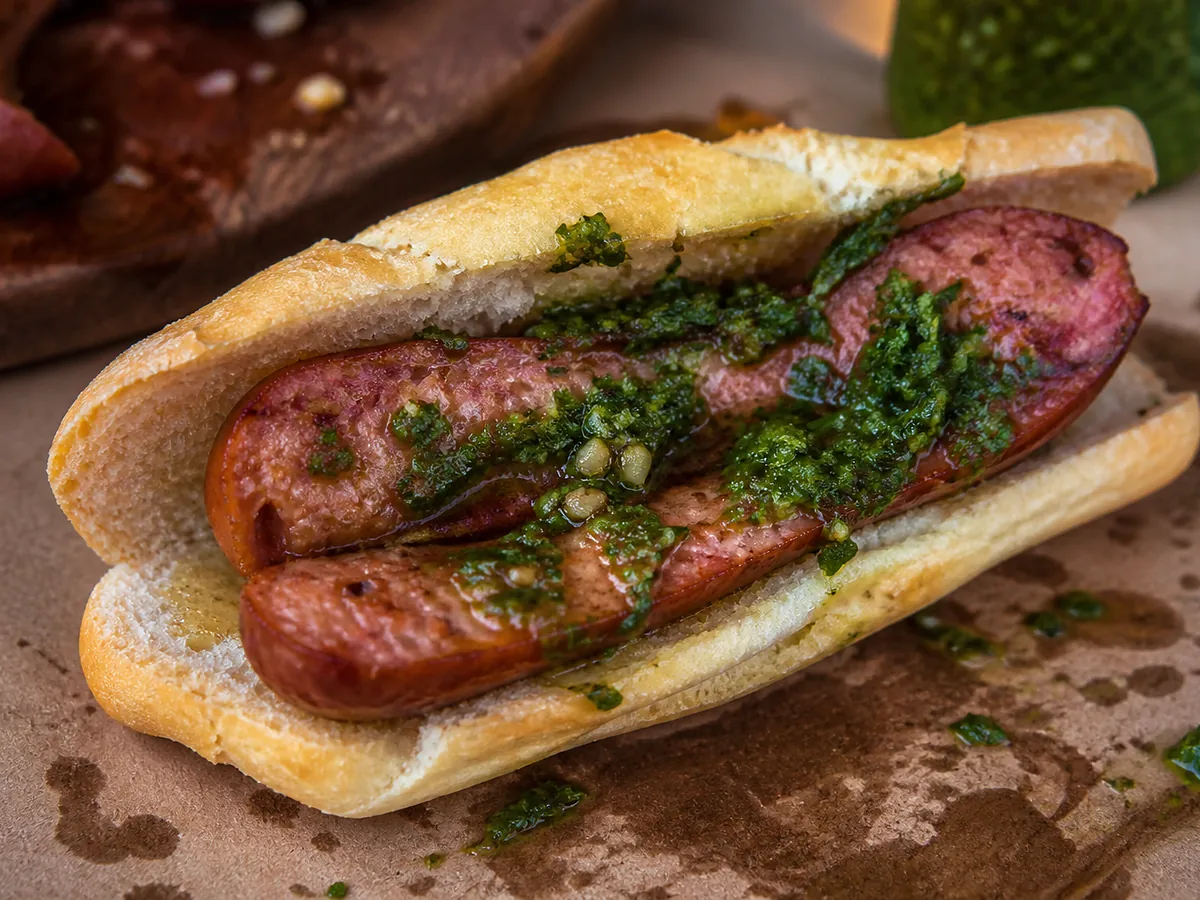
Choripán is a grilled Argentine fresh chorizo, split down the middle, packed into crusty bread, and dressed with chimichurri. Meat, bread, sauce. That is the sandwich. It is what you eat standing up outside a fútbol ground, what the asador hands you before the vacío is ready, what a street cart sells you in a paper napkin that fails immediately.
The rule people get wrong is splitting the sausage too early. Butterfly a raw chorizo and the fat and juices run onto the coals; the casing goes slack; you get a dry, grey tube in a bun and then you drown it in sauce to hide the mistake. Grill the sausage whole first, until the casing is taut and browned and the inside is nearly cooked. Then split it and put the cut face back on the iron so it takes colour and opens a trough for chimichurri.
The second error is using the wrong sausage. Spanish dry chorizo is already cured. Mexican chorizo is a loose, chili-heavy paste. You want chorizo parrillero: fresh, coarse, in a casing, meant for the grill.
Chori plus pan. Italian sausage-making met the Sunday fire. Assembly stays stubborn: sausage, bread, chimichurri. Salsa criolla is a known add-on, not the sandwich itself. For the sauce, make the house chimichurri — 2:1 oil to vinegar, that is the house rule — or use leftover.
The sandwich
- 4 × 120 g4 × 4¼ ozFresh Argentine chorizos parrilleros (criollos), whole, in casing
- 4 × 70–90 g4 × 2½–3 ozPan francés, mignon, or short crusty baguette rollssplit lengthwise
- 80–120 ml⅓–½ cupChimichurri, at room temperaturethe house batch, or leftover
- 5 ml1 tspNeutral oilfor the grate if it is dry — or a film of the sausage's own fat
- 0.5 ga pinchCoarse saltonly if the bread needs it
Salsa criolla — a known add-on, not the sandwich
- 80 g2¾ ozOnion, finely diced1 small onion
- 100 g3½ ozRipe tomato, seeded and diced1 ripe tomato
- 30 g1 ozRed bell pepper, finely dicedabout ¼ of a pepper — optional even inside this add-on
- 30 ml2 tbspOil, olive or a mix
- 15 ml1 tbspRed wine vinegarthe same 2:1 oil-to-vinegar rule as the house chimichurri
- 2 g1 tspDried oregano
- 2 g⅓ tspSalt, to taste
Yield
4 sandwiches.
On the chorizo
Argentine chorizo parrillero is a fresh sausage — usually pork, sometimes pork with beef, coarsely ground, packed in a natural casing, with paprika or ají molido, garlic, oregano, salt, often a splash of wine. It is raw and it must be cooked through. Buy it from the fridge case, not hanging dry next to the jamón. A 120 g link is the street size. Thicker festival sausages take longer and burst more easily on a high fire. I do not prick the casing. Abroad, "Argentine-style" still has to be fresh, coarse, and grillable. A hot-dog texture is wrong. A dry, sliceable chorizo is wrong.
On the bread
Pan francés is a short, crusty roll with a tight crumb; mignon is the smaller cousin. A length of baguette works if you cut it to the sausage, not the other way around. Ciabatta holes dump the filling. Soft supermarket buns steam — a known departure, and you should still toast them. Toast the cut face on the parrilla in the sausage fat, which carries paprika and garlic into the crumb. A dry, pale roll next to a wet sausage is how the sandwich dies.
On the chimichurri
Enough to dress the cut face and soak a little into the bread, not a soup. Keep it at room temperature so the oil is liquid — cold chimichurri sits on the sausage like grease.
On the fire
Medium coals, not a blast furnace. Chorizo on a screaming grate bursts because water in the filling turns to steam faster than the casing can give. Surface around 180–200 °C / 355–390 °F: hot enough to brown, calm enough to turn every few minutes without a fat fireball. A gas grill is a known departure — medium burner, lid open if you can. A heavy pan or plancha is a known departure for a balcony with no grill: film of oil, medium heat, same whole-then-split logic. A microwave is not a method.
On salsa criolla
Onion and tomato, sometimes pepper, oil, vinegar, oregano, salt. A known add-on on the street and at some asados. It does not replace chimichurri. If you put both on, go light or the bread gives up. I like criolla when the sausage is very fatty.
Equipment
- A parrilla, or a kettle grill with a two-zone fire
- Long tongs — not a fork
- An instant-read thermometer
- A cutting board and a sharp knife for the split
- A small bowl and spoon for the chimichurri
What not to use: a fork as your main tool (you puncture, you leak); a lid clamped down to speed things up (the casing goes flabby); a deep pot of water as the main cook (some carts parboil — that is a vendor shortcut); a ridged electric grill so hot the casing blackens in four minutes; nonstick too weak for this heat; a blender for the optional criolla, because you want dice, not juice.
Method
Fire, and let the sausage lose its chill30 min coals · 15 min counter
Build a medium bed of coals and let them ash over. Hold your hand above the grate: you should last three to four seconds, not one. Surface target 180–200 °C / 355–390 °F. Pull the chorizos from the fridge 15 minutes before they go on.
Collagen in the casing sets cleanly when the heat is steady. Stone-cold sausage on a scorching grate browns outside while the centre lags — and then you split too soon.
Prepare medium coals and let them ash over, about 30 minutes; target 180–200 °C / 355–390 °F at the grate. Remove the fresh, raw chorizos from the fridge 15 minutes before grilling.
Grill them whole12–18 min
Lay the links over medium heat, not over licking flame. Leave them 3 minutes so the casing takes a set. Turn. Colour should be deep rust with some blister, not charcoal black. If a flare-up climbs the sausage, move it to the cooler zone and bring it back.
Whole-stage doneness: casing taut and browned, sausage firm rather than squashy, and a thin juice at a tiny probe point mostly clear, not pink-cloudy. Centre of the thickest link 68–70 °C / 154–158 °F before you split. A fat festival link can need 20 minutes whole.
You are coagulating protein and rendering fat inside a closed casing. Split too early and you empty the sausage onto the coals.
Grill whole links over medium heat, away from flames, for 12–18 minutes. Leave the first side 3 minutes, then turn to brown evenly. Move flare-ups to a cooler zone. The center should reach 68–70 °C / 154–158 °F before splitting; thick links may need 20 minutes. They still need the finishing step below.
Split it1 min, off the fire
Hold it with tongs. Cut lengthwise, stopping short of slicing through, so it opens like a book. Do not press the juice out with the knife.
If a link is still soft in the centre, put it back whole. Do not butterfly a raw middle and hope.
The hinge is what keeps the sausage in one piece in the bread. A fully severed chorizo slides out on the first bite.
Off the heat, hold each sausage with tongs and slit lengthwise without cutting all the way through. Open like a book without squeezing out the juices. If the middle is still soft, return it to the grill whole first.
Finish cut-side down2–4 min
Return the opened sausages cut-face to the grate, in the fat they have already spilled. You want colour on the meat, not a hard crust: wet pink-grey turning browned, edges slightly crisp. Centre 71 °C / 160 °F or just over — that is the pork finish. Past 75 °C / 167 °F you cooked it dry.
The cut face should smell roasted, not steamed, and the juices in the trough should bubble clear. The casing still has chew.
This open face is where the chimichurri sits, and Maillard on that coarse grind is what separates this from a boiled link in a bun.
Grill cut-side down for 2–4 minutes until browned with slightly crisp edges. Check the center reaches at least 71 °C / 160 °F; avoid prolonged cooking beyond 75 °C / 167 °F, which dries it out.
Toast the bread in the fat1–2 min
Lay the rolls cut-side down in the same zone, in the rendered fat. Press lightly with the tongs. Pull them when the cut face is spotted brown and smells of toasted wheat and paprika. If the grate is dry, brush a film of oil onto the bread — not a soak.
Starch plus fat plus the sausage's own seasoning is the second sauce. Untoasted bread turns to paste under chimichurri.
Toast rolls cut-side down in the rendered sausage fat for 1–2 minutes until spotted brown. Press lightly; if the grate is dry, brush the bread with a thin film of oil.
Assemble and eatnow
Bread, sausage, a spoon of chimichurri over the cut face and a little on the bread. Close it. If you are using salsa criolla, a thin layer, not a heap.
Choripán waits badly. Bread steams, casing softens, sauce soaks through. Five minutes at its peak.
Fill each roll with a sausage and spoon chimichurri over the cut face and bread. For optional salsa criolla, mix its diced vegetables with its oil, vinegar, oregano and salt; add a thin layer. Close and serve immediately, ideally within five minutes.
Storing it
The pork rule
Pork sausage is done at 71 °C / 160 °F in the centre. Do not serve a pink, soft middle. Fresh chorizo is raw meat: refrigerate at 4 °C / 40 °F or below and cook it within a day or two, or freeze it raw. Raw sausage juice on the board is raw pork — wash the board before the bread goes down.
Leftovers
Cooked chorizo: cool and refrigerate within 2 hours, eat within 3 days, reheat to 74 °C / 165 °F. It will be drier — slice it into a pan with chimichurri. Do not leave assembled choripanes in a warm car after the match. Chimichurri holds in the fridge; bring it back to room temperature. Salsa criolla is best the day you cut it — overnight the onion takes over and the tomato weeps.
Troubleshooting
- The casing burst.
Heat too high, or you stabbed it. Move it to a cooler zone and finish gently. Next time: medium fire, tongs only.
- Raw middle, dark casing.
Grate too hot, sausage too cold. Finish it whole in a cooler zone, and split only when the interior is nearly there.
- Dry, crumbly sausage.
Split too early, or taken past 75 °C / 167 °F, or a lean fine-grind supermarket link. Chimichurri will help. It will not resurrect it.
- Greasy, flabby casing.
You covered the grill and steamed it, or you parboiled. Uncover, and finish cut-side down for colour.
- Bread soggy in two minutes.
You skipped the toast, used too much sauce, or used a soft bun. Toast in the fat. Spoon the chimichurri; do not ladle it.
- The sausage slides out.
You cut all the way through, or the bread is too short. Leave a hinge, and match the bread length to the link.
- Soot from flare-ups.
Fat on live flame. Two-zone fire, scrape the grate. Soot is not char.
- It tastes like Spanish tapas.
Wrong sausage — you grilled cured chorizo. This recipe will not convert it.
- Pale sausage on gas.
Wet grate, low heat, crowded pan. Dry the grate, medium heat, space between the links, and brown the cut face.
- The criolla turns it into salad.
Too much onion, too wet. Drain it on a spoon, or skip it.
Substitutions
Traditional versus known departure
| Component | Traditional | Known departure |
|---|---|---|
| Sausage | Fresh chorizo parrillero, pork or pork-and-beef, coarse, in casing | Italian mild or hot sausage of similar grind and fat, fresh and grillable. Not Spanish dry chorizo. Not Mexican loose chorizo |
| Bread | Pan francés, mignon, short crusty baguette | Ciabatta (holes lose the filling); soft rolls (steam); a gluten-free crusty roll, toasted the same way |
| Sauce | Chimichurri, house 2:1 oil to vinegar | Salsa criolla as an add-on. Mustard is a stadium habit some people have; I do not |
| Fire | Parrilla, wood or charcoal, medium | Gas grill, medium, lid open. Heavy pan or plancha, medium. Last-ditch oven: roast whole at 190 °C / 375 °F to 70 °C inside, then split and colour in a pan |
| Fat on bread | Rendered chorizo fat on the grate | A brush of olive oil if the grate ran dry. Butter tastes like a café |
| Doneness cue | Firm casing, clear juices, 71 °C / 160 °F | Guessing is how you serve raw pork. Use the thermometer once, then you will know your fire |
Scaling
Meat and bread scale 1:1. Chimichurri does not quite — people spoon harder around a fire, so make more than the maths says.
| Sandwiches | Chorizos (≈120 g) | Rolls | Chimichurri | Fire note |
|---|---|---|---|---|
| 4 | 4 | 4 | 80–120 ml (⅓–½ cup) | One medium zone |
| 8 | 8 | 8 | 180–240 ml (¾–1 cup) | Two zones; do not crowd |
| 16 | 16 | 16 | 350–450 ml (1½–2 cups) | Batches; hold on the cool edge, not in a closed cooler |
| 24 | 24 | 24 | 500–650 ml (2–2¾ cups) | Batch the split-and-finish so bread and meat meet hot |
Holding a crowd
Do not stack assembled choripanes under foil — you will serve steamed bread. Hold the sausages on the cool side of the grill, toast the bread as you assemble, and sauce at the last second. A 200 g sausage is one large choripán, not two, and it needs 4 to 8 minutes more whole-grill time before you cut.
What to serve it with
This is the starter or the street meal. At an asado it comes off first, with paper napkins and chimichurri already on the table. Provoleta can share that round; the rest of the grill follows.
- Chimichurri, always
- Salsa criolla, if the sausage is very fatty
- Lettuce, tomato, onion with oil and vinegar, if it is the whole lunch
- Beer, or a young red that can take fat and vinegar
Questions
Can I boil the chorizos first so they do not burst?
Some carts do. It is a known vendor shortcut, and you wash out fat and seasoning doing it. If bursting is your fear, lower the heat and stop poking them.
Do I prick the casing?
No. Pricking drains the sausage on purpose. Turn it, medium heat. A small natural split at the end is fine; a fork grid is not.
Pork and beef mix, or pork only?
Both are ordinary in Argentina, and pork-only is common. A very beefy, lean sausage cooks drier — watch the temperature and do not split early.
Can I use Spanish chorizo?
You can grill it and put it in bread, and you will have grilled Spanish chorizo in bread. Buy fresh parrillero.
Gas grill — lid open or closed?
Open, if the weather allows, so you are grilling rather than baking. Closed only in wind, and then crack it and watch the casing.
How much chimichurri per sandwich?
A spoon on the cut face and a smear on the bread — about 20–30 ml / 1½–2 tbsp. A dry sausage wants more; a wet criolla wants less.
Salsa criolla, on or off?
Off, if you are explaining the sandwich to someone new. On, if you like onion and tomato with fatty sausage. Never instead of chimichurri.
Can I make them ahead?
Grill them whole almost to temperature and hold, then split, colour, toast, and sauce when people are eating. Fully assembled ahead is soggy bread.