Milanesa a la Napolitana
A thin breaded cutlet fried to a real crust, then buried under ham, cooked tomato, and melted cheese. A Buenos Aires plate that borrowed a name from Naples.
- Prep
- 50 min
- Cook
- 25 min
- Serves
- 4, one cutlet each as a main
- Difficulty
- Medium
Kitchen-tested
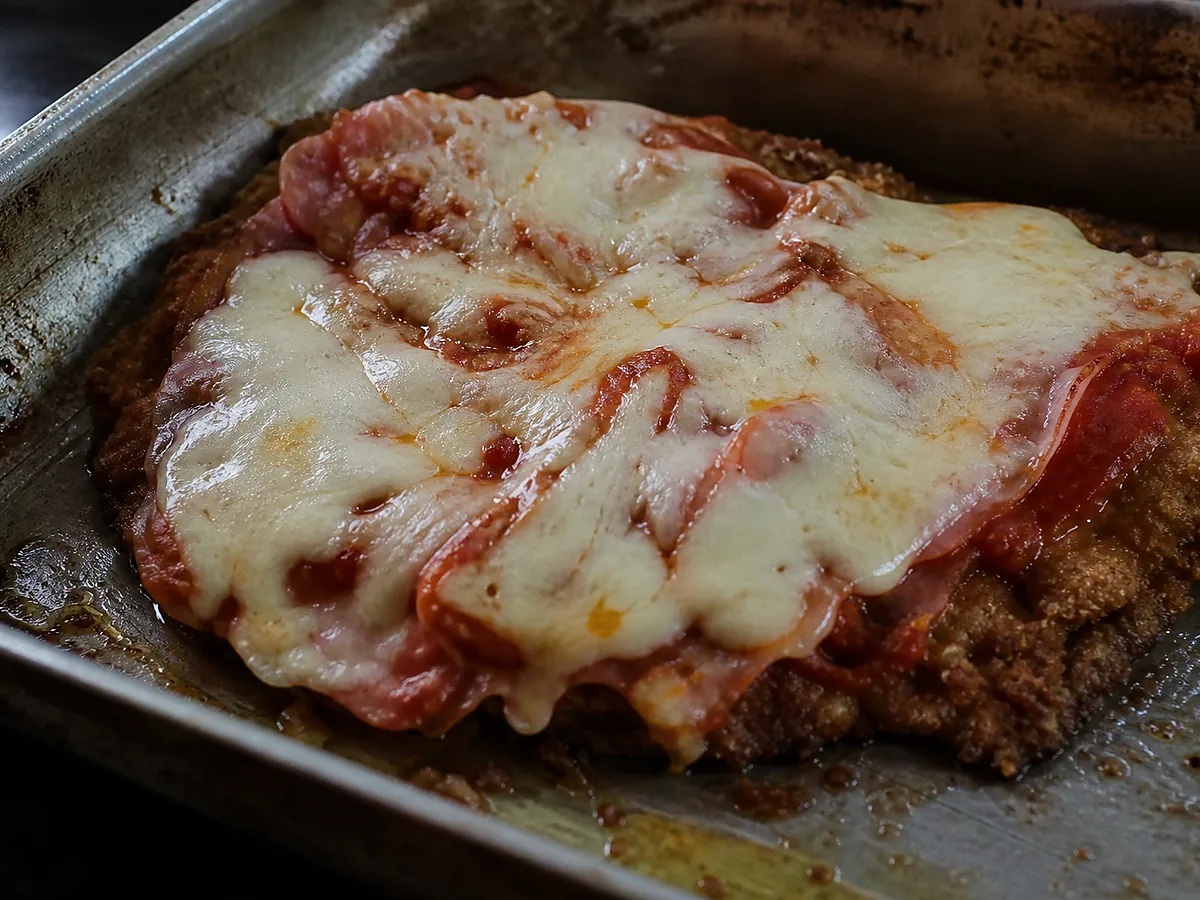
A milanesa a la napolitana is a thin breaded beef cutlet, fried until the crumb is a real crust, then buried under jamón cocido, tomato, and melted cheese. It is a Buenos Aires plate. The name points at porteño restaurant culture — napolitana as a local invention — not at Naples, not at cotoletta alla parmigiana, and not at chicken parmesan.
The rule people get wrong is thickness, and then wetness. They fry a cutlet still 1.5 cm thick, or they drown a pale crust in cold sauce and wait for the oven to “finish” a crust that never formed. The beef has to be pounded thin. The crumb has to be dry. The fry has to set a shell before anything wet touches it. Then ham, then tomato, then mozzarella, then a short blast of heat to melt — not a second cooking of the meat.
I make this on a weeknight that still wants a Sunday plate. Patient in the pounding and the breading. Not complicated. Not quick, once you count the oil coming up.
Beef and the breading line
- 4 × 150 g4 × 5.3 ozNalga (top round) or peceto (eye of round)1–1.5 cm / ⅜–⅝ in as cut, to be pounded
- 8 g1½ tspFine saltdivided — half on the meat, half in the eggs
- 2 g¾ tspBlack pepper, freshly ground
- 80 g⅔ cupAll-purpose flour, for dredging
- 150 g⅔ cupEggs, beaten3 large
- 15 ml1 tbspCold water, in the eggssome kitchens use a splash of milk instead
- 200 g2 cups packedDried breadcrumbs, pan ralladonot panko, not fresh wet crumb
- 1 liter4¼ cupsSunflower oil, for fryingor enough to come 1–1.5 cm / ⅜–⅝ in up the pan
The topping
- 200 g7 ozJamón cocido, cooked ham4 slices, about 2 mm thick. Not jamón crudo
- 250 gabout 1 cupTomato passata or a cooked tomato saucenot watery juice — a thick homemade salsa may need less
- 4 g1 tspDried oreganoplus more to finish
- 4 g1 cloveGarlic, mincedoptional, in the tomato
- 4 g¾ tspFine salt, for the tomatoif it is unsalted
- 5 g1 tspSugaronly if the tomato is harshly acidic — a known correction, not a sweet sauce
- 300 gabout 3 cups shreddedMozzarella — muzarella porteña, or low-moisture cow's mozzarella10–12 slices
- 15 ml1 tbspOlive oilto film the sauce so it does not sit as a puddle
Yield and timing
4 people, one cutlet each. About 50 minutes of active work — pounding, breading, frying — plus 10 minutes for the oil to come up and 8–12 minutes for the oven finish. Four cutlets fry in two rounds in a 28–30 cm pan.
On the beef
Nalga and peceto are the canonical slices: lean, tight grain, cheap enough to pound. They are not ribeye — fat in the crumb fries out and leaves holes. Pound to 6–8 mm / ¼–⅓ in. Thinner than 5 mm is a cracker; thicker than 1 cm and the interior lags behind the crumb. Salt after pounding, not an hour before: a wet surface makes the flour pasty.
On the crumb
Dried pan rallado is traditional — fine, dry, a thin shell that can carry sauce. Fresh breadcrumb is a known departure: it soaks oil and goes soggy under tomato. Panko is another; it is taller, airier, and drinks more oil. No herbs in the crumb tray. Parsley in the egg belongs on a plain milanesa; here it fights the oregano and the tomato. The egg gets salt. That is the seasoning of the crust.
On the frying fat
Sunflower oil is what a lot of Argentine kitchens use: high smoke point, quiet flavour. A spoon of beef dripping is old practice. Extra-virgin olive oil as the frying medium smokes too early. Deep enough that the cutlet floats its edges, not a Dutch-oven dunk. Temperature matters more than brand, and 175 °C / 347 °F is the window I trust.
On the ham, tomato, and cheese
Jamón cocido is cooked ham: mild, about 2 mm thick. Jamón crudo is a known departure and it weeps salt. The tomato must be cooked enough to lose its raw water — cold slices steam the crust from above. Muzarella porteña is wetter and milder than a US low-moisture block; if yours sits in brine, press it in a towel for 20 minutes. Low-moisture mozzarella browns more and weeps less. Provolone is saltier and smokier. No jarred sweet pizza sauce. No chicken-parm stack. No foil tent after plating — that is how a crust dies.
Equipment
- A meat mallet or a heavy saucepan, plus plastic or parchment so you do not tear the slice
- Three shallow trays — flour, egg, crumb
- A heavy 28–30 cm / 11–12 in skillet
- A thermometer for the oil, or the crumb test in the method
- A wire rack over a tray — not a plate of paper towels, which steams the underside
- Tongs, and a sheet pan
- An oven that can broil, or reach 220 °C / 428 °F
What hurts: a deep fryer (you want a flat cutlet, not a puffed pillow); a grill pan (sauce in the grooves); an air fryer as the main cook (pale crumb, no Maillard from fat); a lid on the frying pan (steam). A microwave to melt the cheese is actively harmful — the crumb weeps, the ham rubberizes, and the cheese oils out without browning.
Method
Pound the beef10 min
Lay each slice between plastic or parchment. Pound from the centre out to an even 6–8 mm / ¼–⅓ in. A dull thud, not a wet slap. If the meat smears you are hitting too hard, or it is too warm — chill it 10 minutes.
Even thickness is the point: a thick lobe next to a thin edge means one side pink and the other a chip. Salt both sides, 4 g total across four cutlets, and a grind of pepper. Rest 5 minutes; the surface should look tacky, not wet. Pat it if it weeps.
Pounding shortens the distance heat has to travel, so the crumb can brown at 175 °C / 347 °F in the same minutes the interior cooks through — and it breaks fibres, so lean round eats tender instead of bouncy.
Pound beef between parchment or plastic to an even 6–8 mm / ¼–⅓ in. Chill 10 minutes if it starts smearing. Season both sides with 4 g salt total across the four cutlets and pepper. Rest 5 minutes and pat away surface moisture.
Bread them10 min
Three trays: flour; eggs beaten with the water and 4 g salt; dry breadcrumbs. One hand wet, one hand dry.
Dredge in flour and shake off until matte, not caked — flour is glue, not batter. Dip in egg and drain 2–3 seconds; a thick egg coat fries gummy. Press into the breadcrumbs, then press again. The coat should be even and dry.
Rest on a rack 5 minutes so the crumb hydrates just enough to stick. Skip it and the first turn leaves a breadcrumb slick in the pan. You can hold them uncovered on a rack in the fridge up to 2 hours. Do not bag them.
Set out flour, eggs beaten with water and the remaining 4 g salt, and dry breadcrumbs. Flour each cutlet lightly, dip in egg, drain 2–3 seconds, then press firmly into crumbs. Rest on a rack 5 minutes; if preparing ahead, refrigerate uncovered up to 2 hours.
Heat the oil10 min
Pour the sunflower oil 1–1.5 cm / ⅜–⅝ in deep. Heat toward 175 °C / 347 °F. A pinch of crumb should sizzle at once and brown in about 30 seconds without blackening. If it sits and bleeds white, the cutlet will soak. If it burns on contact you are past 190 °C / 374 °F — pull the pan off.
Below 165 °C / 329 °F the crumb absorbs oil: greasy, soft, no Maillard. Above 190 °C / 374 °F the crumb darkens before the beef sets.
Heat oil 1–1.5 cm / ⅜–⅝ in deep to 175 °C / 347 °F. A breadcrumb should sizzle and brown in about 30 seconds. Below 165 °C / 329 °F the coating gets greasy; above 190 °C / 374 °F it burns, so remove the pan from heat if too hot.
Fry in two batches12–16 min
Lay two cutlets in the pan. Hard, steady sizzle. Do not crowd — crowding drops the oil temperature and you poach bread.
2–3 minutes on the first side: deep gold, not blond, not black. You should smell toasted bread and beef, not scorch. Flip when it releases and the edges look set. Another 2–3 minutes. A 6–8 mm nalga cutlet is cooked through; you are not chasing pink.
Lift onto the rack. A good crust ticks as steam escapes; a soggy one sits silent and wets the rack. Skim the crumbs between batches and bring the oil back to 175 °C / 347 °F. Do not re-salt the crust if you seasoned the egg and the meat.
Fry two cutlets at a time for 2–3 minutes per side until deep golden and cooked through. Lift onto a rack. Skim loose crumbs and return the oil to 175 °C / 347 °F between batches; do not add more salt to the crust.
Top and melt8–12 min
Heat the oven to 220 °C / 428 °F, or set a broiler on high with a rack 15–20 cm from the element.
Warm the tomato with the oregano, optional garlic, salt if it needs it, and the tablespoon of olive oil until it just simmers. It should mound on a spoon. If it runs, cook it 5 minutes more. Water is the enemy of the crust you just built.
On a sheet pan, each cutlet gets: one slice of jamón cocido, then 50–60 g of tomato kept short of the edge so a crumb rim stays dry, then 70–75 g of mozzarella and a pinch of oregano.
Into the oven until the cheese melts, bubbles, and spots brown — 6–10 minutes in a hot oven, 3–5 under a broiler. Watch the broiler. The beef is already cooked; this is melt and a little Maillard on the dairy, not a second fry.
Rest 2 minutes so the cheese does not slide, then serve. A napolitana held twenty minutes is a wet sandwich.
Heat oven to 220 °C / 428 °F, or a high broiler with rack 15–20 cm below. Simmer tomato with oregano, optional garlic, salt as needed and olive oil; cook 5 minutes longer if watery, and add optional sugar only if too acidic. Drain brined mozzarella in a towel for 20 minutes. Top each cutlet with ham, 50–60 g sauce leaving a dry rim, and 70–75 g mozzarella. Add oregano. Bake 6–10 minutes, or broil 3–5 while watching, until melted and spotted brown. Rest 2 minutes and serve.
Storing it
While you are cooking
Beef is raw until it is fried. Keep the pounding board and the egg tray away from the ham and the cheese.
Leftovers, and the better path
Thin round beef at this thickness is well past 70 °C / 158 °F in the centre once the crumb is gold, which is what you want on this cut. Leftover assembled napolitanas: cool within 2 hours, refrigerate at 4 °C / 40 °F or below, eat within 2 days. Reheat on a rack at 190 °C / 374 °F for 12–15 minutes. Do not microwave. The better path is to fry the milanesas plain, refrigerate up to a day, and top and melt them the next day. Do not bag raw breaded beef overnight. Strain the frying oil and reuse it once or twice if it smells clean; discard it if it smells of varnish — and not down the sink.
Troubleshooting
- Soggy crust under the tomato.
The sauce was too wet, or the cutlet was pale when it went into the oven, or you covered it. Reduce the tomato until it mounds. Fry to deep gold first. Leave a dry crumb rim. Never foil.
- The crumb falls off in the pan.
Flour caked on, egg too thick, or you skipped the 5-minute rest after breading — or you flipped too early. Shake the flour off, drain the egg, press the crumb, rest on a rack, and flip only when it releases.
- Greasy, heavy cutlet.
Oil below 165 °C / 329 °F, or fresh wet crumb, or oil so shallow it fried in a wet film. Wait for 175 °C / 347 °F, use dry pan rallado, 1–1.5 cm depth, and drain on a rack rather than a towel pile.
- Dark crumb, raw or dry interior.
The cutlet was thicker than 1 cm after pounding, or the oil went past 190 °C / 374 °F. Pound evenly to 6–8 mm and lower the heat. You cannot unscorch crumb.
- Cheese weeps a puddle and the ham slides.
Wet mozzarella, too much tomato, or you cut into it immediately. Drain and press the cheese, use less sauce, rest 2 minutes. Low-moisture mozzarella is the practical fix.
- Bland plate.
Under-salted egg and meat, dull tomato, cheap ham. Salt the egg. Salt the tomato. The ham is mild by design; the tomato has to carry the acid. A squeeze of lemon is not traditional here — fix the tomato instead.
- Tomato tastes metallic or raw.
Uncooked cold slices, or a tin of thin purée dumped on cold. Short-cook the sauce with oil and oregano until it smells sweet-savoury rather than tinny. A pinch of sugar if the acid is harsh.
- The oil smells and the second batch tastes bitter.
Crumbs burned in the fat. Skim between batches. If the oil is dark and acrid, change it. Bitterness is not a salt problem.
Substitutions
Traditional versus known departure
| Item | Traditional | Known departure | What you lose |
|---|---|---|---|
| Beef | Pounded nalga or peceto | Chicken breast, veal, soy cutlet | Beef flavour and the tight crumb seal; chicken dries faster; soy is another dish |
| Crumb | Dried pan rallado | Panko; fresh breadcrumb | Thickness, oil uptake, sogginess under tomato |
| Frying fat | Sunflower oil | Canola; a spoon of beef dripping | Quiet flavour; olive oil smokes |
| Ham | Jamón cocido | Jamón crudo; turkey slices; no ham | Salt and the pork layer; crudo weeps; turkey is a cafeteria turn |
| Tomato | Thick cooked salsa or passata | Raw tomato slices; jarred sweet pizza sauce | Water on the crust, or sugar that does not belong |
| Cheese | Muzarella porteña | Low-moisture mozzarella; provolone; no cheese | Wetness versus browning; provolone is saltier and smokier |
| Finish | Oven or broiler to melt | Microwave; a lid on the fry pan | The crust. Always |
Other proteins
Chicken milanesa a la napolitana is a known departure: pound to 8 mm, same breading, fry to 74 °C / 165 °F in the centre, then the same topping. Veal is the Italian cousin, not this plate. Soy or eggplant can wear the same topping — call it what it is.
Scaling
Four cutlets is one pan and two batches. Grate space, not appetite, is the limit.
Doubling
For 8, double everything except the oil depth — still 1–1.5 cm, and a second litre only if the first darkens. Hold fried cutlets on racks in a 90 °C / 194 °F oven, uncovered, up to 20 minutes. Do not stack them. Two sheet pans for the melt.
Bigger slices
If your cutlets are 180 g rather than 150 g, still pound to 6–8 mm. Do not fry them thicker to make the plate filling. Serve two thin ones before one thick one.
What to serve it with
The plate is already fried, ham, tomato, and cheese. It does not need much beside it.
- Fries, or a lemoned green salad — one or the other, not both
- Vinegar on the salad, which is the acid that is not in the sauce
- Red wine, or a cold beer
Chimichurri is the wrong condiment here; this is not asado. A fried egg on top makes it milanesa a caballo, which is a different plate.
Questions
Is this Italian?
No. It is a porteño dish that borrowed a name. Naples did not send it, and chicken parmesan did not either.
Dried crumb or fresh?
Dried pan rallado. Fresh crumb soaks oil and collapses under the tomato.
Can I bake the milanesa instead of frying it?
You can, and you will get a drier, paler shell. It is a known departure. Fry it if you are cooking this dish.
Why not raw tomato slices?
They look clean and then they water the crust. Cook the tomato until it mounds on a spoon.
Mozzarella or muzarella?
Muzarella porteña if you have it. Otherwise low-moisture mozzarella, drained if it is wet. Not burrata. Not cheddar.
How thin is thin?
6–8 mm after pounding. Measure it with a ruler once and your eye will learn.
Can I hold them after frying and melt them later?
Yes — rack, uncovered, same day. Top and melt when you eat. Do not hold them already sauced.