Empanadas Argentinas
Three fillings — knife-cut beef, shredded chicken, ham and cheese — into bought 12 cm discs, sealed properly and baked hard at 220 °C.
- Prep
- 45 min
- Cook
- 25 min
- Serves
- 12 empanadas per filling
- Difficulty
- Medium
Kitchen-tested
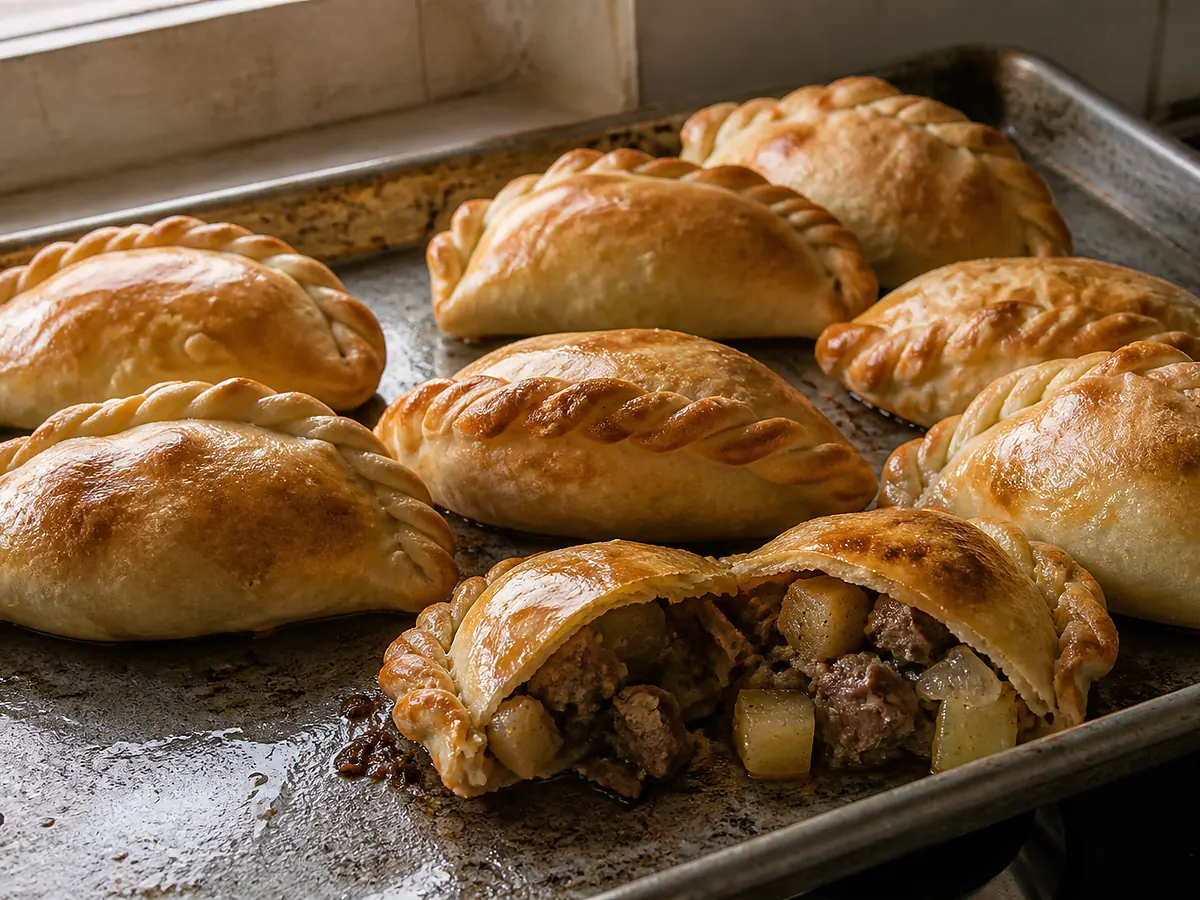
Three fillings, one disc, and the folded edge that every province claims to do better. Salta chops the beef by hand and bakes it. Tucumán fries. Mendoza adds more onion than you think is reasonable and is right about it.
I buy the tapas. Twelve-centimetre discs from the freezer case, thawed overnight — that is what a Tuesday batch looks like from Salta to Buenos Aires, and the supermarket disc is not a failure of character. What follows is the part that actually decides whether they are good: three fillings, a seal that holds, and a hot enough oven.
Two rules run through all three. The filling goes in cold — two hours in the fridge, no exceptions, because warm filling steams the pastry from the inside and splits the crimp. And the air comes out before the rope goes on, because air is what makes them burst.
The discs — buy them
- 12 discs12 discsTapas para empanadas, 12 cm / 5 in, criolla or comúnnot hojaldre. Thawed in the fridge if frozen, still cool to the touch
- 15 ml1 tbspCold water, in a small cupfor wetting the rims
- 11Egg, beaten until evenfor the bake wash — omit on the fry path
Filling 1 — Carne cortada al cuchillo
- 500 g1 lb 2 ozBeef chucksurface gristle trimmed, hand-chopped into 5 mm / ¼ in dice — not ground, not strips
- 400–500 g14 oz–1 lb 2 ozOnions, finely diced2 large, prepared weight
- 40 g1½ ozSpring onions, sliced thin2, white and green
- 60 gabout 4½ tbspBeef fat or lard, in piecescool room temperature. Butter works, and it is not the same
- 8 g1½ tspFine saltplus more to taste once the pan comes off
- 4 g2 tspSweet paprika / pimentón dulcenot smoked
- 4 g2 tspGround cumin
- 2 g1 tspRed pepper flakesor the same weight of ají molido, closer to a northwest pantry
- 33Eggs, hard-boiled 10 minutes and cut into 12 rough piecesan assembly add-in, not a pan ingredient
- 80 g2¾ ozGreen olives, pitted and halvedabout 24 halves — two per empanada
Filling 2 — Pollo
- 1 kg2 lb 3 ozBone-in chicken thighs, skin onor thighs and drumsticks. Not boneless breast as the only meat. Or skip the poach and use 550 g / 1 lb 3 oz cold leftover roast chicken
- 80 g2¾ ozOnion, peeled and halved, for the poaching potwith 1 bay leaf and 8 g / 1½ tsp salt
- 450 g1 lbYellow onion, small 5 mm dice
- 100 g3½ ozRed bell pepper / morrón, small diceoptional, and ordinary
- 45 ml3 tbspSunflower oilor 40 g / 3 tbsp chicken fat or unsalted butter
- 4 g1½ tspSweet paprika / pimentón dulce
- 3 g1¼ tspGround cumin
- 1 g½ tspAjí molidooptional heat, not chile paste
- 6 g1 tspFine saltplus more after tasting
- 2 g¾ tspBlack pepper, freshly ground
- 70–90 ml5–6 tbspReduced poaching liquoror 60 ml / 4 tbsp light chicken stock plus 15 g / 1 tbsp fat, if you used leftovers
Filling 3 — Jamón y queso
- 250 g8.8 ozJamón cocido, cooked ham, in 8–10 mm cubescold. Not shaved, not jamón crudo
- 250 g8.8 ozLow-moisture mozzarella or tybo, in 8–10 mm cubescold. Not wet fresh mozzarella, not cheddar, not Swiss
- 2 g1 tspDried oreganooptional, tossed with the cubes
- 1 ga pinchBlack pepper, freshly groundoptional. Salt is usually none — taste the ham
Yield
12 empanadas per filling. Four as a meal, six to eight as a starter. Eat within ten minutes of the oven.
On buying the discs
I buy the tapas. La Salteña and the brands stacked next to it are what a Tuesday batch looks like from Salta to Buenos Aires, and I will not treat the supermarket tapa as a failure of character. The fight in Argentina is the filling, and whether you bake or fry. The disc is shared. Ask for criolla or común — a short, slightly elastic round that browns. Hojaldre is a laminated Buenos Aires bakery pastry; if the pack says hojaldre you are making a different empanada. Thaw overnight in the fridge, wrapped, or 30–40 minutes on the counter. You want cool and pliable, not sticky, not cracked. A split on the fold means icy or dried out. Cover the stack with a slightly damp cloth. Twelve centimetres matches a heaped tablespoon plus the add-ins.
On the chuck, for the beef filling
Chuck stays juicy after a short pan time and a second cook in the pastry. Round and sirloin go dry. I buy 550–600 g with the fat cap and trim to the 500 g I will chop. Leave the intramuscular fat. Hand-chop: 5 mm slabs, 5 mm strips, 5 mm dice. Ten minutes. Pieces will not be identical. Not paste, and not 2 cm chunks that tear the disc. Ground beef is the known departure — faster, juices trapped in a paste, no cubes. A food processor smears. A knife clicks.
On the cheese, for the ham and cheese
Mozzarella or tybo. Those two. Low-moisture block mozzarella is the practical stand-in: it melts, it stretches, it does not immediately oil out. Tybo is the sandwich cheese — pale, semi-hard, mild, a clean melt. Not cheddar (it oils), not Swiss, not burrata, not starchy pre-shredded bag cheese. Cubes, not a fine grate: a grate floods as one liquid. An 8–10 mm cube still has to travel to the seam, and that delay is the trick.
The chill is not optional
Every filling goes into the disc cold. Spread it thin, let the steam stop, then refrigerate at least 2 hours — overnight if you can. Warm filling tears the dough, steams the pastry from the inside, and splits the repulgue. I have done the impatient version. The tray looked like it exploded.
Equipment
- Sharp chef's knife and a stable board — the beef filling is knife work
- Wide heavy pan, 28–30 cm / 11–12 in
- Small saucepan for the eggs
- Shallow tray, to chill the filling fast
- Two light-colored baking sheets and parchment
- Pastry brush and a cup of water
- Fry path only — a heavy pot at least 12 cm deep, 1.5–2 L neutral oil, a clip-on thermometer, a spider and a rack
Not needed, and actively harmful: a food processor for the beef (it smears); a lid slammed on the onion pan (they steam, then water the filling); a 20 cm pan that crowds the chuck so it boils instead of losing raw colour in 3–4 minutes; a dark warped sheet that burns bottoms at 220 °C / 425 °F.
Method
Make a filling, and get it coldat least 2 hours ahead
Pick one of the three fillings below and cook it first. Spread it thin on a tray, leave it uncovered ten minutes until the steam stops, then cover it and refrigerate at least 2 hours. Overnight is better.
Cold means fridge-cold: the fat has set, the mixture spoons cleanly, and a finger in the heap comes away without warmth. This is the step that decides whether the tray comes out of the oven whole.
Choose one filling below and prepare it first; do not combine all three. Spread cooked filling thinly on a tray, let steam subside for ten minutes, then cover and refrigerate at least 2 hours, preferably overnight. Use it fridge-cold, with set fat and no residual warmth.
Thaw the discsovernight, or 30–40 min
Overnight in the refrigerator, wrapped, or 30–40 minutes on the counter. They stay wrapped until they bend without whitening. Keep the stack under a slightly damp cloth while you work.
Thaw wrapped discs overnight in the refrigerator, or 30–40 minutes on the counter until cool and pliable. Keep the stack under a slightly damp cloth while working.
Fill, wet, and push the air out15–20 min
Heat the oven to 220 °C / 425 °F, middle rack, light sheet, parchment. Work one disc at a time and keep the rest covered.
A heaped tablespoon of cold filling, off-centre — plus that filling's add-ins. For the beef: one piece of hard-boiled egg and two olive halves, not hanging over the future seam. For ham and cheese, less: 22–28 g, and flatten the heap into a low oval rather than a ball, because balls trap air.
Run a thin film of water around the whole rim. Fold. Press from one end while you nudge the air out of the other. The pocket should go slack. Air is what makes them burst.
If the rim slides, there is too much water — wipe it and press dry. If it cracks at the fold, the disc is too cold or too dry; give it five minutes under a cloth.
For baking, heat oven to 220 °C / 425 °F, middle rack, with parchment on a light sheet. Add a heaped tablespoon of cold beef or chicken filling off-center; beef also gets one egg piece and two olive halves. Use only 22–28 g ham-and-cheese filling, flattened. Wet the rim lightly, fold and press out air before sealing. Wipe a slippery rim; rest cracking discs five minutes under a cloth.
The repulgue8–12 min for twelve
The crimped edge is the repulgue. In some kitchens the pattern tells you what is inside — service language, not a law. One overlapping pleat.
Hold the half-moon in your hand, curve toward you. Fold the left corner of the sealed rim over. Take the next bit of rim over that, overlapping, each pleat pressed onto the last. Tuck the end. You want a rope of folds, not a row of pinches. No raw holes. A gentle squeeze should not squelch.
Ugly ones taste identical. Open ones taste like steam.
A fork crimp is a known departure and it is weaker at 220 °C / 425 °F — save it for a torn disc. Pleat-up on the parchment. Ten minutes while the oven heats is fine; an hour on the counter dries the rims.
Fold overlapping pleats along the sealed rim and tuck the end, leaving no gaps. Set pleat-up on parchment. Recheck the seal gently; do not leave assembled empanadas on the counter beyond the short ten-minute oven-preheating wait.
Egg wash and bake18–25 min at 220 °C / 425 °F
A thin egg wash on the tops and on the rope — not a lake in the seams. Egg is Maillard and colour; unwashed discs go blotchy.
Bake to deep gold: 20–25 minutes for beef, 18–24 for chicken, 18–22 for ham and cheese. Not blond, not black at the tips. Bottoms should match tops. Rotate at 12–15 minutes if one side runs hot.
220 °C / 425 °F is the number because the pastry has to set before cold filling turns to steam and blows a hole. 180 °C / 350 °F gives you a beige turnover with a wet interior.
With the ham and cheese, watch the seams from minute 16. You want a threat — a bead of cheese at one scallop, still attached — not a rivulet across the parchment. If cheese is pooling at minute 14, the fill was too heavy or the seal was weak. Pull them; extra time will not restuff them.
For baking, brush tops and crimp lightly with egg. Bake at 220 °C / 425 °F until deep golden above and below: beef 20–25 minutes, chicken 18–24, ham and cheese 18–22. Rotate at 12–15 minutes if needed. Watch cheese seams from minute 16; pooling as early as minute 14 indicates overfilling or a weak seal. Do not bake longer merely to correct a leak.
Eatwithin ten minutes
Rest five minutes — molten cheese burns — then the board and the table. At ten minutes they are the thing you cooked. At thirty they are leftovers. Fat still liquid in the crumb is the peak.
Frying instead is the Tucumán-style path, and it is a regional choice, not a fix: no egg wash, 175–180 °C / 350–355 °F oil, two or three at a time, turn at about 90 seconds, 3–4 minutes total, onto a rack. Salta bakes. That is the headline here.
Rest five minutes before eating; molten cheese can burn. Serve within ten minutes for the best crust. For frying instead, omit egg wash and use 175–180 °C / 350–355 °F oil; fry two or three at a time, turn at about 90 seconds, cook 3–4 minutes total and drain on a rack.
Filling 1 — Carne cortada al cuchillo
The Salta baked beef filling. Hand-chopped chuck is the whole texture: ground beef cooks into a paste, knife-cut beef stays in pieces you can bite. This batch is two large onions on 500 g of chuck. Mendoza would add a third and is right about it for Mendoza.
Eggs and the chop15 min, overlapping
Three eggs into cold water, bring to a boil, then a low boil for 10 minutes. Ice. Peel. Cut into 12 rough pieces. Pit and halve the olives.
While that happens: 500 g chuck down to 5 mm / ¼ in dice. Onions diced. Spring onions sliced. Spices together in one bowl — the bloom is only 30 seconds and you will not have time to measure.
The beef should look like small cubes, wet and red, fat visible. A hamburger look means you went too far.
Bring three eggs to a low boil from cold water and cook 10 minutes; chill in ice, peel and cut into 12 pieces total. Pit and halve olives. Dice 500 g chuck to 5 mm / ¼ in, dice onions and slice spring onions. Measure spices together before starting.
Onions in fat10 min
Melt 60 g beef fat or lard over medium heat — liquid and quiet, not smoking. Add the diced onions and a pinch of the salt. Cook to soft and translucent, about 10 minutes. No brown. The volume drops by half and goes glassy. If it colours at the edges, drop the heat; a spoon of water is better than brown edges.
Browned onion fights the paprika, and the onion is the juice — the beef will not add water later.
Melt 60 g beef fat or lard over medium heat without smoking. Add diced onions and a little of the salt; cook about 10 minutes until soft and translucent, not brown. Lower heat or add a spoonful of water if edges color.
Bloom the spices30 seconds
Paprika, cumin, and pepper flakes into the onion fat. Stir for 30 seconds, until the kitchen smells toasted and the oil goes red. Past 45 seconds the paprika turns bitter in a way salt cannot fix.
Stir paprika, cumin and pepper flakes into the onion fat for 30 seconds, until fragrant and red. Do not exceed about 45 seconds or scorch the paprika.
The beef3–4 min
Raise heat to medium-high. Add chuck and remaining salt and spread out. Start with 3–4 minutes, stirring to cook every piece; continue as needed until the beef is fully cooked before chilling. Use 71 °C / 160 °F as this filling’s endpoint, checked with a thermometer. Keep the dice juicy and distinct; work in two batches if crowded. Do not refrigerate partially cooked beef to finish later in the oven.
Raise heat to medium-high. Add chuck and remaining salt and spread out. Start with 3–4 minutes, stirring to cook every piece; continue as needed until the beef is fully cooked before chilling. Use 71 °C / 160 °F as this filling’s endpoint, checked with a thermometer. Keep the dice juicy and distinct; work in two batches if crowded. Do not refrigerate partially cooked beef to finish later in the oven.
Spring onions, off the heat1 min
Off the burner. Stir in the sliced spring onions. Taste, and salt until it is a little too present — the pastry is bland and will mute it. The verdeo stays bright because it never cooks; on the heat it wilts to strings.
Then spread and chill. Two hours minimum.
Remove from heat and stir in spring onions. Adjust seasoning. Spread thinly and chill for at least two hours. Keep boiled egg and olives separate; add one egg piece and two olive halves when assembling each empanada.
The egg and the olives
Assembly add-ins, not pan ingredients. One piece of hard-boiled egg per empanada, two green olive halves. Stirred through the pan you get random olives and grey egg. Raisins are not this filling. Potato cubes turn up on some Salta and Jujuy tables — a known extra, cooked and cold and small-diced, and it means less beef in the spoon.
Filling 2 — Pollo
Monday chicken: how a lot of Argentine kitchens get a second meal without another butcher's ticket. It is not tinga, not buffalo, not a curry fold. Onion, sometimes a strip of morrón, comino and pimentón, and enough reduced liquor that the meat is not chalk.
Poach30–40 min — skip for leftover roast
Cover the bone-in pieces with cold water by 2 cm. Add the halved onion, bay leaf, and 8 g salt. Keep it at a shiver, not a thrash — 85–90 °C / 185–194 °F. Done at 74 °C / 165 °F in the thickest thigh, not touching bone, in 25–35 minutes. Collagen slips in gentle water; a boil gives tight shreds and cloudy liquor you cannot usefully reduce.
Lift and strain. Reduce 400 ml of the liquor down to 70–90 ml, until it coats a spoon. Shred the meat into short 1–2 cm strands — you want about 550 g. Discard flabby boiled skin.
Cover bone-in chicken with cold water by 2 cm; add halved onion, bay and 8 g salt. Poach at 85–90 °C / 185–194 °F for 25–35 minutes, until the thickest thigh reaches 74 °C / 165 °F without touching bone. Strain; reduce 400 ml liquor to 70–90 ml. Discard skin and shred about 550 g meat into 1–2 cm strands. Or use 550 g cooked roast chicken with 60 ml stock plus 15 g fat, skipping the poach.
The onion18–22 min
Film the skillet with the oil or fat over medium-low. Diced onion and a pinch of salt. 15–18 minutes to translucent and sweet, edges just gold, volume down by half. Morrón, if you are using it, goes in for the last 8–10 minutes: soft, still red.
The water in the onion has to leave, or you pack soup into pastry.
Heat oil or fat over medium-low. Cook diced onion with a pinch of salt for 15–18 minutes until soft, sweet and reduced by half. Add optional pepper during the last 8–10 minutes; cook until soft with no watery pool.
Spices and meat5–7 min
Push the onion aside. Paprika, cumin, and the optional ají into the bare fat for 30–45 seconds, until rust-red and fragrant — spice is soluble in fat, not in the meat.
Add the chicken and the reduced liquor. Toss 2–3 minutes until every shred is coated and the mix mounds on a spoon. A ribbon of juice is fine; a pool is not. Taste — it should be a little too seasoned while hot. You are not cooking the chicken again; the liquor is replacing what shredding squeezed out.
Push onion aside and stir paprika, cumin and optional ají into exposed fat for 30–45 seconds. Add chicken and reduced liquor; toss 2–3 minutes until coated and the filling mounds on a spoon without pooling. Taste and adjust salt and black pepper.
Cool, then fold in the egg45–90 min, not optional
Spread 1.5 cm thick on a tray. Refrigerate until cold to the touch. Then fold in chopped hard-boiled egg if you want it — many home versions do.
Steam inside a closed disc is pressure, and warm filling melts the pastry fat before the oven has set it.
Spread 1.5 cm thick on a shallow tray and refrigerate until completely cold, about 45–90 minutes initially; follow the main method's minimum two-hour chill before filling. Fold in optional chopped hard-boiled egg only after cooling.
Filling 3 — Jamón y queso
The one people grab at a bar in the afternoon because it is already there and already gold. Cooked ham, mozzarella or tybo, cut into cubes and packed cold. The pastry is the work, and the work is not leaking.
Cube, dry, toss10 min
Pat the jamón cocido dry — water on ham is the first leak. Cut the ham and cheese into 8–10 mm cubes. If the mozzarella weeps on the board, press it in a towel. Cold is easier; warm cheese smears.
Toss with the optional oregano and pepper. No salt unless the ham is strangely bland. The bowl should look like a dry salad of pink and white dice.
Even cubes melt at the same speed. Surface water is the first liquid in the oven.
Pat cooked ham dry and cut ham and cheese into 8–10 mm cubes while cold. Press wet mozzarella in a towel. Toss with optional oregano and pepper; add salt only if needed. Keep the mixture cold and dry.
Pack less, and seal harder20–25 min, slower than you want
22–28 g per disc — deliberately less than the beef or chicken scoop. Flatten the heap into a low oval. Fold, press from the filling toward the rim until you feel the air leave, pinch the seam hard, then the repulgue. Go around a second time if any scallop looks open.
Beef is bound with fat and onion; it sits still. This filling becomes fluid, and cheese will find air and then find the hole. The rope is a dam, not decoration. One thin spot is the exit.
Egg wash tops and rope — a dry rope is the first place a leak shows, because it never fused. Chill the loaded tray 15–20 minutes before it goes in.
Use 22–28 g per disc, flattened into a low oval. Fold and press air toward the rim, pinch firmly and crimp; recheck every pleat. For baking, brush tops and crimp lightly with egg, then chill the filled tray 15–20 minutes before baking. Omit egg wash if frying.
The bakery binder, labelled as a departure
A cooled white sauce holds the cubes in a paste so they do not roll. It is a known bakery trick, and it is also more water, which means more steam if you overdo it. Roux of 20 g butter and 20 g flour, 200 ml cold milk whisked in, cooked 5–7 minutes until it mounds on a spoon and the raw flour smell is gone. A scrape of nutmeg if you like. Spread it thin and chill it cold, then fold 80–100 g through the 500 g of cubes — not the whole pot. The dice should still be obvious. If it looks like macaroni cheese, use even less per disc.
Storing it
The discs
Thawed and wrapped, 24 hours in the fridge. Frozen in the pack to the box date. Do not refreeze a thawed disc.
Filling, and filled but unbaked
Filling keeps at or below 4 °C / 40 °F, covered, for 2 days; it freezes for a month, thawed in the fridge and stirred. Assembled and unbaked: freeze on a sheet, then bag, for a month. Bake from frozen at 220 °C / 425 °F with an extra 5–8 minutes, still to deep gold. Do not thaw on the counter.
After they are baked
Honestly, they are for now. Into the fridge within 2 hours if there are leftovers, and reheat at 180 °C / 350 °F for 8–10 minutes if you must. A microwave turns the masa to rubber. Fillings are perishable — do not assemble empanadas, leave them out at room temperature, and bake them later. The egg wash is raw egg. On the fry path: dry hands, dry pastry, pot half full, lid nearby. Water in 180 °C oil spatters.
Troubleshooting
- Split at the crimp.
Warm filling, trapped air, or a dry rim. Chill the filling a full 2 hours. Press the air out. Use a film of water, not a puddle.
- Burst along the fold.
Overfilled, or the disc is under 12 cm. One heaped spoon, then the add-ins.
- Pale at 25 minutes.
No egg wash, or the oven is not actually at 220 °C / 425 °F. Wash them. Get an oven thermometer. Blond is underbaked.
- Black bottoms, pale tops.
Dark sheet, or too low a rack. Middle rack, light sheet, parchment.
- Cheese pooling on the tray.
Too much filling or a weak seal. 22–28 g per disc, a harder pinch, and go round the rope twice. Pull them when you see it — extra time will not restuff them.
- Fried and greasy.
Oil below 170 °C / 340 °F, or you crowded the pot. Two or three at a time, onto a rack, not paper.
- Fried dark in two minutes, filling still cool.
Oil above 190 °C / 375 °F. Bring it back to 175–180 °C / 350–355 °F and give it the full 3–4 minutes.
Substitutions
Traditional versus known departure
| Item | Traditional | Known departure | What you lose |
|---|---|---|---|
| Pastry | 12 cm criolla or común discs | Hojaldre; tortillas; puff pastry | The short crimp. Puff is another pastry entirely |
| Beef | Chuck, hand-chopped to 5 mm | Ground beef | The cubes. Ground beef becomes a paste |
| Beef fat | Grasa vacuna or lard | Butter | Dairy flavour, faster browning, a tighter rim |
| Paprika | Pimentón dulce | Smoked paprika | Pulls the filling toward Spain |
| Chile | Red pepper flakes | Ají molido, same weight | Nothing — ají molido is closer to a northwest pantry |
| Chicken | Poached bone-in thigh | Leftover roast; boneless breast | Breast alone goes chalky and has no liquor to reduce |
| Ham | Jamón cocido, cubed | Jamón crudo; shaved ham; turkey ham | Shaved ham collapses into a salty felt and weeps |
| Cheese | Mozzarella or tybo, cubed | Cheddar; pre-shredded bag cheese | Cheddar oils out; a grate floods as one liquid |
| Heat | Baked at 220 °C / 425 °F (Salta) | Fried at 175–180 °C (Tucumán) | Nothing — it is regional, not moral |
Scaling
Everything here is built on twelve 12 cm discs. One filling batch fills twelve; the fillings do not stretch across two packs.
Doubling
The fillings double cleanly. The pan does not — cook the beef in two batches for the same total time rather than crowding a 30 cm pan, or it steams instead of losing raw colour. Two sheets, and rotate them as well as turning them.
Per disc
A heaped tablespoon of beef or chicken, about 30–35 g. Ham and cheese is deliberately less at 22–28 g, because it turns fluid and tests every gap in the seal. Ten discs to the batch means thick, fifteen means thin, and thin ones leak.
What to serve it with
Empanadas are hand food. They do not need a plate, and they do not need a sauce.
- Chimichurri on the side for the beef ones, though plenty of Argentines would tell you not to
- A green salad with oil and vinegar
- Malbec or Bonarda, or a cold beer in the afternoon
- More empanadas
Eat them within ten minutes of the oven. That is not a serving suggestion; it is when they are the thing you cooked.
Questions
Do I have to make the dough?
No, and I do not. Bought tapas para empanadas — 12 cm, criolla or común — are what most Argentine kitchens use for a weeknight batch, and they are what this recipe is written for. The fight in Argentina is about the filling and about baking versus frying. The disc is shared.
What is the repulgue?
The crimped rope of overlapping pleats that seals the empanada. In some kitchens the pattern tells you what is inside. A fork crimp works but is weaker at 220 °C / 425 °F. Ugly pleats taste identical to neat ones; open ones taste like steam.
Baked or fried?
Salta bakes, and that is the headline here. Tucumán and much of the north fry. Both are correct, and people will tell you otherwise. Pick a heat and do not run both on one tray.
Why does the filling have to be cold?
Warm filling steams inside a sealed disc, and steam is pressure. It also melts the fat in the pastry before the oven has set it. Two hours in the fridge, minimum. This is the single most common reason a tray comes out split.
Can I use ground beef?
You can, and it is the known departure. Hand-chopped chuck gives you small cubes you can bite; ground beef cooks into a paste with the juices trapped in it. Ten minutes with a knife is the difference between an empanada and a mince pie.
Can I freeze them?
Yes, and this is the best reason to make twelve. Freeze them assembled and unbaked on a sheet, then bag them for up to a month, and bake from frozen at 220 °C / 425 °F with an extra 5–8 minutes. Do not thaw them on the counter.