Asado
A method, not a steak recipe — charcoal or hardwood burned to embers, a grate you raise and lower, and three lead cuts that eat completely differently.
- Prep
- 50 min
- Cook
- 2 hr 30 min
- Serves
- 8–10 people, one Sunday sitting
- Difficulty
- Hard
Kitchen-tested
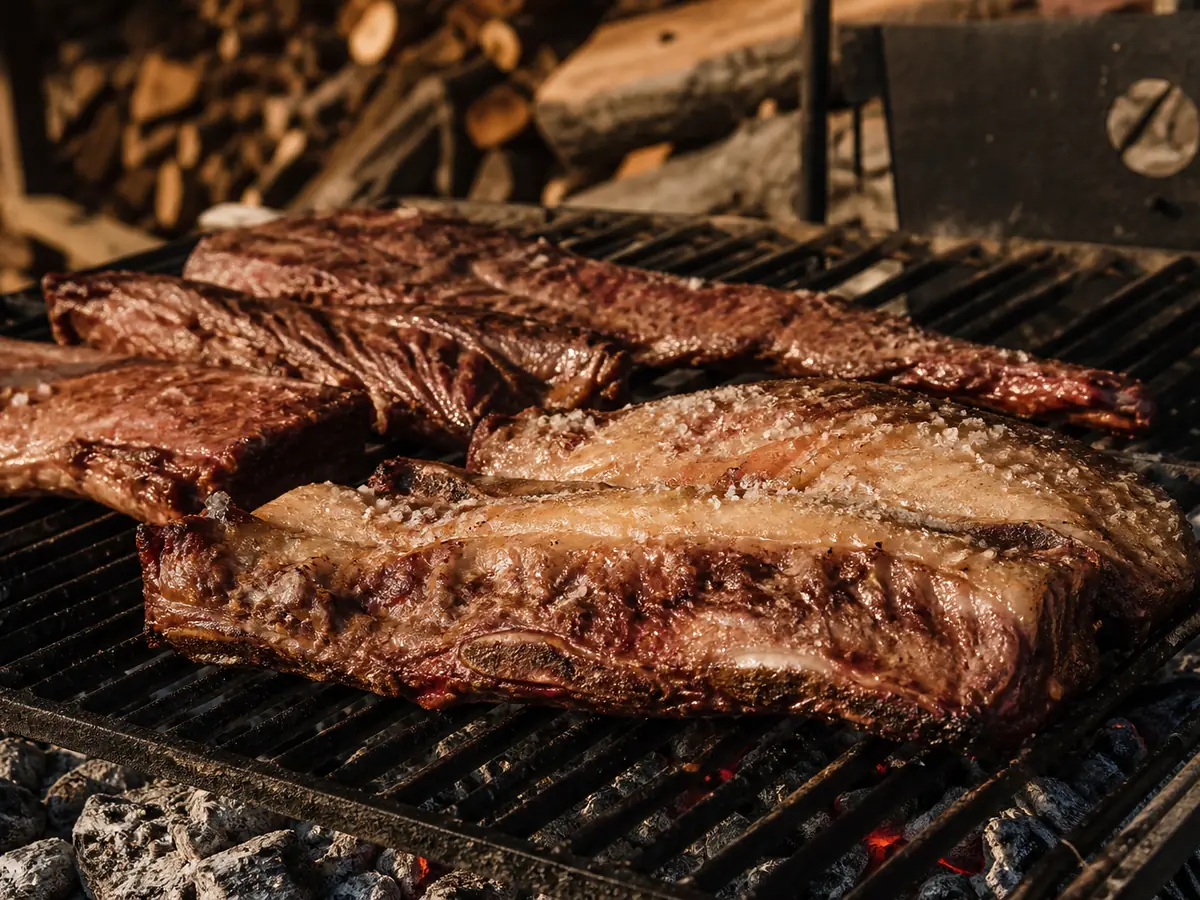
Asado is a method, not a steak recipe: fuel burned down to embers, a grate you raise and lower, and three lead cuts — tira de asado, vacío, entraña — plus chicken, sausage, and achuras on the same fire. The fire lives to one side of an Argentine parrilla. You rake coals under the food. You never cook over flame.
Run it on lump charcoal or on an all-wood fire. Charcoal is the simpler route and the one I use; wood is the traditional one and takes an hour longer to reach the same bed. If you want the hardwood aroma without the wait, lay a few chunks on the lit charcoal — that is what the wood is doing here. What matters is the ember bed, not which bag it came from.
The rule people get wrong is the fire, and the sauce. They grill over active flame because the clock is running. Flame blackens fat and paints soot. The other half of the mistake is brushing chimichurri onto meat on the grate. Wet herbs steam the crust and turn coarse salt into paste. Meat gets salt and heat. Chimichurri lives on the table, after — the house batch is on its own page.
This is Sunday asado. A parrillero stays with the fire. Wine hits the table before the beef does. It is not American barbecue: no closed smoker, no spice rub, no mop, no pork shoulder cooked to 95 °C / 203 °F. It is not Brazilian churrasco: no rotisserie spits, no rodízio, no picanha as the centerpiece. The Argentine grate is horizontal, height-adjustable, and sits over embers you manage by moving coals and by cranking the iron. I cook this for eight to ten. Budget four hours from match to carving.
Fuel — the charcoal route (pick one route, not both)
- 8–10 kg18–22 lbLump hardwood charcoalnot briquettes with binders, and never fluid-soaked. Budget a full load to start and a reserve to feed the bed for two more hours
- 2–3 kg4–7 lbHardwood chunks or splits — quebracho, espinillo, oakoptional, laid on the lit charcoal for aroma and longer coal life. This is the enrichment, not the fuel
Fuel — the all-wood route
- 10–12 kg22–26 lbQuebracho blanco or colorado, or espinillosplit to wrist-thick logs; a small grate burns less
- 150 g5.3 ozDry kindling, twigs or untreated scrapone packed handful — never lighter fluid
The three lead beefs — this is the asado
- 2.5 kg5 lb 8 ozTira de asado (flanken / cross-cut short ribs)4–5 cm / 1½–2 in thick across the bone, fat left on — bigger is better; tell the butcher this number. Explicitly not the thin Mexican-style flanken / kalbi cut
- 1.8 kg4 lbVacío (flank flap)whole, fat cap intact, not a trimmed American flank steak
- 800 g1 lb 12 ozEntraña (outside skirt)diaphragm muscle, membrane on if the butcher sent it that way — not inside skirt
On the same fire, not separate dishes
- 1.8–2.2 kg4–5 lbPollo — one whole chickenbackbone removed and spatchcocked flat, or two halves; skin on, patted dry
- 800 g1 lb 12 ozChorizo criollo or parrillero8 links, raw, coarse-ground, in casing, not smoked
- 600 g1 lb 5 ozMorcilla4–6 links, already cooked in the casing
- 600 g1 lb 5 ozMollejasveal or young-beef sweetbreads
Optional achuras
- 400–500 g14 oz–1 lb 2 ozChinchulinessmall intestine, turned and rinsed by the butcher
- 400 g14 ozRiñonesbeef kidneys, halved, suet trimmed, soaked
Optional fourth beef — pick one if the table is large
- 800 g–1 kg1 lb 12 oz–2 lb 3 ozMatambre (flank cover) or tapa de asado (rib-plate cap)fat on; skip if the grate is full. Not a lead cut
Salt, and the liquids that touch achuras and chicken
- 100 gabout 7 tbspCoarse sal parrillera or coarse kosher flakecrystal size changes volume
- 1 liter4¼ cupsCold water, for the mollejas soak
- 40–50 ml3 tbspLemon juice, for the mollejas waterabout 1 lemon
- 30 ml2 tbspWhite vinegarsecond rinse for chinchulines if they still smell of gut
- 15 ml1 tbspNeutral oilonly if raw iron will tear the first chorizo or the chicken skin — not for painting beef
On the table, not on the grate
- 1 batch1 batchChimichurri, the house recipemade ahead — it is a finishing sauce, never a marinade
- 1 kg2 lb 3 ozCrusty breadtwo loaves, sliced
- 22Lemons, cut in wedgesfor mollejas and chicken at the table
Yield
8–10 people, one Sunday sitting. About 4 hours from lighting to carving. Food on the grate about 2 to 2½ hours, staggered. One fire, one grate. This does not split across two nights.
On the fuel — charcoal or wood
Both routes work. Pick one and read the fire, not the clock.
Charcoal is the simple route, and it is what I use. Lump hardwood charcoal arrives already carbonised, so you skip the hour of burning logs down and go almost straight to a usable ember bed. It gives clean, controllable heat and it is far easier to judge if you have not run a parrilla before. Use lump, not briquettes — binders and fillers taste of themselves, and never anything pre-soaked with lighter fluid. The one thing charcoal will not do on its own is give you the aroma of burning hardwood. Lay 2–3 kg of quebracho, espinillo, or oak chunks on the lit charcoal and you get most of it back. That is what the wood is for here: enrichment, not fuel.
The all-wood route is the traditional one, and it takes longer. Quebracho and espinillo are the right woods: dense, low resin, long coal life, clean heat. They do not perfume meat the way mesquite does — asado is ember cooking, not smoke cooking. Oak or hickory are the practical substitutes. Mesquite burns hot and tastes like itself; use it as a fraction of the pile, mixed with oak. Never pine, never pallet wood.
What both routes share: you are cooking over embers you can rake and a grate you can raise. Neither is a compromise. Flame is the mistake, not the fuel.
On the tira de asado
This cut tells you whether you built an asado or a steak dinner. Cross-cut short rib, bones across each strip, fat and connective tissue on — and it has to be thick. Tell the butcher 1½–2 inches, about 4–5 cm, across the bone. This is not Mexican-style flanken and it is not kalbi. Those strips are a centimetre or less; they cook like bacon; they never get the collagen window a Sunday plate needs. If the butcher only knows English short rib, ask for a recut across the bone at 4–5 cm. The fat stays. Bone-side toward the coals first: the bones shield the meat while collagen starts to convert, then you flip for color.
On the vacío
Vacío is the flank flap, thicker than a trimmed American flank steak, with a fat cap that must face the coals first so it bastes as it melts. It is a slow cut. Do not marinate. Acid on raw vacío before the fire turns the surface to mush and fights the crust. If your butcher hands you a denuded flank, cook it faster and expect less basting — that is a departure, not a disaster.
On the entraña
Entraña here is outside skirt: the diaphragm. Loose grain, intense beef, a silver membrane some parrilleros leave on as a shield and peel after. It is not inside skirt, which US butchers often sell simply as "skirt". Inside skirt is thinner, milder, and dries out if you treat it like entraña. Outside skirt cooks fast on a hot patch. Put it on with the tira and you serve shoe leather, or a cold skirt while you wait for ribs.
On the pollo
Sunday asado chicken is the whole bird, backbone out, pressed flat, or two halves. Skin on. Salt only. Spatchcocking gives you one plane of skin facing the coals so the fat renders and the thighs finish with the breast. A whole unopened bird on this grate gives you burnt skin and a raw joint. Chicken goes on after the sausage course, before the three beefs.
On the achuras
Chorizo criollo is raw pork sausage. It goes on first because it can stall while you manage coals, and because people are hungry. Morcilla is already cooked; you are warming it and tightening the casing. Mollejas need a cold soak to draw blood, then a dry surface, then enough heat to brown without leaving the interior like paste. Chinchulines must be clean; riñones must be soaked and the white suet trimmed or they taste of ammonia. Achuras are the opening. They sit over hotter coals than the tira.
On the salt
Coarse salt, as the cut goes on, not the night before. Overnight salt on these cuts pulls moisture you will not get back on a dry grate. I salt in the air, a visible scatter, then lay the meat down. Fine table salt dissolves and oversalts before you see it. Rubs and wet brines are American barbecue logic. Salt is the only seasoning on the meat. Fat comes from the cuts. Acid and chile wait in the chimichurri.
Equipment
- An Argentine parrilla — firebox, a grate you can raise and lower, fire to one side, a coal bed you rake
- A chimney starter, if you are running charcoal
- A metal shovel or coal rake
- Long tongs — you do not stab meat to flip it
- A stiff wire brush, used on hot iron
- Kitchen shears, to spatchcock the chicken
- Three boards, or one washed between jobs — raw poultry, raw beef, raw offal
- An instant-read thermometer (optional)
- Water or a hose within reach
What you do not need, and what hurts: a kettle lid clamped shut to "smoke it" (you steam the crust); a water pan; a gas sear burner as the only heat; a sauce brush; a marinade bag. A cast-iron grill pan will brown one steak and will not feed ten people from achuras through vacío.
Method
Light the fire and wait for embers30–40 min charcoal · 60–75 min wood
Charcoal. Fill a chimney starter, light it, and let it run until the top coals are ashed over — 15 to 20 minutes. Pour it into the firebox to one side, not under the cooking zone, and add unlit lump on top; it will catch from below and give you a bed that keeps feeding. If you want the hardwood aroma, lay the chunks on now and let them catch and settle for another 10 minutes. You are ready when the bed glows evenly under a light grey ash and the flames from the fresh lump have died back. Keep a reserve of unlit charcoal within reach — you will be feeding this bed for two more hours.
Wood. Stack kindling in the firebox, to one side. Light it. Feed wrist-thick hardwood as it takes. After 45 minutes you want white-edged coals with a faint red core, little active flame, a layer of ash. If the pile is still roaring, wait.
Either way, the target is the same. Flame is unburned gas and soot; embers render fat without painting it black. Collagen in a 4–5 cm tira and in vacío converts to gelatin in a window of moderate, dry heat. Flame spikes the surface past 200 °C / 392 °F in bursts, scorching fat before the interior moves. A coal bed you can rake puts roughly 160–200 °C / 320–392 °F at the grate for the slow cuts and the chicken, and a hotter patch for achuras.
No parrilla? A kettle works on the charcoal route: full chimney, bank the coals to one side, lid off or barely cracked, and use the grate you have. Gas is the one real compromise — preheat high, shut one burner to fake a bank, grate as high as it goes. You lose the ember bed and the radiant heat. Gas asado is grilled meat at a party. It is not this.
Choose charcoal or wood. Charcoal: light a chimney until ashed over, 15–20 minutes, then tip into a side firebox and feed with lump charcoal. Optional hardwood chunks need about 10 minutes to settle. Wood: light kindling, add hardwood and check for settled embers after 45 minutes; allow 60–75 minutes overall. Cook over embers, not flames. Aim for 160–200 °C / 320–392 °F under slow cuts; keep reserve fuel for two more hours.
Read the grate and build two zones10 min
Brush the hot grate. A flick of water should hiss and vanish. Rake a deeper bed under one third — achuras, and later entraña. Leave a thinner bed under the rest for chicken, then tira and vacío. Keep the fire alive on the far side so you can feed coals for two more hours. Raise the grate if the first chorizo flares. Lower it only when the sizzle goes quiet and you are not getting color.
If you are putting a disc of provoleta on as a starter, this is the moment — hot iron, eat it when the middle collapses, get it off the grate.
Brush the hot grate. Build a deeper ember bed under one third for achuras and later entraña; use a thinner, moderate bed under the rest for chicken and slow beef. Raise the grate or move coals if fat flares. If serving provoleta, cook it now on hot iron until its center softens.
Soak, dry, and stage30 min, overlapping the fire
Mollejas: cover with 1 liter (4¼ cups) cold water and the lemon juice. Soak 30 minutes. Drain. Pat until tacky, not wet. Wet glands steam and never brown.
For cleaned, uncooked chinchulines, simmer 20 minutes in salted water (10 g / 2 tsp per liter / 4¼ cups), drain and dry. Skip this simmer if the butcher already pre-boiled them. Discard spoiled offal; boiling does not make it safe.
Riñones, if using: soak in two changes of cold water 20 minutes, trim the white core, pat dry.
Chorizo and morcilla: room temperature, casings dry, no oil.
Chicken: backbone out, pressed flat, skin dried with a towel. Salt the skin just before it goes on, not now — salt too early on skin draws beads of moisture that steam.
Soak mollejas in 1 liter / 4¼ cups cold water plus lemon juice for 30 minutes; drain and pat dry. For cleaned, unboiled chinchulines, simmer 20 minutes in salted water (10 g / 2 tsp salt per liter / 4¼ cups), then drain and dry; skip pre-boiling if the butcher already did it. Do not try to salvage spoiled offal by boiling. Soak kidneys in two changes of cold water for 20 minutes, trim the white core and dry. Dry sausage casings. Spatchcock and dry the chicken; salt just before grilling.
Achuras and chori first25–40 min
This is the opening. Hot third of the grate. People eat standing up with bread. You stay at the fire.
Salt chorizo and mollejas as they go on — a visible scatter. Morcilla gets almost none; it is seasoned inside.
Chorizo on the hotter third, not jammed together. Steady sizzle, not a roar. Turn when the casing is browned and tight, 8–10 minutes a side. Done when juices at the end run clear, not pink, and the link feels firm. About 71 °C / 160 °F if you check. One small prick at the start if a link is ballooning; do not empty the fat that bastes.
Mollejas on the same hot zone. They should seize, hiss, and pick up deep gold. Turn once the first side releases from the iron — if you scrape, they are not ready. Interior opaque and just firm, like a cooked scallop, not chalky. If they weep pink, another 3–4 minutes. Lemon at the table, not in a pan sauce.
Chinchulines, if on: color and a little crisp, surface blistered, smell roasted, not viscera. Kidneys: start with 3–4 minutes per side and continue until the center reaches 71 °C / 160 °F. Check that temperature in sweetbreads and chinchulines too; color alone does not establish safety. Morcilla last, cooler edge of the hot zone. Turn gently. Pull when the casing is taut and hot through, 8–12 minutes.
Send achuras to the table as they come off.
Cook chorizos and sweetbreads over the hot third, salting as they go on. Turn chorizos after 8–10 minutes per side and check at least 71 °C / 160 °F inside. Brown sweetbreads until they release from the grate; if still pink inside, cook another 3–4 minutes and check doneness. Brown chinchulines until blistered. Kidneys take about 3–4 minutes per side initially. For safety, cook all these organ meats to 71 °C / 160 °F rather than relying on a pink center or color. Warm already-cooked morcilla on the cooler edge for 8–12 minutes, turning gently, until hot through. Serve as ready.
Then the chicken40–55 min
Clear the hot zone. Move the remaining coals so the moderate bed is even. Salt the spatchcocked chicken in the air, both sides, more on the skin. Skin-side toward the coals first. Medium sizzle — fat rendering from the skin, not a flare that blackens the wings.
Leave it. The skin should go taut and turn deep gold, not mahogany-black. If you smell burning within five minutes, raise the grate. After 20–25 minutes, the skin should release from the iron. Flip to bone-side down so the joints finish. Use a thermometer to verify at least 74 °C / 165 °F in both the thigh and the thickest breast, without touching bone. Rest the chicken on a board 10 minutes while the beefs work.
Why this order: achuras need the hot patch and they feed people immediately. Chicken needs a long moderate bed and would steal that patch if you started it first. The three beefs want the grate to themselves.
Salt both sides of the flattened chicken. Grill skin-side down over moderate coals, raising the grate if it burns. Turn after 20–25 minutes, when the golden skin releases. Cook bone-side down to finish, about 40–55 minutes total. Verify 74 °C / 165 °F in both breast and thigh with a thermometer. Rest 10 minutes.
Then the three beefs — tira and vacío70–100 min
Salt both sides in the air as they leave the board. Now the grate has room. Moderate bed for tira and vacío. Keep a hotter third for entraña later.
Tira de asado — bone-side toward the coals first. The bones sit down. They are a rack. Heat moves through bone and fat into the rib plate so collagen starts to ease before the meat face takes a hard crust. Medium sizzle — fat rendering, not screaming. If you smell burnt fat within two minutes, raise the grate or rake coals out. Flip when the bone side is deep mahogany, fat at the edges turning translucent, meat releasing. Often 35–50 minutes on the bone, then 25–40 on the meat face. Interior before rest: 55–58 °C / 131–136 °F in the thickest meat between bones. Carryover adds 3–5 °C / 5–9 °F. Finished tira looks lacquered at the fat, not charred black. A bone that wiggles slightly in the strip is a better doneness sign than a clean bone.
Vacío — fat-cap toward the heat first. You are melting the cap so it bastes the meat as it renders. If you start meat-side down, the cap stays rubbery and the meat dries. 30–40 minutes on the cap, then 15–25 on the meat side. Thickest part 55–58 °C / 131–136 °F before rest. Slice across the grain, 1 cm (⅜ in).
If flare-ups start, do not spray water on the meat. Move the cut, rake the coals, raise the grate. Water on fat makes steam and ash mud.
Safety: the pink finishes described above are below the USDA recommendation for whole beef cuts. To follow it, reach 63 °C / 145 °F before removing from heat, then rest at least 3 minutes. Do not rely on carryover to reach that temperature.
Salt tira and vacío. Grill tira bone-side down over moderate coals 35–50 minutes, then meat-side down 25–40 minutes, until browned and the fat renders. Grill vacío fat-cap down 30–40 minutes, then meat-side down 15–25 minutes. For USDA safety guidance, verify 63 °C / 145 °F before removing and rest at least 3 minutes; the resting step below allows 10–15 minutes for these cuts. Move cuts or coals for flare-ups; do not spray water. Slice vacío across the grain, 1 cm / ⅜ in thick.
Entraña last, and hot8–12 min
Do not put it on with the tira. When tira and vacío are 10 minutes from coming off, salt the outside skirt and lay it on the hot third, membrane-side down if the membrane is still on — that is the shield; the meat face hits the iron on the second side.
Hard sear, pink center. Two to four minutes a side after the membrane tightens and the meat releases. Pull at 52–54 °C / 126–129 °F in the thickest part; it is thin, and carryover is real. Peel the membrane at the board after a 5-minute rest if you left it on. Slice across the grain, thinner than the vacío. Overcooked entraña is the cut people swear they hate.
If you ran the optional fourth beef: tapa de asado rides with the tira, fat down, same clock. Matambre rides a little faster than vacío — pull it when the surface is browned and the thickest part is 55 °C / 131 °F.
Safety: the pink finishes described above are below the USDA recommendation for whole beef cuts. To follow it, reach 63 °C / 145 °F before removing from heat, then rest at least 3 minutes. Do not rely on carryover to reach that temperature.
When tira and vacío have about 10 minutes left, salt entraña and sear on the hot third, membrane-side down first if present, about 2–4 minutes per side initially. Verify 63 °C / 145 °F before removing. Rest 5 minutes, peel off the membrane and slice thinly across the grain. Optional tapa follows the tira timing, fat-side down; matambre cooks faster than vacío. Verify 63 °C / 145 °F and rest at least 3 minutes for these cuts too.
Rest, then carve10–15 min
Tira and vacío rest on a board, loosely tented only if the wind is cold. Resting lets juices redistribute after fibers tightened on the heat; cut at once and you dump them. Entraña rests 5 minutes. Chicken should already have rested; if it has gone cold, a minute near the fire, not a second cook.
Slice tira between bones; vacío across the grain; entraña across the grain, thinner; chicken through the joint, then the breast on a slight bias. A pinch of salt after slicing if needed — not a second crust. Chimichurri on the table. The parrillero sits last.
Rest tira and vacío for 10–15 minutes, loosely tenting only if cold; entraña rests 5 minutes. Cut ribs between bones, slice flank and skirt across the grain, and joint the chicken. Taste for salt and serve with bread, lemon and chimichurri.
Storing it
Three raw problems, three boards
Raw chicken, raw offal, and raw sausage are three different problems. One board for chicken, one for mollejas and optional chinchulines or riñones, one for tira, vacío, entraña. Wash tongs that handled raw chorizo or raw chicken before they touch cooked beef, or keep two pairs.
Doneness that is about safety, not preference
Chorizo is raw pork — serve cooked through, clear juices, 71 °C / 160 °F. Chicken: 74 °C / 165 °F in the thigh. Morcilla is pre-cooked; heat it hot. Mollejas must be opaque at the center. Chinchulines are intestine; cleanliness before the fire is the safety step. Riñones are kidney; soak and trim, then cook hot and fast.
Leftovers
Leftover cooked beef: cool within 2 hours, refrigerate at 4 °C / 40 °F or below, eat within 3 days. Reheat in a hot pan or a 180 °C / 356 °F oven; do not microwave. Leftover chicken: 3 days, reheat to steaming. Leftover achuras, morcilla especially, are same-day. Raw meat before the fire: 1–2 days, bottom shelf, leak-proof, poultry and offal separate. Do not thaw chicken or chinchulines on the counter.
Troubleshooting
- Sooty, bitter crust.
Flame, pine, or fat dripping into fire under the meat. Embers only. Raise the grate. Move the cut off the flare.
- Tira still tough after an hour.
Coals too hot, so collagen never had time; or you seared a 4–5 cm strip like a steak. Raise the grate, thin the coal bed, give it 20–30 more minutes. A 4–5 cm plate is supposed to take the long sit. If the strip was thin Mexican flanken or kalbi, you bought the wrong cut — it will be dry, not tender.
- Tira done in ten minutes, dry and rattly.
You bought kalbi or thin Mexican flanken. That is not this method. Tell the butcher 1½–2 inches next time.
- Vacío fat cap still rubbery.
Started meat-side down, or heat too low to render. Fat-cap down first, moderate sizzle. If already flipped, stand it on the cap against a hotter edge 5–8 minutes.
- Entraña dry, like liver.
Overcooked, or you used inside skirt and treated it like a slow cut, or you sliced with the grain. Outside skirt, hot and last, rest five minutes, slice across. Chimichurri helps; it does not restore moisture.
- Chicken with burnt skin and a raw joint.
Whole bird never flattened, or it sat over flame, or it went on too late over dying coals. Spatchcock. After achuras, before the three beefs. Moderate bed. Skin down first. Check the thigh, not the breast.
- Chorizo burst and dry.
Heat too high, or you pricked it like a balloon. Cooler zone, one prick only if it balloons.
- Mollejas grey and spongy.
They went on wet, or the heat was too low, so they steamed. Dry them. Hotter zone. Gold crust, just-firm center.
- Gas grill — fat never renders, taste flat.
No coal bed. Bank the burners, raise the grate, extend the time, accept the departure. Do not add liquid smoke.
Substitutions
Traditional versus known departure
| Item | Traditional | Known departure | What you lose |
|---|---|---|---|
| Fuel | Lump charcoal, or an all-wood fire — both supported | Briquettes with binders; anything pre-soaked in fluid | Charcoal loses hardwood aroma unless you add chunks; briquettes taste of themselves |
| Aroma wood | Quebracho, espinillo | Oak, hickory; mesquite as a fraction of the pile | Coal life and clean heat; mesquite adds its own taste |
| Grill | Parrilla, fire to one side, height crank | Kettle, lid off, coals banked; gas, one burner off | Ember management; gas loses the coal bed entirely |
| Tira de asado | Flanken / cross-cut short ribs, 4–5 cm (1½–2 in) | Thin Mexican flanken / kalbi; English-cut short rib | Thin strips cook like bacon and skip the collagen; English-cut changes the bone rhythm |
| Vacío | Whole flap, fat cap on | American flank steak, trimmed | Thickness and self-basting; cook faster, watch dryness |
| Entraña | Outside skirt (diaphragm) | Inside skirt, hanger | Grain and intensity; inside skirt dries; hanger is a cousin, not a twin |
| Pollo | Spatchcocked whole bird, salt only | Bone-in thighs only; marinated supermarket halves | The Sunday bird; marinade fights the crust |
| Chorizo criollo | Raw Argentine mix | Mexican chorizo, Italian sausage | Spice profile; Mexican is wetter and chile-heavy |
| Mollejas | Veal or young-beef sweetbreads | Skip | The opening plate. Do not fake a gland |
| Chinchulines / riñones | Optional, cleaned | Skip | Nothing required |
| Fourth beef | Matambre or tapa de asado | Skip, or more tira | Optional only |
| Salt | Coarse sal parrillera | Coarse kosher flake | Fine salt oversalts |
| Chimichurri | House recipe, on the table | Bottled | Acid, garlic, the point of the table |
Scaling
Grate space is the limit, not appetite. Two waves of beef is better than a crowded grate that steams.
Smaller and larger tables
For 4–5 people, halve the three beefs, run one smaller chicken or skip it, keep 4 chorizos and the mollejas. The fire does not halve — you still need a coal bed for two hours. For 14–16, add a second tira rather than a fourth mystery cut, add a second chicken, do not add five new muscles. Do not make the tira thicker than 5 cm to feed more people; buy another strip.
Fuel and salt
On charcoal, figure about 1 kg (2.2 lb) of lump per person as a starting load, plus a reserve to feed the bed. On the all-wood route, 1–1.2 kg (2.2–2.6 lb) of hardwood per person, plus the bank that keeps feeding coals. Neither scales down as far as you would expect — a short fire still has to last two hours. Salt: about 1% of meat weight by feel, a visible scatter, not a crust of brine.
What to serve it with
- Chimichurri, and bread
- Lettuce, onion, and tomato with oil and vinegar — acid next to fat
- Malbec, or any red that can stand the plate
- Salsa criolla (onion, pepper, tomato, oil, vinegar), next to the chimichurri
- Provoleta as a starter, from its own page, not from this one
- A squeeze of lemon on the chicken
No cream side. No sweet glaze. The chicken can take a squeeze of lemon. The beef should not.
Questions
Is asado just Argentine barbecue?
No. Barbecue in the US sense is low-and-slow in a closed chamber, often with a rub and a target of falling-apart collagen. Asado is open embers, salt, a height-adjustable grate, and cuts you still slice.
How thick is tira de asado?
1½–2 inches, about 4–5 cm, across the bone. Bigger is better. Tell the butcher that number. The thin Mexican-style flanken or kalbi cut is the wrong piece of meat, not a faster version of this one.
Charcoal or wood?
Both. Lump charcoal is the simple route and the one I use — it is already carbonised, so you reach a usable ember bed in about half the time and the heat is easier to read. An all-wood fire is the traditional route and takes an hour longer. If you run charcoal and want the hardwood aroma, lay 2–3 kg of quebracho, espinillo, or oak chunks on the lit coals. Use lump, not briquettes, and nothing pre-soaked in fluid.
How much charcoal do I need?
About 1 kg (2.2 lb) of lump per person as a starting load — 8–10 kg for a table of eight to ten — plus a reserve to feed the bed for the second half of the cook. Running out at the tira stage is the common mistake; the beefs are the longest thing on the grate and they come last.
Why not cook over flame if I like char?
Char from flame is soot and scorched fat. Char from embers is Maillard. They are not the same taste.
Can I put chimichurri on as a marinade?
No. It is a finishing sauce. Parsley burns. Garlic turns acrid. Salt turns to paste. Make the house chimichurri and park it on the table.
Do I need entraña, vacío, and tira, or can I pick one?
You can pick one and you will have grilled beef. The Sunday method is the three together because they eat differently: collagen and bone, fat-cap basting, and a fast skirt. That contrast is the meal.
Inside skirt was all my butcher had.
Cook it like a thin steak, hot and fast, and do not call it entraña. It will do. It is not the cut.
When does the chicken go on?
After the achuras and chorizo come off, before the three beefs. Skin toward the coals first, moderate bed, 40–55 minutes. It rests while the beefs cook.
What if I have no parrilla?
Kettle, lid off, coals banked: a known departure that still gives embers. Gas: a known departure that gives heat and not this fire. A grill pan: one steak, not a Sunday asado.
How much meat per person?
This list is deliberately generous: 5.1 kg of beef across the three cuts for 8–10 people, which is 500–600 g (18–21 oz) each before the chicken and the achuras. An Argentine asado over-caters on purpose and the leftovers are part of the plan. If you want to trim it, take it out of the vacío and leave the tira alone. A leaner table is 400–450 g (14–16 oz) of beef per person. Some Sundays drink more than they eat.