Chimichurri
A cured sauce, not a blended one — dried herbs hydrated first, acid before oil, and a ratio you only have to remember once.
- Prep
- 20 min
- Serves
- About 2 cups (500 ml)
- Difficulty
- Easy
Kitchen-tested
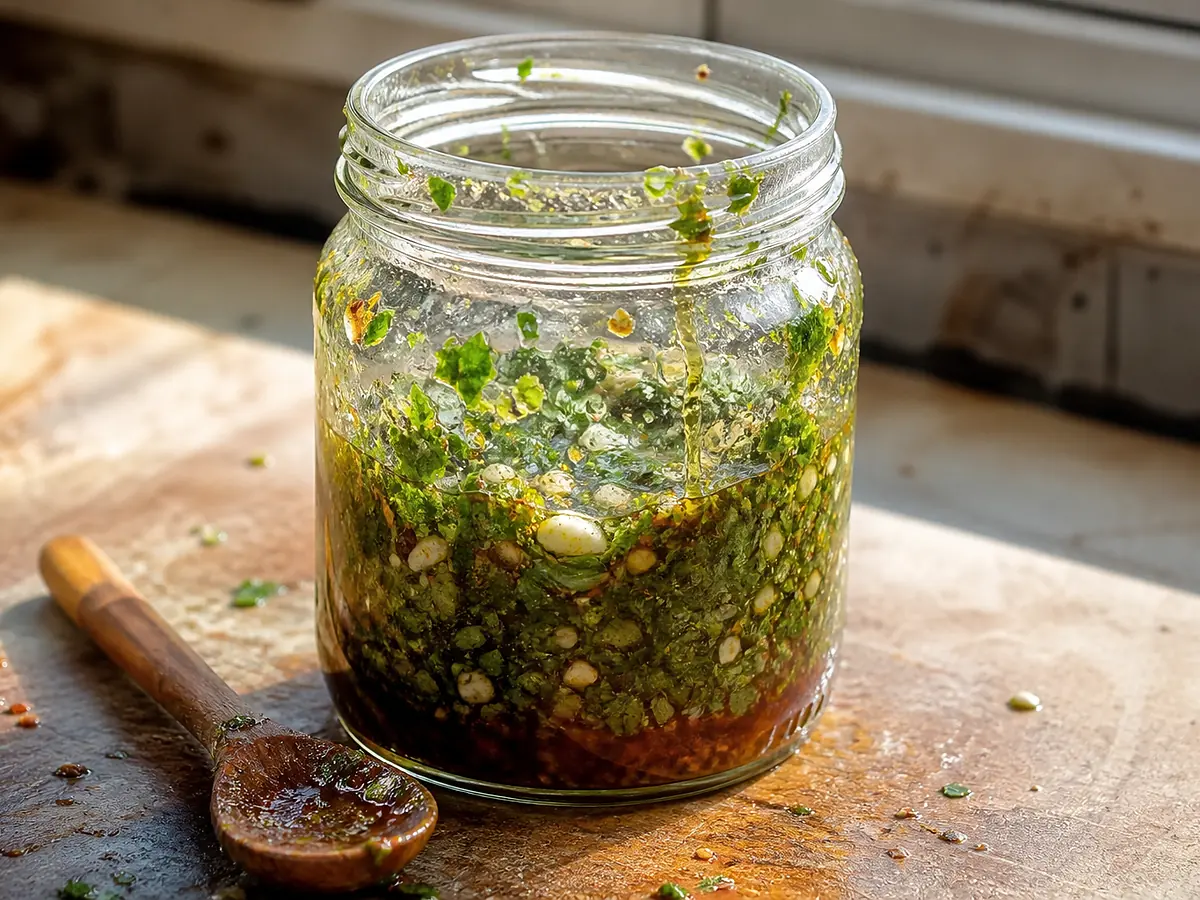
Chimichurri is not a green sauce you throw in a food processor. It is a cured sauce — dried herbs, raw garlic, acid, and oil, given time to come together in a specific order. Get the order wrong and you get exactly what most recipes produce: parsley suspended in oil, sitting next to vinegar that never had a chance to do its job.
This is the version I grew up with. Two rules govern the whole thing:
Rule one: two parts oil, one part vinegar. Everything scales from that. A cup of oil, half a cup of vinegar. A liter of oil, half a liter of vinegar. Memorize this ratio and you never need a recipe again.
Rule two: the dried herbs get hydrated before anything else touches them. Oregano and ají molido dropped straight into oil take days to soften. Warm water does it in four minutes. This is the step almost every recipe online skips, and it’s the single biggest difference between chimichurri that tastes like a sauce and chimichurri that tastes like a spice rack.
- 40 g~1 large bunch, packedFlat-leaf parsley, leaves only
- 12 cloves (~45 g)12 clovesGarlic
- 9 g3 tbspDried oregano
- 3–6 g3–6 g, roughly 1½ tsp to 1 tbsp by grindAjí molidoweigh it if you can; spoons are a starting point, not a measure — see the heat note below
- 240 ml1 cupSunflower oilor olive — see the note below
- 120 ml½ cupRed wine vinegar
- 60 ml¼ cupWarm water
- 6 g1 tspFine salt
- 2 g1 tspBlack pepper, freshly ground
Yield
Makes about 2 cups (500 ml) — roughly 16 servings as a steak condiment.
On the heat
Ají molido is given as a range because brands vary more than you'd expect, and so do people. The range is in grams on purpose: volume spoons vary a lot by grind, so weigh it when you can. Start at 3 g if you're unsure or cooking for a mixed table — that's a warm sauce, not a hot one. Go to 6 g for the version I make. If you only have spoons, 3 g is roughly 1½ teaspoons of coarse flakes and 6 g roughly a tablespoon; treat those as starting points, begin with a packed teaspoon, and taste after the resting period rather than trusting a conversion. You can always add more after the rest; you cannot take it out.
On the parsley weight
40 g is leaves, not stems. A supermarket bunch usually yields 35–45 g of leaf. Stems are bitter and fibrous — pull them.
On the oil
Traditional Argentine chimichurri uses sunflower oil. It's neutral and lets the herbs carry the flavor. I use olive oil, and I'll defend it — it's heavier and greener, and I like what it does here. But it is a departure. If you want the version my family made, use sunflower.
Equipment
- A sharp chef's knife (this recipe is 90% knife work)
- One medium mixing bowl
- One small bowl for the hydration step
- A clean glass jar with a tight lid, 500 ml or larger
Not needed, and actively harmful: a food processor or blender. Blades bruise parsley rather than cutting it, which releases bitter compounds and turns the sauce a dull army green within hours. Chop by hand.
Method
Hydrate the dried herbs4 min
Combine the dried oregano and ají molido in a small bowl. Pour the warm water over the top and stir. Set it aside and leave it alone while you do the knife work.
The water should be warm to the touch, not boiling — around 50–60°C / 120–140°F. Hot enough to open the herbs, not hot enough to cook off the aromatics.
You'll see the oregano swell and darken. That's the whole point. Dried herbs are dehydrated cell walls; oil can't penetrate them, but water can. By the time you finish chopping, they'll have gone from brittle flakes to something soft enough to actually taste.
Combine oregano and ají molido with the warm water at 50–60°C / 120–140°F, not boiling. Start with 3 g ají for milder heat, up to 6 g to taste. Stir and leave to soften while you chop.
Chop the garlic and parsley8 min
Garlic first. Slice each clove thin, then cross-cut into a fine mince. You want small and even — not paste. Paste turns aggressive and sulfurous in raw applications.
Parsley second. Strip the leaves from the stems, gather them into a tight pile, and chop fine. Rock the knife; don't press and drag. Pressing bruises.
Both go into your medium bowl.
Finely mince the garlic without crushing it to paste. Strip and finely chop the parsley leaves; the 40 g is leaves only. Put both in a medium bowl.
Vinegar in, slowly2–3 min
Add the red wine vinegar to the bowl in stages — a splash, then mix, then another splash. Keep stirring for a full two to three minutes.
This is the step that matters most, and it's why the order is what it is. Oil coats. The moment the parsley and garlic are sealed in oil, nothing else gets in — not salt, not acid, not the hydrated herbs. Vinegar first means the acid actually penetrates the herbs and starts breaking them down. Take the time here. It feels like too long. It isn't.
Add the red wine vinegar in stages, stirring for 2–3 minutes before adding any oil.
Add the hydrated herbs, then season2 min
Scrape in the oregano and ají molido mixture, water and all. Don't drain it — that water is now carrying flavor. Mix slowly and thoroughly.
Then add the salt and black pepper. Salt goes in now, while there's still enough liquid for it to dissolve properly. Salt added after the oil sits on the surface as grit.
Stir in the softened oregano and ají with all their soaking water; do not drain. Mix thoroughly, then add the salt and black pepper.
Oil in a slow stream2–3 min
Pour the oil in a thin, steady stream while stirring continuously. Again — slowly. You are not making an emulsion (chimichurri is meant to separate), but a slow pour coats the herbs evenly instead of dumping a layer on top that you then have to beat in.
Taste. Adjust salt. Adjust heat with more ají molido if you want it hotter.
Pour in sunflower or olive oil in a thin stream, stirring steadily for 2–3 minutes. Taste and adjust salt and ají; the sauce is meant to separate.
Rest it
Chimichurri made and eaten immediately is fine. Chimichurri that has rested two hours is noticeably better. Overnight in the fridge is better still. The garlic mellows, the acid settles, and the oregano finishes softening.
Rest for two hours for fuller flavor, or refrigerate overnight. Stir before serving and follow the refrigeration guidance below.
Storing it
Sterilizing the jar
Bring a small pot of water to a boil. Carefully lower in the jar and lid — labels removed — and leave them for a few minutes. Lift them out with tongs and set them upside down on a clean towel to dry.
This isn't fussiness. You're storing raw garlic in oil, even if only for a few days; you want to start from a clean container.
Filling it
Transfer the chimichurri to the jar and press down gently so every herb sits below the oil line. Anything poking above the surface is exposed to air, and that's where the color and flavor go first. If you're short on coverage, top with a thin film of extra oil.
That is a quality measure, not a safety one. Herbs under oil keep their color and taste better; they do not make the sauce shelf-safe, and they do not stretch the four-day clock below.
How long it keeps — and the part most recipes skip
Refrigerate it. Always. Use it within four days, or freeze it.
Raw garlic submerged in oil is a known food-safety concern. Clostridium botulinum is an anaerobic bacterium; its spores are common in soil and survive on garlic, and a layer of oil is close to an ideal low-oxygen environment for them. This is why commercially sold garlic-in-oil is acidified at the factory before it ever reaches a shelf.
What the official guidance actually says
Current USDA guidance for home-made garlic-in-oil is strict: keep it refrigerated at 4 °C / 40 °F or colder and use it within seven days at most, or freeze it. That figure assumes plain garlic in plain oil, with nothing to lower the pH.
Chimichurri is not quite that. This recipe carries 120 ml of vinegar to 240 ml of oil, which acidifies the sauce substantially — and that is why longer fridge times turn up in Argentine home practice. But the garlic pieces themselves have not been individually acidified all the way through, which is the specific thing the guidance is about, and the pH of this exact formula has not been measured and documented. Until it has, it is not a validated process, and home practice is not evidence.
So: four days, refrigerated, is the rule here. It sits inside the seven-day ceiling on purpose, and it is far shorter than the "keeps for a month" advice you will find elsewhere. Past four days, freeze it — that is unambiguously safe, and it works well.
The rules that aren't negotiable
- Do keep it in the refrigerator, in a sealed jar, herbs below the oil line, and use it within four days.
- Do take it out 20–30 minutes before serving. Cold oil goes cloudy and semi-solid; it needs to come back to room temperature to taste right.
- Do freeze it if you want to keep it longer. Three months, no ambiguity.
- Don't store it on the counter, in a pantry, or in a warm kitchen — not overnight, not "just for the party."
- Don't water-bath can it or attempt shelf storage. Chimichurri is not a tested canning recipe.
- Don't double-dip a brush that's touched raw meat back into the jar. Pour out what you need into a separate bowl.
- Don't eat it if the jar smells fermented, looks fizzy, or the lid has bulged. Throw it out. Botulinum toxin cannot be reliably detected by taste, smell, bubbling, or appearance, so a jar that looks and smells fine is not proof of safety — those signs are only ever a reason to discard.
Freezing
Chimichurri freezes well. Portion it into an ice-cube tray, freeze solid, then transfer the cubes to a freezer bag. Three months. The parsley loses a little texture but the flavor holds up better than you'd expect — and single cubes are a genuinely convenient way to finish a steak or a piece of fish.
Troubleshooting
- It tastes bitter.
Almost always the parsley. Either stems got in, or it was processed in a blender, or the knife was dull and bruised rather than cut. Bitterness from bruised parsley doesn't fade with resting.
- It tastes flat and harsh at the same time.
You skipped the hydration step, or you haven't rested it. Raw dried oregano reads as dusty and hollow; the harshness is raw garlic that hasn't had time to mellow. Give it two hours in the fridge and taste again.
- It's aggressively vinegary.
Your ratio drifted. Correct back toward 2:1 by adding oil — not water, which dilutes flavor without balancing acid.
- It's too spicy.
Add more parsley and oil in proportion. Fat carries and mutes capsaicin better than anything else you can add.
- It separated in the jar.
That's correct behavior. Chimichurri is not an emulsion. Stir before serving.
- There's a watery layer at the bottom.
The hydration water settling out. Harmless — stir it back in.
- It went dark and muddy within a day.
Bruised parsley (see bitterness above), or it was blended. Hand-chopped chimichurri holds its color for the full four days it is kept.
- The oil solidified in the fridge.
Normal, especially with olive oil. Let it sit at room temperature for 20–30 minutes before serving.
Substitutions
Ají molido is a coarsely ground Argentine chili — smoky, moderately hot, more fruity than sharp. It is not the same as crushed red pepper, and swapping one-for-one will make your chimichurri hotter and flatter than intended.
If you can't find ají molido
| Use instead | Amount | Notes |
|---|---|---|
| Gochugaru (Korean chili flakes) | Equal amount | Closest texture match. Slightly sweeter and milder. My top recommendation. |
| Aleppo pepper | Equal amount | Fruity, mild, excellent here. Second choice. |
| Crushed red pepper flakes | ⅔ the amount | Noticeably hotter and sharper. Start low. |
| Sweet paprika + cayenne | Equal weight paprika, plus ¼ tsp cayenne per 6 g replaced | Gets you the color and body, less of the character. |
Vinegar
| Vinegar | Verdict |
|---|---|
| Red wine vinegar | The standard. Use this. |
| White wine vinegar | Works. Cleaner and sharper, less depth. |
| Sherry vinegar | Works well. Nuttier, slightly rounder. A good variation. |
| Apple cider vinegar | Usable but fruity and distinctly non-traditional. |
| Balsamic | No. Too sweet, too dark, wrong sauce entirely. |
| Distilled white vinegar | No. Harsh and one-dimensional. |
Oil
| Oil | Verdict |
|---|---|
| Sunflower | Traditional. Neutral, lets the herbs lead. |
| Grapeseed / canola | Fine neutral substitutes for sunflower. |
| Extra virgin olive oil | My preference. Heavier, greener, more assertive. Changes the sauce — knowingly. |
| Light / refined olive oil | A middle path if you want olive character without the weight. |
Oregano
Use Mediterranean or Greek dried oregano. Mexican oregano is a different plant — more citrus and anise — and will pull the sauce somewhere else. Fresh oregano is not a substitute; the hydration step does nothing for it, and the flavor is entirely different. Dried is the point.
Parsley
Flat-leaf is standard. Curly works — slightly grassier, and chop it finer. Cilantro is not a substitute. Cilantro plus parsley makes a good sauce, but it isn't chimichurri.
Garlic
Fresh cloves only. Jarred pre-minced garlic is packed in acid and has lost most of its aromatic compounds; in a raw sauce like this you'll taste the difference immediately.
Scaling
The 2:1 oil-to-vinegar ratio holds at every size. Everything else scales with it.
| Row label | Half batch | Base | Double | Party batch (4×) |
|---|---|---|---|---|
| Yield | ~1 cup / 250 ml | ~2 cups / 500 ml | ~4 cups / 1 L | ~8 cups / 2 L |
| Serves | ~8 | ~16 | ~32 | ~64 |
| Parsley | 20 g | 40 g | 80 g | 160 g |
| Garlic | 6 cloves | 12 cloves | 24 cloves (~2 heads) | 48 cloves (~4 heads) |
| Dried oregano | 1½ tbsp | 3 tbsp | 6 tbsp | ¾ cup |
| Ají molido | 1.5–3 g | 3–6 g | 6–12 g | 12–24 g |
| Oil | 120 ml | 240 ml | 480 ml | 960 ml |
| Red wine vinegar | 60 ml | 120 ml | 240 ml | 480 ml |
| Warm water | 30 ml | 60 ml | 120 ml | 240 ml |
| Fine salt | ½ tsp | 1 tsp | 2 tsp | 4 tsp |
| Black pepper | ½ tsp | 1 tsp | 2 tsp | 4 tsp |
Scale by taste, not just by math
Garlic, salt, and chili don't scale linearly in perception. At 3× and above, hold back about 20% of the garlic and ají molido, taste after the resting period, and add from there. It's easy to add heat to a finished batch and impossible to remove it.
Serving math
Figure roughly 2 tablespoons (30 ml) per person as a steak condiment. The base batch, 500 ml, is sized for about 16 people. It does not cover a 20-person asado: that table needs at least 625 ml, and the simple, generous answer is a double batch — chimichurri disappears faster than people expect.
What to serve it with
Chimichurri's home is grilled beef — skirt steak, flank, short ribs, anything with char to cut through. But it's more versatile than its reputation.
- Grilled or roasted fish, especially oily fish like salmon or mackerel
- Roasted potatoes, tossed while still hot
- Grilled vegetables — eggplant, zucchini, peppers, corn
- Eggs — a spoonful over fried eggs is genuinely excellent
- Sandwiches, as a condiment in place of mayonnaise
- Grilled chicken, brushed on after cooking (never before — the herbs burn)
One rule: chimichurri goes on after the heat, never during. It's a finishing sauce, not a marinade. The parsley scorches and the raw garlic turns acrid.
Questions
Is chimichurri supposed to be blended?
No. Traditional Argentine chimichurri is hand-chopped. Blades bruise the parsley, which releases bitter compounds and dulls the color. The texture should be distinct — you should see individual pieces of herb, not a purée.
Olive oil or sunflower oil?
Traditional Argentine chimichurri uses neutral sunflower oil. Olive oil is a common modern variation and produces a heavier, greener sauce. Both work; they're different sauces. Sunflower is authentic, olive is my preference.
How long does chimichurri last?
Four days in a sealed jar in the refrigerator, with the herbs kept below the oil line, or up to three months frozen. Current USDA guidance for garlic in oil allows no more than seven refrigerated days at 4 °C / 40 °F or colder; four is this site's more conservative rule for a recipe whose pH has not been validated. It should never be stored at room temperature — raw garlic in oil is a food-safety risk outside refrigeration.
Can I make chimichurri ahead of time?
Yes, and you should. It's better after two hours and better still the next day. Make it up to four days before you need it, or freeze cubes to have it ready further ahead.
Is chimichurri spicy?
Mildly. Ají molido brings warmth rather than aggressive heat. This recipe gives a range by weight: 3 g makes a warm, crowd-friendly sauce, and 6 g is the version I make. Push to 9 g if you want it properly hot. Spoons are only a rough guide — about 1½ teaspoons, a tablespoon and a heaped tablespoon respectively, depending on the grind — so weigh it when you can.
Can I use fresh oregano instead of dried?
No. The hydration step is designed for dried oregano, and dried oregano is what gives chimichurri its characteristic flavor. Fresh oregano makes a good sauce — a different one.
What's the difference between chimichurri and chimichurri rojo?
Chimichurri rojo adds sweet paprika or roasted red pepper, producing a deeper red sauce with a rounder, slightly sweeter profile. The green version here is the standard.