Alfajores de Maicena
Two pale cornstarch biscuits that dissolve on the tongue, stuck together with thick dulce de leche and rolled in coconut. Colour in the oven is a failure signal.
- Prep
- 2 hr
- Cook
- 13 min
- Serves
- 18–24 sandwiches
- Difficulty
- Medium
Kitchen-tested
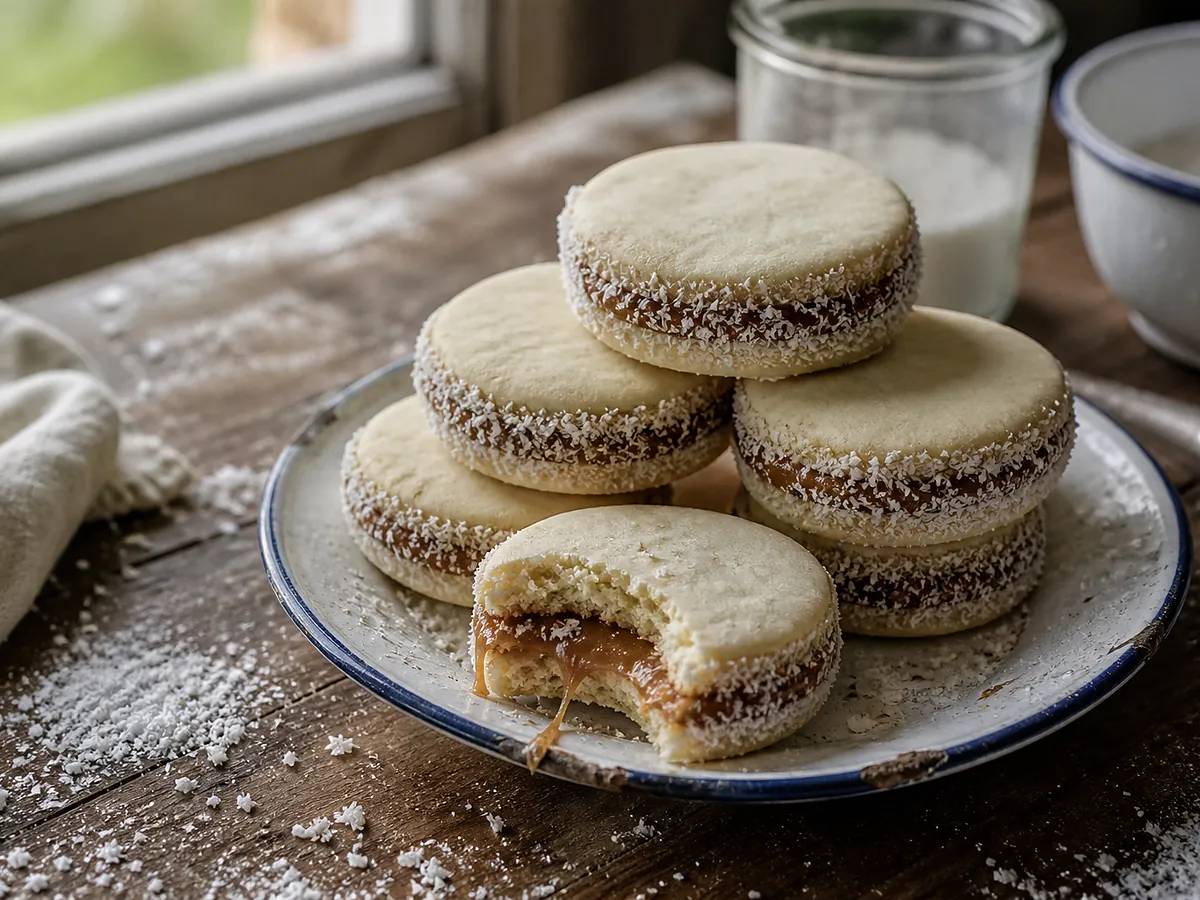
An alfajor de maicena is two pale cornstarch biscuits, almost too fragile to pick up, stuck together with a thick slab of dulce de leche and rolled in coconut so the filling does not smear your fingers. That is the whole cookie. It is not a chocolate-dipped industrial sandwich, and it is not a sugar cookie with a patriotic name.
The rule people get wrong: they treat the dough like wheat-cookie dough. They cream hard, they add whole eggs, they chase colour in the oven, they roll it thin so it looks neat. Then they wonder why the biscuit snaps instead of dissolving.
Maicena is the majority of the dry mix on purpose. Wheat flour is a modest scaffold so the round survives the spatula. Cornstarch has no gluten. The melt is the starch, the fat, and the yolks. Colour is a failure signal — golden means you baked the tenderness out.
I make these the home way: butter, yolks, powdered sugar, lemon zest, vanilla, baking powder, a rest, a thick roll, a pale bake, store-bought firm dulce de leche, coconut on the equator. Boiling milk for six hours is not a prerequisite for a Tuesday alfajor.
The dough
- 250 gabout 2¼ cupsCornstarch / maicenaspooned and levelled — but weigh it if you can
- 100 g¾ cup plus 1 tbspWheat flour, harina 0000 or other low-protein pastry flour
- 150 g10½ tbspUnsalted butter, cool room temperaturepliable but not greasy
- 100 g¾ cup plus 2 tbspPowdered sugar / azúcar impalpable, siftedUS cup volume measured before sifting; weighing is preferable
- 54 g3 yolksEgg yolks, from large eggs, at room temperature
- 8 g2 tspBaking powder
- 2 g⅓ tspFine salt
- 4 g2 tspLemon zest, finely gratedyellow only, about 1 lemon
- 5 ml1 tspVanilla extract
Filling and finish
- 450 gabout 1½ cupsThick dulce de leche, repostero or the stiffest jar you can buy
- 80 gabout 1 cup, loosely packedUnsweetened shredded coconut
Yield
18 to 24 sandwiches — 36 to 48 biscuits — depending on cutter size. I cut 4.5 to 5 cm rounds from a 7 mm sheet and land near 20 sandwiches.
The ratio
Flour : cornstarch : butter : sugar : yolks at 100 g : 250 g : 150 g : 100 g : 3 yolks (≈54 g). That is a home-kitchen starting point, not a locked national formula. Argentine kitchens drift on sugar type and butter weight.
On the cornstarch
Maicena is not a thickener you sneak in. It is the cookie. Native cornstarch granules gelatinise poorly in a low-moisture dough, which is exactly what you want: a baked crumb that fails the moment saliva hits it. If wheat flour takes the lead you get a snap. Potato starch makes the dough slack and the bake gummy. Stay with cornstarch.
On the flour and the yolks
Harina 0000 is Argentine bakery flour — low protein, fine mill. All-purpose works if you do not knead it. Bread flour does not belong here. The flour's only job is enough gluten to lift the round off the tray in one piece. Whites are water plus albumin, and albumin sets — that is a snappy biscuit. Yolks bring fat and lecithin; they emulsify butter into the starch without building a protein net. Two yolks make a dough that cracks at the cutter. Four make a slightly cakier round. Three is the home starting point. Whole eggs are a different cookie.
On the butter and sugar
Cool room temperature, not melted, not fridge-hard. Cream it just enough to hold the sugar, not enough to whip air for a cake. Powdered sugar dissolves into that fat without the grit of granulated, and it carries a little starch of its own. Granulated works and the surface will be slightly more open. Do not use a soft baking spread — water in the fat is steam, and steam is lift you do not want.
On the dulce de leche
Store-bought is traditional for this cookie, and I mean that. Pastry kitchens reach for dulce de leche repostero: cooked thicker, less flow, designed to sit between biscuits without weeping. If you only have a dessert-style jar, chill it hard and do not overfill. If you made it at home, take it to a thicker stage — a spoonful should stand in a mound, not ribbon off like sauce — or refrigerate it overnight. Warm dulce is a leak.
On the coconut
Unsweetened shredded coconut, the dry kind. Not wet sweetened bakery shred, not coconut flour. You are rolling a sticky equator, not flavouring a cake. Toasted coconut is a departure I do not take; it fights the pale biscuit and the dairy of the dulce. If the shred is very long, chop it once so it packs onto the edge.
Equipment
- A digital scale — volume measurement on cornstarch is a liar
- A large bowl and a wooden spoon, or a hand mixer on its lowest setting for the first minute only
- A rolling pin and a 4.5–5 cm round cutter
- Two light-coloured baking sheets lined with parchment — not dark nonstick
- An offset spatula
- A wire rack
Do not use: a food processor; a stand mixer on medium or high; a dark cookie sheet; a silicone mat; or convection on a high fan without dropping the temperature. A tiny cutter gives you fussy sandwiches that dry out.
Method
Cream, do not whip2 min
Do not heat the oven yet — the dough needs a rest and you should not race a hot box.
Put the butter and powdered sugar in the bowl. Beat on the lowest speed, or mash with a wooden spoon, until the mixture looks like wet sand that has just become a paste. It should not be pale and fluffy. Whipped butter is air, and air is a cookie that puffs, dries, then snaps.
Stop when the sugar has disappeared. Scrape the bowl. You are dispersing fat around starch, not building a foam.
Weigh the ingredients. Mix cool, softened butter with sifted powdered sugar until combined, without prolonged whipping.
Yolks, zest, vanilla1 min
Add the three yolks, the lemon zest, and the vanilla. Mix until the paste turns satin and a shade darker — 30 to 45 seconds.
If it looks broken, with slick butter and yolk sitting on top, the butter was too cold. Keep mixing on low and the lecithin will pull it together. Do not add water or a splash of milk. This dough is dry on purpose.
Mix in 54 g yolks (about 3 large yolks), lemon zest and vanilla until smooth.
Dry mix, barely1 min
In a second bowl, whisk the cornstarch, flour, baking powder, and salt until the baking powder is not sitting in a pocket.
Tip the dry mix onto the paste in two additions. Cut it in with a spatula until there are no dry streaks. The dough will look shaggy, then come together as a soft, slightly greasy ball. If it stays crumbly, check the ingredient weights and let cold butter soften slightly before pressing it together. More mixing is not always the answer; do not add extra flour.
Press it: it should hold a fingerprint and feel like cool marzipan, not like bread dough. Stop the second it is a ball — you can still make gluten with 100 g of flour if you knead it.
Whisk cornstarch, flour, baking powder and salt. Fold into the butter mixture in two additions until the dough holds together. Do not knead or add flour; if crumbly, check weights and let cold butter soften slightly before pressing together.
Flatten and rest45–60 min, cold
Press the ball into a disc about 2 cm thick. Wrap it. Refrigerate 45 to 60 minutes; you can rest it up to 24 hours. After an overnight rest, sit it on the counter 10 to 15 minutes before rolling so it does not crack.
Cold butter stops smear, hydrated starch rolls cleaner, and any stray gluten relaxes. Skip the rest and the dough sticks to the pin — then you add flour, and you have ruined the ratio you just weighed.
Flatten to a 2 cm disc, wrap and chill 45–60 minutes. After an overnight chill, let stand 10–15 minutes before rolling.
Heat the oven10 min, overlapping
175 °C / 350 °F, conventional, rack in the middle. If you only have convection, use 160–165 °C / 320–330 °F and watch the first tray — convection paints colour on these faster than you expect.
Light-coloured sheets, parchment on.
Preheat to 175 °C / 350 °F conventional, or 160–165 °C / 320–330 °F fan. Line light-coloured trays with parchment; use the middle rack.
Roll thick5–8 min
Work with half the dough and leave the other half cold. Dust the bench with a teaspoon of cornstarch, not a handful of flour. Roll to 6–8 mm — I aim for 7 mm. Thin dough bakes into a wafer, and a wafer is not an alfajor de maicena.
If the dough cracks at the edges it is too cold; wait two minutes. If it sticks it is too warm, and a two-minute freeze is better than more starch.
Cut close together. Press the scraps once and re-roll once — a third re-roll toughens. Transfer with the spatula, 2 cm apart.
Roll half the dough at a time to 6–8 mm with very little cornstarch for dusting. Cut 4.5–5 cm rounds and space 2 cm apart. Re-roll scraps once. Let cracking cold dough warm slightly; chill sticky dough rather than adding starch.
Bake pale10–13 min
You are done when the tops are still matte and ivory, the edges have taken no colour, and the biscuit looks dry rather than shiny. The bottom may be the faintest blond. If you see golden, you went too far.
They will feel too soft in the centre. That is correct. They firm on the sheet for 3 to 4 minutes, and then you move them with the spatula to a rack. Grab them now and they fold.
You are drying a starch-fat dough, not running Maillard. Browning is sugar and milk solids cooking past the point where the crumb still collapses on the tongue. Pale is the point, not underbaked.
Bake one tray at a time for about 10–13 minutes, checking from 10. Tops should be set and pale, with at most a faint blond base. Do not wait for golden edges. Rest on the tray 3–4 minutes before transferring carefully to a rack.
Cool completely30–40 min
Do not fill warm biscuits. Warm starch plus warm dulce is a smear and a slide. The round should be room temperature, dry to the touch, and fragile.
If a biscuit broke, eat it. Do not glue fragments.
Cool completely, about 30–40 minutes, before filling; warm biscuits are fragile.
Fill and roll15 min
Pair similar sizes. Turn one biscuit flat-side up. Divide the 450 g of dulce evenly between the pairs: about 19 to 25 g each for 18 to 24 sandwiches. Spoon or pipe it into the centre. Do not spread it to the rim; the top biscuit will push it out. Cap it and press until the filling just meets the edge in an even band.
Pour the coconut onto a plate and roll the equator in it, so the shred sticks to the dulce rather than to the biscuit face. If the filling is shy of the edge, the coconut will not hold.
Stand them in a single layer until the filling sets, about 20 minutes, then pack them.
Pair the biscuits and divide the 450 g dulce de leche between them (about 19–25 g per sandwich for 18–24). Sandwich gently and roll the exposed filling in coconut. Rest about 20 minutes before packing; follow the storage guidance below.
Storing it
Unfilled biscuits
4 to 5 days in an airtight tin at cool room temperature, parchment between layers. They stale faster than a wheat cookie — there is almost no gluten to hold water. Freeze unfilled rounds up to a month and thaw them in the tin so condensation stays off the surface.
Filled alfajores
These are a dairy sandwich. I leave a plate out the afternoon I fill them. After that, refrigerate in a covered box with parchment between layers, up to 5 days. The biscuit softens as moisture migrates out of the dulce; that is homemade style, not a defect, unless they go wet. Freeze filled sandwiches wrapped, and thaw in the refrigerator. Do not hold them in a hot car. The dough contains raw yolks — bake it.
Troubleshooting
- The biscuits browned.
Oven too hot, tray too dark, or you waited for "done" as if they were vanilla cookies. Drop 10 °C / 20 °F and pull at pale. Convection needs the lower setting.
- They spread into ovals.
Butter was too warm, or you skipped the rest. Chill the cut rounds 10 minutes on the sheet before they go in.
- They crack when you lift them.
You rolled thinner than 6 mm, or you moved them before the 3-minute set on the tray. Use the spatula. Make the next batch thicker.
- They snap instead of melt.
Too much flour, whole egg, overworked dough, or a golden bake. Check the scale. Stop mixing when it is a ball.
- The dough is a sticky mess.
The kitchen is hot, or the butter went greasy. Flouring the bench will fix the handling and ruin the crumb. Refrigerate 20 minutes instead.
- The dough crumbles at the cutter.
Too cold, or a little dry from over-measured cornstarch. Press it together once with the heel of your hand and try again. If it still will not cohere, a teaspoon of yolk is a more honest fix than water.
- Dulce squirts out the sides.
The filling is too loose or too warm, or you overfilled. Chill the jar. Use less. A repostero dulce is the structural product for this sandwich.
- The coconut will not stick.
The filling never reached the equator. Pipe a ring rather than a central blob, or press a little more firmly.
- They taste flat.
You forgot the salt, or the lemon zest included white pith, or the vanilla was old. Zest only the yellow. Salt is not optional in a sweet starch dough.
Substitutions
Traditional
Cornstarch majority, wheat flour minority, butter, yolks, powdered sugar, lemon zest, vanilla, baking powder, a rest, thick pale rounds, firm dulce de leche, unsweetened coconut. That is the homemade maicena style.
Acceptable home shifts
Granulated sugar for powdered, with a slightly more open crumb. Orange zest for lemon, which is common. A dusting of powdered sugar on the finished sandwich is decoration, not structure.
Departures, named as such
Dipping these in chocolate makes a different cookie, closer to the commercial sandwich in a box. Cocoa in the dough is a departure. Honey in the dough is a departure. Shortening or coconut oil for butter changes melt and aroma. Filling with jam is a different sandwich — the Argentine maicena cookie is a dulce de leche cookie. Gluten-free: more cornstarch plus 15 g milk powder in place of the wheat is a departure, and the rounds will be more fragile.
Scaling
The 100 : 250 : 150 : 100 : 3-yolk mix doubles cleanly — 200 g flour, 500 g cornstarch, 300 g butter, 200 g sugar, 6 yolks. Rest it the same.
Batches and limits
Bake in batches; stacked trays brown unevenly. For a half batch, beat the yolks and weigh 27 g (about 1½ large yolks), not 2 whole yolks. Do not triple this dough in one bowl. The last third of a big mass gets overworked while you chase dry flour. A 5 cm round at 7 mm uses roughly 14–19 g of dough.
What to serve it with
They travel in tins, which is most of the point.
- Mate, if that is the table
- Café con leche
- A small glass of cold milk, for children who will otherwise inhale three before anyone sits down
I do not plate these with berries. After asado they are too much; after a light lunch they are enough.
Questions
Can I use whole eggs?
No. You can, physically — and you will get a snappier, puffier round. That is not this cookie.
Why is my dough greasy?
The butter was too warm, or you creamed it as if you were making a layer cake. Start with cooler butter. Do not add flour to "fix" grease.
Do I have to rest the dough?
Yes. Thirty minutes is the floor, 45 to 60 is what I do, and overnight is fine — often easier if you are filling them the next day.
Store-bought dulce de leche, really?
Yes. For this cookie, yes. Buy the thickest one. If you have made the from-scratch pot and it is firm, use it. If it is sauce, do not.
My oven only runs hot. How pale is pale?
Ivory. The colour of uncooked pasta, maybe a shade drier. If a neighbour would call them golden, they are overdone.
Can I make the biscuits a week ahead?
Unfilled, in a tin, 4 to 5 days is honest. Freeze them for longer.
Why coconut and not chopped peanuts?
Peanuts appear on other alfajores. Maicena in a home kitchen is coconut.
Is this the same as the chocolate ones from the kiosco?
No. Those are a different formula, usually wheat-forward and usually dipped. This is the homemade cornstarch sandwich.