Sancocho de Res y Gallina
Weekend cooking on riverbanks and in backyards — beef short ribs and stewing hen simmered until their collagen dissolves into amber broth, then tropical roots staged by starch density so yuca, ñame, ocumo and auyama each finish intact rather than dissolving into sludge.
- Prep
- 40 min
- Cook
- 2 hr 15 min
- Serves
- 8 large feast bowls
- Difficulty
- Medium
Researched · Kitchen testing pending
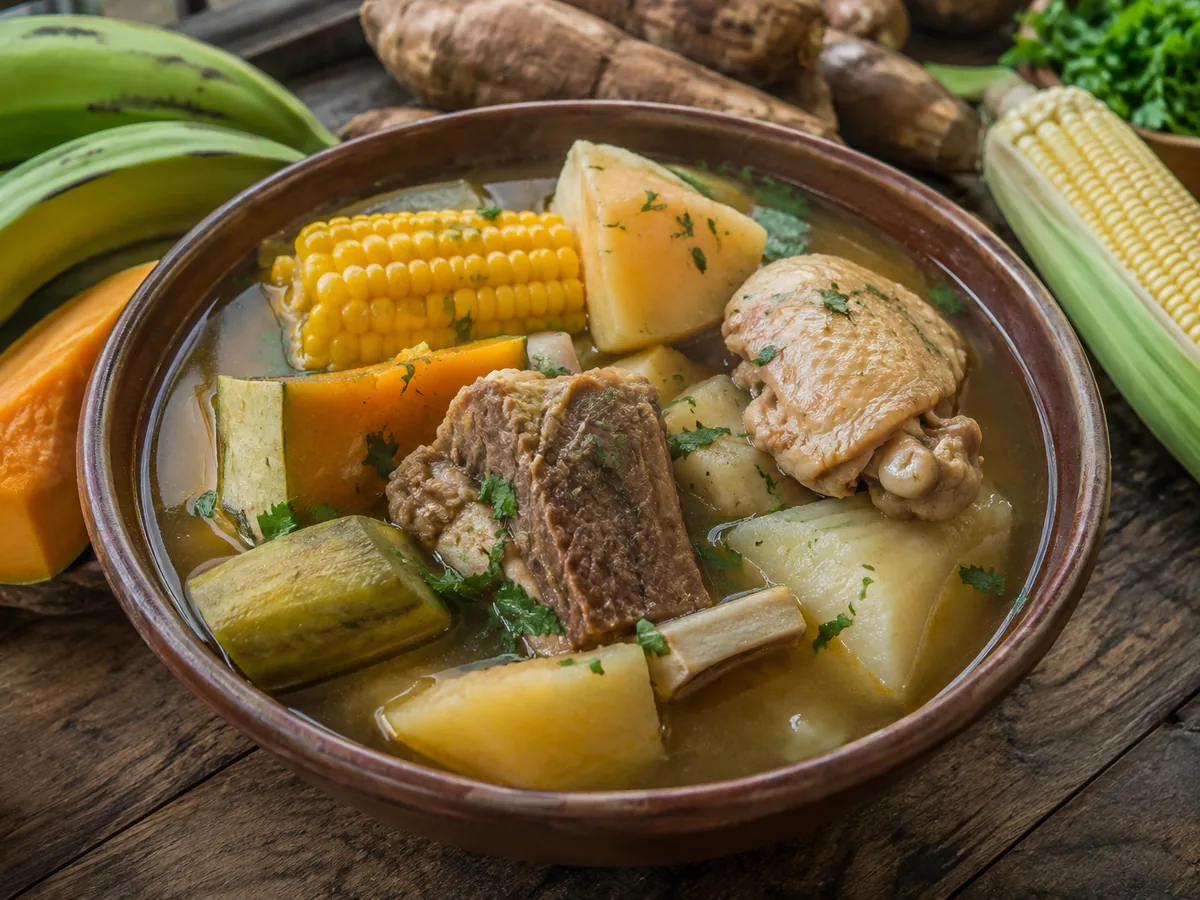
Sancocho is the communal heartbeat of Venezuelan weekends, cooked in enormous pots over open firewood on riverbanks and in backyards. Unlike European broths that strain out their ingredients, a Venezuelan sancocho is an abundant meal-in-a-bowl.
It combines bone-in beef short ribs with old-fashioned stewing hen, simmered low until their marrow and collagen dissolve into an aromatic amber broth. Then comes the battery of tropical roots: fibrous yuca, silky ñame, earthy ocumo, green plantain and sweet corn on the cob.
Finished with a sofrito of ají dulce, culantro and garlic, it delivers deep herbal warmth and comforting starchy sweetness.
Meats and broth
- 1 kg2.2 lbBone-in beef short ribs (costilla de res), cut across the bone into 5 cm pieces
- 1 kg2.2 lbStewing hen or heritage chicken, cut into 8 bone-in serving pieces
- 4 L17 cupsCold filtered water
- 400 g2 largeYellow onions, peeledone halved for the stock, one diced fine for the sofrito
- 8 cloves8 clovesFresh garlic, peeled and crushed flat
- 3 g1 tspWhole black peppercorns
- 25 g1½ Tbsp + 1 tspFine sea saltseasoned in stages
Roots, staged
- 1 large1 largeGreen plantain, peeled and sliced into 2.5 cm rounds
- 500 g1 large rootYuca (cassava), peeled, woody core removed, cut into 4 cm chunks
- 3 ears3 earsSweet corn on the cob, husked and cut into 4 cm rounds
- 400 g1 rootÑame (white yam), peeled and cut into 4 cm chunks
- 300 g2 tubersOcumo (taro / malanga), peeled and cut into 4 cm chunks
- 400 g2 cupsAuyama (Kabocha or calabaza squash), peeled and cut into 4 cm cubes
Sofrito and finish
- 30 ml2 TbspCorn oil or extra-virgin olive oil
- 10 pieces10 piecesVenezuelan ají dulce, or sweet mini peppers, seeded and minced fine
- 5 g1½ tspGround cumin seeds, freshly toasted
- 4 g1½ TbspDried wild oregano
- 4 sprigs4 leavesFresh culantro (cilantro cimarrón)or 1 cup fresh cilantro with its stems
- 30 g½ cupFresh cilantro leaves, chopped fine
Two proteins, one timeline
Stewing hen carries mature, cross-linked collagen that needs over 90 minutes of steady simmering at 88–92 °C to break down — the same window the beef short ribs need. They go in together from cold water.
Roots behave differently, so stage them
Green plantain and yuca hold dense, tight starch matrices and need about 35 minutes. Ñame and ocumo soften in 20, shedding amylopectin that gives the soup its silky body. Auyama breaks down in 15, tinting the broth amber. Dump them in together and you get dissolved squash around hard yuca.
Never a rolling boil
Violent boiling breaks the roots into cloudy sludge and emulsifies the fat into the broth. Hold a gentle, murmuring simmer that breaks the surface every couple of seconds.
Season in stages
Yuca and plantain absorb enormous amounts of sodium. Taste as you go, and season the broth thoroughly before the dense roots enter.
The five tastes on this plate
Salt seasons the broth from the start, penetrating the roots and the marrow. Fat is rendered beef marrow and chicken lipids forming golden ojitos across the surface. Acid is naturally low, finished at the table with lime squeezed into the bowl. Heat is garlic, peppercorn and the herbal pungency of oregano and culantro. Umami is the collagen and nucleotide extraction from ribs and hen bones.
Equipment
- Heavy 12–14 qt stainless stockpot
- Wide spoon, for skimming
- Small skillet, for the sofrito
- Ladle
- Wide, deep bowls
Traditionally a 16-to-20 quart heavy aluminium or cast-iron caldero over an outdoor wood fire. A heavy 12-to-14 quart multi-clad stainless stockpot works in a modern kitchen — the thick base keeps dense yuca and ñame from catching on the bottom.
Method
Simmer the meats and clarify1 hr 30 min
Put the short ribs and hen in a 14-quart stockpot with 4 litres cold water and set over medium-high heat.
As it heats toward a simmer, skim the grey foam off the surface for 15 minutes.
Add the halved onion, 4 crushed garlic cloves, peppercorns and 1 Tbsp salt. Turn to low, cover partially, and simmer gently 1 hour 15 minutes until the meats begin to soften.
Heat ribs and hen with 4 litres cold water over medium-high; skim foam for 15 minutes as it warms. Add halved onion, 4 crushed garlic cloves, peppercorns and 1 tablespoon salt. Partly cover; simmer low at 88–92 °C for 1 hour 15 minutes until meats begin softening.
Stage one — corn, plantain and yuca15 min
Add the corn rounds, sliced green plantain and yuca chunks directly to the simmering broth.
Simmer gently 15 minutes.
Add the corn rounds, sliced green plantain and yuca chunks directly to the simmering broth.
Simmer gently 15 minutes.
Stage two — ñame and ocumo10 min
Add the cubed ñame and ocumo and simmer another 10 minutes.
They will soften along their edges, releasing starches that give the broth a light, velvety body.
Add the cubed ñame and ocumo and simmer another 10 minutes.
They will soften along their edges, releasing starches that give the broth a light, velvety body.
Stage three — squash and the sofrito15 min
Add the cubed auyama.
In a small skillet, heat 30 ml oil and sauté the remaining diced onion, remaining garlic, minced ají dulce, cumin and oregano for 6 minutes until fragrant. Pour this hot sofrito straight into the pot, and drop in the culantro.
Simmer 15 minutes until the squash is fork-tender and the broth turns rich golden-amber.
Add squash. Separately heat 30 ml oil; sauté remaining onion and garlic, ají dulce, cumin and oregano 6 minutes until fragrant. Add hot sofrito and culantro to soup; simmer 15 minutes until squash is fork-tender and broth golden-amber.
Season and finish3 min
Taste the broth and add the remaining salt as needed. Discard the spent onion half and the culantro stems.
Check the meat: the rib should pull cleanly from the bone at 93 °C / 200 °F.
Stir in the chopped cilantro and pull the pot off the heat.
Taste; add remaining salt as needed. Discard the onion half and culantro stems. Check ribs release cleanly from the bones at 93 °C / 200 °F. Stir in chopped cilantro and remove from heat.
Plate the bowls
Ladle the hot broth into wide, deep bowls, making sure each one gets a piece of beef rib, a piece of hen, a round of corn, and one chunk each of yuca, ñame, ocumo and auyama.
Serve steaming with fresh lime halves and warm arepas.
Serve hot broth in deep bowls, each with beef rib, hen, corn and a piece of yuca, ñame, ocumo and squash. Accompany with fresh lime halves and warm arepas.
Sensory cues of doneness
- Visual: a shimmering golden-amber broth full of distinct, fork-tender roots; the beef slips off the rib bone; the corn kernels are plump and bright yellow.
- Auditory: a steady, gentle murmur breaking the surface every couple of seconds — never a churning boil.
- Olfactory: beef marrow, simmered hen broth, sweet corn steam, fresh culantro and sautéed sweet peppers.
Look for glossy amber broth, distinct fork-tender roots, beef releasing from bone and plump yellow corn. Maintain a gentle bubble every few seconds, never a rolling boil; expect marrow, hen, corn, culantro and sweet pepper aromas.
Troubleshooting
- Dissolved squash and hard yuca in the same pot.
Everything went in at once. Follow the staged timing — dense roots first, squash last.
- A cloudy, greasy broth.
It boiled hard, breaking up the roots and emulsifying the fat. Keep it at a low, gentle simmer.
- Bland roots in a seasoned broth.
Under-salting. Yuca and plantain absorb a great deal of sodium — taste and season in stages.
Substitutions
One-to-one global substitutions, with the technique adjustment each one requires.
Ingredient substitutions
| Ingredient | Replace with | Culinary impact and technique adjustment |
|---|---|---|
| Ñame and ocumo | Taro root, malanga or Yukon Gold potatoes | One-to-one. Potatoes soften in 15 minutes, so add them with the squash |
| Ají dulce | Sweet mini peppers | One-to-one |
| Culantro (cilantro cimarrón) | Fresh cilantro stems with a pinch of dried oregano | One-to-one. Delivers the pungent coriander aroma |
Scaling
Half, for 4 portions
Halve the ingredients in an 8-quart stockpot. The simmering times for meats and roots are identical.
Double, for 16 portions
Double the ingredients in a 24-to-30 quart pot, keeping the simmer low so the vegetables do not crush each other under their own weight.
What to serve it with
- Arepas calientes — freshly grilled arepas with butter, for dipping into the broth
- Fresh lime wedges squeezed straight into the bowl at the table
- Guasacaca — the Venezuelan herb-and-avocado salsa, spooned over the boiled meats
Questions
What is the difference between sancocho and hervido?
They are largely synonymous in Venezuela, though hervido often means a lighter broth of chicken or fish, while sancocho means the heavier, multi-tuber, multi-meat feast.
Can I make this with only beef or only chicken?
Yes — sancocho de costilla and sancocho de gallina are both widely made. Using both together, cruzado, gives the richest flavour.
What is ocumo?
The Venezuelan name for taro or malanga. It adds an earthy, nutty starch that thickens the broth naturally.