Cachapas con Queso de Mano
No flour at all — just tender sweet corn cut from the cob and pulsed coarse, so kernels stay visible in the batter. Griddled at a steady medium-low until the surface craters, then folded over a thick round of fresh cheese that softens into stretchy layers in about a minute.
- Prep
- 25 min
- Cook
- 20 min
- Serves
- 6 large cachapas, about 20 cm each
- Difficulty
- Medium
Researched · Kitchen testing pending
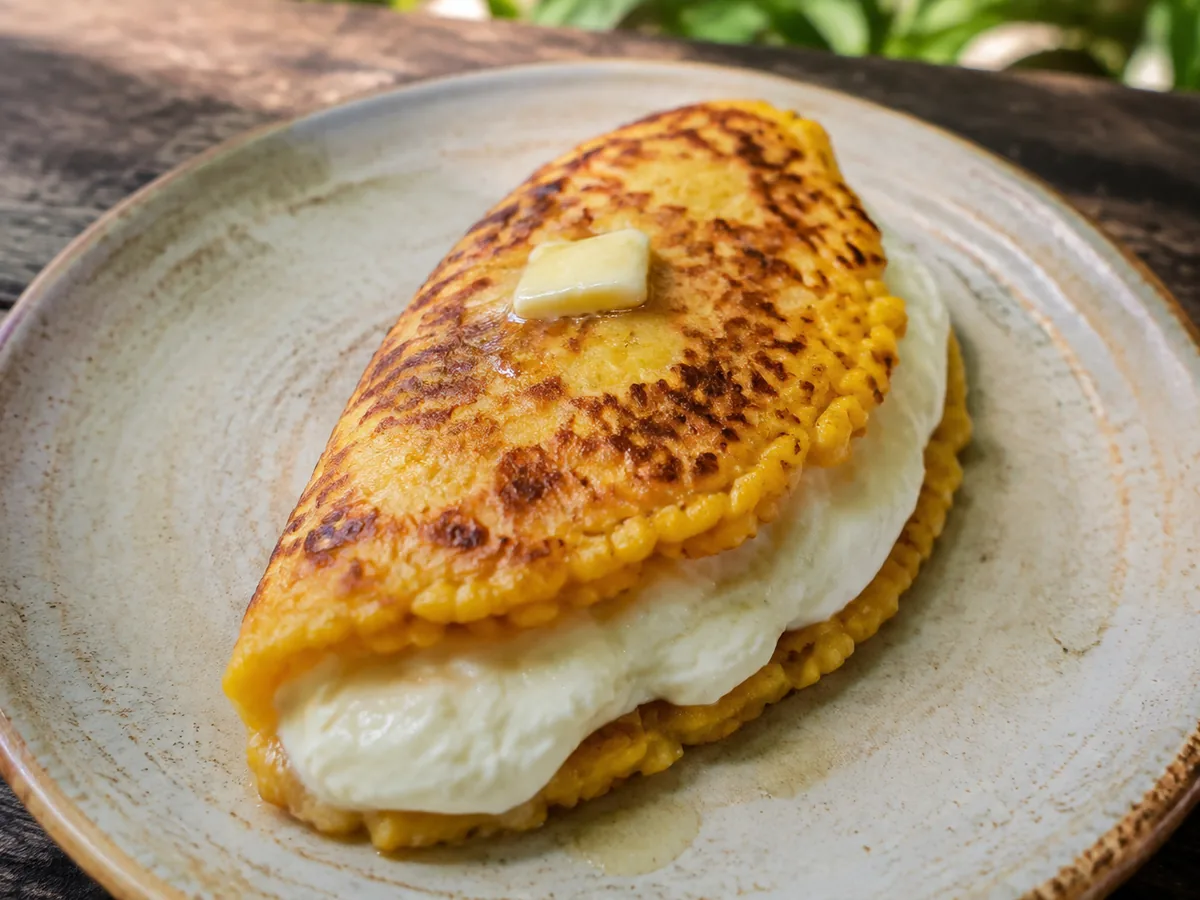
Cachapas belong to the fertile plains and roadside stalls of Miranda and Aragua. Unlike Mexican tortillas or American pancakes, an authentic cachapa contains no flour base at all.
They are made directly from tender ears of fresh sweet yellow corn, ground raw into a thick, milky batter with a touch of sugar, salt and milk. Poured onto a buttered, smoking budare, the batter caramelises into a thick golden pancake studded with sweet corn bits.
Folded over a thick round of fresh, elastic white cheese and smeared with farmhouse butter, it delivers a balance of sweet corn starch and warm, salty melted dairy.
Batter
- 1.2 kg6 cups kernelsFresh sweet yellow corn (maíz tierno), shucked, kernels cut from 6 large ears with the cobs scraped for their milk
- 60 ml¼ cupWhole milk or heavy cream
- 40 g3 TbspGranulated cane sugaradjust to the natural sweetness of the corn
- 10 g1½ tspFine sea salt
- 30 g2 TbspPrecooked white cornmeal (Harina P.A.N.) or cornstarchbinds the excess moisture
- 1 large1 largeEgg, at room temperature
- 60 g4 TbspUnsalted European butter, meltedplus extra cold butter to smear over the hot cakes
Filling
- 6 rounds6 thick roundsQueso de mano, or queso guayanés or fresh whole-milk mozzarella, cut 1.5 cm thickabout 600 g total
Pulse, never purée
Fresh kernels hold liquid endosperm full of water, sucrose and ungelatinised starch. Grinding ruptures the cells into a wet batter — but blending it smooth destroys the rustic bite that defines a real cachapa. Pulse six to eight times only, leaving small visible niblets.
The egg and the spoonful of Harina P.A.N.
Together they form a protein-starch network that traps the free corn water. Without them the batter is too loose to flip.
Steady medium-low heat
At about 180 °C the surface sugars caramelise into a golden blistered crust while the internal starches gelatinise at 70–75 °C and bind the cake. Too hot and the surface sugars burn before the centre cooks, leaving a raw, gooey middle.
Wait for the craters
Flip only once bubbles have risen and popped across the surface and the edges look dry. Earlier than that and the delicate cake tears.
The five tastes on this plate
Salt is sea salt in the batter and the briny finish of the cheese. Fat is melted butter in the batter and more smeared over the hot cake. Acid is gentle, balanced by the clean lactic tang of fresh queso de mano. Heat is absent by design — this is a pure sweet corn profile. Umami is fresh corn sugars and whole-milk curds.
Equipment
- Sharp chef's knife
- Blender
- Heavy 12 in cast-iron skillet or budare
- Ladle
- Wide, thin spatula
Traditionally a heavy cast-iron Venezuelan budare seasoned with oil and lard. A heavy 12-inch cast-iron skillet or non-stick griddle works in a modern kitchen — cast iron holds the heat steady so the thick batter cooks through to the centre before the bottom scorches.
Method
Cut and scrape the corn10 min
Stand the shucked ears upright in a wide bowl and slice downward to cut the kernels from the cob.
Use the back of the knife spine to scrape the bare cobs, extracting the sweet, starchy corn milk. Transfer kernels and milk to a blender.
Strip kernels from upright cobs into a bowl; scrape the bare cobs with the knife spine to collect their starchy corn milk. Transfer both to the blender.
Blend the batter3 min
Add the milk, sugar, salt, egg, melted butter and Harina P.A.N. to the blender.
Pulse 6 to 8 times only — you want a coarse, thick batter with small visible bits of kernel, not a smooth liquid.
If it feels runny, rest it 5 minutes so the cornmeal absorbs the liquid.
Add milk, sugar, salt, egg, melted butter and Harina P.A.N. Pulse just 6–8 times, leaving visible corn pieces in thick batter. If runny, rest 5 minutes to absorb excess liquid.
Heat the budare3 min
Set a heavy cast-iron skillet over medium-low heat and brush the floor lightly with butter.
It is ready when a drop of batter sizzles immediately without smoking, about 180 °C / 350 °F.
Set a heavy cast-iron skillet over medium-low heat and brush the floor lightly with butter.
It is ready when a drop of batter sizzles immediately without smoking, about 180 °C / 350 °F.
Ladle and cook the first side3–4 min
Pour roughly 160 ml of batter into the centre and spread it outward with the back of the ladle into an even disc 18 to 20 cm wide and 8 mm thick.
Cook undisturbed 3 to 4 minutes: bubbles will rise and pop, the edges will firm and look dry, and the underside will turn deep golden-brown.
Spread about 160 ml batter into an even 18–20 cm disc, 8 mm thick. Cook undisturbed 3–4 minutes until bubbles rise and burst, edges look dry and firm, and the underside is deep golden-brown.
Flip and finish2–3 min
Slide a wide, thin spatula completely under the cachapa and flip it in one confident motion.
Cook the second side 2 to 3 minutes until set and golden-brown, then slide onto a warm plate.
Slide a wide, thin spatula completely under the cachapa and flip it in one confident motion.
Cook the second side 2 to 3 minutes until set and golden-brown, then slide onto a warm plate.
Fold with cheese and butter
Smear a pat of cold butter over the steaming surface straight away.
Lay a thick round of queso de mano across one half and fold the other half over it like a turnover.
The trapped heat softens the cheese within 60 seconds into warm, stretchy layers. Serve hot.
Immediately butter the hot surface with cold butter. Place a thick round of queso de mano on one half and fold over. Let trapped heat soften the cheese for 60 seconds; serve hot.
Sensory cues of doneness
- Visual: small bursting steam holes across the surface like a pancake; the flipped side deeply golden-amber with toasted brown spots; the cheese inside softening into supple folds.
- Auditory: a lively sizzle as raw batter hits the buttered iron, then quiet hissing as steam escapes the surface craters.
- Olfactory: roasted sweet corn, browned butter and warm melted curds.
Look for popped steam holes, deep amber surfaces with toasted spots and cheese softening into folds. Initial sizzling should become quiet hissing as steam escapes; expect roasted sweet corn, browned butter and warm cheese aromas.
Storing it
Cook them fully, cool, stack between sheets of parchment and freeze in bags. Reheat on a hot dry skillet for 2 minutes per side.
Troubleshooting
- A smooth, pasty batter.
It was puréed into baby food. Pulse just until ground, keeping small corn niblets intact.
- A burnt surface over a raw centre.
The griddle ran too hot. Use steady medium-low heat so the inside cooks through.
- The cake tears when flipped.
It was turned before the bottom crust was rigid. Wait until the surface bubbles pop and look dry.
Substitutions
One-to-one global substitutions, with the technique adjustment each one requires.
Ingredient substitutions
| Ingredient | Replace with | Culinary impact and technique adjustment |
|---|---|---|
| Queso de mano | Fresh whole-milk mozzarella in brine, or Oaxaca cheese | One-to-one. Slice thick; it softens into stretchy layers under heat |
| Harina P.A.N. | Cornstarch or fine yellow cornmeal | One-to-one. Binds the wet corn batter |
| Fresh choclo | Frozen sweet yellow corn, thawed and drained | One-to-one, with an extra tablespoon of Harina P.A.N. for the extra water |
Scaling
Half, for 3 cachapas
Halve the ingredients. Each cake still takes 6 to 7 minutes.
Double, for 12 cachapas
Double the ingredients and cook on two large cast-iron skillets side by side so everyone gets them hot.
What to serve it with
- Pernil horneado — slow-roasted sliced pork leg tucked in beside the cheese, making it a cachapa con queso y pernil
- Papelón con limón — icy cold limeade sweetened with raw cane sugar
- Queso telita or guayanés, the other fresh Venezuelan stretched-curd cheeses
Questions
Can I use frozen or canned corn?
Fresh corn on the cob is best, because it carries living starch and milk. With frozen corn, thaw and drain it thoroughly and add an extra tablespoon of Harina P.A.N. to compensate for the water.
What is queso de mano?
A fresh Venezuelan cow's milk cheese made by pasta filata (pulled curd) methods similar to mozzarella, formed into layered discs that soften into stringy, tender sheets when warmed.
Can I freeze prepared cachapas?
Yes. Cook them fully, cool, stack between parchment and freeze in bags, then reheat on a hot dry skillet for 2 minutes per side.