Asado Negro Caraqueño
Eye of round dropped into papelón taken past caramel to a smoking black foam, which stains the beef pitch-black in minutes. Two and a half hours of braising in its wine marinade turn that burnt sugar into a glossy mahogany sauce that is bittersweet, not burnt.
- Prep
- 30 min
- Cook
- 2 hr 30 min
- Serves
- 8 portions
- Difficulty
- Hard
Researched · Kitchen testing pending
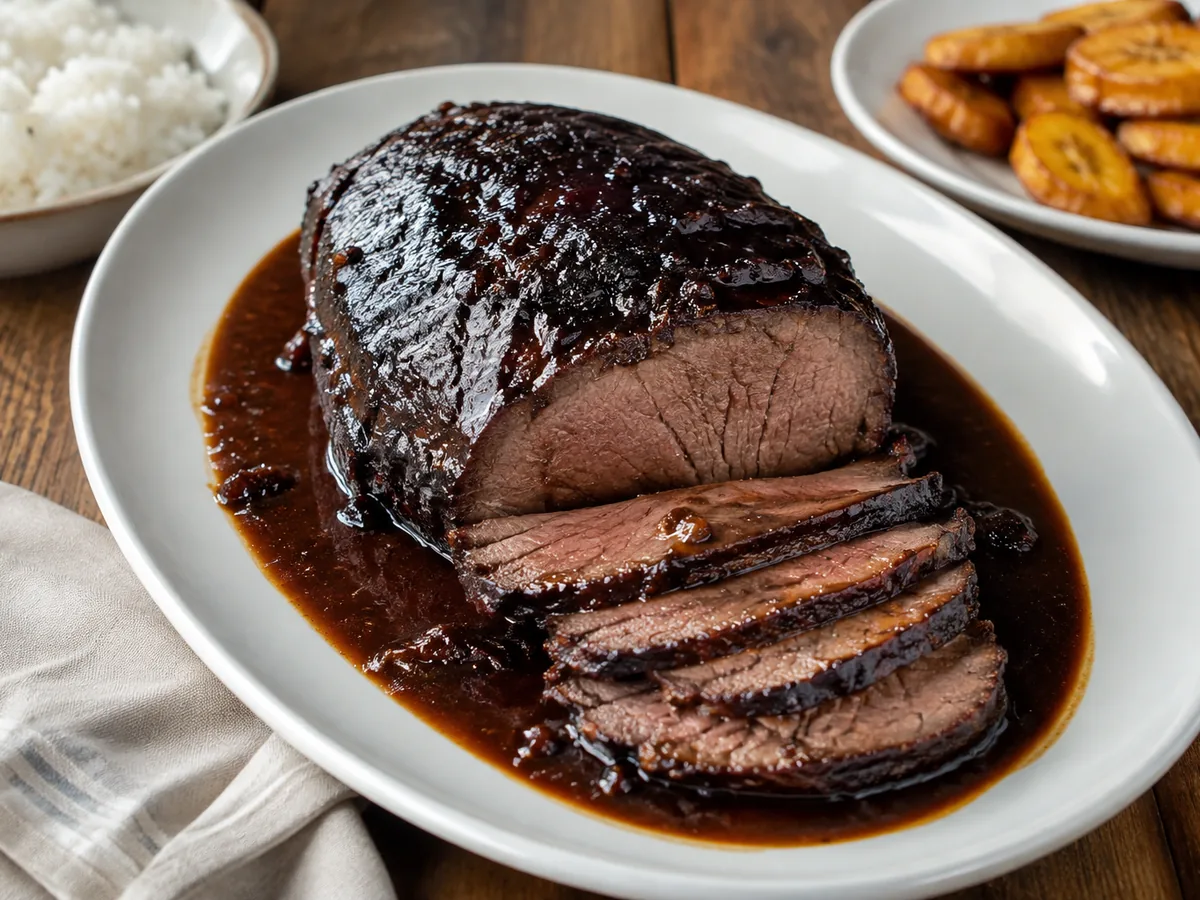
Asado negro is the dark, bittersweet pride of old Caracas family tables. The recipe centres on a whole beef eye of round, marinated in red wine, garlic and onions, then dropped into a smoking pot of melted, bubbling papelón.
The cook sears the meat until the sugar chars into a gleaming, pitch-black mahogany shell.
Braised slowly in its own marinade for over two hours, the meat turns tender and yielding, and is sliced into clean discs sauced with a rich, glossy reduction that balances dark caramel bitterness against savoury beef fond.
Beef and marinade
- 1.8 kg4 lbWhole beef eye of round roast (muchacho redondo), trimmed of excess outer fat but with a 3 mm fat cap left intact
- 350 ml1.5 cupsDry red wine — Cabernet Sauvignon or Syrah
- 45 ml3 TbspWorcestershire sauce (salsa inglesa)
- 400 g2 largeYellow onions, peeled and chopped fine
- 8 cloves8 clovesFresh garlic, peeled and crushed flat
- 1 large1 largeRed bell pepper, seeded and diced fine
- 6 pieces6 piecesVenezuelan ají dulce, or sweet mini peppers, seeded and minced
- 15 g1 TbspFine sea salt
- 4 g1½ tspFreshly ground black peppercorn
The black caramel
- 60 ml4 TbspCorn oil or neutral vegetable oil
- 150 g¾ cup packedGrated papelón (raw cane sugar), or dark muscovado sugar
The braise
- 300 g2 largeRipe plum tomatoes, peeled, seeded and puréed
- 2 whole2 wholeBay leaves
- 500 ml2.1 cupsRich beef bone broth, hot
This is pyrolysis, not scorching
Papelón carries unrefined sucrose, glucose and molasses minerals. Heated in oil to 160–180 °C it melts, froths and pyrolyses into bittersweet aromatic compounds — maltol and furans. Searing the beef in that smoking syrup drives Maillard reactions between the meat's amino acids and the reducing sugars, building a jet-black crust in minutes without cooking the core.
The exact second to add the meat
When the sugar foams, turns nearly black and the first wisps of white smoke rise — about 3 to 4 minutes. A moment longer and it is bitter charcoal.
Dry the meat first
Surface moisture stops the sugar adhering. Wipe the roast down with paper towels after pulling it from the marinade.
Keep the fat cap
Eye of round is very lean. Leaving 3 mm of fat protects the meat from drying out during a sear that hot.
Passive time, counted separately
The beef marinates 12 to 24 hours, and the cooked roast rests 20 minutes before slicing. Neither is active work, and both sit outside the times quoted above.
The five tastes on this plate
Salt is sea salt and Worcestershire balancing the sweet caramel. Fat is the oil carrying the caramelised sugar plus the beef's own drippings. Acid is the red wine reduction, tomato and the tamarind-vinegar notes of the Worcestershire. Heat is coarse black pepper, garlic and ají dulce. Umami is an extreme Maillard crust over beef fond and reduced bone broth.
Equipment
- Large container, for marinating
- Heavy 7 qt enamelled cast-iron Dutch oven
- Long wooden spoon
- Carving fork
- Instant-read thermometer
- Sharp slicing knife
Traditionally a heavy cast-aluminium or cast-iron caldero. A heavy 7-quart enamelled cast-iron Dutch oven works in a modern kitchen — cast iron distributes the intense sugar heat evenly, which is what keeps the papelón from scorching into bitter ash.
Method
Marinate the meat — day one15 min
Prick the roast all over with a carving fork and put it in a large container.
Add the onions, garlic, bell pepper, ají dulce, red wine, Worcestershire, salt and black pepper, and rub the marinade into the meat.
Cover and refrigerate 12 to 24 hours, turning the roast once or twice.
Keep the roast’s 3 mm fat cap. Prick all over; rub with onion, garlic, bell pepper, ají dulce, red wine, Worcestershire, salt and pepper. Cover and refrigerate 12–24 hours, turning once or twice.
Separate meat and marinade5 min
Pull the beef from the marinade and wipe it dry with paper towels — moisture prevents the sugar adhering.
Strain the marinade, reserving the liquid and the aromatics separately.
Pull the beef from the marinade and wipe it dry with paper towels — moisture prevents the sugar adhering.
Strain the marinade, reserving the liquid and the aromatics separately.
Blacken the meat in caramel12 min
Heat 60 ml oil in the Dutch oven over high heat and add the 150 g grated papelón.
Stir continuously with a long wooden spoon as the sugar melts, bubbles and darkens. Watch closely: when it foams and turns nearly black with wisps of white smoke — about 3 to 4 minutes — immediately drop the roast in.
Sear aggressively 3 to 4 minutes per side, rolling it until the whole exterior is a glistening pitch-black crust.
Heat 60 ml oil on high; add 150 g papelón. Stir constantly with a long wooden spoon. After 3–4 minutes, when sugar foams nearly black with first white smoke, immediately add the dried roast. Sear 3–4 minutes per side, rolling until entirely glossy black.
Deglaze and add aromatics5 min
Add the reserved onion and pepper aromatics and toss them in the hot fat 3 minutes.
Pour in the reserved wine marinade and the puréed tomatoes, scraping the bottom to dissolve every bit of caramelised crust, then add the 500 ml hot broth and the bay leaves.
Cook reserved onion-and-pepper aromatics in the hot fat 3 minutes. Add reserved wine marinade and tomato purée; scrape up every bit of caramelised fond. Add 500 ml hot broth and bay leaves.
Braise gently2 hr 15 min
Bring to a gentle boil, turn the heat to low and cover tightly.
Simmer 2 hours to 2 hours 15 minutes, turning the roast every 30 minutes, until the centre yields easily to a carving fork at 90–93 °C / 194–200 °F.
Bring to a gentle boil; cover tightly and simmer on low 2 hours to 2 hours 15 minutes, turning every 30 minutes, until a fork enters easily and the centre reaches 90–93 °C / 194–200 °F.
Rest, slice and reduce10 min
Move the roast to a board and rest 20 minutes — slicing it hot shreds the lean eye of round.
Meanwhile, simmer the pot sauce uncovered 10 minutes until it reduces to a thick, glossy glaze.
Slice the rested meat across the grain into clean 5 mm medallions, fan them on a warm platter, and ladle the hot black sauce over the top.
Rest roast on a board 20 minutes. Meanwhile, reduce sauce uncovered 10 minutes until thick and glossy. Slice meat across the grain into 5 mm medallions, fan on a warm platter and spoon hot black sauce over.
Sensory cues of doneness
- Visual: an almost pitch-black, glossy exterior; sliced open it reveals tender rosy-brown meat, and the sauce is deep mahogany and coats a spoon.
- Auditory: furious, violent hissing as the cold marinated meat hits the molten black sugar.
- Olfactory: dark bittersweet molasses caramel, searing beef, red wine reduction and toasted garlic.
Look for a glossy near-black crust, tender rosy-brown slices and mahogany sauce coating a spoon. Expect vigorous hissing during searing, with bittersweet molasses, beef, reduced wine and toasted garlic aromas.
Storing it
Leftovers are superb. Sliced cold asado negro makes one of the great sandwich fillings in Latin America, especially stuffed into hot buttered arepas.
Troubleshooting
- Bitter, ashy sauce.
The sugar went past the black-foam stage into charcoal. Drop the meat in the exact second white smoke rises and the foam turns dark mahogany.
- Shredded, stringy slices.
The lean eye of round was cut hot. Rest it 20 minutes so the juices redistribute.
- Dry meat under the crust.
The fat cap was trimmed away. Leave 3 mm on to protect the meat through the sear.
Substitutions
One-to-one global substitutions, with the technique adjustment each one requires.
Ingredient substitutions
| Ingredient | Replace with | Culinary impact and technique adjustment |
|---|---|---|
| Muchacho redondo (eye of round) | Beef bottom round or top sirloin roast | One-to-one. Keep the cut tied tight into an even cylinder |
| Papelón | Dark muscovado sugar or piloncillo | One-to-one. Same unrefined molasses notes |
| Ají dulce | Sweet mini peppers | One-to-one |
Scaling
Half, for 4 portions
Use a 1 kg roast and halve the marinade. The braise drops to 1 hour 45 minutes.
Double, for 16 portions
Cook two 1.8 kg roasts in two separate Dutch ovens. Browning both in one pot drops the sugar temperature and boils the meat instead of searing it.
What to serve it with
- Arroz blanco y plátanos al horno — steamed white rice and baked sweet plantains with white cheese
- Puré de papas — velvety buttered mash to pool the dark caramel sauce
- A Gran Reserva Cabernet Sauvignon or Syrah, whose structured tannins echo the bittersweet molasses
Questions
Why does the meat look black if it isn't burnt?
The colour comes from the caramelisation and pyrolysis of unrefined cane sugar, not scorched meat. It tastes sweet, savoury and deep, with no burnt bitterness.
Can I make asado negro in an electric pressure cooker?
Yes. Sear in caramel in a Dutch oven first, then pressure cook with the liquid for 50 minutes on high with natural release.
How does it keep as leftovers?
Superb. Sliced cold, it makes one of the great sandwich fillings in Latin America, especially inside hot buttered arepas.