Hallacas Navideñas
Venezuela's most complex undertaking, assembled every December at family hallacazos. Annatto steeped in warm lard to draw out its crimson, a three-meat guiso chilled overnight until it sets, and each parcel tied inside smoked plantain leaves that perfume the dough as it boils.
- Prep
- 2 hr
- Cook
- 50 min
- Serves
- 24 traditional hallacas
- Difficulty
- Hard
Researched · Kitchen testing pending
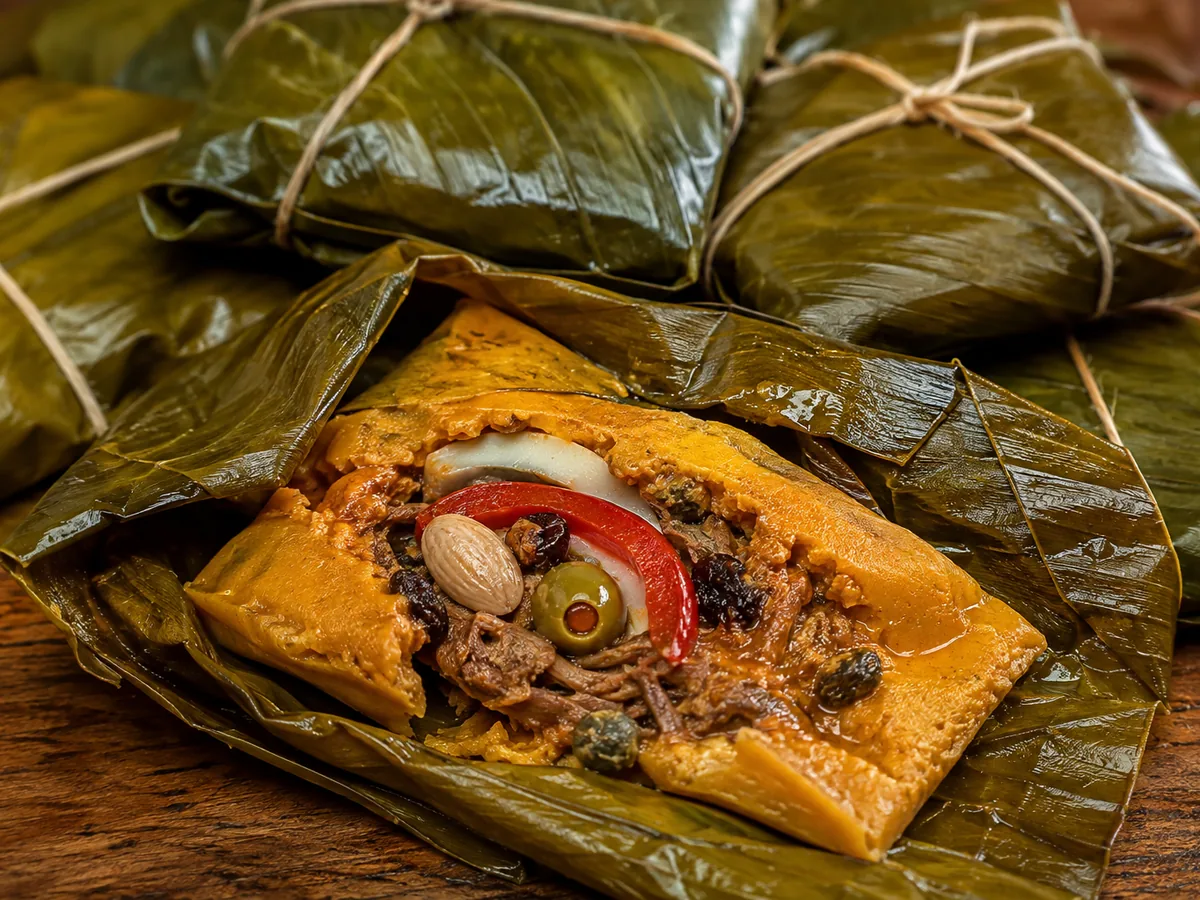
The hallaca is Venezuela’s most complex culinary undertaking, assembled each December in lively family gatherings called hallacazos.
A thin blanket of corn dough, tinted crimson with onoto and enriched with lard, cradles a rich multi-meat guiso of beef chuck, pork shoulder and chicken, simmered with sweet Moscatel, papelón, green olives, capers and ají dulce.
Each parcel is garnished with onion rings, red pepper strips, whole almonds and raisins, then tied securely inside smoked plantain leaves with cotton twine and simmered in a hot water bath.
Guiso — the three meats
- 1 kg2.2 lbBeef chuck roast, trimmed of silverskin, hand-diced into 8 mm cubes
- 1 kg2.2 lbBoneless pork shoulder, trimmed and cut into 8 mm cubes
- 1 kg2.2 lbBone-in chicken thighs, skin removed, poached, meat pulled and diced
Annatto lard
- 150 ml⅔ cupRendered pork lard (manteca de cerdo), or corn oildivided between the guiso and the dough
- 60 g½ cupWhole annatto seeds (semillas de onoto)
Guiso aromatics
- 600 g4 cupsYellow onions, peeled and cut into fine 4 mm brunoise
- 200 g1.5 cupsLeeks, white and pale green parts only, washed and minced fine
- 150 g1 cupScallions (cebollín), finely sliced
- 8 cloves8 clovesFresh garlic, minced to a paste
- 15 pieces15 piecesVenezuelan ají dulce, or sweet mini peppers, seeded and minced fine
- 500 g4 largeRipe plum tomatoes, peeled, seeded and puréed smooth
- 240 ml1 cupSweet fortified wine — Vino Moscatel or sweet Marsala
- 60 ml¼ cupRed wine vinegar
- 50 g¼ cup packedGrated papelón (raw cane sugar), or dark brown sugar
- 60 g½ cupSpanish capers, drained
- 100 g¾ cupPitted green Manzanilla olives, roughly chopped
- 80 g½ cupDark seedless raisins
- 15 g1 TbspFine sea salt
- 5 g1½ tspGround cumin seeds, freshly toasted
- 2 g1 tspFreshly ground black peppercorn
Dough and wrapping
- 1 kg6.5 cupsHarina P.A.N. (precooked white cornmeal flour)
- 1.8 L7.5 cupsRich chicken or pork stock, warm
- 20 g1½ TbspFine sea salt
- 2 kg4.4 lbSmoked plantain or banana leaves, cleaned, deveined and cut into 30×30 cm squares
- 1 roll1 rollUnbleached cotton kitchen twine (pabilo)
Garnish, per parcel
- 24 sets24 setsOne onion ring, one red bell pepper strip, two raisins, one whole olive and one whole peeled almond each
Bixin is fat-soluble, not water-soluble
Annatto seeds carry bixin, an apocarotenoid pigment that will not dissolve in water but dissolves readily in warm fat. Heating the seeds in lard at about 110 °C draws that vivid orange-crimson out without scorching them. Strain immediately — leave the seeds in and the fat turns bitter.
What the lard does to the dough
Worked into the cornmeal, it lubricates the starches so the dough turns supple and rolls to a paper-thin 2 mm without tearing.
The leaves are an ingredient
Banana leaves are coated in natural plant waxes and polyphenols. Across the 50-minute boil, those fragrant compounds steam out of the leaf and diffuse into the porous dough, which is where the distinct smoky, tea-like aroma of a real hallaca comes from.
The guiso must be cold
Assembling with warm guiso melts the lard in the dough and turns the parcel to soup. Chill it a full 24 hours so the gelatin solidifies and it spoons in as a jelly.
Passive time, counted separately
The guiso chills overnight, and the boiled hallacas drain on an angled rack for 15 minutes. Neither is active work, and the whole project is distributed across two days.
The five tastes on this plate
Salt comes through capers, Manzanilla olives and the seasoned stock in the dough. Fat is annatto-infused lard coating every grain of cornmeal. Acid is the Moscatel reduction, red wine vinegar and caper liquor. Heat is garlic, leek, scallion, ají dulce and toasted cumin. Umami is the three-meat synergy of beef, pork and chicken with reduced stock.
Equipment
- Small saucepan and fine-mesh sieve, for the annatto lard
- Wide Dutch oven, for the guiso
- Large mixing bowl
- Kitchen shears
- 16 qt stockpot
- Tongs and an angled draining rack
Traditionally a 20-to-30 quart aluminium tamale stockpot over an outdoor propane burner. A 16-quart stainless stockpot works in a modern kitchen — boil in two batches of twelve so the water stays at a rolling boil.
Method
Extract the aceite onotado8 min
Heat the 150 ml lard in a small saucepan over medium-low, to about 105–110 °C / 221–230 °F. Add the 60 g annatto seeds.
Cook gently 5 minutes, swirling the pan, until the fat turns intense ruby-crimson.
Strain immediately through a fine sieve into a clean bowl, discarding the seeds, and let it cool to warm.
Heat 150 ml lard on medium-low to 105–110 °C / 221–230 °F; add 60 g annatto seeds. Swirl gently 5 minutes until ruby-crimson. Strain immediately, discard seeds and let fat cool to warm.
Cook the guiso — day one1 hr
Heat 45 ml of the annatto lard in a wide Dutch oven over medium-high heat and sear the diced pork and beef 8 minutes until lightly browned.
Stir in the onions, leeks, scallions, garlic and ají dulce, and cook 10 minutes until soft and fragrant.
Add the puréed tomatoes, sweet wine, vinegar, papelón, cumin, salt and black pepper, then stir in the diced chicken, capers, olives and raisins.
Simmer on low 40 minutes until thick and glossy. Cool and chill overnight to solidify the gelatin.
Heat 45 ml annatto lard over medium-high; brown diced pork and beef 8 minutes. Add onions, leeks, scallions, garlic and ají dulce; soften 10 minutes. Add tomatoes, wine, vinegar, papelón, cumin, salt and pepper, then poached diced chicken, capers, olives and raisins. Simmer low 40 minutes until thick; cool and refrigerate 24 hours until jellied.
Hydrate the onotado dough — day two8 min
Whisk the warm stock, the remaining annatto lard (about 100 ml) and 20 g salt together in a large bowl.
Pour in the 1 kg Harina P.A.N. gradually, kneading with both hands 3 to 4 minutes into a pliable, smooth, vibrant golden-orange dough. Cover with a damp cloth.
Whisk warm stock, remaining annatto lard (about 100 ml) and 20 g salt. Gradually add 1 kg Harina P.A.N.; knead 3–4 minutes until smooth, pliable and golden-orange. Cover with a damp cloth.
Prepare the leaves15 min
Wipe the smoked leaf squares clean with a damp cloth on both sides.
Trim off any stiff central ribs with kitchen shears so the leaves fold without splitting.
Wipe the smoked leaf squares clean with a damp cloth on both sides.
Trim off any stiff central ribs with kitchen shears so the leaves fold without splitting.
Assemble each parcel50 min
Lay a leaf square smooth-side up and wipe the centre with a few drops of annatto oil.
Press a 100 g ball of dough into the centre and flatten it with damp fingers into a thin rectangle, about 20×25 cm and 2 mm thick.
Spoon 120 g of the cold jellied guiso into the middle, and decorate with one onion ring, one red pepper strip, two raisins, one olive and one almond.
Set leaf smooth-side up; oil its centre with annatto oil. Flatten 100 g dough with damp fingers to 20 × 25 cm, 2 mm thick. Add 120 g cold jellied guiso; top with one onion ring, pepper strip, olive and almond, plus two raisins.
Fold, wrap and tie30 min
Fold the leaf in half over the filling, bringing the edges together, and fold the seam down twice. Fold the sides inward into a tight rectangle.
Wrap a second leaf crosswise as a faja to protect the seams.
Tie with cotton twine in a firm cross pattern — three passes lengthwise, two crosswise. Even tension: loose ties let water in, tight ties cut the leaves.
Fold leaf over filling; double-fold the joined seam downward and tuck sides inward. Cross-wrap with a second leaf. Tie cotton twine with three lengthwise and two crosswise passes, keeping even tension: loose ties admit water; tight ties cut leaves.
Boil and rest50 min
Bring a 16-quart pot of salted water to a rolling boil and lower in 12 hallacas. Cover and boil 50 minutes.
Lift them out with tongs and rest on an angled rack 15 minutes to drain and firm up before serving.
Bring a 16-quart pot of salted water to a rolling boil and lower in 12 hallacas. Cover and boil 50 minutes.
Lift them out with tongs and rest on an angled rack 15 minutes to drain and firm up before serving.
Sensory cues of doneness
- Visual: a flat, tightly bound rectangular green parcel; unwrapped, the dough is glowing crimson-gold and smooth over a glistening dark guiso.
- Auditory: the gentle, muffled clatter of wrapped parcels bobbing against each other in boiling water.
- Olfactory: smoked banana leaves, sweet Moscatel, simmered pork, annatto lard and briny olives.
Look for tight flat green parcels; opened dough should be smooth crimson-gold over glossy dark guiso. Expect muffled parcels tapping in boiling water and smoked-leaf, sweet wine, pork, annatto fat and olive aromas.
Storing it
Boiled and cooled hallacas keep in the refrigerator up to 3 weeks in their leaves, and freeze well for up to 6 months. Reheat by dropping the wrapped parcels into boiling water for 15 minutes, or 25 from frozen.
Troubleshooting
- A parcel that turns to soup.
Warm guiso melted the lard in the dough. Chill it a full 24 hours so the gelatin sets before assembly.
- Waterlogged filling, or split leaves.
The ties were too loose or too tight. Tie with firm, even tension.
- Leaves cracking as you fold.
They were raw and un-smoked. Buy pre-smoked frozen leaves, thaw them, and pass them briefly over a flame if they still feel brittle.
Substitutions
One-to-one global substitutions, with the technique adjustment each one requires.
Ingredient substitutions
| Ingredient | Replace with | Culinary impact and technique adjustment |
|---|---|---|
| Banana leaves | Parchment paper wrapped over foil | Parchment against the dough, foil outside. The parcel holds, but you lose the herbal leaf aroma |
| Vino Moscatel | Sweet Marsala or Madeira | One-to-one. Same sweet dried-fruit and raisin notes |
| Pork lard | High-smoke-point corn oil | One-to-one, including for the annatto extraction |
Scaling
Half, for 12 hallacas
Halve the ingredients. The water bath stays at 50 minutes.
Double, for 48 hallacas
Double the quantities and run an assembly line — one rolling dough, one filling, one garnishing, two tying.
What to serve it with
- Pan de jamón — the Venezuelan holiday bread rolled with smoked ham, bacon, raisins and green olives
- Ensalada de gallina — shredded hen with potato, carrot, green apple, peas and mayonnaise
- Ponche crema — the traditional homemade eggnog liqueur with aged rum and condensed milk
Questions
Why are three different meats used in the guiso?
Beef brings iron richness, pork provides gelatin and succulent fat, and chicken delivers clean poultry sweetness. Together they make a balanced stew.
How long do hallacas keep?
Boiled and cooled, up to 3 weeks in the refrigerator in their leaves, and up to 6 months frozen.
How do you reheat them?
Drop the wrapped parcels straight into boiling water for 15 minutes, or 25 minutes from frozen, then snip the twine and unwrap.