Arepa Reina Pepiada
Named in 1955 for Venezuela's first Miss World. Precooked white cornmeal hydrated and rested five minutes so it never cracks, seared on a smoking budare into a rigid shell, baked until it rings hollow, then split and packed with poached chicken folded through mashed Hass avocado.
- Prep
- 30 min
- Cook
- 25 min
- Serves
- 6 large stuffed arepas
- Difficulty
- Medium
Researched · Kitchen testing pending
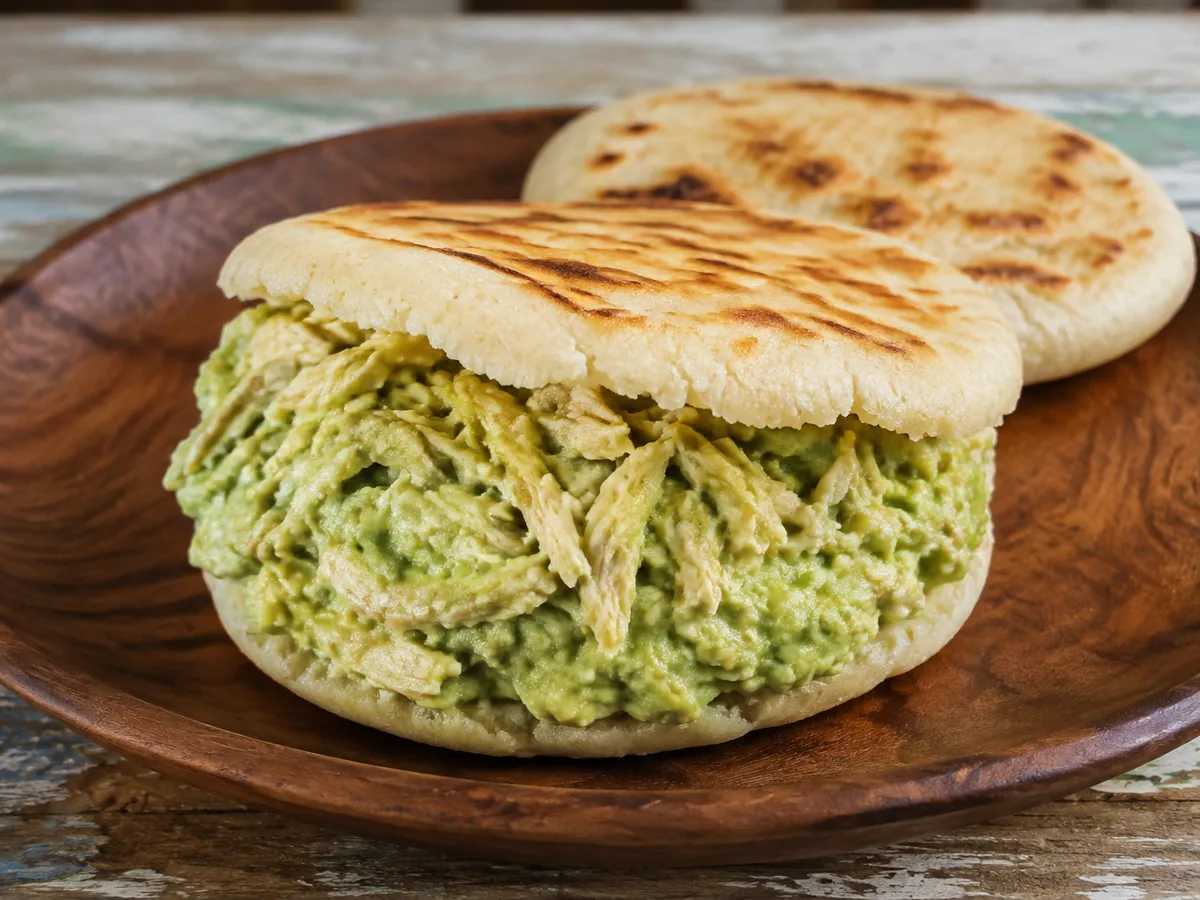
The reina pepiada was born in Caracas in 1955 at the arepera Los Hermanos Álvarez, named in honour of Susana Duijm, Venezuela’s first Miss World — pepiada being local slang for gorgeous.
The arepa itself is a round disc of precooked white cornmeal dough, seared on a hot budare until a crunchy shell forms, then baked until hollow.
Slit open while steaming, it is packed to bursting with tender poached chicken folded into ripe, buttery Hass avocado, spiked with lime, minced onion, fresh cilantro and a discreet bind of whole-egg mayonnaise.
Arepa dough
- 400 g2.5 cupsHarina P.A.N. (precooked white cornmeal flour)
- 600 ml2.5 cupsLukewarm filtered water, about 40 °C / 104 °F
- 8 g1½ tspFine sea salt
- 15 ml1 TbspCorn oil, for kneading and greasing the budare
Chicken
- 600 g1.32 lbBoneless, skinless chicken breasts, trimmed of fat
- 1 L4.2 cupsCold water, for poaching
- 1 medium1 mediumYellow onion, halvedone half for the poach, one half minced fine for the filling
- 3 cloves3 clovesFresh garlic, crushed flat
Filling
- 2 large2 largeRipe Hass avocados, about 400 g of flesh, halved and pitted
- 60 ml4 TbspHigh-grade whole-egg mayonnaise
- 30 ml2 TbspFreshly squeezed lime juice
- 20 g½ cup packedFresh cilantro leaves, washed, spun dry and minced fine
- 1 piece1 pieceSmall ají dulce, or sweet mini pepper, seeded and minced to a paste
- 6 g1 tspFine sea salt
- 2 g½ tspFreshly ground white pepper
Why the dough rests five minutes
Harina P.A.N. is industrially precooked by hydrothermal milling, so its starches are already partly gelatinised and absorb water instantly. Five minutes of rest lets that moisture equalise across the starch particles, which is what eliminates cracking when you flatten the discs.
Sear, then bake
On a smoking cast-iron budare at 200 °C the surface starches dehydrate into a rigid, blistered shell — the concha. In the oven, the internal water turns to steam, expands the crumb and separates it cleanly from that crust, which is why a finished arepa rings hollow when tapped.
Mash the avocado by hand
A food processor turns it grey and watery. Mash one avocado with a fork and dice the second for texture, and let fresh lime juice halt the oxidation — it keeps the filling green for up to 6 hours.
Not masa harina
Harina P.A.N. is precooked white corn without the alkaline nixtamalisation used for Mexican tortillas. Masa harina carries a distinct lime flavour and a softer structure that will not produce a true arepa crust.
Passive time, counted separately
The poached chicken chills before it is folded in, and the baked arepas rest 2 minutes before cutting. Neither is active work and both sit outside the times quoted above.
The five tastes on this plate
Salt is the salted corn dough and the sea salt balancing rich avocado fat. Fat is buttery avocado lipids with silky whole-egg mayonnaise. Acid is lime cutting the fat and holding the colour. Heat is minced raw onion, subtle garlic and white pepper. Umami is poached chicken and egg yolk lecithin.
Equipment
- 3 qt saucepan, for poaching
- Wide mixing bowl
- Heavy 12 in cast-iron skillet or budare
- Wire oven rack
- Serrated paring knife
- Clean cloth, for handling hot arepas
Traditionally a cast-iron Venezuelan budare or clay griddle seasoned with oil. In a modern kitchen, a heavy 12-inch cast-iron skillet or flat griddle for the stovetop sear, then a wire oven rack at 200 °C / 400 °F to bake them through.
Method
Poach and shred the chicken20 min
Combine the chicken, half an onion, 2 crushed garlic cloves, 1 tsp salt and 1 litre cold water in a 3-quart saucepan.
Bring to a simmer and poach gently at 75–80 °C / 167–176 °F for 15 to 18 minutes, until the interior reads 74 °C / 165 °F.
Cool on a board, shred by hand into bite-sized strands, and chill.
Combine chicken, half an onion, 2 crushed garlic cloves, 1 teaspoon salt and 1 litre cold water. Poach gently at 75–80 °C / 167–176 °F for 15–18 minutes until chicken reaches 74 °C / 165 °F. Cool, shred into bite-sized strands and chill.
Hydrate the dough8 min
Pour 600 ml lukewarm water into a wide bowl and stir in 8 g salt until dissolved.
Pour in the 400 g Harina P.A.N. in a steady stream, moving your fingers through the liquid to eliminate dry pockets. Let it stand undisturbed 5 minutes.
Knead firmly 2 minutes with the heel of your hand. Add 30 ml water if it feels stiff — it should be soft as an earlobe and show zero cracks when pressed.
Dissolve 8 g salt in 600 ml water at about 40 °C / 104 °F. Stream in 400 g Harina P.A.N., mixing out dry pockets; rest untouched 5 minutes. Knead 2 minutes until soft and crack-free, adding 30 ml water if stiff. Use precooked cornmeal, not masa harina.
Shape the arepas6 min
Divide the dough into 6 portions of about 160 g and roll each between damp palms into a smooth ball.
Flatten gently between your hands, rotating the edges to keep the borders smooth and uncracked, into discs about 10 cm across and 2 cm thick.
Divide into 6 portions, about 160 g. Roll smooth balls with damp palms; flatten into 10 cm discs, 2 cm thick, rotating and smoothing the edges to prevent cracks.
Sear on the budare and bake21–24 min
Preheat the oven to 200 °C / 400 °F and heat a cast-iron skillet over medium-high with a light wipe of oil.
Lay the arepas in and sear undisturbed 5 minutes, until a firm crust forms with dark toasted spots. Flip and sear 4 minutes.
Transfer to the middle oven rack and bake 12 to 15 minutes, until they puff slightly and sound hollow when tapped underneath.
Heat oven to 200 °C / 400 °F and lightly oiled cast iron over medium-high, about 200 °C. Sear arepas undisturbed 5 minutes until crusted with toasted spots; flip for 4 minutes. Bake on middle rack 12–15 minutes until puffed and hollow underneath.
Mix the reina pepiada filling8 min
Mash one avocado with a fork until smooth, and dice the second into 1 cm chunks for texture.
Stir in the mayonnaise, lime juice, minced onion, garlic, ají dulce, cilantro, salt and white pepper.
Fold in the cold shredded chicken until it is coated in a thick, chunky, creamy green salad.
Fork-mash one avocado; dice the other into 1 cm pieces. Stir in mayonnaise, lime juice, minced onion, garlic, ají dulce, cilantro, salt and white pepper. Fold in cold shredded chicken until coated in thick, chunky green salad.
Slit and pack
Wrap a hot arepa in a clean cloth and, with a serrated paring knife, slice horizontally three-quarters of the way around, leaving a hinge at the back.
Open the pocket, swipe a little butter inside if you like, and stuff generously until the filling mounds over the front rim. Serve immediately.
Rest hot arepas 2 minutes. Hold in a clean cloth; cut horizontally three-quarters around with a serrated knife, leaving a hinge. Open, butter inside if desired and fill generously. Serve immediately.
Sensory cues of doneness
- Visual: a pale cream crust mottled with toasted golden and dark brown griddle marks, and a chunky, bright pistachio-green filling.
- Auditory: a crisp, drum-like hollow sound when you tap the baked arepa's bottom.
- Olfactory: toasted cornmeal on hot iron, warm chicken, crushed cilantro and sharp lime.
Look for pale cream arepas with golden and dark griddle marks and chunky pistachio-green filling. The baked base should sound crisp and hollow; expect toasted corn, chicken, cilantro and lime aromas.
Storing it
Bake the arepas, cool them and store them wrapped. Before serving, toast them on a hot skillet for 3 minutes to restore the crisp crust. The filling keeps up to 6 hours in an airtight container with plastic wrap pressed against the surface.
Troubleshooting
- Dry, cracking dough.
The flour went in too fast without enough water. Let it hydrate a full 5 minutes, and knead in an extra splash of warm water if it still cracks.
- Watery, grey filling.
The avocado was blended in a processor. Mash it by hand with a fork and use fresh lime juice to halt oxidation.
- A gummy interior.
The arepa was sliced straight from the oven while boiling steam was still trapped. Rest it 2 minutes on a board first.
Substitutions
One-to-one global substitutions, with the technique adjustment each one requires.
Ingredient substitutions
| Ingredient | Replace with | Culinary impact and technique adjustment |
|---|---|---|
| Harina P.A.N. | Another precooked corn flour, such as Doñarepa | One-to-one. Do not use raw cornmeal or Mexican nixtamalised masa harina |
| Hass avocado | Fuerte or Reed avocado | One-to-one. Make sure the fruit is soft and buttery |
| Ají dulce | Sweet mini pepper | One-to-one. Delivers the sweet vegetal aroma |
Scaling
Half, for 3 arepas
Halve the ingredients. The poaching and baking times are unchanged.
Double, for 12 arepas
Double the ingredients, searing across two large skillets or in batches, then baking all twelve together on two oven racks.
What to serve it with
- Nata criolla — rich Venezuelan cultured sour cream on the side
- Malta Polar, the chilled sweet malted soft drink
- Batido de maracuyá — fresh passionfruit juice over crushed ice
Questions
Can I make the arepas ahead of time?
Bake them, cool them and store them wrapped. Before serving, toast them on a hot skillet for 3 minutes to bring the crisp crust back.
Why use Harina P.A.N. instead of Mexican masa harina?
Harina P.A.N. is precooked white corn with no alkaline nixtamalisation. Masa harina has a distinct lime flavour and softer structure that will not produce a true Venezuelan arepa crust.
How long does reina pepiada filling stay fresh?
The lime juice keeps the avocado green up to 6 hours in an airtight container, with plastic wrap pressed directly against the surface.