Pabellón Criollo
The national platter, and four cultural threads on one plate — flank steak braised at a sub-boil then pulled into threads, black beans sweetened with papelón and simmered until the liquor turns velvety, white rice, and plantains fried only when the skins have gone black.
- Prep
- 45 min
- Cook
- 2 hr 15 min
- Serves
- 6 full portions
- Difficulty
- Hard
Researched · Kitchen testing pending
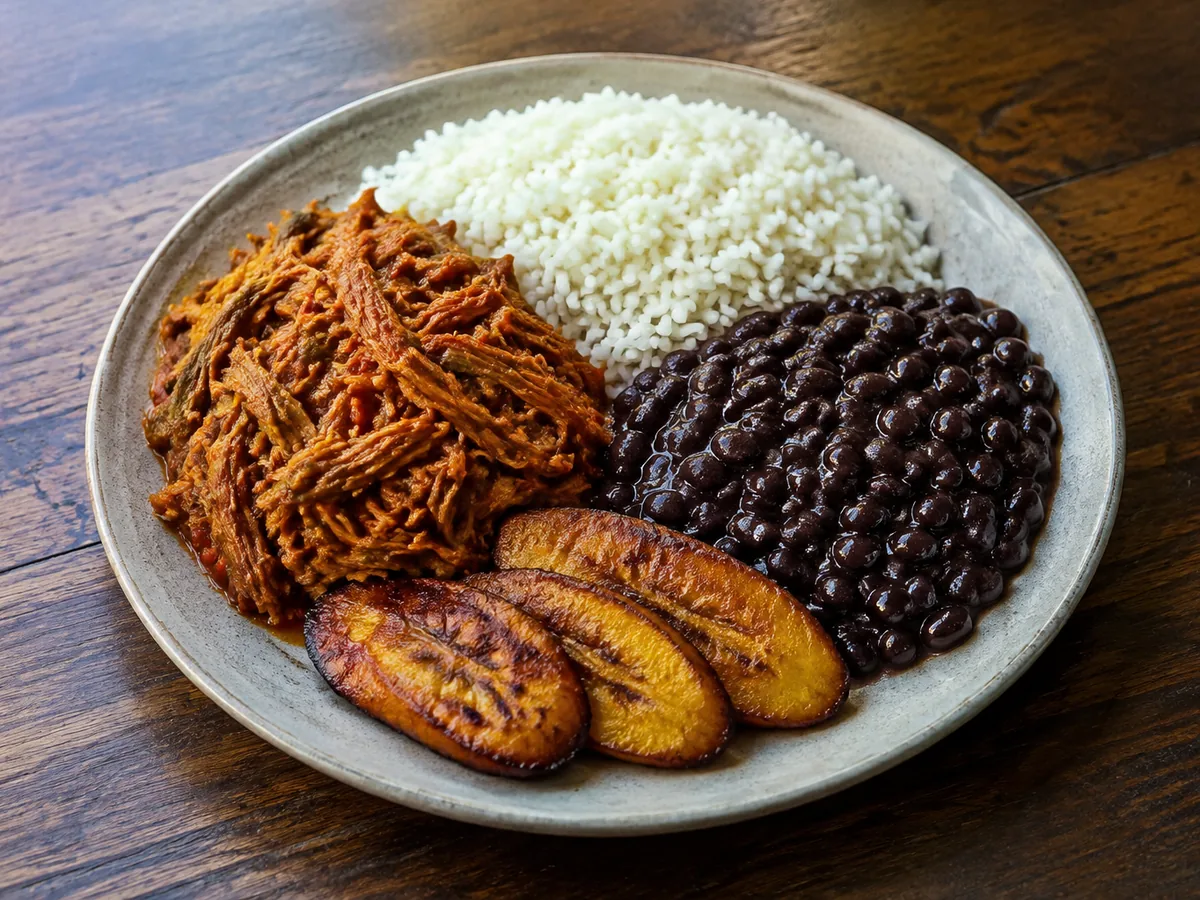
Pabellón criollo brings Venezuela’s cultural threads onto one platter. At its centre is shredded flank steak simmered in sweet pepper sofrito, from the Spanish colonial cattle plains. Alongside sit slow-simmered black beans, from the African heritage of the Caribbean coastal valleys.
Steamed white rice anchors the middle, flanked by golden crescents of fried ripe plantain.
A proper pabellón leaves no dry component. The black bean broth must be viscous enough to glaze the rice without turning soupy, while the shredded beef stays bathed in an aromatic, reduced onion and ají dulce liquor.
Carne mechada
- 1 kg2.2 lbBeef flank steak (falda de res), trimmed of heavy silverskin, cut across the grain into 8 cm slabs
- 45 ml3 TbspRendered beef tallow or high-smoke-point corn oil
- 400 g3 mediumRipe plum tomatoes, peeled, seeded and chopped coarse
- 30 g2 TbspDouble-concentrated tomato paste
- 1 large1 largeGreen bell pepper, cored and diced into 4 mm brunoise
Caraotas negras
- 500 g2.5 cupsDried black turtle beans (caraotas negras), picked clean and rinsed
- 30 g2 TbspGrated papelón (raw cane sugar) or piloncillo
Shared aromatics
- 2.5 L10.5 cupsCold filtered waterdivided between the bean pot and the beef braise
- 400 g2.5 cupsYellow onions, peeled and cut into fine 4 mm brunoisedivided
- 8 cloves8 clovesFresh garlic, peeled and crushed to a smooth pastedivided
- 12 pieces12 piecesFresh Venezuelan ají dulce, or sweet mini peppers, seeded and minced finedivided
- 10 g2 tspGround cumin seeds, freshly toasted in a dry skillet
- 4 g1½ TbspDried wild oregano, hand-crushed
- 20 g1½ TbspFine sea saltdivided across the beans, beef and rice
- 3 g1 tspFreshly ground black peppercorn
Rice and tajadas
- 400 g2 cupsLong-grain white rice, rinsed until the water runs clear
- 600 ml2.5 cupsFiltered waterfor the rice
- 3 large3 largeVery ripe plantains, skins heavily mottled with black, peeled and sliced diagonally into 1 cm planks
- 250 ml1 cupCorn oil, for shallow frying
Why the beef is braised, not boiled
Flank carries long, thick longitudinal fibres tied together by tough type-I collagen sheaths. Boiled violently, those fibres shorten and dry out. Braised instead at 90–93 °C for 90 minutes, the collagen hydrolyses into gelatin and the meat pulls effortlessly along its striations into thin, tender threads.
The plantains must be black
Yellow plantains without black spots are still starchy and fry dry. Only once the skin is heavily mottled black have the starches converted to sugars, which then caramelise at 175 °C into a crisp shell around a custardy centre.
Papelón in the beans
Grated raw cane sugar is what gives Venezuelan caraotas their characteristic sweet note, balancing the earthiness of the beans against the sharp cumin.
No dry component
A proper pabellón leaves nothing dry. The bean broth should be viscous enough to glaze the rice without turning soupy, and the beef stays bathed in its reduced onion and ají dulce liquor.
Passive time, counted separately
The beans soak before cooking, and the braised beef cools 15 minutes before shredding. Neither is active work and both sit outside the times quoted above.
The five tastes on this plate
Salt is layered into the bean broth, the beef and the garlicky rice. Fat is rendered tallow carrying the sofrito, plus the oily edges of the tajadas. Acid is stewed tomato, ají dulce and tomato paste cutting the collagen. Heat is toasted cumin, garlic paste and black pepper. Umami is hydrolysed beef connective tissue, stewed bean liquor and concentrated tomato.
Equipment
- 6 qt enamelled cast-iron Dutch oven, for the beef
- 4 qt heavy saucepan, for the beans
- Heavy saucepan with a tight lid, for the rice
- 12 in cast-iron skillet, for the tajadas
- Two forks, for shredding
Traditionally a heavy cast-iron paila for the plantains, a wide earthenware pot for the caraotas and an aluminium pressure cooker for the flank. In a modern kitchen: a 6-quart enamelled Dutch oven for the beef, a 4-quart saucepan for the beans, and a 12-inch cast-iron skillet for the tajadas.
Method
Braise and shred the beef1 hr 45 min
Put the flank slabs in a Dutch oven with half the onion, 3 crushed garlic cloves, 1 tsp salt and 1.2 litres water.
Bring to a boil, skim the surface foam, then cover and simmer gently on low for 90 minutes until fork-tender.
Move the beef to a board to cool 15 minutes, reserving the broth, then pull it along its natural grain into long, thin shreds.
Combine flank, half the onion, 3 crushed garlic cloves, 1 teaspoon salt and 1.2 litres water. Boil and skim; cover and simmer gently at 90–93 °C for 90 minutes until fork-tender. Reserve broth; cool beef 15 minutes and shred lengthwise along the grain.
Simmer the caraotas negras1 hr 35 min
Cover the drained soaked beans with 1.3 litres fresh water in a 4-quart pot and simmer on medium-low 60 to 75 minutes until tender.
In a small skillet, sweat half the remaining onion, 2 garlic cloves and 4 minced ají dulce in 15 ml oil for 6 minutes. Stir this sofrito into the beans with 1 tsp cumin, 15 g papelón and 1 tsp salt.
Simmer uncovered 20 minutes until the bean liquor thickens into a glossy, velvety glaze.
Simmer soaked, drained beans in 1.3 litres fresh water on medium-low 60–75 minutes until tender. Sweat half remaining onion, 2 garlic cloves and 4 ají dulce in 15 ml oil 6 minutes. Add to beans with 1 teaspoon cumin, 15 g papelón and 1 teaspoon salt; simmer uncovered 20 minutes until glossy.
Build the carne mechada sofrito28 min
Heat 30 ml tallow in the Dutch oven over medium heat. Add the remaining onion, green pepper, ají dulce and garlic, and cook 8 minutes until translucent.
Stir in the tomato paste, chopped tomatoes, cumin, oregano and black pepper, and cook 5 minutes until the oil separates.
Add the shredded beef, toss to coat, pour in 240 ml of the reserved braising broth, and simmer on low 15 minutes until the sauce coats every shred.
Heat 30 ml tallow over medium; soften remaining onion, green pepper, ají dulce and garlic 8 minutes. Add tomato paste, tomatoes, cumin, oregano and pepper; cook 5 minutes until oil separates. Coat beef in sofrito, add 240 ml reserved broth and simmer low 15 minutes until every strand is sauced.
Steam the white rice21 min
Heat 15 ml oil in a heavy saucepan and sauté 1 crushed garlic clove for 1 minute without browning. Add the rinsed rice and toast 2 minutes.
Pour in 600 ml water and 1 tsp salt and bring to a rolling boil. When the water drops below the rice surface, cover tightly, turn the heat to its lowest setting, and steam 18 minutes. Fluff with a fork.
Heat 15 ml oil; cook 1 crushed garlic clove 1 minute without browning. Toast rinsed rice 2 minutes. Add 600 ml water and 1 teaspoon salt; boil until water drops below rice. Cover tightly, steam on lowest heat 18 minutes and fluff.
Fry the tajadas8 min
Heat 250 ml oil in a heavy 12-inch skillet to 175 °C / 350 °F.
Slide the plantain slices in in a single layer and fry 3 to 4 minutes per side until deeply browned and caramelised at the edges.
Drain on paper towels and season with a pinch of sea salt.
Use very ripe, black-mottled plantains. Heat 250 ml oil in a heavy 12-inch skillet to 175 °C / 350 °F. Fry slices in one layer 3–4 minutes per side until deeply browned with caramelised edges. Drain on paper and salt lightly.
Plate the pabellón
Mound the white rice in the centre of wide warm plates.
Spoon the glistening carne mechada along one side, the velvety black beans along the other, and frame the plate with three overlapping tajadas.
Serve immediately.
Mound rice in the centre of warm plates, with glossy beef on one side and creamy black beans on the other. Frame each plate with three overlapping plantain slices; serve immediately.
Sensory cues of doneness
- Visual: the beef glistens in a thick reddish-orange glaze; the beans are jet-black in a velvety sauce; the plantains carry deep mahogany edges.
- Auditory: gentle, thick plopping from the bean pot, and rapid crackling from the plantains in oil.
- Olfactory: sweet fried plantain sugar, toasted cumin, sweet allium sofrito and braised beef.
Look for moist beef in reddish-orange glaze, glossy black beans and plantains with mahogany edges. Expect thick gentle bean bubbling and rapid plantain crackling, with sweet fried plantain, cumin, sofrito and beef aromas.
Troubleshooting
- Tough, leathery beef.
It boiled hard, tightening the fibres. Keep the braise at a lazy sub-boil so the collagen dissolves.
- Watery, thin black beans.
They were served before the starch broke down. Simmer uncovered at the end and crush a spoonful against the pot wall to thicken the sauce.
- Dry, starchy plantains.
They were under-ripe. The skin must be heavily mottled black so the starches have converted to sugars.
Substitutions
One-to-one global substitutions, with the technique adjustment each one requires.
Ingredient substitutions
| Ingredient | Replace with | Culinary impact and technique adjustment |
|---|---|---|
| Flank steak (falda) | Skirt steak or beef brisket flat | One-to-one. Brisket needs about 30 minutes more braising |
| Ají dulce | Sweet mini peppers with a pinch of seeded habanero | One-to-one. Matches the aromatic floral sweetness |
| Papelón | Dark brown sugar or jaggery | One-to-one. Same molasses-like sweetness |
Scaling
Half, for 3 portions
Halve the ingredients. The simmer times are identical; the liquid reduces slightly faster.
Double, for 12 portions
Double the ingredients, braising the beef in an 8-to-10 quart Dutch oven and frying the plantains in batches so the oil temperature holds.
What to serve it with
- Queso blanco rallado — finely grated salty white palmita or llanero cheese over the black beans
- Papelón con limón — raw cane sugar dissolved in water with fresh lime
- Pabellón a caballo — the same plate with a sunny-side-up fried egg set over the beef
Questions
Can I cook the beef in a pressure cooker?
Yes. Cook the flank under high pressure for 35 minutes with natural release, and it shreds effortlessly.
What gives Venezuelan caraotas their characteristic sweet note?
Grated papelón — unrefined raw cane sugar. It balances the earthiness of the black beans against the sharp cumin.
Can I freeze carne mechada?
Yes. It freezes exceptionally well in its braising sauce for up to 3 months. Reheat gently in a skillet.