Tequeños
No Venezuelan celebration starts without them. Dough ribbons wound around cheese batons like a mummy, each turn overlapping by half so no steam escapes, then three minutes in clean 175 °C oil until the pastry blisters and the salty cheese inside pulls into strings.
- Prep
- 45 min
- Cook
- 15 min
- Serves
- 30 tequeños, about 10 cm each
- Difficulty
- Medium
Researched · Kitchen testing pending
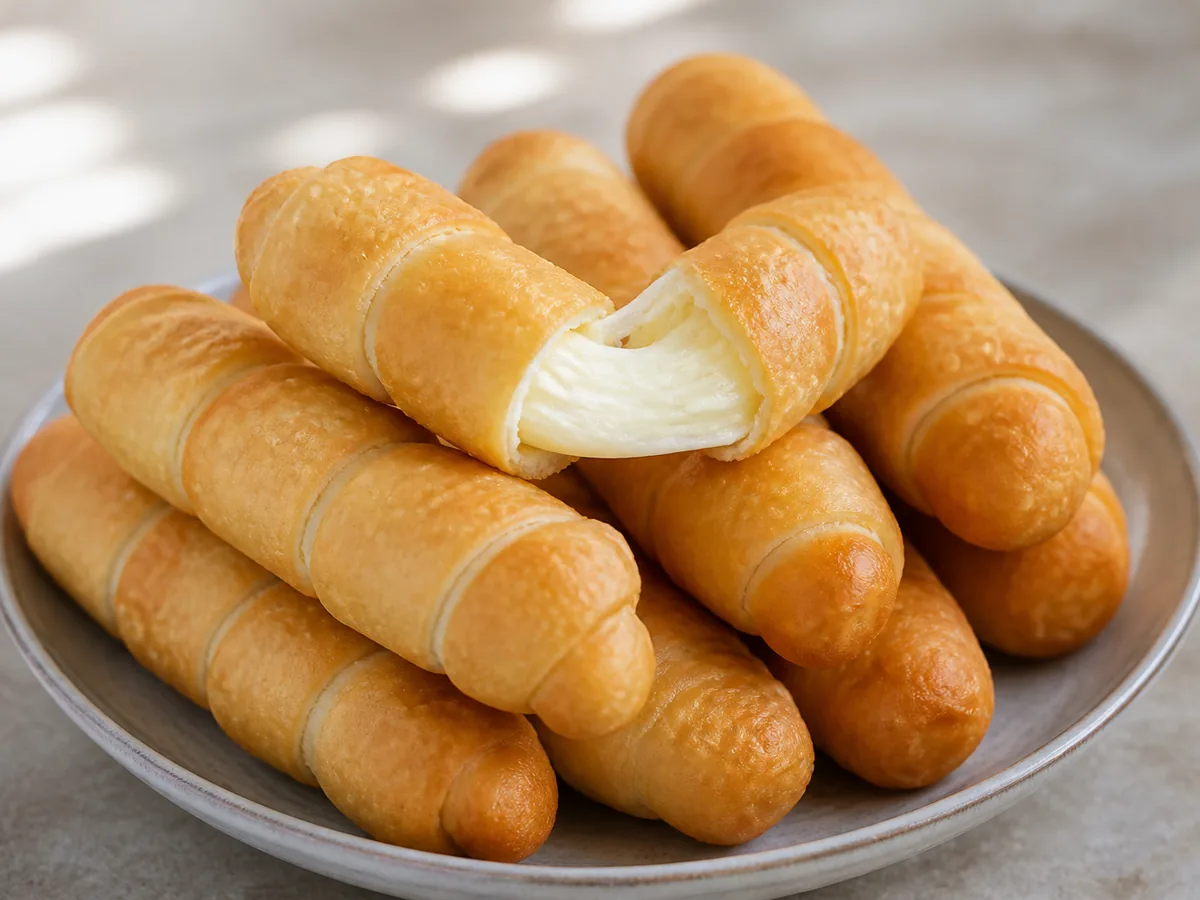
No Venezuelan celebration begins without tequeños. Born in Los Teques, a hillside retreat outside Caracas in the early twentieth century, these pastry spears wrap a thick baton of firm, salty white cheese inside a supple wheat dough.
The raw dough is wound tight around the cheese like a mummy, the seams pinched shut so no steam escapes.
Dropped into clean, hot oil for barely three minutes, the pastry blisters into golden, flaky layers while the cheese inside softens into an elastic, molten core that pulls into long strings at the first bite.
Pastry
- 500 g4 cupsAll-purpose wheat flour, about 10.5% protein, sifted
- 120 g½ cup + 1 TbspUnsalted European butter, 82% butterfat, chilled hard and cut into 1 cm cubes
- 1 large1 largeEgg, at room temperature
- 15 g1 TbspGranulated cane sugar
- 10 g1½ tspFine sea salt
- 150 ml⅔ cupLukewarm water or whole milk, about 38 °C / 100 °F
Cheese and frying
- 600 g1.32 lbQueso blanco llanero, queso palmita or another salty, firm white cheese that holds its shape under heat, cut into 30 batons of 8 × 1.5 × 1.5 cm
- 1 L4.2 cupsHigh-smoke-point corn, peanut or canola oil
The cheese has to be the right kind
It needs high tensile strength and moderate acidity, around pH 5.2–5.4. Queso llanero softens at 65 °C into a hot, elastic core without liquefying into whey. Regular mozzarella or cheddar liquefies and bursts the dough within a minute.
Overlap by half, seal both tips
Wrapping with a 50% overlap and pinching the ends shut forms an airtight pressure seal. If cheese touches the hot oil it melts instantly, burns and spatters violently.
Where the flake comes from
Rubbing cold butter cubes into flour leaves small flattened sheets of solid fat between the gluten strands. At 175 °C the water in that butter flashes to steam and pushes the dough layers apart into a blistered shell.
Dry the cheese first
Surface moisture stops the dough adhering. Pat the batons dry and keep them refrigerated until you wrap them.
Passive time, counted separately
The dough rests 30 minutes to relax the gluten, and the wrapped tequeños can go into the freezer for 15 minutes to firm before frying. Neither is active work and both sit outside the times quoted above.
The five tastes on this plate
Salt is dominated by the briny sharpness of the white cheese, balanced by the seasoned pastry. Fat is chilled European butter layered into the dough and fried crisp in clean oil. Acid is mellow, met by sweet-tart dips like salsa de guayaba. Heat is absent from the pastry itself. Umami is aged milk protein and roasted wheat starch.
Equipment
- Large mixing bowl
- Pastry blender
- Rolling pin
- Pizza cutter or sharp knife
- Heavy 5 qt Dutch oven or deep fryer
- Oil thermometer
- Slotted spoon and spider skimmer
Traditionally a deep cast-iron caldero filled with corn oil. A heavy 5-quart Dutch oven or countertop fryer with a clip-on thermometer works in a modern kitchen — a deep volume of oil is what keeps the temperature from dropping when cold tequeños go in.
Method
Cut the cheese batons12 min
Slice the firm white cheese into 30 uniform batons measuring 8 cm long, 1.5 cm wide and 1.5 cm thick.
Pat them dry with paper towels and keep them refrigerated until wrapping.
Slice the firm white cheese into 30 uniform batons measuring 8 cm long, 1.5 cm wide and 1.5 cm thick.
Pat them dry with paper towels and keep them refrigerated until wrapping.
Make the pastry12 min
Whisk the sifted flour, sugar and salt. Add the cold cubed butter and rub it in with a pastry blender or your fingertips until it resembles coarse cornmeal with pea-sized butter bits.
Whisk the warm water with the egg and pour it in, mixing by hand into a shaggy ball.
Knead on a lightly floured board 4 to 5 minutes until smooth, pliable and elastic. Wrap and rest at room temperature 30 minutes.
Whisk flour, sugar and salt; rub in cold butter to coarse crumbs with pea-sized pieces. Whisk egg with water at 38 °C / 100 °F; mix into a shaggy dough. Knead on lightly floured board 4–5 minutes until elastic. Wrap; rest at room temperature 30 minutes.
Roll and cut ribbons8 min
Cut the dough in half. Roll one half into a thin rectangle roughly 40 × 30 cm and 1.5 mm thick.
With a pizza cutter, cut it into long strips 2 cm wide.
Cut the dough in half. Roll one half into a thin rectangle roughly 40 × 30 cm and 1.5 mm thick.
With a pizza cutter, cut it into long strips 2 cm wide.
Wrap the tequeños25 min
Press one end of a strip over one tip of a cheese baton, pinching to seal completely.
Wrap the ribbon diagonally around the baton in a tight spiral, overlapping each turn by half the width of the strip so no cheese is exposed.
At the other end, fold the dough over the tip and pinch firmly shut, then roll the wrapped tequeño gently between your palms to fuse the seams.
Repeat for all 30. Freezing them 15 minutes firms the dough before frying.
Seal a dough-strip end over one cheese tip. Spiral-wrap tightly with 50% overlap, exposing no cheese; fold over and pinch the other tip shut. Roll gently between palms to fuse seams. Repeat for all 30; freeze 15 minutes to firm before frying.
Heat the oil6 min
Pour 1 litre of oil into a heavy 5-quart Dutch oven to a depth of at least 5 cm, clip on a thermometer, and heat to 175–180 °C / 350–355 °F.
Pour 1 litre of oil into a heavy 5-quart Dutch oven to a depth of at least 5 cm, clip on a thermometer, and heat to 175–180 °C / 350–355 °F.
Fry to blistered gold15 min
Fry in batches of 5 or 6 — do not overcrowd the pot.
Fry 3 to 4 minutes, rolling them with a slotted spoon so they brown evenly, until pale golden, crisp and blistered.
Lift out with a spider onto a paper-towel-lined tray and cool 2 minutes before serving hot.
Fry 5–6 at a time without crowding, 3–4 minutes, turning with a slotted spoon until evenly pale gold, crisp and blistered. Drain on a paper-lined tray; cool 2 minutes before serving hot.
Sensory cues of doneness
- Visual: pale golden dough with tiny crisp blistered bubbles across the surface, and no white cheese leaking from the tips.
- Auditory: a lively crackling hiss that calms to a gentle sizzle as each tequeño floats to the surface.
- Olfactory: fried buttery pastry, toasted wheat and warm melted curds.
Look for pale golden pastry with tiny crisp blisters and no cheese escaping the ends. Frying crackle should soften as they float; expect buttery fried pastry, toasted wheat and warm cheese aromas.
Storing it
Tequeños freeze beautifully. Freeze them raw on a parchment-lined tray until solid, then bag them and fry straight from the freezer at 170 °C / 340 °F for 4 to 5 minutes.
Troubleshooting
- Cheese leaking into the oil.
The ribbons did not overlap, or a tip was left unsealed. Double-check both end seals before frying.
- Greasy, soggy pastry.
The oil dropped below 160 °C / 320 °F and soaked in before the crust set. Hold 175–180 °C throughout.
- The dough bursts within a minute.
A low-melting cheese was used. It must be a firm, salty white cheese that holds shape under heat.
Substitutions
One-to-one global substitutions, with the technique adjustment each one requires.
Ingredient substitutions
| Ingredient | Replace with | Culinary impact and technique adjustment |
|---|---|---|
| Queso blanco llanero | Halloumi, queso panela or firm farmer's cheese | One-to-one. Halloumi gives identical elasticity and salinity |
| European butter | Rendered leaf lard or vegetable shortening | One-to-one. Lard gives even more blistered flakiness |
| Whole milk | Cold water | One-to-one. Water makes the crust slightly crisper, milk more tender |
Scaling
Half, for 15 tequeños
Halve the recipe. Frying batches and oil temperature are unchanged.
Double, for 60 tequeños
Double the quantities, rolling the dough in four manageable batches and freezing the extras for future parties.
What to serve it with
- Salsa de guayaba — sweet-tart guava reduction with a squeeze of lime, the classic sweet-and-salty pairing
- Salsa tártara criolla — garlic and herb mayonnaise with capers and minced onion
- An ice-cold Polar pilsner
Questions
What cheese can I substitute outside Venezuela?
Queso blanco duro, queso paisa, halloumi or firm Greek kasseri. Halloumi gives the exact salty bite and holds its structure without bursting.
Can tequeños be frozen?
Yes, beautifully. Freeze them raw on a tray until solid, then bag them, and fry from frozen at 170 °C / 340 °F for 4 to 5 minutes.
Can I bake tequeños instead of frying?
You can bake them at 200 °C / 400 °F for 12 to 14 minutes brushed with egg wash, but the authentic blistered flake only comes from immersion frying.