Polvorosa de Pollo
Named for polvo, dust — a pâte sablée so rich in butter and lard that it shatters into sand under the fork. Inside, a colonial-era sweet-savoury chicken guiso with Moscatel, papelón, capers, olives, raisins and a whisper of clove, cooked down until nothing runs.
- Prep
- 45 min
- Cook
- 40 min
- Serves
- 8 portions, one 25 cm / 10 in deep-dish pie
- Difficulty
- Hard
Researched · Kitchen testing pending
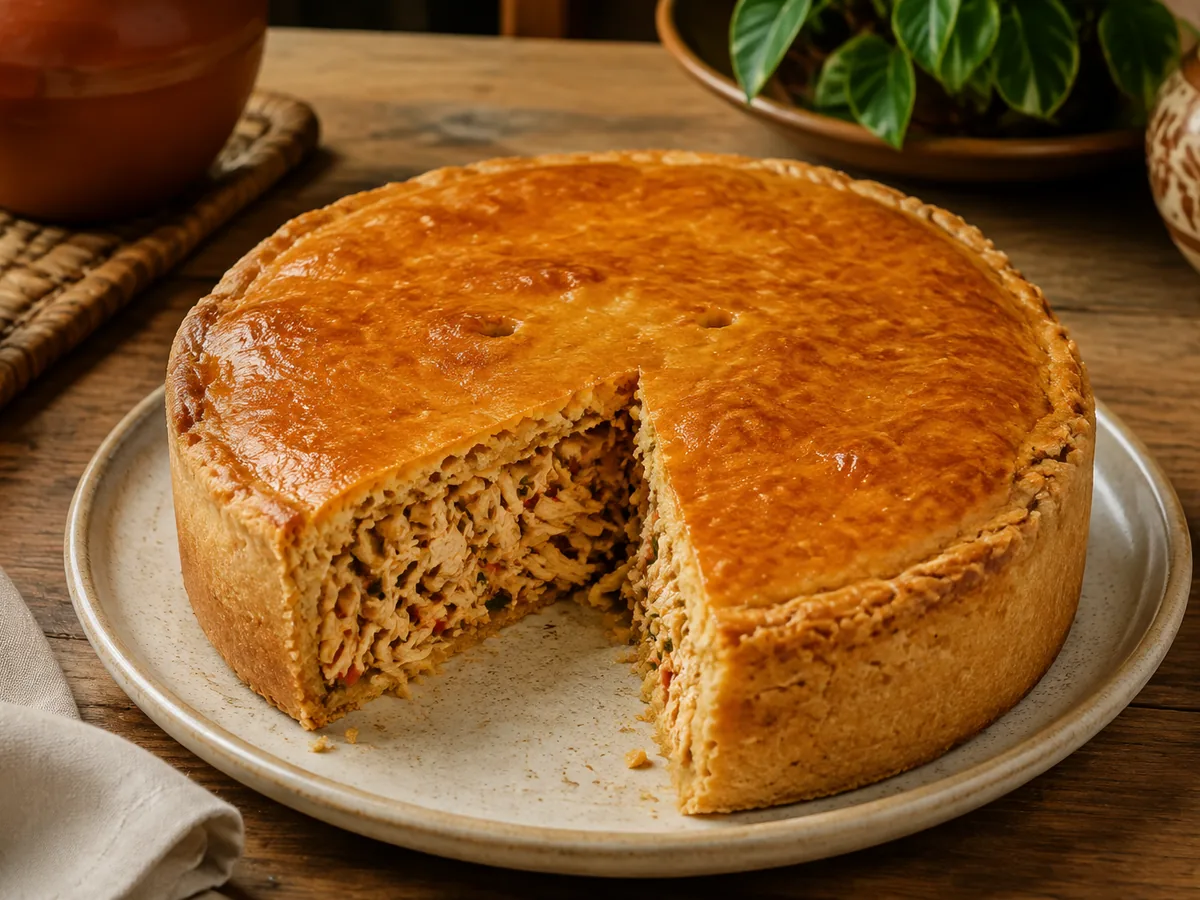
Polvorosa de pollo is the crown of eighteenth-century colonial Caracas pastry cooking. Its name comes from polvo, dust — a reference to the fragile, melt-in-the-mouth shortcrust that crumbles like fine sand beneath the fork.
The dough is enriched with lard and butter, sweetened with sugar and bound with egg yolks. Inside sits a sweet-savoury chicken guiso reflecting the aristocratic Creole palate: shredded chicken braised with onion, garlic, tomato, sweet Moscatel, dark papelón, Spanish capers, green olives, plump raisins and a whisper of ground clove.
Baked to a golden amber glaze, it delivers a brittle, buttery crust giving way to hot, spiced filling.
Polvorosa pastry
- 600 g4.8 cupsAll-purpose wheat flour, 10.5% protein, sifted
- 200 g14 TbspUnsalted European butter, 82% butterfat, chilled hard and cut into 1 cm dice
- 100 g7 TbspRendered leaf pork lard, or vegetable shortening, chilled cold
- 50 g¼ cupGranulated cane sugar
- 8 g1½ tspFine sea salt
- 3 large3 largeEgg yolks, cold
- 60 ml4 TbspIce-cold filtered water
Chicken guiso
- 800 g1.76 lbBoneless, skinless chicken thighs, trimmed, poached and shredded into bite-sized strands
- 45 ml3 TbspRendered lard or extra-virgin olive oil
- 350 g2.5 cupsYellow onions, peeled and cut into fine 4 mm brunoise
- 6 cloves6 clovesFresh garlic, minced to a paste
- 8 pieces8 piecesVenezuelan ají dulce, or sweet mini peppers, seeded and minced
- 400 g3 largeRipe plum tomatoes, peeled, seeded and puréed smooth
- 120 ml½ cupSweet fortified wine — Vino Moscatel, sweet Marsala or Madeira
- 30 ml2 TbspRed wine vinegar
- 40 g3 TbspGrated papelón (raw cane sugar), or dark brown sugar
- 40 g¼ cupSpanish capers, drained
- 60 g½ cupPitted green olives, sliced into rings
- 50 g⅓ cupDark seedless raisins
- 1 g¼ tspGround cloves, freshly ground
- 2 g½ tspGround allspice (pimienta guayabita)
- 10 g2 tspFine sea salt
- 2 g½ tspFreshly ground black peppercorn
Finish
- 1 large1 largeEgg beaten with 15 ml whole milkthe egg wash
Sandy dough, by design
Rubbing hard butter and chilled lard into flour coats each flour particle with lipid before any moisture arrives, so the glutenin and gliadin never form long gluten networks. The sugar draws out free water and inhibits them further. The result is extremely tender and fragile — handle it as little as possible.
No free liquid in the filling
The guiso must be cooked down until nothing runs and then chilled completely. Warm or watery filling is what produces a soggy bottom crust in a pastry this delicate.
Roll it between parchment
The dough is too fragile to move by hand. Roll each disc between two sheets of parchment, peel the top away, and invert it into the pan.
Rest before slicing
Polvorosa dough collapses into loose crumbs while hot. Twenty minutes on a rack lets the butter and starches firm up so clean wedges lift out.
Passive time, counted separately
The guiso chills at least an hour, the dough another hour, and the baked pie rests 20 minutes. None of that is active work and it sits outside the times quoted above.
The five tastes on this plate
Salt is capers, green olives and the seasoned guiso. Fat is cold butter and leaf lard building the sandy crust. Acid is Moscatel, red wine vinegar and stewed tomato. Heat is ground clove, allspice, garlic and black pepper. Umami is shredded thigh meat, chicken fond and cooked tomato.
Equipment
- Dutch oven, for the guiso
- Large mixing bowl and pastry blender
- Rolling pin and parchment paper
- 25 cm deep-dish tart pan with a removable bottom
- Offset spatula
- Pastry brush
- Wire rack
Traditionally a deep earthenware pie dish or heavy ceramic tart pan. A 25 cm deep-dish fluted tart pan with a removable bottom, or a springform, works in a modern kitchen — the removable base is what lets you unmould and slice a fragile, crumbly crust without breaking it.
Method
Cook the chicken guiso32 min
Heat 45 ml lard in a Dutch oven over medium heat and sweat the onions, garlic and ají dulce 8 minutes until translucent.
Add the puréed tomatoes, sweet wine, vinegar, papelón, cloves, allspice, salt and black pepper, and cook 8 minutes until thick and glossy.
Fold in the shredded chicken, capers, olives and raisins, and simmer on low 15 minutes until the sauce reduces completely and glazes the chicken with no pooling liquid.
Cool to room temperature and chill at least 1 hour.
Heat 45 ml lard over medium; sweat onion, garlic and ají dulce 8 minutes. Add tomatoes, wine, vinegar, papelón, cloves, allspice, salt and pepper; cook 8 minutes until thick. Add poached shredded chicken, capers, olives and raisins; simmer low 15 minutes until glazed with no liquid pooling. Cool, then refrigerate at least 1 hour.
Make the polvorosa dough12 min
Whisk the flour, sugar and salt. Add the cold butter and lard and rub them in quickly with your fingertips until the texture is evenly sandy with no large fat chunks.
Whisk the egg yolks with the ice water and drizzle it over. Press the dough together just until it forms a cohesive ball — do not knead.
Divide into two discs, 60% for the bottom and 40% for the top, wrap, and chill 1 hour.
Whisk flour, sugar and salt; quickly rub in cold butter and lard until evenly sandy. Whisk yolks with ice water; drizzle in and press together without kneading. Divide into discs, 60% base and 40% lid; wrap and chill 1 hour.
Roll the bottom crust10 min
Butter the tart pan. Roll the larger disc between two sheets of parchment into a 32 cm circle about 3 mm thick.
Peel off the top sheet, invert the dough into the pan, press it gently into the corners and up the sides, then peel off the second sheet.
Trim flush with the rim and chill 15 minutes.
Butter the pan. Roll larger disc between parchment sheets to 32 cm across and 3 mm thick. Peel top sheet, invert into pan, gently fit corners and sides, then remove second sheet. Trim flush; chill 15 minutes.
Fill and top10 min
Preheat the oven to 180 °C / 350 °F.
Spoon the cold guiso into the shell and level it with an offset spatula.
Roll the second disc between parchment into a 26 cm circle, invert it over the filling, trim, and crimp the edges firmly against the bottom crust.
Cut 3 small slits in the centre to vent steam.
Heat oven to 180 °C / 350 °F. Fill shell with cold guiso and level. Roll lid between parchment to 26 cm; invert over filling, trim and firmly crimp to base. Cut 3 small central steam vents.
Glaze and bake35–40 min
Brush the top with a thin, even coat of egg wash.
Bake on the middle rack 35 to 40 minutes, rotating halfway, until the crust is a rich deep golden-amber and the centre reads 80 °C / 176 °F.
Brush the lid with a thin, even egg glaze. Bake on the middle rack 35–40 minutes, rotating halfway, until deep golden-amber and 80 °C / 176 °F at the centre.
Cool and slice
Set the pan on a wire rack and rest strictly 20 minutes before unmoulding or slicing, so the crust firms enough to lift clean wedges with a pie server.
Rest the pan on a wire rack for 20 minutes before unmoulding or slicing, allowing the fragile crust to firm enough for clean wedges.
Sensory cues of doneness
- Visual: a rich golden-amber crust with a satin sheen from the glaze, and small steam vents with juices bubbling beneath.
- Auditory: a delicate, brittle crack as the knife breaks the upper shell.
- Olfactory: browned butter pastry, sweet Moscatel, clove, allspice and braised chicken.
Look for deep amber pastry with a satin glaze and juices bubbling beneath the vents. The top should crack delicately when cut; expect browned butter pastry, sweet wine, cloves, allspice and chicken aromas.
Storing it
Assemble the pie unbaked, wrap tightly in plastic and foil, and freeze up to 2 months. Bake straight from the freezer at 175 °C / 350 °F for 55 to 60 minutes.
Troubleshooting
- A soggy, doughy bottom.
The guiso was warm or still watery. Cook it down until nothing runs, then chill it completely before filling.
- A tough, rubbery crust.
The dough was over-kneaded, or the butter was warm. Handle it as little as possible.
- The pie collapses into crumbs.
It was sliced straight from the oven. Rest it 20 minutes first.
Substitutions
One-to-one global substitutions, with the technique adjustment each one requires.
Ingredient substitutions
| Ingredient | Replace with | Culinary impact and technique adjustment |
|---|---|---|
| Pork lard | Unsalted European butter | One-to-one. Butter gives pure dairy flavour; lard an even crumblier texture |
| Vino Moscatel | Sweet Marsala, sweet sherry or Madeira | One-to-one. Delivers the sweet dried-fruit notes |
| Ají dulce | Sweet mini peppers | One-to-one |
Scaling
Half, for 4 portions
Bake in an 18 cm pie dish, dropping the bake to 30 minutes at 180 °C.
Double, for 16 portions
Double the ingredients and bake two 25 cm pies side by side on the centre rack.
What to serve it with
- Ensalada verde con vinagreta ligera — a crisp, acidic green salad against the rich shortcrust
- An aromatic dry white such as Torrontés, echoing the floral Moscatel and clove
- Papelón con limón — cold raw cane sugar limeade
Questions
Why is it called polvorosa?
Because the shortcrust carries so much butter and lard relative to flour that it shatters into fine powder — polvo — and melts in the mouth.
Can I freeze polvorosa de pollo?
Yes. Assemble it unbaked, wrap tightly in plastic and foil, and freeze up to 2 months. Bake from frozen at 175 °C / 350 °F for 55 to 60 minutes.
Can I use chicken breast instead of thighs?
Yes, but thighs carry more gelatin and stay much juicier through the double cooking of braising and then baking.