Pastel de Chucho
Margarita Island's stratified casserole of sea and land — poached stingray flaked and stewed with ají dulce, capers and papelón, layered between planks of fried black-ripe plantain, bound with an egg-and-cream custard and baked under a blanket of salty white cheese.
- Prep
- 40 min
- Cook
- 30 min
- Serves
- 8 portions, one 23 × 33 cm / 9 × 13 in dish
- Difficulty
- Hard
Researched · Kitchen testing pending
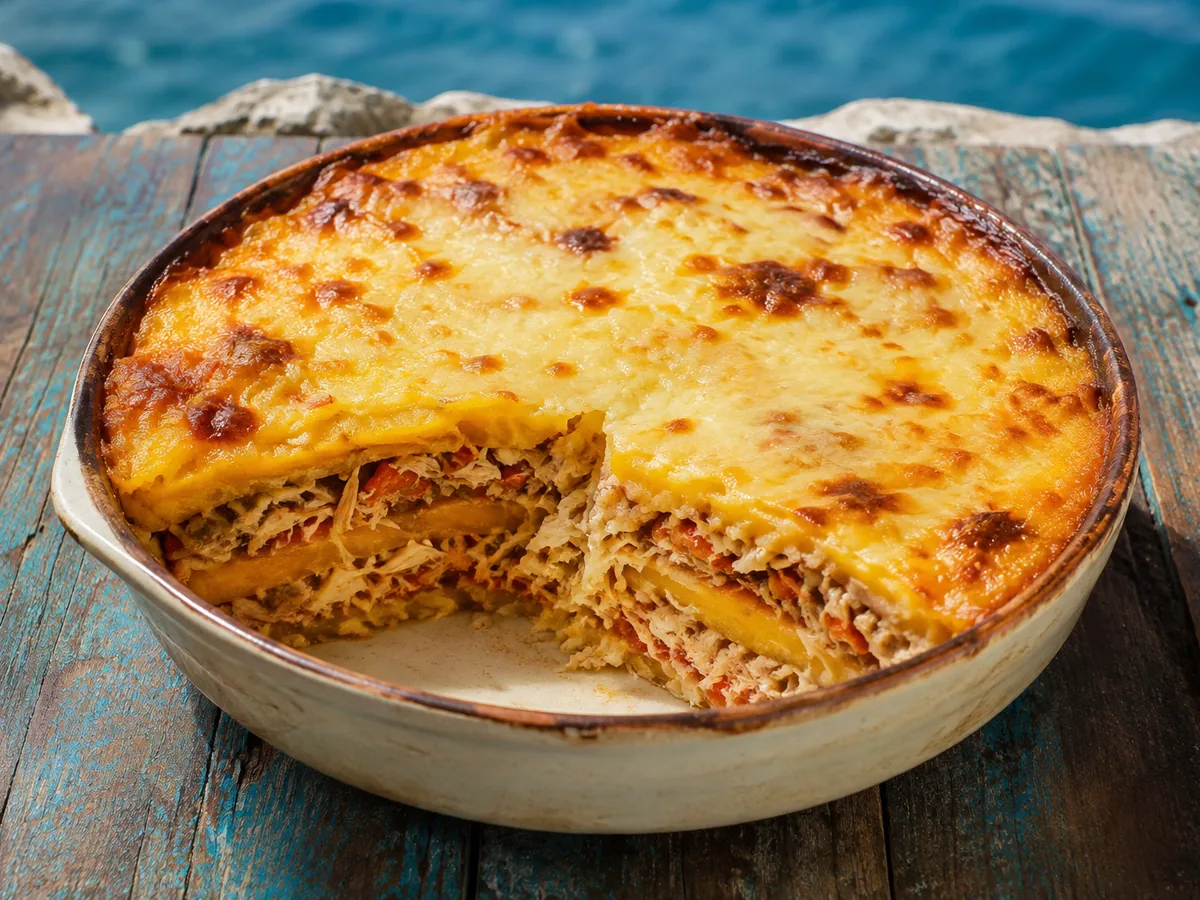
Pastel de chucho is the pride of Margarita Island in eastern Venezuela, created by the chef Rubén Santiago in the 1980s. It sets the sea and the land in alternating strata, sweet against savoury.
The savoury layer is shredded stingray — or dogfish shark, cazón — poached, flaked, and stewed with sweet ají dulce margariteño, onion, garlic, capers and papelón. The sweet layer is planks of black-ripe plantain fried to a deep caramel.
Bound with an egg-and-cream custard and blanketed in salty white cheese, the casserole bakes until bubbling and golden, delivering plantain caramel against briny fish.
Fish and guiso
- 1.2 kg2.6 lbFresh stingray wings (chucho) or dogfish shark fillets (cazón), skinned and cartilage removed, or a firm white fish such as cod, halibut or mahi-mahi
- 60 ml4 TbspAnnatto-infused corn oil (aceite onotado), or extra-virgin olive oil
- 400 g2.5 cupsYellow onions, peeled and cut into fine 4 mm brunoise
- 8 cloves8 clovesFresh garlic, minced to a paste
- 12 pieces12 piecesVenezuelan ají dulce margariteño, or sweet mini peppers, seeded and minced fine
- 1 large1 largeRed bell pepper, cored and diced fine
- 400 g3 largeRipe plum tomatoes, peeled, seeded and puréed smooth
- 30 g2 TbspSpanish capers, drained
- 50 g⅓ cupDark seedless raisins
- 40 g3 TbspGrated papelón (raw cane sugar), or dark brown sugar
- 15 ml1 TbspWhite wine vinegar
- 12 g2 tspFine sea saltdivided between the poaching water and the guiso
- 3 g1 tspFreshly ground black peppercorn
Plantains and custard
- 5 large5 largeVery ripe plantains with heavily blackened skins, peeled and cut lengthwise into 5 mm planks
- 250 ml1 cupCorn oil, for frying the plantains
- 4 large4 largeEggs, at room temperature
- 120 ml½ cupHeavy cream or whole milk
- 250 g2.5 cupsQueso blanco llanero, queso palmita or queso paisa, finely grated
- 30 g2 TbspUnsalted butter, for greasing the dish
Why the fish flakes into clean shreds
Stingray and shark are elasmobranchs — firm, gelatinous muscle fibres with no pin bones. Poached gently at about 80 °C / 176 °F the flesh tenderises without the strands seizing, so it pulls apart by hand into clean flakes.
Only blackened plantains
Starchy yellow plantains stay dry and hard. The skins should be heavily blackened so the sugars caramelise in the pan and the planks turn sweet and pliable enough to hold the layers together.
The custard is the binder
Egg and cream coagulate at 72–74 °C, locking the loose fish shreds and plantain planks into a sliceable cake with clean edges. Pour it slowly so it seeps all the way down through the layers.
No free liquid in the guiso
Reduce the tomato sofrito properly before assembling. The fish should be moist but leave nothing pooling, or the casserole weeps water as it bakes.
Passive time, counted separately
The baked casserole rests 15 minutes before slicing so the custard sets. That is not active work and it sits outside the times quoted above.
The five tastes on this plate
Salt is Spanish capers, sea salt and the grated salty white cheese. Fat is annatto oil in the guiso, the plantain frying oil and whole-milk cheese. Acid is white wine vinegar, puréed tomato and sweet ají dulce. Heat is crushed garlic, black pepper and sweet chilli aromatics. Umami is poached fish collagen, concentrated tomato sofrito and aged white cheese.
Equipment
- 6 qt pot, for poaching
- Wide Dutch oven, for the guiso
- 12 in skillet, for frying the plantains
- Mixing bowl and whisk
- 23 × 33 cm ceramic or glass baking dish
- Offset spatula
- Instant-read thermometer
Traditionally a deep clay baking casserole or rectangular enamelled steel roasting pan. A 23 × 33 cm ceramic or glass baking dish works in a modern kitchen — ceramic heats evenly, so the custard sets through to the centre without over-browning the bottom plantain layer.
Method
Poach and flake the fish18 min
Bring 2 litres of salted water with half an onion and 2 crushed garlic cloves to a simmer in a 6-quart pot.
Add the cleaned fish and poach gently over medium-low heat 12 to 15 minutes, until tender at 60 °C / 140 °F.
Lift onto a tray to cool, then shred by hand or with two forks into small flakes, discarding any cartilage or tough skin.
Simmer 2 litres salted water with half an onion and 2 crushed garlic cloves. Add cleaned fish; poach gently over medium-low, about 80 °C, for 12–15 minutes until tender at 60 °C / 140 °F. Cool on a tray; flake, removing cartilage and tough skin.
Cook the fish guiso24 min
Heat 60 ml annatto oil in a wide Dutch oven over medium heat and cook the diced onions, remaining garlic, bell pepper and ají dulce 8 minutes until soft and fragrant.
Add the puréed tomatoes, capers, raisins, papelón, vinegar, salt and black pepper, and simmer 6 minutes until glossy.
Fold in the flaked fish and cook on low 10 minutes, until the fish takes up the sauce and stays moist with no pooling liquid. Pull off the heat.
Heat 60 ml annatto oil over medium; soften onion, remaining garlic, bell pepper and ají dulce 8 minutes. Add tomato purée, capers, raisins, papelón, vinegar, salt and pepper; simmer 6 minutes. Fold in fish; cook low 10 minutes until moist and glazed with no pooling liquid. Remove from heat.
Fry the plantain planks12 min
Heat 250 ml corn oil in a 12-inch skillet to 175 °C / 350 °F.
Fry the plantain planks in batches, 3 minutes per side, until deep golden-brown and caramelised. Drain on paper towels.
Use very ripe plantains with heavily blackened skins. Heat 250 ml corn oil in a 12-inch skillet to 175 °C / 350 °F. Fry planks in batches 3 minutes per side until deeply golden and caramelised; drain on paper.
Whisk the custard3 min
Whisk the 4 eggs with 120 ml cream and a pinch of salt until smooth and homogenous.
Whisk the 4 eggs with 120 ml cream and a pinch of salt until smooth and homogenous.
Layer the casserole10 min
Preheat the oven to 180 °C / 350 °F and butter the baking dish.
Lay half the fried plantains across the bottom in an overlapping sheet. Spread all the fish guiso over them and level it with a spatula, then scatter half the grated cheese across the top.
Cover with the remaining plantains in an even layer. Pour the custard slowly and evenly across the whole surface so it seeps down through the layers, then scatter the remaining cheese over the top.
Heat oven to 180 °C / 350 °F; butter dish. Overlap half the plantains across base; spread all fish guiso and half the cheese over. Cover with remaining plantains. Slowly pour custard evenly through the layers; top with remaining cheese.
Bake, rest and slice30 min
Bake on the centre rack 30 minutes, until the cheese is golden-brown and bubbling and the centre reads 74 °C / 165 °F.
Rest the dish on a board 15 minutes before cutting into squares, so the custard sets and the slices hold their edges. Serve warm.
Bake on centre rack 30 minutes until cheese is golden and bubbling and the centre reaches 74 °C / 165 °F. Rest 15 minutes on a board to set the custard; cut into squares and serve warm.
Sensory cues of doneness
- Visual: a golden, bubbling top with browned cheese blisters; cut open it shows alternating bands of orange plantain and crimson-flecked white fish.
- Auditory: a gentle, steady hissing and bubbling around the edges of the dish as the custard sets.
- Olfactory: caramelised sweet plantain, roasted ají dulce, sautéed garlic, sea fish and browned cheese.
Look for golden bubbling cheese and alternating layers of orange plantain and white fish flecked crimson. Expect gentle edge bubbling as the custard sets, with caramelised plantain, ají dulce, garlic, fish and cheese aromas.
Storing it
Assemble the whole casserole in its dish, cover, and refrigerate up to 24 hours. Bake straight from the fridge at 180 °C / 350 °F for 40 minutes.
Troubleshooting
- A watery casserole that weeps.
The tomato guiso was not reduced before assembling. The fish must be moist but leave no free liquid.
- Dry, hard plantain layers.
Starchy yellow plantains were used. Use fruit with heavily blackened skins so the sugars caramelise in the pan.
- The slices run apart on the plate.
It was cut straight out of the oven. Rest it 15 minutes so the protein matrix firms up.
Substitutions
One-to-one global substitutions, with the technique adjustment each one requires.
Ingredient substitutions
| Ingredient | Replace with | Culinary impact and technique adjustment |
|---|---|---|
| Stingray (chucho) or dogfish (cazón) | Fresh cod, halibut, mahi-mahi or haddock | One-to-one. Poach gently and flake by hand |
| Queso blanco llanero | Queso cotija or queso panela | One-to-one |
| Ají dulce | Sweet mini peppers | One-to-one |
Scaling
Half, for 4 portions
Bake in a 20 cm square ceramic dish, dropping the bake to 25 minutes at 180 °C.
Double, for 16 portions
Bake in two 23 × 33 cm dishes side by side, rotating the pans halfway through the 30-minute bake.
What to serve it with
- Ensalada de palmitos y aguacate — hearts of palm and avocado with a lime dressing
- A crisp, saline white such as Albariño, matching the coastal Margarita seafood
- Papelón con limón — cold raw cane sugar limeade
Questions
What can I use if stingray or shark is unavailable?
Firm white fish — Atlantic cod, halibut, mahi-mahi or grouper — substitutes well and gives a similar flaky texture.
What cheese works best?
Queso blanco llanero or queso palmita. Cotija, halloumi, or firm feta mixed with mozzarella all make good alternatives.
Can I assemble it ahead of time?
Yes. Assemble the entire casserole in its dish, cover, and refrigerate up to 24 hours, then bake straight from the fridge at 180 °C / 350 °F for 40 minutes.