Arepa Pelúa
La pelúa — the hairy one — is the midnight order at every Venezuelan arepera. Flank steak braised ninety minutes and pulled along the grain into long threads, packed steaming into a blistered corn cake and buried under coarse-grated yellow Gouda that melts at the base and stays sharp on top.
- Prep
- 35 min
- Cook
- 1 hr 45 min
- Serves
- 6 large stuffed arepas
- Difficulty
- Medium
Researched · Kitchen testing pending
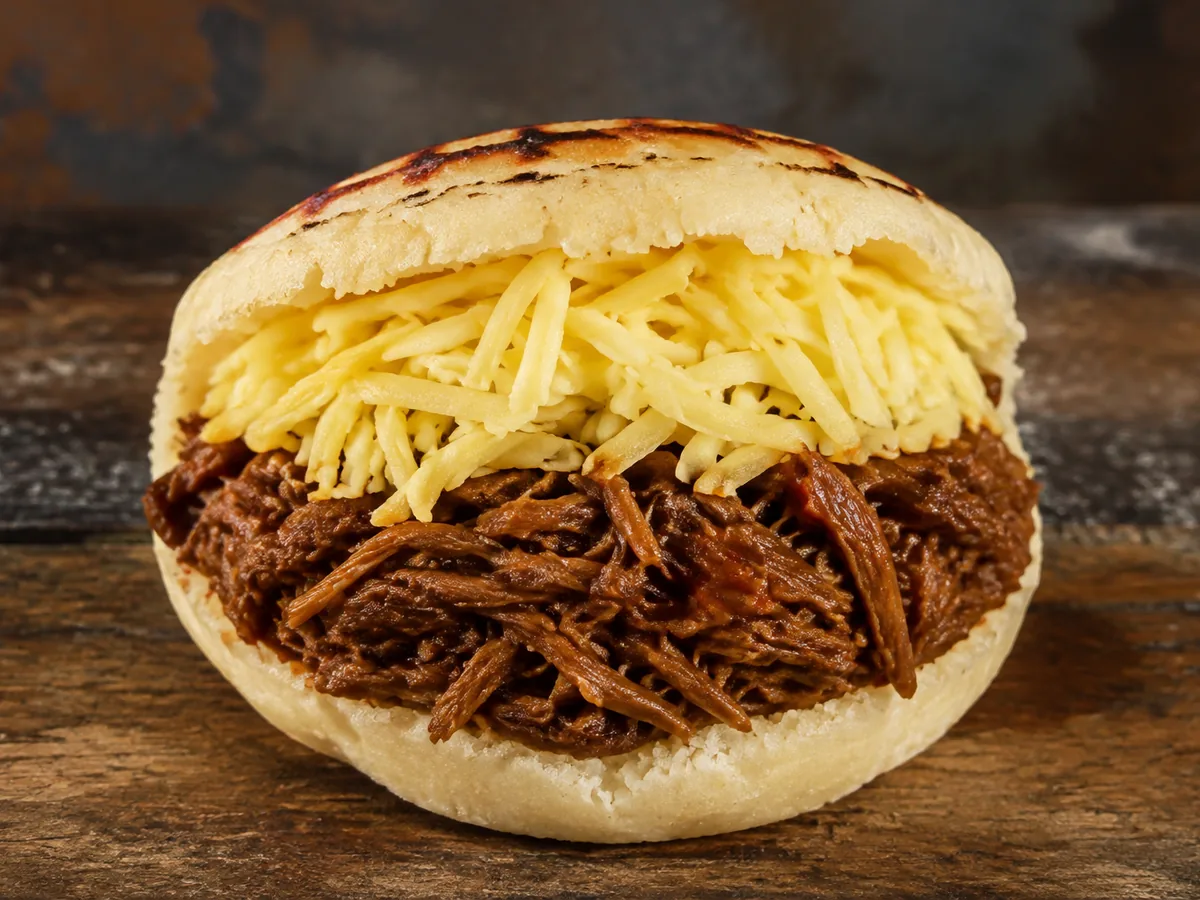
La pelúa is one of the most-called orders in Venezuelan areperas at midnight. The name translates playfully as “the hairy one” — a nod to the tangle of long, juicy beef threads and strands of coarsely grated yellow cheese spilling out of the open arepa like unruly hair.
The corn cake is griddled on hot iron until blistered and crusty, baked until hollow, then sliced open steaming. Inside goes a mound of carne mechada, flank steak braised in a sweet ají dulce, onion and tomato sofrito, buried under a mountain of sharp yellow Gouda.
The heat of the meat melts the bottom layer of cheese into a rich fondue while the cheese on top stays cool, sharp and elastic.
Arepa dough
- 400 g2.5 cupsHarina P.A.N., precooked white cornmeal
- 600 ml2.5 cupsLukewarm filtered water, about 40 °C / 104 °F
- 8 g1½ tspFine sea salt
- 15 ml1 TbspCorn oil, for greasing the griddle
Carne mechada
- 700 g1.5 lbBeef flank steak (falda de res), trimmed of heavy silverskin and cut across the grain into 8 cm slabs
- 1 L4.2 cupsCold filtered water, for the braise
- 30 ml2 TbspRendered beef tallow or corn oil
- 300 g2 cupsYellow onions, peeled and cut into fine 4 mm brunoisedivided between the braise and the sofrito
- 6 cloves6 clovesFresh garlic, peeled and minced finedivided between the braise and the sofrito
- 6 pieces6 piecesVenezuelan ají dulce, or sweet mini peppers, seeded and minced fine
- 1 medium1 mediumGreen bell pepper, seeded and diced fine
- 250 g2 mediumRipe plum tomatoes, peeled, seeded and chopped fine
- 15 g1 TbspDouble-concentrated tomato paste
- 5 g1½ tspGround cumin seeds, freshly toasted in a dry skillet
- 3 g1 TbspDried wild oregano, hand-crushed
- 10 g2 tspFine sea saltdivided between the braise and the sofrito
- 2 g½ tspFreshly ground black peppercorn
To fill
- 350 g3.5 cups packedAged Dutch Gouda or Edam (queso amarillo), coarsely shredded on the large holes of a box grater
- 45 g3 TbspUnsalted European butter, at room temperature
Two temperatures of cheese at once
Gouda's milk fat liquefies between 45 and 50 °C. Pile cold coarse shreds straight onto carne mechada at 74 °C and the bottom layer melts into a savoury fondue that coats the beef threads, while the top shreds stay firm, sharp and elastic. That contrast is the whole dish.
Pull the beef the long way
Shred the braised flank along its longitudinal grain into thin, long strands — the tangle the dish is named for. Chopping across it gives short crumbs instead.
Coarse holes only
A fine microplane turns Gouda into powder that gums together. Use the large holes of a box grater for distinct, messy strands.
Leave the hinge
Cut three-quarters of the way around and leave a sturdy 3 cm hinge at the back. Slice all the way through and the beef and melted cheese fall out behind.
Passive time, counted separately
The dough stands 5 minutes to hydrate, the braised beef cools 15 minutes before shredding, and the baked arepas rest 2 minutes before slicing. None of that is active work and it sits outside the times quoted above.
The five tastes on this plate
Salt is the salted corn dough, the seasoned beef sofrito and sharp aged Gouda. Fat is beef tallow, butter swiped inside the hot pocket, and the melting milk fats of the cheese. Acid is stewed tomato and the ají dulce reduction cutting the rich cheese. Heat is toasted cumin, sautéed garlic and cracked black pepper. Umami is slow-braised beef meeting aged Gouda.
Equipment
- 4 qt pot, for the braise
- Skillet, for the sofrito
- Wide mixing bowl
- 12 in seasoned cast-iron skillet or budare
- Box grater
- Serrated paring knife
Traditionally a cast-iron Venezuelan budare or heavy steel plancha. A 12-inch seasoned cast-iron skillet followed by a 200 °C oven works in a modern kitchen — the iron builds the crust, and the oven heat is what puffs the centre hollow so there is a pocket to fill.
Method
Braise and shred the flank steak1 hr 35 min
Put the flank slabs in a 4-quart pot with half the chopped onion, 2 crushed garlic cloves, 1 tsp salt and 1 litre water.
Bring to a boil, skim the foam, then cover and simmer on low 90 minutes until fork-tender at 93–96 °C / 200–205 °F.
Cool the beef on a board 15 minutes, reserving 240 ml of the braising broth, then pull it along its longitudinal grain into thin, long strands.
Cover flank with half the onion, 2 crushed garlic cloves, 1 teaspoon salt and 1 litre water. Boil and skim; cover and simmer low 90 minutes until fork-tender at 93–96 °C / 200–205 °F. Cool 15 minutes, reserving 240 ml broth; shred into long strands along the grain.
Cook the meat sofrito28 min
Heat 30 ml tallow in a skillet over medium heat and sauté the remaining onion, green bell pepper, ají dulce and remaining garlic 8 minutes until translucent.
Stir in the tomato paste, chopped tomatoes, cumin, oregano, black pepper and 1 tsp salt, and cook 5 minutes.
Fold in the shredded beef and the reserved 240 ml broth, and simmer on low 15 minutes until thick, glossy and steaming hot at 74 °C / 165 °F.
Heat 30 ml tallow over medium; sauté remaining onion and garlic, green pepper and ají dulce 8 minutes until translucent. Add tomato paste, tomatoes, cumin, oregano, pepper and 1 teaspoon salt; cook 5 minutes. Add beef and 240 ml broth; simmer low 15 minutes until glossy and 74 °C / 165 °F.
Hydrate the arepa dough8 min
Stir 8 g salt into 600 ml lukewarm water in a wide bowl until it dissolves.
Sprinkle in the 400 g Harina P.A.N. gradually with your fingers, then let it stand undisturbed 5 minutes to hydrate fully.
Knead firmly 2 minutes into a supple, smooth dough that shows no cracks when pressed with a thumb.
Dissolve 8 g salt in 600 ml water at about 40 °C / 104 °F. Gradually sprinkle in 400 g Harina P.A.N.; rest untouched 5 minutes. Knead firmly 2 minutes until smooth, supple and free of cracks when pressed.
Shape the discs6 min
Divide the dough into 6 portions of about 160 g.
Roll each between damp palms into a smooth sphere, then flatten into a disc 10 cm across and 2 cm thick, keeping the edges smooth and uncracked.
Divide into 6 portions, about 160 g. With damp palms, roll smooth balls and flatten to 10 cm discs, 2 cm thick; smooth all edges to eliminate cracks.
Griddle and bake23 min
Preheat the oven to 200 °C / 400 °F and heat a lightly oiled cast-iron skillet over medium-high.
Lay the arepas in and cook 5 minutes, until a firm crust forms with dark toasted spots. Flip and cook 4 minutes on the reverse.
Move them onto the centre oven rack and bake 12 to 14 minutes, until puffed and hollow-sounding when tapped underneath.
Heat oven to 200 °C / 400 °F and lightly oiled cast iron over medium-high. Cook arepas 5 minutes until crusted with dark spots; flip for 4 minutes. Bake directly on centre rack 12–14 minutes until puffed and hollow underneath.
Slice, butter and assemble5 min
Rest the hot arepas 2 minutes on a board. With a serrated paring knife, slice horizontally three-quarters of the way around, leaving a 3 cm hinge at the back.
Open the pocket and swipe room-temperature butter inside both faces.
Pack about 100 g of steaming hot carne mechada into the bottom, then immediately pile roughly 50 g of coarsely shredded Gouda on top, letting it spill out of the opening like long hair. Serve at once.
Rest 2 minutes. Slice horizontally three-quarters around with a serrated knife, leaving a 3 cm hinge. Butter both inner faces. Fill each with about 100 g steaming beef and immediately add roughly 50 g cold, coarsely grated Gouda. Serve immediately.
Sensory cues of doneness
- Visual: a crisp, toasted corn cake split open on dark reddish-brown shredded beef, overflowing with bright golden-yellow strands melting at the base.
- Auditory: a hollow thud when the baked crust is tapped, and a soft crunch as the teeth break the toasted corn shell.
- Olfactory: roasted corn off cast iron, cumin beef sofrito, melted butter and sharp aged Gouda.
Look for toasted crisp arepas around dark reddish-brown beef and golden cheese strands melting at the base. The shell should sound hollow and crunch; expect roasted corn, cumin-beef sofrito, butter and aged Gouda aromas.
Storing it
The carne mechada keeps 4 days refrigerated and reheats well — griddle and bake the arepas fresh, since they lose their crust once stored.
Troubleshooting
- The cheese never melts.
The carne mechada was only lukewarm. It must go in steaming hot at 74 °C / 165 °F for the fondue layer to form instantly.
- Gummy, pasty cheese.
It was grated on a fine microplane. Use the large coarse holes of a box grater for distinct strands.
- The filling falls out the back.
The arepa was cut all the way through. Leave a sturdy 3 cm hinge.
Substitutions
One-to-one global substitutions, with the technique adjustment each one requires.
Ingredient substitutions
| Ingredient | Replace with | Culinary impact and technique adjustment |
|---|---|---|
| Queso amarillo (Gouda) | Aged Edam, mild yellow cheddar or Fontina | One-to-one. Gouda is the most authentic |
| White Harina P.A.N. | Yellow Harina P.A.N. | One-to-one. Yellow corn flour gives a golden hue and sweeter corn flavour |
| Carne mechada | Pollo mechado, shredded braised chicken | One-to-one, and it becomes la catira |
Scaling
Half, for 3 arepas
Halve the ingredients. Every cooking time is unchanged.
Double, for 12 arepas
Double the ingredients, reheat the meat in a wide Dutch oven, and bake the arepas on two oven racks.
What to serve it with
- Guasacaca criolla — creamy avocado, cilantro and green pepper salsa
- Papelón con limón — icy cold limeade sweetened with raw cane sugar
- An ice-cold Polar pilsner
Questions
What cheese is traditional for la pelúa?
Aged Dutch Gouda or Edam, known across Venezuela simply as queso amarillo. It brings a sharp dairy tang and melts smoothly.
Can I make the arepas in an air fryer?
Yes. Sear them on a hot skillet 2 minutes per side to build the crust, then air-fry at 190 °C / 375 °F for 10 minutes.
What is the difference between la pelúa and la catira?
La pelúa is filled with shredded beef and yellow cheese; la catira with shredded chicken and yellow cheese.