Revuelto Gramajo
The Montevideo café scramble. Matchstick potatoes fried crisp, ham ribbons and peas warmed in butter, then eight eggs poured over, a count of three, and the pan pulled off the flame so the residual heat sets them into loose, glossy curds around the crunch.
- Prep
- 20 min
- Cook
- 10 min
- Serves
- 4
- Difficulty
- Medium
Researched · Kitchen testing pending
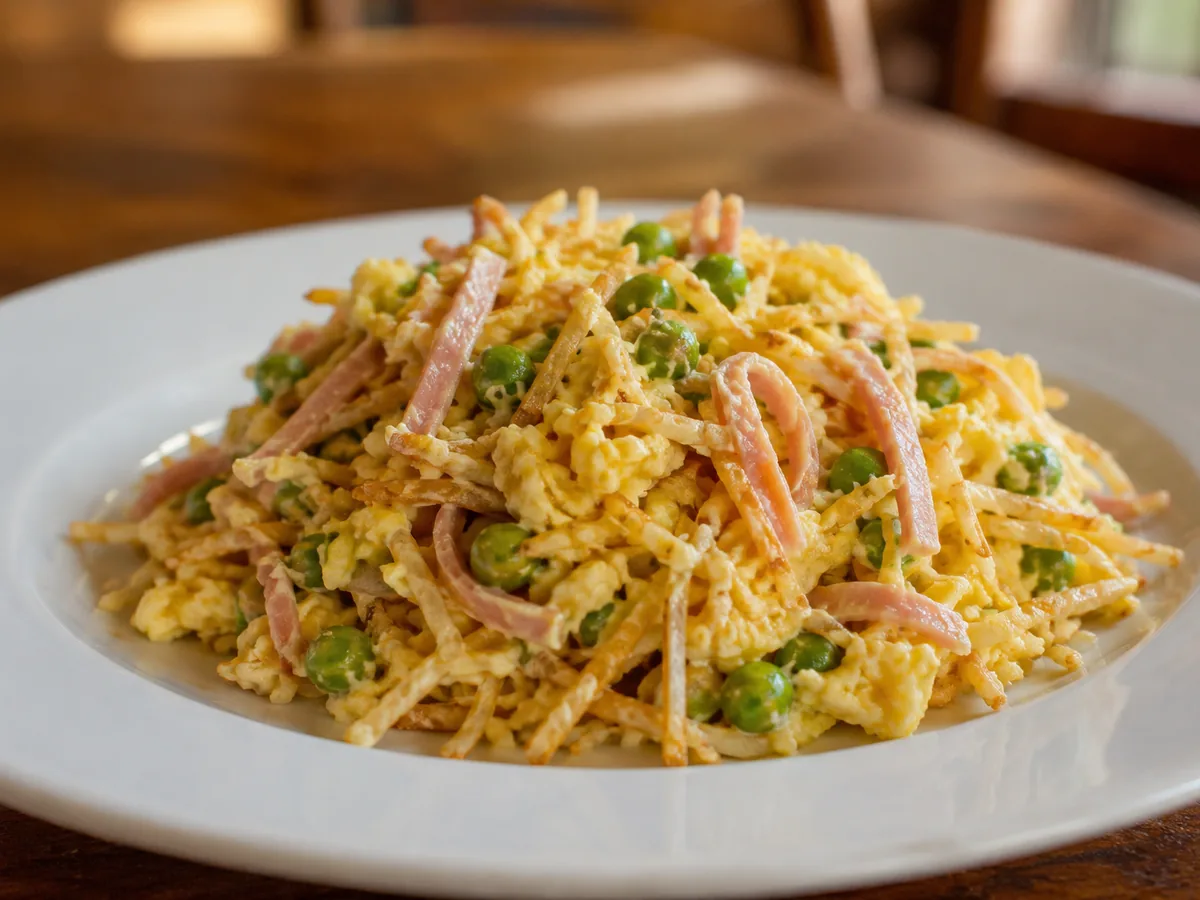
In the historic cafés and bodegones of Montevideo, revuelto gramajo has long been the late-night cure. Colonel Artemio Gramajo, a dandy military aide in the nineteenth-century Río de la Plata, is credited with inventing it as a fast midnight scramble from whatever a café kitchen had on hand: shoestring potatoes, strips of ham, peas and eggs.
The triumph of a real gramajo is not a dry breakfast scramble. The eggs hit the hot pan and the pan leaves the burner while they are still loose and custardy, coating the crisp potato needles like a velvety carbonara.
- 600 g1⅓ lbRusset or Kennebec potatoes, peeled and cut into 1.5 mm matchsticks
- 8 large8 largeEggs, beaten lightly with a forkdo not whip air into them
- 200 g7 ozCooked ham, sliced 2 mm and cut into matchsticks to match the potatoes
- 100 g¾ cupSweet green peas, fresh or blanched frozen
- 40 g2½ TbspUnsalted butter, 82 percent fatdivided
- 15 ml1 TbspExtra-virgin olive oil
- 1 small1 smallWhite onion, sliced paper-thinoptional, café style
- 6 g1 tspFine sea salt
- 2 g½ tspFreshly cracked white pepper
- 20 g¼ cupFlat-leaf parsley, finely chopped
- 600 ml2½ cupsSunflower or peanut oil, for frying the potatoes
Needles, not chips
At 1.5 mm the potatoes have an enormous surface area for their volume. Rinsed of surface starch so they do not clump, and fried at 185 °C, their water flashes off in under two minutes and they turn into rigid, crunchy needles.
Off the heat is the technique
Egg whites set at 62 °C and yolks at 65. Left over the flame, the proteins keep tightening and squeeze out water, and the scramble goes rubbery and wet. Pulled off the burner the instant the eggs land, the residual heat of the pan sets them into custardy curds and stops there.
The five tastes on this plate
Salt is cured ham, salted eggs and salted potato needles. Fat is butter in the curds, frying oil on the potatoes and egg yolk. Acid is mild, with hot sauce or a cold beer alongside. Heat is white pepper and sweated onion. Umami is seared ham, egg protein and sweet peas.
Equipment
- Mandoline with a fine julienne blade
- Deep saucepan and thermometer, for frying
- Spider strainer
- 12-inch heavy stainless, carbon-steel or nonstick skillet
- Heatproof silicone spatula
Carbon steel or heavy nonstick is best because the delicate curds release cleanly. The classic pan is a seasoned iron skillet with sloped walls.
Method
Cut, soak and dry the potatoes10 min
Slice the potatoes on the mandoline's fine julienne blade into 1.5 mm matchsticks. Submerge in ice-cold water and swish to wash off the cloudy starch. Drain and spread on clean towels, patting completely dry. Any water will spit dangerously in the oil.
Cut potatoes into 1.5 mm matchsticks with the mandoline. Swish in ice water to remove starch, drain and pat completely dry on clean towels; any remaining water will spit in hot oil.
Flash-fry the potato needles6 min
Heat the oil in a deep pan to 185 °C. Fry the matchsticks in three small batches, 90 to 120 seconds each, stirring with a spider so they do not tangle, until pale straw-gold and crisp. Drain on paper towels, sprinkle lightly with salt, and keep warm.
Heat oil to 185 °C. Fry potatoes in three small batches, 90–120 seconds each, stirring with a spider to separate them, until pale straw-gold and crisp. Drain on paper, salt lightly and keep warm.
Sweat the onion and warm the ham7 min
In the skillet, melt 20 g butter with the olive oil over medium heat. Add the onion and sweat 4 to 5 minutes until soft and translucent without browning. Add the ham and peas and toss 2 minutes until hot.
Melt 20 g butter with olive oil over medium. Sweat onion 4–5 minutes until soft and translucent without browning. Add ham and peas; toss 2 minutes until hot.
Beat and season the eggs1 min
Crack the eggs into a bowl and beat with a fork for 15 seconds, only until the yolks and whites combine. Season with salt and white pepper.
Crack the eggs into a bowl and beat with a fork for 15 seconds, only until the yolks and whites combine. Season with salt and white pepper.
The off-heat coagulation1 min
Add the remaining 20 g butter to the skillet over medium-high heat. As soon as it foams, toss in 80 percent of the fried potatoes, keeping the rest for the top. Pour the eggs over everything. Count to three, then pull the pan completely off the flame.
With the spatula, fold the potatoes through the eggs from the outside in. The pan's residual heat sets the eggs into loose, creamy curds in 30 to 45 seconds. Stop while they are still wet and glossy.
Add remaining 20 g butter over medium-high; when foaming, add 80% of potatoes, reserving the rest. Pour in eggs; after 3 seconds remove completely from heat. Fold outside-in 30–45 seconds as residual heat forms loose creamy curds; stop while wet and glossy.
Plate at once
Slide onto warm plates. Scatter the reserved crisp potatoes over the top so every bite has crunch, dust with parsley, and serve immediately.
Slide onto warm plates. Scatter the reserved crisp potatoes over the top so every bite has crunch, dust with parsley, and serve immediately.
Sensory cues of doneness
- Visual: a glistening golden nest of matchstick potatoes bound by soft, glossy yellow curds and pink ham, dotted with green peas.
- Auditory: a loud sizzle as the eggs hit the buttered pan, then silence as it leaves the flame.
- Olfactory: fried shoestring potatoes, foaming butter, ham and warm eggs.
Look for glossy golden potato strands bound with soft yellow curds, pink ham and green peas. Expect a loud initial sizzle, then quiet off heat; aromas should be fried potatoes, butter, ham and eggs.
Troubleshooting
- Dry, rubbery eggs.
The skillet stayed on the burner while you stirred. Residual heat is all it needs. Pull it off the flame.
- Soggy potato needles.
Cut too thick, or the oil was crowded. Cut to 1.5 mm, dry them well, and fry in small batches.
- No crunch on the plate.
All the potatoes went into the wet eggs. Keep a handful back and scatter them over the top at the last second.
Substitutions
One-to-one swaps, with the technique change each one needs.
Ingredient substitutions
| Ingredient | Replace with | Culinary impact and technique adjustment |
|---|---|---|
| Kennebec or russet potatoes | Yukon Gold or Idaho russet | One-to-one. High starch gives the crispest needles |
| Cooked ham | Good boiled ham or smoked turkey breast | One-to-one. Cut into thin matchsticks |
| Sweet peas | Fresh baby peas, or leave them out | The purist gramajo is only potato, ham and egg |
Scaling
Half, for 2
Halve everything in a 10-inch skillet. The off-heat set takes barely 20 seconds.
Double, for 8
Do not scramble 16 eggs in one home pan. Make two consecutive four-portion batches.
What to serve it with
- A draft pilsner, or a strong café con leche, as in the Montevideo cafés
- Toasted baguette, for wiping the plate
- Eat it the second it lands; three minutes of steam softens the potatoes and dries the eggs
Questions
Can I use bagged shoestring potatoes?
In a pinch, good commercial papas pay work, but fresh-cut Kennebecs fried to order have far better flavour and crunch.
Can I swap the ham for chicken?
Yes. Cafés often list a gramajo de pollo with shredded roast chicken breast in place of the ham.
What does "baveuse" mean?
The French term for eggs cooked until softly set and still slightly runny, so they form a natural sauce around everything else.