Corvina Negra a la Parrilla
Black drum split open down the backbone and grilled scale side down over hardwood embers, the scales left on as armour against the coals. For half an hour it is basted with warm salmuria, a brine of salt, garlic, oregano and lemon, using a rosemary sprig as the brush, then flipped for three minutes to sear.
- Prep
- 20 min
- Cook
- 35 min
- Serves
- 6
- Difficulty
- Hard
Researched · Kitchen testing pending
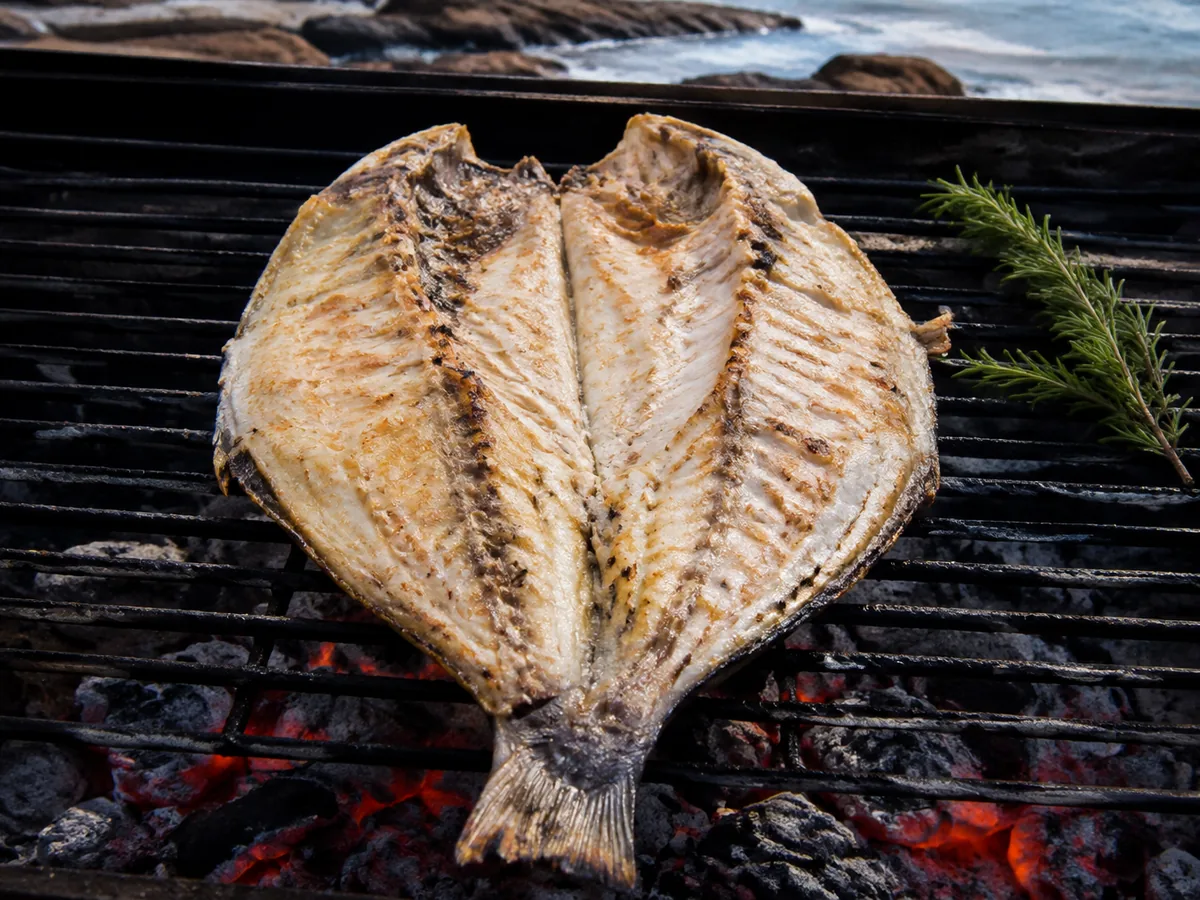
Along the shores of the Río de la Plata and the wild Atlantic coast of Rocha, fishermen build driftwood fires on the sand to grill corvina negra, the black drum. Weighing anywhere from three to ten kilos and fed on crabs and shellfish, it has firm white flesh with a clean, sweet flavour.
The technique is a la espalda: the fish is split down the backbone and opened like a book, with the scales left intact as armour against the coals. It roasts skin side down over hardwood embers while the cook brushes it with warm salmuria, a brine of salt, garlic, oregano and lemon, using a sprig of rosemary as the brush.
Fish
- 2.5 kg5½ lbWhole corvina negra (black drum), gutted, split down the spine and opened flat, head removed or halvedscales left on the skin, or red drum or a large sea bass
Salmuria
- 300 ml1¼ cupsWarm water
- 30 g2 TbspCoarse sea salt, sal parrillera
- 6 cloves6 clovesGarlic, crushed flat
- 2 whole2 wholeLemons, juiced, about 60 mlplus 1 lemon in wedges for the table
- 4 g1½ TbspDried oregano, crushed
- 2 g1 tspAjí molido, crushed red pepper
- 60 ml¼ cupExtra-virgin olive oil
- 3 g1 tspCoarsely ground black pepper
- 2 large2 largeFresh rosemary sprigs, tied to a spoon handle as the basting brush
The scales are the cooking vessel
Bare fish skin sticks to a grate and tears. Left on, the thick scales dry, scorch and form an insulating crust that carries the heat gently up through the flesh for half an hour without the fish moving. They are discarded at the end, like a cedar plank or a banana leaf.
What the salmuria does
Each brushing of warm brine pushes salt into the open muscle by osmosis, and the water evaporating off the surface keeps the thick flesh from drying out. Cold brine would shock the fish and drop the heat, so it stays warm by the fire.
Ninety percent skin side down
The fish flips once, flesh side down, for two or three minutes at the end to sear the garlic and herbs into the surface. Any more turning tears it.
The five tastes on this plate
Salt is the warm brine brushed on throughout the cook. Fat is olive oil in the brine and the fish's own lipids. Acid is fresh lemon in the salmuria. Heat is crushed garlic, black pepper and ají molido. Umami is sweet, crab-fed drum flesh caramelised over wood smoke.
Equipment
- Brick parrilla, or a charcoal kettle grill with a hinged fish basket
- Heavy chef's knife, for butterflying
- Small stainless saucepan, for the brine
- Two large metal spatulas
- Instant-read thermometer
- Large wooden board
A hinged fish basket makes the single flip safe. Indoors, set the butterflied fish scale side down on a rack in a roasting pan at 200 °C and finish 3 minutes under the grill.
Method
Make the salmuria8 min
In a small saucepan combine the warm water, salt, crushed garlic, oregano, ají molido and black pepper. Simmer gently 3 minutes to dissolve the salt and bloom the garlic. Off the heat stir in the lemon juice and olive oil. Tie the rosemary sprigs to the end of a wooden spoon with twine as your brush. Keep the brine warm beside the grill.
Simmer warm water, salt, crushed garlic, oregano, ají molido and pepper 3 minutes. Off heat, stir in lemon juice and olive oil. Tie rosemary to a wooden spoon with twine for brushing; keep brine warm beside the grill.
Butterfly the fish10 min
Lay the gutted fish skin side down and cut along one side of the backbone with a heavy knife to open it flat like a book. Press along the spine until it lies completely flat. Do not scale it. Pat the open flesh dry.
Lay gutted fish skin-down. Cut along one side of the backbone with a heavy knife; open like a book and press the spine flat. Leave scales intact and pat exposed flesh dry.
Set up the coals45 min
Rake a bed of glowing hardwood embers under the grate. Hold your hand 12 cm above it: you should manage about 6 seconds, a moderate 150 to 160 °C. Clean the grate thoroughly.
Rake a bed of glowing hardwood embers under the grate. Hold your hand 12 cm above it: you should manage about 6 seconds, a moderate 150 to 160 °C. Clean the grate thoroughly.
Roast scale side down25 to 30 min
Lay the fish on the grate skin and scale side down, flesh facing up. Brush the flesh generously with warm salmuria. Close the lid, or leave it open on a brick hearth, and grill undisturbed 25 to 30 minutes, basting every 6 to 8 minutes. White albumin will bead along the backbone and the flesh will turn opaque from the skin upward.
Set fish scale-side down; brush flesh generously with warm salmuria. Cover if using a lidded grill, or leave open on a brick hearth. Grill undisturbed 25–30 minutes, basting every 6–8 minutes, until albumin beads along the spine and flesh turns opaque upward.
The three-minute flesh sear3 min
With two large spatulas, or by closing the basket, flip the fish flesh side down onto the grate for 2 to 3 minutes only, to sear the garlic, herbs and lemon into the surface. Probe the centre: 63 °C.
Using two large spatulas or the closed basket, flip flesh-side down for only 2–3 minutes to sear the aromatics. Probe the centre for 63 °C.
Carve and serve
Flip the fish back skin side down onto a large board. Brush with a last coat of warm salmuria and a drizzle of olive oil. Lift thick steaming flakes off the skin with a spoon or fish spatula; the charred scaled skin stays on the board. Serve with lemon wedges and crusty bread.
Transfer skin-down to a board; brush with warm salmuria and drizzle olive oil. Lift thick flakes from the skin with a spoon or spatula, leaving charred scales behind. Serve with lemon wedges and crusty bread.
Sensory cues of doneness
- Visual: snow-white opaque flesh separating into thick petals under a finger, charred rigid scales beneath, garlic and oregano flecking the surface.
- Auditory: a gentle hiss as brine drips onto the embers.
- Olfactory: hardwood smoke, roasting fish skin, sea brine, garlic and charred rosemary.
Look for opaque white flesh separating into thick flakes above rigid charred scales, with garlic and oregano on top. Expect gentle brine hissing and wood-smoke, fish, garlic and rosemary aromas.
Troubleshooting
- The skin sticks and the flesh tears.
The fish was scaled. The scales are the heat shield; leave them on.
- The fish falls apart.
It was flipped back and forth. Cook 90 percent of the time scale side down and flip once, briefly, at the end.
- The cook stalls after basting.
The salmuria was cold and shocked the fish. Keep it warm by the fire.
Substitutions
One-to-one swaps, with the technique change each one needs.
Ingredient substitutions
| Ingredient | Replace with | Culinary impact and technique adjustment |
|---|---|---|
| Corvina negra | Black drum, red drum, striped bass or grouper | One-to-one. Keep the scales on the skin |
| Salmuria | White wine, lemon, garlic and coarse salt | A classic variation with the same seasoning effect |
| Rosemary brush | A pastry brush or a bay sprig | Rosemary adds a faint woodsy oil; the others do not |
Scaling
Half, for 3
Use a 1.2 kg fish and cut the scale-down time to 18 to 20 minutes.
Double, for 12
Grill two 2.5 kg fish side by side on a wide grate over a generous bed of coals.
What to serve it with
- Papas al plomo, whole potatoes wrapped in foil and roasted in the embers, split with butter and coarse salt
- Ensalada criolla, diced tomato, pepper and white onion in oil and vinegar
- A coastal Uruguayan Albariño from Garzón or Maldonado
Questions
What fish works outside Uruguay?
Black drum, red drum, striped bass or a large sea bass. Any big round-bodied white fish with sturdy scales.
Can I do this in an oven?
Yes. Scale side down on a parchment-lined sheet at 200 °C for 25 minutes, basting with salmuria, then 3 minutes under the grill.
Is the skin edible?
No. The scaled skin is discarded. It is purely the cooking vessel.