Pan de Grasa con Bizcochos
The bread of the mate hour. A yeast dough enriched with melted beef tallow, then laminated with more softened tallow, which has a higher melting point than butter and no water, so it folds at room temperature. Half becomes two blistered loaves, half becomes flaky salted bizcochos.
- Prep
- 45 min
- Cook
- 25 min
- Serves
- 2 loaves and 16 bizcochos
- Difficulty
- Hard
Researched · Kitchen testing pending
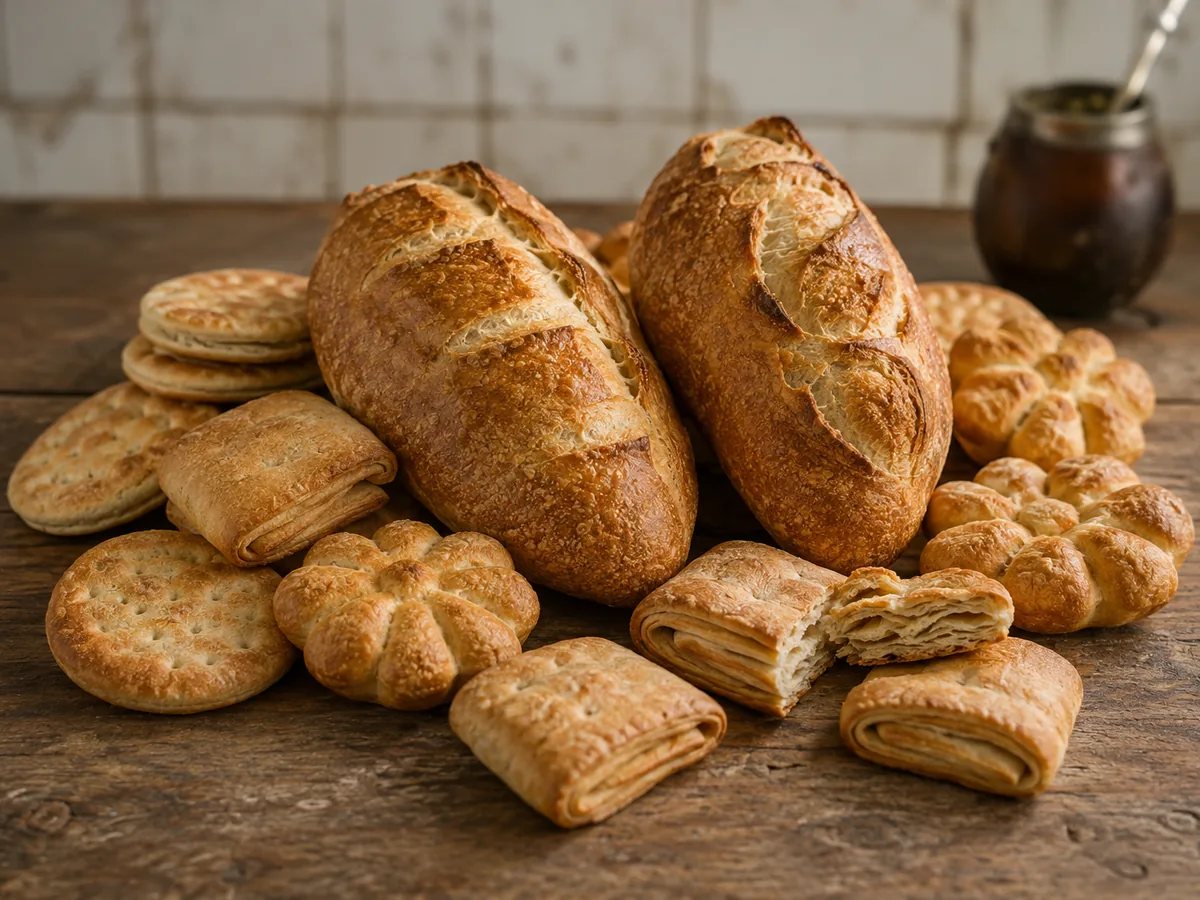
Morning and afternoon in Uruguay belong to one ritual: the mate gourd and a warm paper bag of bizcochos. Uruguay drinks more yerba mate per head than any country on earth, and the bakeries time their ovens to the kettle.
The foundation of Uruguayan baking is refined beef tallow. Unlike a butter-heavy European brioche, pan de grasa and its savoury offspring, the bizcochos salados, margaritas, cremonas and galletas de campaña, rely on strong flour, yeast and layers of beef fat laminated into the dough. A hot oven turns the crust shattering-crisp and blistered over an airy, flaky crumb scented with roasted beef fat and salt.
- 1 kg8 cupsBread flour, 12 to 13 percent protein, sifted
- 15 g1½ TbspInstant dry yeast
- 20 g1½ TbspGranulated sugarfeeds the yeast and helps the crust brown
- 25 g1½ TbspFine sea salt
- 520 ml2.2 cupsLukewarm water, about 38 °C
- 150 g⅔ cupRefined beef tallow (grasa de pella) or good lard, meltedfor the dough
- 150 g⅔ cupRefined beef tallow, softened to a spreadable pastefor the lamination
- 40 g¼ cupPlain flour, for dusting the folds
- 15 g1 TbspCoarse sea salt, to scatter over the bizcochos
Why tallow laminates at room temperature
Beef fat melts at 45 to 48 °C, well above butter's 32 to 35, and it is pure lipid with no water. The fat layer stays solid through rolling and folding without tearing the dough or soaking in. In a 220 °C oven with steam, the dough's moisture flashes and forces the layers apart before the fat melts, and the fat then fries the thin sheets from inside.
Steam in the first five minutes
A dry oven gives a dull, matte crust. A splash of ice water into a preheated cast-iron pan on the oven floor makes the steam that blisters the surface.
The five tastes on this plate
Salt is fine salt in the dough and coarse crystals on the bizcocho crusts. Fat is beef tallow laminated between the sheets. Acid is the faint lactic note of the ferment, met by the bitterness of the mate. Heat is absent; it is warm bread. Umami is toasted wheat crust, roasted beef fat and caramelised yeast.
Equipment
- Stand mixer with a dough hook, or a clean bench
- Rolling pin and offset spatula
- Two half-sheet pans lined with parchment
- Razor blade or sharp knife, for scoring
- Cast-iron skillet, for the oven steam
- Wire racks
The bakery version comes from a brick deck oven with steam injection. At home put a cast-iron pan on the bottom rack while the oven heats to 220 °C and throw 100 ml of ice water into it the moment the bread goes in.
Method
Knead the master dough40 min
Combine the bread flour, yeast, sugar, salt and 150 g melted tallow, then pour in the lukewarm water. Knead 8 to 10 minutes, by hook or by hand, until the dough is smooth, firm and elastic and cleans the bowl. Cover and rest at room temperature 30 minutes.
Combine bread flour, yeast, sugar, salt and 150 g melted tallow; add water at about 38 °C. Knead 8–10 minutes until smooth, firm and elastic, clearing the bowl. Cover and rest at room temperature 30 minutes.
Laminate with the softened fat30 min
Roll the dough on a lightly floured bench into a rectangle about 30 by 60 cm and 1 cm thick. Spread the 150 g softened tallow over two-thirds of it with an offset spatula and dust lightly with flour. Fold the bare third over the centre, then the remaining fatted third over that, a letter fold. Roll out lengthwise again and repeat the fold. Rest in a cool spot 20 minutes.
Roll on a lightly floured surface to 30 × 60 cm, 1 cm thick. Spread 150 g soft tallow over two-thirds; dust with flour. Fold bare third inward, then remaining greased third over it. Roll lengthwise and repeat the letter fold; rest cool 20 minutes.
Shape the loaves40 min
Cut the laminated dough in half. Divide one half into two pieces of about 450 g, roll each into an oval, then roll tightly into a tapered batard. Set on a lined sheet, score two deep lengthwise slashes, cover, and proof 35 minutes until doubled.
Halve dough. Divide one half into two pieces, about 450 g; roll each into an oval, then tightly into a tapered loaf. Place on a lined sheet, slash twice lengthwise, cover and proof 35 minutes until doubled.
Shape the bizcochos30 min
Roll the other half into a 5 mm sheet. For margaritas and cremonas, cut 8 cm squares, fold the corners into the centre, and press. For galletas de campaña, cut 6 by 10 cm rectangles, dock the centre deeply with a fork, and pinch the ends. Set on a sheet, mist with water, scatter with coarse salt, and proof 25 minutes.
Roll remaining half 5 mm thick. For margaritas/cremonas, cut 8 cm squares and press corners into centres. For galletas, cut 6 × 10 cm rectangles, dock centres deeply and pinch ends. Transfer to sheet, mist with water, add coarse salt; proof 25 minutes.
Bake with steam28 min
Heat the oven to 220 °C with a cast-iron skillet on the floor. Slide the sheets onto the middle racks, pour 100 ml ice water into the skillet, and shut the door fast.
Bake the bizcochos 18 to 20 minutes until puffed, golden-amber and crisp. Bake the loaves 25 to 28 minutes until blistered and hollow-sounding underneath. Cool on racks.
Heat oven to 220 °C with a cast-iron skillet on its floor. Load middle racks, pour 100 ml ice water into skillet and close quickly. Bake bizcochos 18–20 minutes until puffed, amber and crisp; loaves 25–28 minutes until blistered and hollow underneath. Rack-cool.
Sensory cues of doneness
- Visual: a deep golden-amber crust blistered with micro-bubbles, flaky strata visible along the sides, salt crystals gleaming.
- Auditory: a hollow wooden knock on the base of the loaf; a crackling flake when a bizcocho is torn.
- Olfactory: roasted beef tallow, toasted wheat, yeast and caramelised flour.
Look for blistered amber crusts, visible flaky layers and salt crystals. Loaves should sound hollow underneath and bizcochos crackle when torn; expect roasted tallow, toasted wheat, yeast and caramelised flour aromas.
Storing it
Bizcochos are best within six hours of baking. Refresh day-old ones in a 180 °C oven for 5 minutes to re-crisp the fat layers.
Troubleshooting
- The dough tears during folding.
The fat was cold and hard from the fridge. Soften it to the texture of spreadable butter.
- Dull, matte crust with no blisters.
No steam. Throw water into a hot pan on the oven floor as the bread goes in.
- Gummy, greasy interior.
Pulled too pale. Bake to a deep golden-chestnut so the laminated layers crisp through.
Substitutions
One-to-one swaps, with the technique change each one needs.
Ingredient substitutions
| Ingredient | Replace with | Culinary impact and technique adjustment |
|---|---|---|
| Beef tallow | Leaf pork lard, or vegetable shortening | One-to-one. Pork lard flakes the same; shortening loses the beef flavour |
| Bread flour | Plain flour plus 2 percent vital wheat gluten | Supports the heavy lamination and the oven spring |
| Instant yeast | Fresh cake yeast, 45 g for 15 g instant | Dissolve in the warm water before mixing |
Scaling
Half
Halve everything for one loaf and eight bizcochos. Baking times do not change.
Double
Double the ingredients for four loaves and 32 bizcochos, and bake in shifts.
What to serve it with
- Yerba mate amargo in a gourd, the pairing the whole thing exists for
- Colonia cheese and quince paste on warm sliced pan de grasa, the Martín Fierro
- Salted butter on warm morning bizcochos
Questions
What is grasa de pella?
The rendered suet from around the beef kidneys. Neutral and clean, with the ideal melting point for Río de la Plata bakery lamination.
Can I use butter instead?
You can, but you will have made brioche or croissant. The savoury aroma and the crisp, flaky snap of a real bizcocho come only from beef fat.
How long do bizcochos stay crisp?
About six hours. Re-crisp older ones in a 180 °C oven for 5 minutes.