Empanadas Criollas
Strictly savoury, no raisins. Beef cut by hand into 5 mm dice, cooked in tallow with a mountain of sweet onion, paprika and cumin, chilled overnight, then folded into a warm lard-and-brine dough, sealed with a rope repulgue and baked hot until the seams blister.
- Prep
- 50 min
- Cook
- 20 min
- Serves
- 16 empanadas, about 120 g each
- Difficulty
- Hard
Researched · Kitchen testing pending
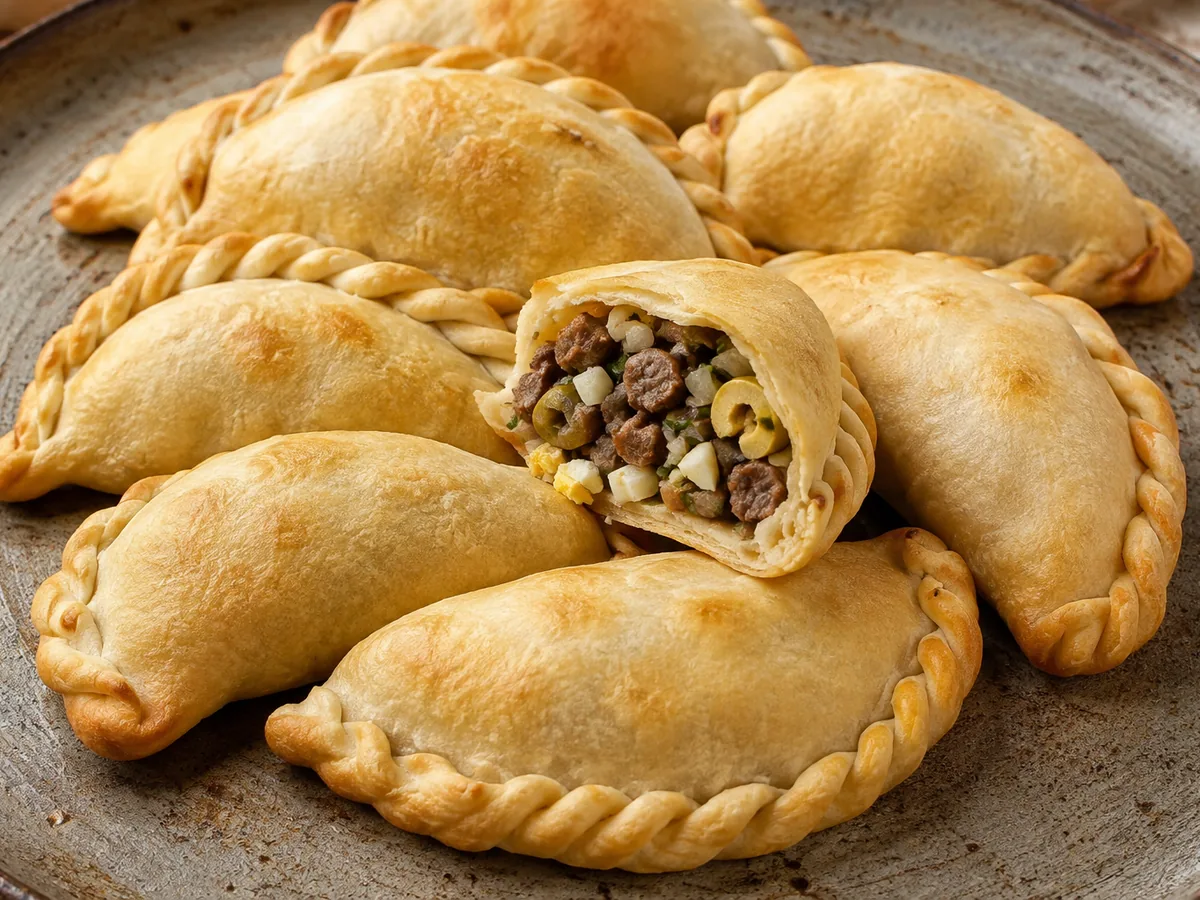
Empanadas in Uruguay have a distinct character. Unlike the sweeter Chilean version with its raisins, the Uruguayan criolla is strictly savoury: beef cut by hand into small dice, cooked in tallow with sweet white onion, garlic, paprika and toasted cumin, then finished with brined green olives, chopped boiled egg and scallion greens.
The dough is flour, warm salt brine and refined beef lard, rolled thin, stuffed cold, sealed with a tight rope-braided seam, and baked in a blazing oven until the crust blisters.
Dough
- 600 g4¾ cupsUnbleached plain flour, about 11 percent protein, sifted
- 120 g½ cupRefined beef tallow (grasa de pella) or pork lard, melted to about 50 °C
- 12 g2 tspFine sea salt
- 260 ml1.1 cupsWarm water, about 45 °C, for the salmuera brine
Filling
- 700 g1½ lbBeef shoulder clod, top round or sirloin, hand-cut into 5 mm dice
- 700 g4½ cupsWhite onions, minced into 5 mm dice
- 45 ml3 TbspRendered beef fat or sunflower oil
- 15 g1 TbspSweet Spanish paprika
- 5 g1½ tspGround cumin, freshly toasted
- 3 g1 TbspDried oregano, hand-crushed
- 2 g1 tspAjí molido, crushed red pepper
- 10 g2 tspFine sea salt
- 3 g1 tspFreshly cracked black pepper
- 80 ml⅓ cupBeef bone broth or water
- 4 large4 largeHard-boiled eggs, peeled and chopped into 8 mm dice
- 80 g⅔ cupGreen manzanilla olives, pitted and roughly chopped
- 60 g1 cupScallions, dark green parts only, sliced into thin rings
Glaze
- 1 large1 largeEgg beaten with 15 ml milk
Knife-cut beef
A grinder crushes the muscle fibres and releases water and myoglobin that puddle into a soupy filling. Hand-diced beef keeps its juices inside each cube until it is bitten.
Warm fat, short dough
Pouring 50 °C fat into the flour coats the gluten proteins and limits their development. The result is an extensible dough that rolls thin without snapping back.
Twelve hours in the fridge
Chilling the cooked filling overnight solidifies the tallow and natural gelatin. In a 230 °C oven that cold fat melts into broth inside a sealed envelope that steams within and crisps without.
The five tastes on this plate
Salt is the warm brine in the dough, seasoned beef and brined olives. Fat is beef lard in the pastry and tallow in the filling. Acid is the green olives and a spoon of chimichurri at the table. Heat is toasted cumin, paprika, oregano and ají molido. Umami is caramelised knife-cut beef, reduced stock and chopped egg.
Equipment
- Heavy Dutch oven, for the filling
- Shallow tray, for chilling the filling
- Rolling pin
- Two half-sheet pans lined with parchment
- Pizza stone or baking steel, if you have one
The bakery version comes out of a wood-fired brick oven at 240 °C with strong heat from the stone floor. At home, preheat a pizza stone or steel on the middle rack for 45 minutes and set the sheet pan directly on it for a crisp base.
Method
Cook the filling, day one45 min
Melt the beef fat in a Dutch oven over high heat. Sear the diced beef in two batches, 5 minutes each, until browned. Add the cumin, paprika, oregano, ají molido, salt and pepper, then stir in the minced onions. Turn to low, cover, and sweat 25 to 30 minutes until the onions are completely soft and sweet.
Pour in the stock to dissolve the fond and simmer uncovered 5 minutes. Off the heat, fold in the scallion greens, olives and chopped eggs. Spread on a shallow tray, cool, and refrigerate 12 to 24 hours until cold and firm.
Heat beef fat on high; brown diced beef in two 5-minute batches. Add cumin, paprika, oregano, ají, salt, pepper and onions. Cover on low 25–30 minutes until onions soften. Add stock, scrape fond and simmer uncovered 5 minutes. Off heat, fold in scallions, olives and eggs; spread shallow, cool and refrigerate 12–24 hours until firm.
Make the salmuera and the dough, day two15 min
Dissolve the salt in the warm water. Mound the flour on the bench with a wide well, pour in the warm melted fat, and rub it into the flour with your fingertips until it feels like warm sand. Pour in the brine gradually and knead 8 to 10 minutes to a smooth, pliable, warm dough. Wrap and rest at room temperature 45 minutes.
Dissolve salt in 45 °C water. Rub 50 °C melted fat into flour until sandy; gradually add brine and knead 8–10 minutes until smooth and pliable. Wrap and rest at room temperature 45 minutes.
Portion and roll the discs15 min
Divide the dough into 16 balls of about 60 g and shape each smooth. On a lightly floured surface roll each from the centre out into a 13 to 14 cm circle about 2 mm thick. Keep the discs under a damp towel.
Divide into 16 smooth balls, about 60 g. On a lightly floured surface, roll centre-out into circles 13–14 cm wide and 2 mm thick. Keep covered with a damp towel.
Fill and seal with the rope repulgue20 min
Set 60 g of cold, firm filling in the centre of a disc. Moisten the top half of the edge with a drop of water, fold the bottom half over to a half-moon, and press firmly to push out trapped air.
Starting at one corner, fold a 1 cm triangle of dough inward and press, then continue folding overlapping pleats tightly along the curve to build a rigid rope braid.
Place 60 g cold, firm filling in each disc. Moisten half the rim, fold into a half-moon and firmly expel air. Starting at one corner, fold overlapping 1 cm triangles inward along the curve, pressing tightly into a rope seal.
Vent, glaze and bake20 min
Heat the oven to 230 °C. Set the empanadas on the lined sheets 3 cm apart, prick one pinhole in each top with a toothpick, and brush with the egg glaze. Bake 18 to 20 minutes, rotating the pans halfway, until the crust is golden-chestnut and blistered. Rest 5 minutes on a rack.
Heat oven to 230 °C. Space empanadas 3 cm apart on lined sheets; prick each top once and brush with egg glaze. Bake 18–20 minutes, rotating halfway, until chestnut-gold and blistered. Rest on a rack 5 minutes.
Sensory cues of doneness
- Visual: a glistening golden-chestnut crust with blistered, rigid rope seams and no raw dough at the borders.
- Auditory: a dry crackle when tapped; a faint hiss of steam from the pinhole.
- Olfactory: roasted beef-lard pastry, toasted cumin, sweet stewed onion and seared beef.
Look for glossy chestnut-gold pastry, rigid blistered crimping and no raw dough at the edges. Expect a dry crackle and faint vent steam, with toasted beef-fat pastry, cumin, onion and beef aromas.
Storing it
Freeze unbaked empanadas solid on a tray, then bag them. Bake from frozen at 210 °C for 25 minutes, glazing just before they go in.
Troubleshooting
- Torn, leaking bottoms.
Warm filling melted the lard in the raw pastry. Chill the filling until firm.
- Seams burst and juices spill.
The repulgue was crimped loosely. Fold the pleats tightly with firm downward pressure.
- Pale, leathery crust.
The oven was under 200 °C and dried the pastry before it browned. Bake hot, at 230 °C.
Substitutions
One-to-one swaps, with the technique change each one needs.
Ingredient substitutions
| Ingredient | Replace with | Culinary impact and technique adjustment |
|---|---|---|
| Beef lard | Leaf pork lard, or unsalted butter at 82 percent fat | One-to-one. Pork lard flakes the same; butter adds dairy aroma |
| Sweet Spanish paprika | Hungarian sweet paprika | One-to-one. Same colour and sweet dried-pepper flavour |
| Manzanilla olives | Castelvetrano or pitted green salad olives | One-to-one. Chop coarsely |
Scaling
Half, for 8
Halve everything. Bake time stays 18 to 20 minutes at 230 °C.
Double, for 32
Double the ingredients, cook the filling in two pans, and bake on separate racks rotating halfway.
What to serve it with
- Chimichurri criollo spooned into the filling after the first bite
- A cold young Tannat, or clericó, the white-wine fruit punch
- Serve warm and warn guests that the juices inside are very hot
Questions
Why no raisins?
Unlike Chilean and northern Argentine empanadas, the Uruguayan criolla is strictly savoury: green olives and scallion, never sweet fruit.
Can I use minced beef?
Coarse 80/20 mince works, but hand-cut beef gives the texture that defines Río de la Plata cooking.
Can I freeze them?
Yes, unbaked. Freeze solid on a tray, bag them, and bake from frozen at 210 °C for 25 minutes.