Puchero
The winter feast pot. Marrow-bone shanks, short ribs, a stewing hen, chorizos and a slab of bacon started in cold water and held at a sub-boil, with each vegetable entering at the moment its starch can take it. The broth is served first in mugs, then the meats and vegetables on platters.
- Prep
- 35 min
- Cook
- 2 hr 15 min
- Serves
- 8
- Difficulty
- Medium
Researched · Kitchen testing pending
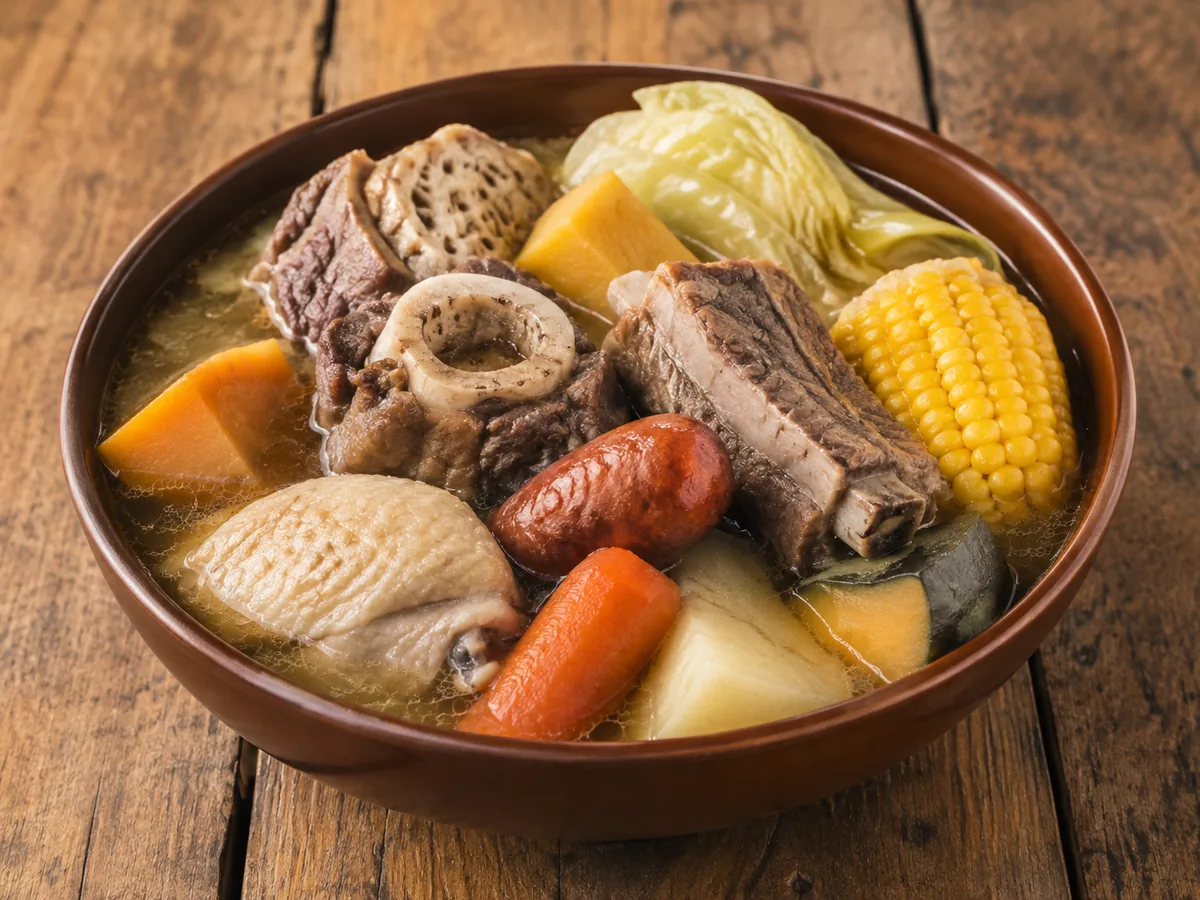
When the pampero blows off the icy Atlantic across the plains, families put a giant stockpot on the back burner for puchero. Inherited from the Spanish cocido and rebuilt around the abundance of the pampas, it is a grand feast of meats, sausages, sweet squash and root vegetables.
Unlike a European boiled dinner where everything cooks together into shreds, an authentic puchero is staged so every cut and every vegetable keeps its shape. The clear, fat-flecked broth is ladled into mugs first as a steaming consommé, then come the platters of meat and vegetables dressed with olive oil and coarse salt.
Meats
- 1.2 kg2.6 lbBone-in beef shank, cut 5 cm thick with the marrow bones intact
- 800 g1¾ lbBone-in beef short plate or flank ribs (falda), in chunks
- 600 g1⅓ lbStewing hen or bone-in chicken thighs
- 4 whole4 wholeFresh pork chorizos criollos, uncured
- 200 g7 ozSmoked bacon, in one slab
Broth
- 4 L17 cupsCold water
- 20 g1½ TbspCoarse sea salt, plus more at the table
- 2 whole2 wholeLeeks, washed and cut into 5 cm chunks
- 2 stalks2 stalksCelery with leaves, in 5 cm chunks
- 1 tsp1 tspBlack peppercorns
Vegetables
- 2 large2 largeCarrots, peeled and halved crosswise
- 2 large ears2 large earsSweet corn, husked and cut into 4 rounds
- 4 medium4 mediumWaxy yellow potatoes, peeled and left whole
- 4 medium4 mediumSweet potatoes, peeled and left whole
- 800 g1¾ lbZapallo criollo or kabocha pumpkin, in 4 large wedges with the skin on
- ½ head½ headSavoy cabbage, in 4 thick wedges
- 30 g½ cupFlat-leaf parsley, finely chopped, to finish
Staged by starch
Shank and falda need two hours between 85 and 90 °C for their collagen to dissolve into stock. Root vegetables added at the start would disintegrate and turn the broth to mud. So they enter by density: carrot and corn with 45 minutes to go, potatoes and sweet potatoes at 25, pumpkin and cabbage in the final 15.
Cold start, slow rise
Bringing the meats up slowly from cold lets the grey protein foam rise cleanly to be skimmed, and keeps the broth clear. A hard boil would emulsify the fat and cloud it.
The marrow
Inside the shank bone the marrow, caracú, liquefies into something like beef butter. It is spread hot on crusty bread with coarse salt, and diners keep a narrow spoon for it.
The five tastes on this plate
Salt is coarse sea salt dissolved into the water, reaching into shanks and whole vegetables. Fat is yellow marrow, rendered chorizo and chicken fat. Acid is gentle, cut at the table with mustard and mayonnaise. Heat is leek, celery and peppercorn, with chilli sauce optional. Umami is everything the marrow bones, falda, hen and pumpkin give up over two hours.
Equipment
- 12 to 14-quart heavy stainless stockpot
- Ladle and fine sieve
- Slotted spoon and tongs
- Two large warmed platters
If you do not own a pot this size, split the cook between two 7-quart Dutch ovens, one for the meats and one for the vegetables with broth transferred across. The traditional pot is a 14 to 16-quart enamelled or stainless stockpot.
Method
Cold start and skim25 min
Put the shanks, falda, hen and bacon slab in the stockpot and pour in 4 litres of cold water, so the meats sit 3 cm under. Set over medium-low heat and bring slowly towards 85 °C over 20 to 25 minutes. Skim the grey foam from the surface with a ladle until it stays clean.
Cover shanks, falda, hen and bacon with 4 litres cold water, 3 cm above the meat. Heat slowly on medium-low toward 85 °C over 20–25 minutes, skimming grey foam until the surface stays clear.
Add aromatics and simmer1 hr 15 min
Add the coarse salt, leeks, celery and peppercorns. Turn to low, set the lid slightly ajar, and hold a trembling 88 °C simmer for 1 hour 15 minutes, until the beef begins to yield to a skewer.
Add the coarse salt, leeks, celery and peppercorns. Turn to low, set the lid slightly ajar, and hold a trembling 88 °C simmer for 1 hour 15 minutes, until the beef begins to yield to a skewer.
Add the hard vegetables and chorizos15 min
Prick the chorizos with a toothpick and add them with the halved carrots and the corn rounds. Simmer gently 15 minutes.
Prick the chorizos with a toothpick and add them with the halved carrots and the corn rounds. Simmer gently 15 minutes.
Add the tubers10 min
Lower the whole potatoes and sweet potatoes into the broth and simmer 10 minutes.
Lower the whole potatoes and sweet potatoes into the broth and simmer 10 minutes.
Add pumpkin and cabbage15 min
Set the pumpkin wedges skin side down on top of everything and wedge the cabbage around the edge. Simmer 15 minutes exactly, until the potatoes and pumpkin pierce easily and the cabbage is tender. Take the pot off the heat.
Set pumpkin skin-side down on top and tuck cabbage around the edges. Simmer exactly 15 minutes until potatoes and pumpkin pierce easily and cabbage is tender. Remove from heat.
Serve in two courses
First the caldo: ladle the broth through a fine sieve into warm mugs or bowls with a scatter of parsley.
Then the meats and vegetables: lift the meats onto one warmed platter and the vegetables onto another. Slice the chorizos into rounds and cut the chicken into pieces. Serve family-style with coarse salt, olive oil, Dijon mustard, mayonnaise and crusty bread for the marrow.
Strain broth into warm cups or bowls and add parsley. Transfer meats and vegetables to separate warm platters; slice chorizos and portion chicken. Serve family-style with coarse salt, olive oil, Dijon, mayonnaise and crusty bread for the marrow.
Sensory cues of doneness
- Visual: a clear amber-gold broth with golden marrow droplets; whole orange pumpkin wedges, yellow corn rounds and shanks pulling from the bone on the platters.
- Auditory: a calm, rhythmic sub-boil murmur.
- Olfactory: beef marrow, sweet corn steam, leek, sweet potato and smoked bacon.
Look for clear amber-gold broth with marrow droplets, intact pumpkin and corn, and beef releasing from bones. Maintain a calm simmer; expect marrow, sweet corn, leek, sweet potato and smoked bacon aromas.
Troubleshooting
- Muddy, cloudy broth.
Sweet potato and pumpkin went in at the start and dissolved. Follow the staging strictly.
- Marrow gone and fat emulsified into the broth.
The pot boiled hard. Hold a lazy sub-boil throughout.
- Bland vegetables in seasoned broth.
The broth was salted too late. Large whole roots need salt in the water to penetrate, so season before the tubers go in.
Substitutions
One-to-one swaps, with the technique change each one needs.
Ingredient substitutions
| Ingredient | Replace with | Culinary impact and technique adjustment |
|---|---|---|
| Marrow-bone shank | Beef shank cross-cuts, or short ribs plus extra marrow bones | One-to-one. Make sure the bones show white marrow centres |
| Zapallo criollo | Kabocha or buttercup squash, skin on | One-to-one. Dense and sweet, holds its shape in the pot |
| Boniato | Orange or red sweet potatoes | One-to-one. Peel and leave whole |
Scaling
Half, for 4
Halve everything in an 8-quart stockpot. The staged timings stay the same.
Double
Do not double in one home pot unless you own a 30-quart cauldron. Use two 14-quart pots.
What to serve it with
- Hot marrow scooped from the shank bone onto crusty bread with coarse salt
- Sharp mustard and homemade garlic mayonnaise over the boiled meats and potatoes
- A robust Tannat blend or Cabernet Franc against the marrow, chorizo and sweet pumpkin
Questions
What is caracú?
The Uruguayan word for beef marrow, especially from the hind shank. At a puchero dinner, diners use a narrow marrow spoon to get it out hot.
Can I add chickpeas?
Yes. Soak dried chickpeas overnight and add them in a cheesecloth bag with the beef at the start.
What do I do with leftovers?
Chop the cold beef and potatoes fine and fry them with onion, garlic and eggs into the Río de la Plata hash called ropa vieja.