Matambre Arrollado
The "hunger killer", the thin muscle over the ribs, tamed two ways. Rolled around whole eggs, carrot and red pepper, tied, poached for two hours and pressed cold so it slices into mosaic rounds, or laid flat and braised in milk until the milk reduces to sweet caramelised curds.
- Prep
- 30 min
- Cook
- 2 hr
- Serves
- 6
- Difficulty
- Hard
Researched · Kitchen testing pending
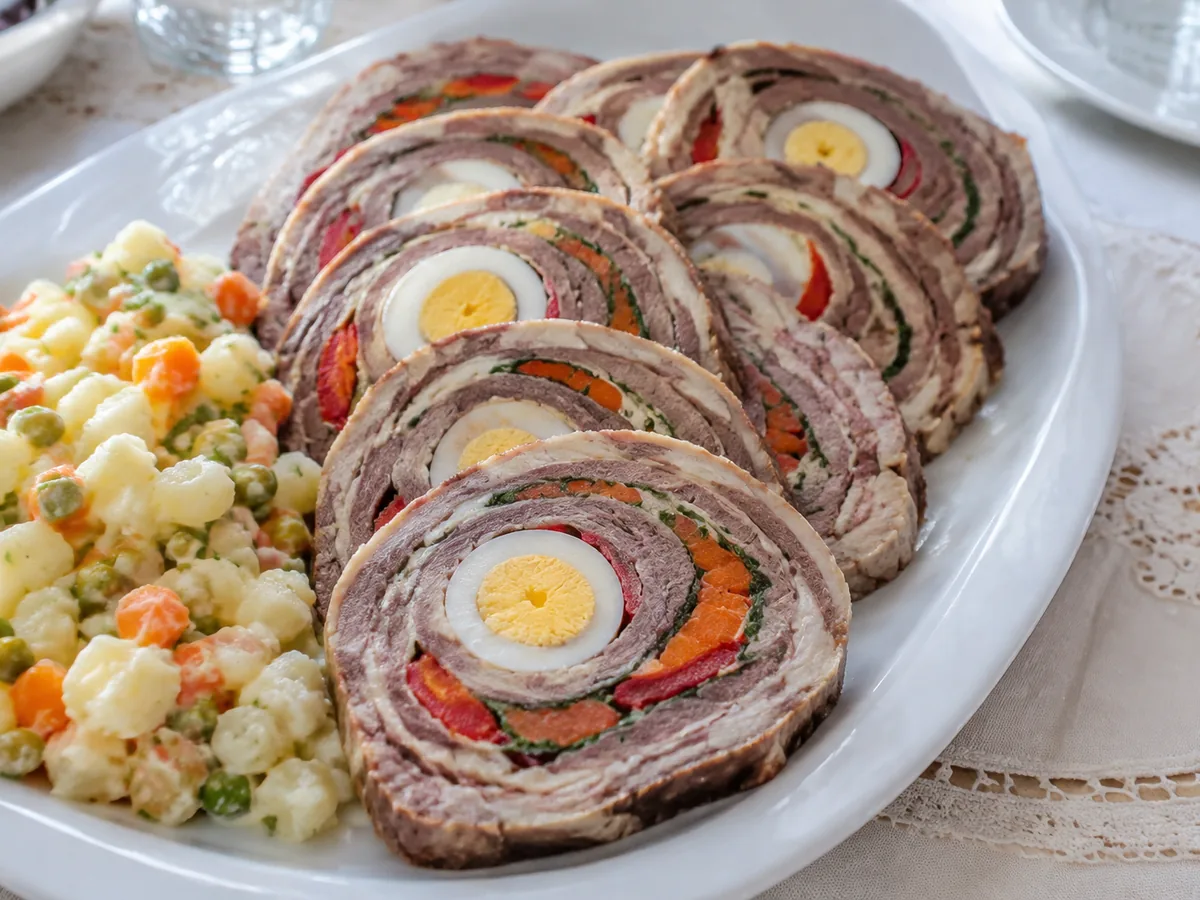
The name comes from mata-hambre, “hunger killer”: the thin layer of muscle over the rib cage that gauchos carved out first at a slaughter to cook over coals while the carcass hung. Left alone it is tough and loaded with connective tissue. Uruguayan cooks tame it two ways.
Rolled, the raw sheet is seasoned, layered with boiled eggs, carrot and red pepper, tied into a tight cylinder, poached until tender and pressed cold under weights to be sliced into mosaic rounds at family feasts. Flat, it is submerged in milk with garlic and bay and braised low until the milk reduces to sweet caramelised curds and the meat cuts with a fork.
Beef and seasoning
- 1.5 kg3.3 lbBeef matambre, the flank cover, trimmed of hard yellow fat to an even 2 mm white layer and squared into a rectangle
- 6 cloves6 clovesGarlic, minced or smashed
- 10 g2 tspFine sea salt
- 3 g1 tspBlack peppercorns, whole or cracked
- 4 g1½ tspDried oregano
- 2 g1 tspAjí molido, crushed red pepper
- 30 g½ cupFlat-leaf parsley, finely chopped
- 3 whole3 wholeBay leaves
Arrollado filling
- 4 large4 largeHard-boiled eggs, peeled and left whole
- 2 medium2 mediumCarrots, cut lengthwise into long 5 mm batons
- 1 large1 largeRed bell pepper, cut into long 5 mm strips
- 15 g1 TbspUnflavoured powdered gelatinlocks the roll for clean cold slicing
- 50 g½ cupAged Sardo cheese, freshly grated
Poaching liquid
- 11Onion, halved, plus 1 carrot and 1 Tbsp saltwith water or light beef stock to cover
Milk braise
- 1.5 L6.3 cupsWhole milkfor the matambre a la leche variation
What the cut is
Matambre is the cutaneous trunci, the thin sheet of muscle over the ribs that gauchos cut out first at a slaughter to cook over the coals while the carcass hung. On its own it is tough, dense with type-I collagen. Both methods hold it between 85 and 92 °C for around two hours until that collagen becomes gelatin.
Gelatin in the roll
A dusting of powdered gelatin over the raw meat binds the vegetables and eggs into one solid matrix when the roll is chilled under weights. It is the difference between clean mosaic slices and a roulade that falls apart.
Why milk tenderises
Milk carries lactic acid and calcium ions that activate the meat's own calpain enzymes and weaken the muscle structure, while the heat hydrolyses the collagen. As the milk reduces, its casein and lactose concentrate into sweet golden curds that glaze the meat.
The five tastes on this plate
Salt seasons the meat surface and the poaching or braising liquid. Fat is the thin white fat cap and, in the milk version, butterfat. Acid is the lactic acid in the milk, or brined vegetables served alongside. Heat is garlic, black pepper, oregano and ají molido. Umami is slow-cooked beef, aged Sardo and concentrated milk proteins.
Equipment
- Meat mallet
- Butcher's twine
- Large oval Dutch oven or roasting pan, 7-quart
- Two rimmed baking sheets and about 5 kg of weights, for pressing
- Sharp slicing knife
- Foil, for the milk braise
For the roll you need a pot long enough to submerge it lying flat, and for the milk braise a pan covered tightly with a double layer of foil so the milk does not evaporate too fast.
Method
Flatten and season the sheet10 min
Lay the trimmed matambre flat, fat side down. Pound the thicker sections with a mallet so the whole sheet is an even 1 cm. Season generously with salt, black pepper, oregano, minced garlic and chopped parsley. Dust the surface evenly with the gelatin powder, then scatter the grated Sardo over it.
Lay trimmed matambre fat-down; pound thick sections to an even 1 cm. Season with salt, pepper, oregano, minced garlic and parsley. Dust evenly with gelatin and scatter grated Sardo over the surface.
Lay in the fillings5 min
Arrange the red pepper strips and carrot batons lengthwise across the meat in alternating lines. Line the four whole boiled eggs end to end in a straight row across the centre.
Arrange the red pepper strips and carrot batons lengthwise across the meat in alternating lines. Line the four whole boiled eggs end to end in a straight row across the centre.
Roll and tie tightly10 min
Starting from the long edge nearest you, roll the meat tightly over the eggs and vegetables, pulling back firmly as you go to squeeze out air. Tie butcher's twine around the roll with a secure knot every 2 cm along its length, and tie off the ends so nothing escapes.
Roll tightly from the nearest long edge over eggs and vegetables, pulling back to expel air. Tie secure twine knots every 2 cm along the roll; tie both ends closed.
Poach the roll2 hr
Set the tied roll in the oval Dutch oven and cover with cold water or light stock. Add the onion, carrot, bay leaves and a tablespoon of salt. Bring to a gentle boil, then drop to low and simmer uncovered at 85 to 90 °C for 2 hours, until a skewer slides into the centre with no resistance and the core reads 88 to 92 °C.
Cover tied roll with cold water or light stock; add onion, carrot, bay and 1 tablespoon salt. Bring to a gentle boil, then simmer uncovered at 85–90 °C for 2 hours until a skewer enters freely and the core reads 88–92 °C.
Press, chill and slice8 hr
Lift the roll onto a rimmed baking sheet. Set a second sheet on top and weight it with about 5 kg of bricks or cast-iron pans. Refrigerate under the weights at least 8 hours or overnight. Remove the weights, snip the twine, and slice into 5 mm mosaic rounds with a sharp knife. Serve cold.
Set roll on a rimmed tray; top with another tray weighted with about 5 kg of bricks or cast-iron pans. Refrigerate under weight at least 8 hours or overnight. Remove weights and twine; slice 5 mm rounds and serve cold.
Sensory cues of doneness
- Visual: tight spiral slices of white fat, brown beef, orange carrot, red pepper and yellow-and-white egg rounds. For the milk braise, golden-brown meat under caramelised curds that a fork glides through.
- Auditory: a quiet, gentle simmer throughout, never a hard boil.
- Olfactory: braised beef, bay, garlic and oregano, and in the milk version, sweet caramelised milk sugars.
Look for tight mosaic spirals of beef, fat, vegetables and egg. The milk variation should be fork-tender beneath golden curds. Keep a gentle simmer; expect beef, bay, garlic and oregano, or sweet caramelised milk aromas.
Matambre a la leche, the flat milk braise
The other classic treatment of the same cut. Skip the filling, the gelatin and the roll, and serve it hot with mashed potatoes.
Season and submerge
Trim the matambre to a clean 2 mm fat layer and season both sides with salt, pepper, oregano and ají molido. Lay it flat in a heavy roasting pan or Dutch oven, scatter the smashed garlic and bay leaves over it, and pour in 1.5 litres of whole milk so the meat is submerged.
Trim matambre to a 2 mm fat layer; season both sides with salt, pepper, oregano and ají molido. Lay flat in a heavy pan, add smashed garlic and bay, and submerge in 1.5 litres whole milk.
Braise covered1 hr 30 min
Cover tightly with foil and braise in a 160 °C oven for 1 hour 30 minutes.
Cover tightly with foil and braise in a 160 °C oven for 1 hour 30 minutes.
Uncover and caramelise25 to 30 min
Remove the foil, raise the oven to 190 °C, and roast 25 to 30 minutes more while the milk reduces and its solids turn into sweet golden curds glazing the meat. It is done when it cuts with the side of a fork.
Remove foil; raise oven to 190 °C and roast 25–30 minutes until the milk reduces into golden curds glazing the meat. The curdling is expected; the meat should cut with the side of a fork.
The milk is supposed to curdle
As the milk heats with the acids from the meat and reduces, the water boils off and the solids curdle, brown and caramelise. That is the sauce, nutty and sweet.
Storing it
Cold rolled matambre keeps tightly wrapped in the fridge for up to 5 days and makes excellent sandwich cuts.
Troubleshooting
- Tough, chewy meat.
Cooked too fast or pulled early. The collagen needs at least 1½ to 2 hours of gentle simmering.
- The roll falls apart when sliced.
Rolled loosely, or not pressed under weight while chilling. Tie it tight, dust with gelatin, and weight it until cold.
- Scorched, bitter milk.
The milk boiled hard. Keep the oven at 160 °C for a steady, gentle braise.
Substitutions
One-to-one swaps, with the technique change each one needs.
Ingredient substitutions
| Ingredient | Replace with | Culinary impact and technique adjustment |
|---|---|---|
| Matambre | Flank steak butterflied flat, or veal breast | One-to-one. Flank rolls easily and tenderises under slow cooking |
| Whole milk | Whole milk with 20 percent cream | Richer sauce and faster caramelisation |
| Sardo cheese | Aged parmesan, grana padano or pecorino | One-to-one. Same sharp, savoury notes |
Scaling
Half
Halve the ingredients. For the milk braise, use a 3-quart dish with 800 ml milk for 1 hour 30 minutes.
Double, for 12
Double the ingredients across two Dutch ovens. Cooking and pressing times do not change.
What to serve it with
- Ensalada rusa with the cold rolled matambre, the universal pairing
- Silky mashed potatoes with the milk braise, to catch the curds
- A round Merlot with the milk version; a structured Tannat with the cold roll
Questions
What is matambre called in English?
Rose meat, flank cover or the "fly shaker" muscle. If your butcher cannot supply it, a wide thin flank steak or butterflied skirt works.
Why does the milk curdle?
Heat, the meat's natural acids and reduction curdle the milk solids on purpose. The curds brown and caramelise into a sweet, nutty sauce.
How long does the cold roll keep?
Up to 5 days tightly wrapped in the fridge.