Asado de Tira
Cross-cut short ribs over hardwood embers, seasoned with nothing but coarse salt. They cook bone side down for most of the time so the bones carry the heat gently into the meat, then flip once onto the fat cap to crust, and come to the table under a chimichurri made the day before.
- Prep
- 20 min
- Cook
- 50 min
- Serves
- 6
- Difficulty
- Hard
Researched · Kitchen testing pending
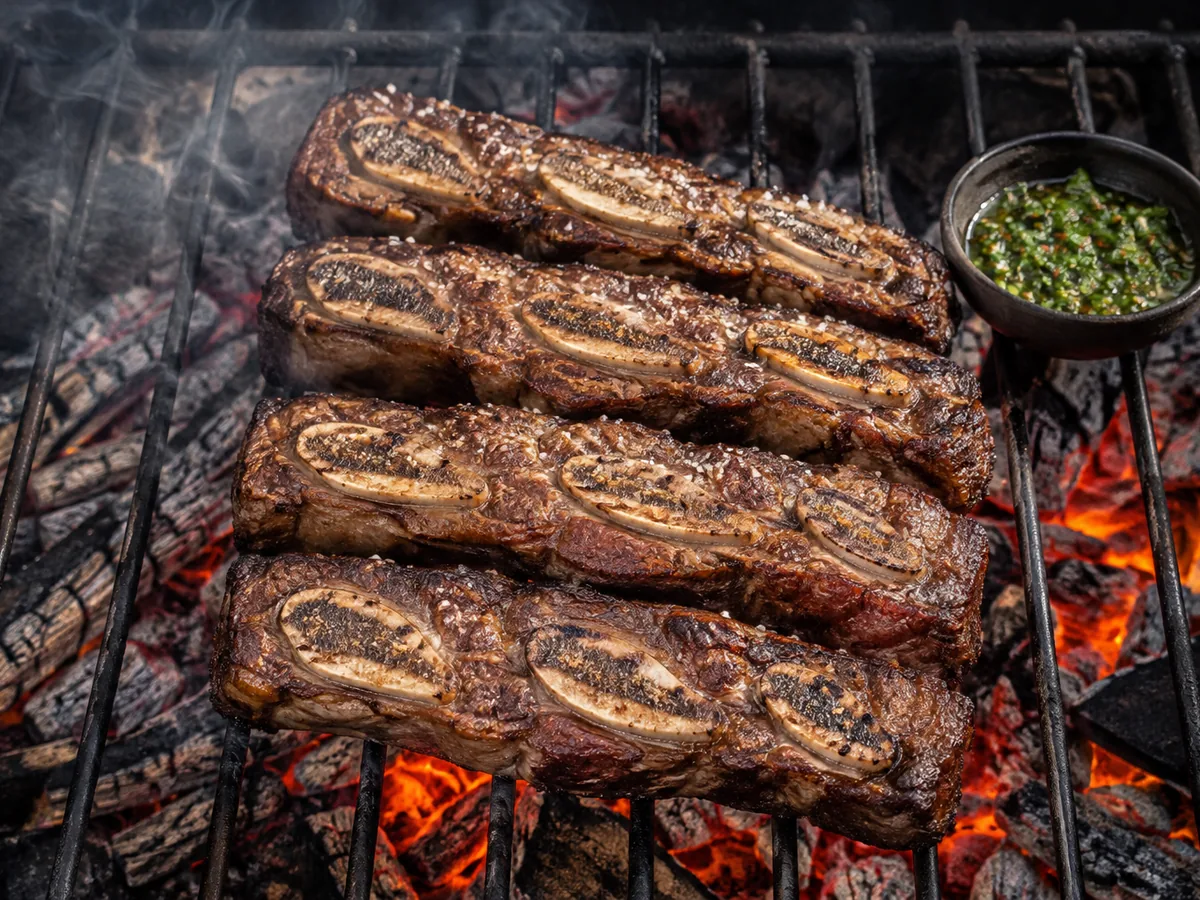
In Uruguay grilling beef is not a cooking method, it is a cultural anchor. The ritual starts hours before dinner: native hardwood, coronilla, espinillo or quebracho, burns in an iron basket called a brasero, and as the logs collapse the glowing coals fall through to the floor. The asador drags them under the heavy iron grate with a poker, adjusting the heat by the shovelful.
The cut is asado de tira, short ribs sliced across the bones so each strip holds three or four oval bone medallions in marbled meat. Seasoned with nothing but coarse salt, the ribs sizzle bone side down for most of the cook while the fat renders and the smoke of the wood perfumes the crust.
Ribs
- 2.4 kg5.3 lbAsado de tira, cross-cut beef short ribs, 3.5 cm thick across 3 to 4 boneswell marbled, fat cap trimmed to 5 mm
- 40 g2½ TbspSal parrillera, medium-coarse sea salt without anti-caking agents
Chimichurri
- 60 g2 cups packedFlat-leaf parsley, washed, dried and minced fine by hand
- 6 cloves6 clovesGarlic, minced to a fine 1 mm dice
- 8 g1½ TbspDried oregano, crushed between the palms
- 6 g1 TbspAjí molido, South American crushed red pepper
- 10 g2 tspFine sea salt
- 3 g1 tspFreshly cracked black pepper
- 60 ml¼ cupWarm water, to bloom the dried herbs
- 120 ml½ cupRed wine vinegar
- 240 ml1 cupSunflower oil or mild extra-virgin olive oil
Table
- 1 loaf1 loafCrusty country bread, pan de campo
Embers, not flames
Hardwood coals give off steady infrared heat without the soot or creosote of burning logs or chemical briquettes. Meat over live flame blackens outside and stays raw inside. Burn the wood down first, then rake the embers under the grate.
Why bone side down for so long
For roughly seventy percent of the cook the bones sit on the grate and conduct heat gently up into the meat without scorching the surface. Between 54 and 65 °C the intramuscular fat melts and bastes the fibres from inside. One flip onto the fat cap at the end drives the crust.
Coarse salt only
Fine salt dissolves instantly and pulls moisture out by osmosis. Coarse crystals dissolve at the pace the fat renders, seasoning evenly without drying the surface.
The five tastes on this plate
Salt is coarse sal parrillera working into the hot fibres. Fat is the rib's own tallow and the sizzling cap. Acid is red wine vinegar in the chimichurri slicing through the fat. Heat is raw garlic, oregano, black pepper and ají molido. Umami is Maillard browning over wood, marrow and rendered collagen.
Equipment
- Brick parrilla with a side brasero, or a charcoal kettle grill set up for two zones with lump hardwood charcoal
- Long tongs, never a fork
- Iron poker or small shovel, for moving coals
- Instant-read thermometer
- Glass jar with a lid, for the chimichurri
The Uruguayan parrilla is a sloped iron grate on a crank, fed with embers from a basket of burning native hardwood beside it. A kettle grill with lump charcoal does the job. Indoors, sear the ribs hard in a heavy cast-iron grill pan and finish 25 minutes in a 160 °C oven.
Method
Make the chimichurri a day ahead10 min
In a glass jar, combine the crushed oregano, ají molido, salt and black pepper. Pour in the warm water and let stand 5 minutes to hydrate the dried herbs. Add the garlic and the hand-chopped parsley. Stir in the vinegar with a fork, then the oil. Seal and shake hard. Refrigerate at 4 °C or below for 24 hours to develop the flavours; use within 4 days.
In a jar, hydrate oregano, ají molido, salt and pepper with warm water 5 minutes. Add garlic and parsley; stir in vinegar, then oil. Seal, shake and refrigerate at 4 °C or below for 24 hours. Use within 4 days.
Light the fire45 min
Stack hardwood logs in the brasero and light kindling underneath. As the logs burn down, glowing coals drop to the floor. Scrape a bed of them under the grate with the poker. Clean the grate with a wire brush or folded newspaper, then wipe it with a piece of beef fat.
Burn hardwood logs down to glowing embers in the brasero; rake them beneath the grate. Clean the grate with a wire brush or folded newspaper, then wipe with beef fat. Cook over embers, not live flames.
Calibrate the heat and salt the ribs10 min
Hold your open palm 10 cm above the grate. You should manage 5 to 6 seconds before pulling away, which is a medium heat of about 160 to 175 °C. Salt the cold ribs generously with sal parrillera on all sides 10 minutes before they go on, so the grains adhere.
Set medium grill heat, about 160–175 °C: an open palm held 10 cm above the grate should tolerate it for 5–6 seconds. Generously salt cold ribs on every side with sal parrillera 10 minutes before grilling.
Roast bone side down30 to 35 min
Lay the ribs bone side down across the bars. Keep the coals steady, shovelling fresh embers under as needed and putting more heat under the thicker bone ends. Leave them undisturbed 30 to 35 minutes. The meat will shrink back about 5 mm from the bone edges and juices will bead on the upper surface.
Grill ribs bone-side down, undisturbed, 30–35 minutes. Maintain steady embers, adding more beneath thicker bone ends. Look for meat shrinking about 5 mm from the bone edges and juices beading on top.
Flip and crust the meat side12 to 15 min
With long tongs, flip the ribs meat side down directly over the coals. Grill 12 to 15 minutes, watching for flare-ups as the tallow drips. The surface should turn mahogany with a crisp, crackling fat border. Probe the thickest section: 57 to 60 °C.
Flip meat-side down with long tongs; grill 12–15 minutes, watching for fat flare-ups. Look for a mahogany crust and crisp fat border; probe the thickest section for 57–60 °C.
Rest, carve and serve8 min
Rest on a wooden board 8 minutes. Slice down between the bones into individual rib steaks, spoon chimichurri over the hot meat, and serve with warm bread.
Rest on a wooden board 8 minutes. Slice down between the bones into individual rib steaks, spoon chimichurri over the hot meat, and serve with warm bread.
Sensory cues of doneness
- Visual: a glistening mahogany exterior with bubbling crisp fat along the borders, bones pulling slightly back, a juicy pink-rose centre.
- Auditory: a constant rhythm of fat droplets hissing on the coals and sending up wisps of white smoke.
- Olfactory: charred native wood smoke, sizzling tallow, toasted marrow and the garlic and vinegar of the chimichurri.
Look for glossy mahogany ribs, crisp bubbling fat, slightly exposed bones and a juicy pink centre. Expect fat hissing on embers and aromas of wood smoke, tallow, marrow, garlic and vinegar.
Troubleshooting
- Black, bitter outside and cold inside.
The meat went over burning logs. Burn the wood to glowing embers first, then rake them under the grate.
- Dry meat and flare-ups.
It was pierced with a fork, which dumped the juices into the fire. Turn asado with tongs only.
- Bitter, muddy chimichurri.
It was made in a food processor, which bruises the parsley and garlic. Mince both by hand with a sharp knife.
Substitutions
One-to-one swaps, with the technique change each one needs.
Ingredient substitutions
| Ingredient | Replace with | Culinary impact and technique adjustment |
|---|---|---|
| Asado de tira | Flanken-style short ribs, cut 1½ inches thick across the bones | One-to-one. Look for good marbling |
| Sal parrillera | Coarse kosher salt or coarse sea salt | One-to-one. No iodine, no additives |
| Ají molido | Crushed red pepper flakes or Aleppo pepper | One-to-one. Aleppo matches the mild, fruity dried-pepper heat |
Scaling
Half, for 3
Grill 1.2 kg, about two strips. Fire building and cooking times do not change, because the radiant heat requirement is the same.
Double, for 12
Grill 4.8 kg across a wider bed of embers, and keep the brasero burning so you can replenish heat throughout.
What to serve it with
- Warm pan de campo, torn by hand to catch the drippings
- Provoleta, a slab of provolone grilled in a small iron pan until bubbling, with oregano and ají molido
- Uruguayan Tannat from Canelones or Garzón, built to cut through the fat
Questions
Why coarse salt and not table salt?
Fine salt dissolves at once and draws moisture out of the meat. Coarse crystals dissolve slowly at the pace the fat renders, seasoning evenly without drying the surface.
How thick should the ribs be cut?
About 3.5 cm. Thinner, like Korean galbi, overcooks before it sears. Thicker, and the outside burns before the interior fat melts.
Why warm water in the chimichurri?
It rehydrates the dried oregano and ají molido and releases their oils before the vinegar and oil coat the herbs.