Chivito
The national sandwich, invented in 1944 when a bar in Punta del Este had no goat. Tenderloin pounded to 4 mm and seared for a minute in foaming butter, stacked with ham, melted cheese, bacon and a runny egg, served in a toasted roll or over a mountain of twice-fried chips.
- Prep
- 25 min
- Cook
- 15 min
- Serves
- 4
- Difficulty
- Medium
Researched · Kitchen testing pending
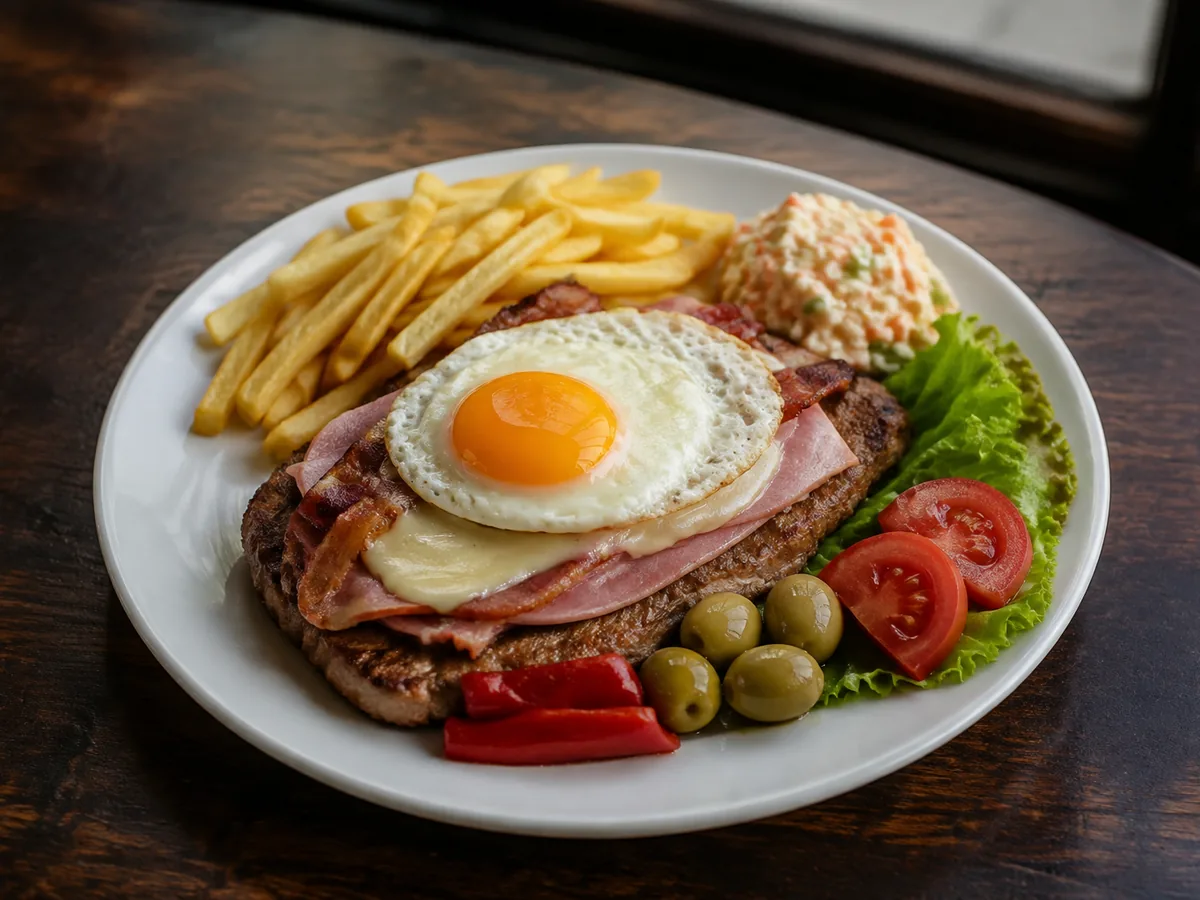
In 1944, at the bar El Mejillón in Punta del Este, a customer asked Antonio Carbonaro for roast baby goat. He had none. He took a thin slice of grass-fed tenderloin, buttered a roll, seared the steak on the hot plate and stacked it with ham. The customer loved it, and the chivito became Uruguay’s national sandwich.
Ordered al pan it comes in a soft toasted roll. Ordered al plato the bread is dropped and the whole stack sits on a mountain of hand-cut chips beside a scoop of cold ensalada rusa. Either way it is salty, rich and stacked high.
Beef
- 600 g1⅓ lbBeef tenderloin or boneless ribeye, trimmed, cut into 4 steaks and pounded to 4 mm between plastic wrap
- 40 g2½ TbspUnsalted butter, for searing
- 8 g1½ tspFine sea salt
- 1 g½ tspCoarsely ground black pepper
The stack
- 8 slices8 slicesCooked ham, sliced thinabout 160 g
- 8 thick strips8 stripsSmoked bacon, 3 mm thickabout 200 g
- 200 g7 ozMozzarella or Uruguayan Danbo cheese, sliced thin
- 4 large4 largePasteurized shell eggs for the traditional soft yolk
- 30 ml2 TbspVegetable oil, for the eggs and bacon
- 2 large2 largeRipe tomatoes, sliced into 5 mm rounds
- 8 leaves8 leavesButterhead or romaine lettuce, washed and dried
- 60 g½ cupPimiento-stuffed green olives, sliced into rings
- 60 g⅓ cupPickled sweet red peppers, sliced into strips
- 80 g⅓ cupWhole-egg mayonnaise
- 44Soft sandwich rolls, pan catalán or tortuga, split and butteredomit for al plato
Chips
- 800 g1¾ lbRusset or Kennebec potatoes, peeled, cut into 1 cm batons and soaked in cold water
Thin meat, hot plate, sixty seconds
Pounding the tenderloin to 4 mm makes it easy to bite through. Foaming butter on the hot plancha browns the surface in under a minute a side. A thin-tip probe inserted from the side lets you check the centre before the meat dries out.
Melt the cheese on the ham, not the bread
Domed on the flat-top, the mozzarella melts over the hot ham and bonds the layers into one tier that lifts as a unit onto the steak.
The yolk is the sauce
The egg is fried only until the white sets. When the top bun presses down, the yolk breaks into the bread and binds the whole stack.
The five tastes on this plate
Salt is cured bacon, ham, seasoned beef and brined olives. Fat is bacon fat, butter on the beef, mayonnaise and yolk. Acid is pickled peppers, olives and fresh tomato cutting through the fat. Heat is black pepper in the crust, with mustard at the table. Umami is beef juices, aged cheese, smoked bacon and the fond.
Equipment
- 12-inch cast-iron flat griddle, or two heavy cast-iron skillets
- Deep pot and thermometer, for the chips
- Basting dome or a metal bowl
- Fish spatula, for the eggs
The sandwich shops use a wide carbon-steel plancha with separate heat zones for bacon, steak and eggs at once. At home, work in fast batches on a hot cast-iron griddle so the metal keeps its heat when cold meat lands.
Method
Twice-fry the chips12 min
Drain the potato batons and dry them thoroughly. Heat oil in a deep pot to 150 °C and blanch the potatoes 5 to 6 minutes until soft but pale. Lift out and drain.
Just before assembling, reheat the oil to 190 °C and fry the blanched potatoes 2 to 3 minutes until crisp and golden. Drain, salt, and keep warm.
Dry drained potato batons thoroughly. Fry at 150 °C for 5–6 minutes until soft and pale; drain. Just before assembly, fry again at 190 °C for 2–3 minutes until golden and crisp. Drain, salt and keep warm.
Crisp the bacon and melt the cheese8 min
Heat the griddle to medium-high, about 200 °C. Lay down the bacon and cook 3 minutes a side until deeply browned and crisp. Push to the cooler side. Lay the ham flat on the hot zone, put the mozzarella on top, and cover with a dome for 60 seconds until the cheese melts over the ham. Push it alongside the bacon.
Heat griddle to 200 °C. Cook bacon 3 minutes per side until deeply browned and crisp; move to the cooler zone. Top ham with mozzarella on the hot zone; cover 60 seconds until melted, then move beside bacon.
Toast the bread2 min
For al pan, set the buttered rolls cut side down on the griddle for 2 minutes until golden. Spread both sides with mayonnaise and layer the bottoms with lettuce and tomato, with a pinch of salt on the tomato.
For al pan, set the buttered rolls cut side down on the griddle for 2 minutes until golden. Spread both sides with mayonnaise and layer the bottoms with lettuce and tomato, with a pinch of salt on the tomato.
Flash-sear the steaks2 min
Heat the plancha to about 230 °C and melt the butter. Season the steaks, sear 45–60 seconds, flip and top with ham, cheese and bacon. After about 30 seconds, slide a thin-tip thermometer sideways into the beef. Cook to at least 63 °C and rest on a clean plate for 3 minutes while frying the eggs.
Heat the plancha to about 230 °C and melt the butter. Season the steaks, sear 45–60 seconds, flip and top with ham, cheese and bacon. After about 30 seconds, slide a thin-tip thermometer sideways into the beef. Cook to at least 63 °C and rest on a clean plate for 3 minutes while frying the eggs.
Fry the eggs2 min
On the cleared griddle with a splash of oil, crack the eggs and cook over medium-high 60 to 90 seconds until the whites set and crisp at the edges while the yolks stay fluid. Lift each with a fish spatula. For a soft yolk use pasteurized shell eggs. With ordinary eggs cook until both white and yolk are firm.
On the cleared griddle with a splash of oil, crack the eggs and cook over medium-high 60 to 90 seconds until the whites set and crisp at the edges while the yolks stay fluid. Lift each with a fish spatula. For a soft yolk use pasteurized shell eggs. With ordinary eggs cook until both white and yolk are firm.
Assemble
Al pan: set each beef stack on its tomato and lettuce base, slide a fried egg on top, scatter olives and pickled pepper over the yolk, close with the top bun and press gently so the yolk breaks into the bread. Serve with the chips.
Al plato: mound the chips on wide platters, centre the stack on the chips, top with the egg and pickles, and serve with a scoop of chilled ensalada rusa.
Al pan: place beef stack on prepared bun, add egg, olives and pickled pepper; close and press gently to break yolk. Serve with fries. Al plato: set stack over fries, top with egg and pickles, and add chilled ensalada rusa.
Sensory cues of doneness
- Visual: a thin golden sear on the beef, cheese fully melted and draped over the ham, a domed glossy yolk.
- Auditory: a loud, violent sizzle the instant the thin beef hits the buttered steel.
- Olfactory: rendered bacon, sizzling butter, seared beef and toasted bread.
Look for a thin golden beef crust, cheese melted over ham and a glossy domed yolk. Expect strong sizzling on the griddle and bacon, butter, beef and toast aromas.
Troubleshooting
- Grey, dry, chewy beef.
Pound the steaks evenly and sear in small batches. Remove as soon as a thin probe inserted from the side reads 63 °C and rest 3 minutes.
- A bun that dissolves.
Tomato went straight against hot meat or untoasted bread. Toast the bun, spread mayonnaise as a fat barrier, and put the tomato on the lettuce.
- A firm yolk and a dry sandwich.
The egg was overcooked. The runny yolk is the sauce that ties the stack together.
Substitutions
One-to-one swaps, with the technique change each one needs.
Ingredient substitutions
| Ingredient | Replace with | Culinary impact and technique adjustment |
|---|---|---|
| Beef tenderloin | Boneless ribeye or top sirloin | One-to-one. Trim the silverskin and pound to 4 mm |
| Danbo cheese | Mild provolone, fontina or low-moisture mozzarella | One-to-one. Melts smoothly over the ham |
| Pan catalán | Brioche burger buns or Portuguese rolls | One-to-one. Toast the cut face so it stands up to the juices |
Scaling
Half, for 2
Halve everything and work in a single 12-inch cast-iron pan. Times stay the same.
Double, for 8
Double the ingredients and use an outdoor flat-top, or cook the meats and eggs in fast consecutive batches, holding cooked meat in an 80 °C oven for no more than 5 minutes.
What to serve it with
- Chips served directly under the steak, so the juices and yolk season them
- Ensalada rusa, chilled potato, carrot and pea salad in mayonnaise
- Ice-cold Patricia lager, or a young unoaked Tannat
Questions
Can I use flank or sirloin?
Yes, if you trim all connective tissue and pound it to 3 mm. Ribeye works well for its marbling. Tenderloin is the standard for effortless bite-through.
What makes a chivito canadiense?
A chivito común is meat, lettuce and tomato. The canadiense adds the works: bacon, ham, melted cheese, fried egg, olives and pickled peppers.
Why is it called chivito with no goat in it?
Antonio Carbonaro named it in 1944 after a customer asked for baby goat. He had none, so he made her a "little goat platter" out of buttered beef tenderloin instead.