Torta Pascualina
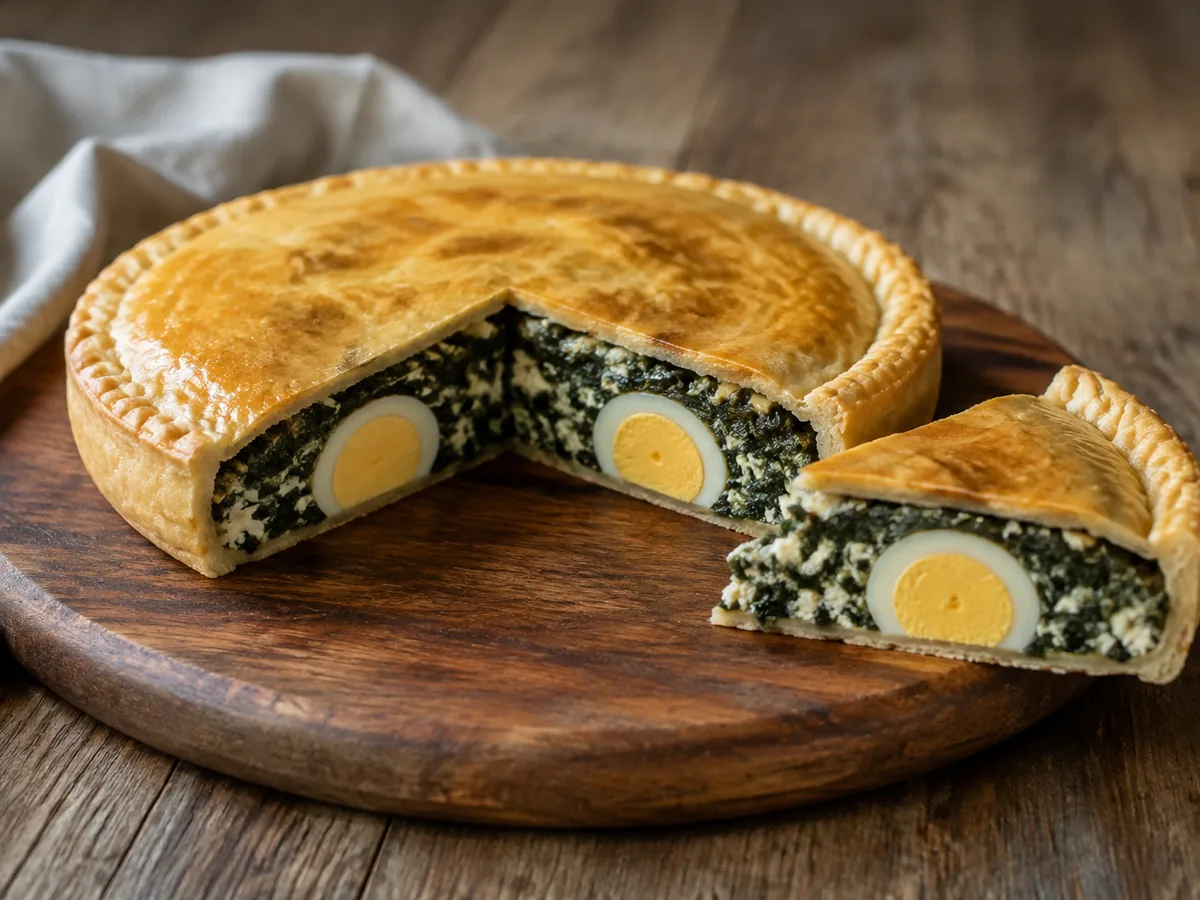
The Genoese Easter pie that became an everyday Uruguayan staple. A lard-laminated crust around Swiss chard wrung bone-dry and mixed with ricotta and aged cheese, with six raw eggs cracked into wells in the filling so they set into whole yellow discs as it bakes.
- Prep
- 45 min
- Cook
- 45 min
- Serves
- 8 slices, from a 26 cm pan
- Difficulty
- Medium
Researched · Kitchen testing pending
In the late nineteenth century, Ligurian immigrants from Genoa arrived in the port of Montevideo carrying the torta pasqualina, an Easter centrepiece said to have been made with thirty-three paper-thin layers of pastry. In Uruguay it shed the ceremony and became an everyday staple of bakeries and home kitchens.
The Uruguayan version wraps a flaky lard-laminated crust around Swiss chard and fresh ricotta. Before the lid goes on, the cook presses wells into the green filling and cracks a raw egg into each one. Sliced after baking, the pie shows bright yellow egg discs set whole in the emerald chard.
Pastry
- 500 g4 cupsUnbleached plain flour, about 11 percent protein, sifted
- 120 g½ cupRendered beef lard or cold unsalted butter, softenedfor the lamination
- 10 g2 tspFine sea salt
- 240 ml1 cupCold water
- 15 ml1 TbspExtra-virgin olive oil
Filling
- 1.2 kg3 large bunchesSwiss chard, thick stems removed, leaves washed thoroughly
- 500 g2 cupsWhole-milk ricotta, drained in cheesecloth 30 minutes
- 1 large1 largeYellow onion, minced fine
- 2 cloves2 clovesGarlic, minced fine
- 80 g1 cupAged Sardo or Reggianito cheese, freshly grated
- 2 g½ tspNutmeg, freshly grated
- 8 g1½ tspFine sea salt
- 2 g½ tspFreshly cracked white pepper
- 2 large2 largeEggs, beaten, to bind the filling
Eggs and glaze
- 6 large6 largeEggs, whole and raw, for the wells
- 1 large1 largeEgg beaten with 15 ml milk, for the glaze
Dry chard is the whole recipe
Chard is about 92 percent water. Add it wet and that water turns to steam in the oven, soaks the bottom pastry into paste and splits the ricotta. Wilt it in dry steam, chill it, and wring it inside a towel until nothing drips. It is the single most important step.
Why lard laminates so well
Spreading softened lard or butter between thin sheets of dough creates fat barriers. At 200 °C the moisture in the dough flashes to steam and pushes the layers apart into flakes.
Eggs poached inside the pie
Raw eggs cracked into wells set gently by conduction inside the insulating ricotta, reaching about 72 °C without going rubbery. Boiled eggs would be cooked twice.
The five tastes on this plate
Salt is the aged Sardo, the seasoned dough and the seasoned filling. Fat is the lard-laminated pastry, whole-milk ricotta and baked yolks. Acid is mild, with the subtle bitterness of the chard doing that work. Heat is fresh nutmeg, white pepper and cooked garlic. Umami is the aged cheese, slow-sweated onion and egg protein.
Equipment
- 26 cm springform or metal tart pan with 4 cm sides
- Large pot with lid, for wilting the chard
- Clean kitchen towel, for wringing
- Rolling pin
- Wire rack
Use a metal pan. Metal conducts oven heat quickly and browns the bottom crust far better than glass or ceramic. The traditional pan is tinplate with straight sides.
Method
Make the laminated pastry45 min
Mound the flour on the bench with the salt. Work in the olive oil and cold water to a smooth, supple dough and knead 6 to 8 minutes until elastic. Divide into two balls, one slightly larger for the base, cover, and rest 30 minutes.
Roll the larger ball to a 2 mm sheet. Spread half the softened lard over it, fold into thirds like a letter, roll out again, and fold once more. Repeat with the second ball. Chill both 20 minutes.
Mix flour, salt, olive oil and cold water; knead 6–8 minutes until elastic. Divide into two balls, one larger; cover and rest 30 minutes. Roll each 2 mm thick, spread with half the softened lard and fold in thirds. Roll and fold again; chill both 20 minutes.
Wilt and wring the chard15 min
Heat a large pot with 60 ml water over high heat. Add the chard in batches, cover, and steam 3 to 4 minutes until wilted. Tip into a colander and rinse with cold water to stop the cooking. Squeeze handfuls to drain, then wrap the chard in a clean towel and wring it hard over the sink until no more water comes out. Chop finely.
Heat 60 ml water on high; steam chard in covered batches 3–4 minutes until wilted. Drain and rinse cold. Squeeze by handfuls, then wring hard in a clean towel until no water drips. Chop finely.
Cook the sofrito and mix the filling12 min
Heat the olive oil in a skillet over medium heat and sweat the onion and garlic 8 minutes until soft and golden. In a large bowl combine the chard, drained ricotta, sofrito, grated Sardo, nutmeg, white pepper, salt and the 2 beaten eggs. Mix until cohesive and creamy.
Drain ricotta in cheesecloth 30 minutes. Sweat onion and garlic in olive oil over medium 8 minutes until soft and golden. Mix with chard, ricotta, Sardo, nutmeg, white pepper, salt and 2 beaten eggs until creamy and cohesive.
Line the pan and make the egg wells10 min
Heat the oven to 200 °C. Roll the base sheet into an even 32 cm circle and drape it into the buttered pan, pressing it into the corners with 2 cm of overhang. Fill with the chard mixture and smooth the top.
With the back of a large spoon, press six deep, evenly spaced wells into the filling. Crack one egg gently into each, keeping the yolks whole. Sprinkle a pinch of salt and grated cheese over each yolk.
Heat oven to 200 °C. Roll base to 32 cm; line buttered pan, pressing corners and leaving 2 cm overhang. Fill and smooth. Make six deep, evenly spaced wells; crack one egg into each without breaking yolks. Sprinkle each with salt and grated cheese.
Seal and crimp5 min
Roll the second sheet into a 28 cm circle and lay it gently over the filling. Trim the excess. Fold the base overhang over the lid and twist it into a rope border with your fingers to lock the seal. Prick the top in four places with a toothpick, away from the yolks, and brush with the egg glaze.
Roll lid to 28 cm; lay over filling and trim. Fold base overhang over the lid; twist into a tight rope seal. Prick four holes away from yolks and brush with egg glaze.
Bake and cool45 min
Bake on the lower-middle rack at 200 °C for 40 to 45 minutes until the top is deep golden and the base feels firm. Set on a wire rack and cool at least 25 to 30 minutes before slicing, so the ricotta sets and each slice holds its shape.
Bake on the lower-middle rack at 200 °C for 40–45 minutes until deep golden with a firm base and set filling; eggs inside reach about 72 °C. Cool on a rack at least 25–30 minutes before slicing.
Sensory cues of doneness
- Visual: shiny, blistered, deep golden pastry; clean whole egg rounds in dark green chard and white ricotta when sliced.
- Auditory: a crisp flaking crackle under a serrated knife; the base feels rigid when lifted.
- Olfactory: toasted lard pastry, sweet cooked onion, fresh nutmeg and aged cheese.
Look for shiny blistered golden pastry and clean whole-egg rounds in green chard and white ricotta. The base should feel rigid and pastry flake when cut; expect toasted pastry, onion, nutmeg and aged cheese aromas.
Storing it
Wrap slices in foil and refrigerate up to 3 days. Reheat 10 minutes in a 180 °C oven to re-crisp the crust. Avoid the microwave, which turns the laminated pastry rubbery.
Troubleshooting
- Soggy bottom crust.
The chard was not wrung dry. Squeeze it in a towel until no moisture is left; nothing else matters as much.
- Broken yolks in the wells.
The eggs were dropped from height. Make wide, deep wells, crack each egg into a cup first, and slide it in.
- The filling runs out like soup.
It was cut straight from the oven. Give it 30 minutes on a rack to firm up.
Substitutions
One-to-one swaps, with the technique change each one needs.
Ingredient substitutions
| Ingredient | Replace with | Culinary impact and technique adjustment |
|---|---|---|
| Swiss chard | Fresh spinach or cavolo nero | One-to-one. Steam, chill and squeeze bone-dry |
| Sardo cheese | Aged pecorino romano, parmesan or grana padano | One-to-one. Same sharp, salty savouriness |
| Rendered beef lard | Unsalted butter, 82 percent fat | One-to-one for the lamination. Flaky, buttery layers |
Scaling
Half
Bake in an 18 cm round pan with three egg wells, and cut the bake to 35 minutes.
Double
Bake two separate 26 cm pies. One giant pie stays raw in the centre while the edge burns.
What to serve it with
- Chilled Uruguayan Sauvignon Blanc, or white wine with soda from a siphon
- Sliced ripe tomatoes with olive oil and oregano
- Serve warm or at room temperature, never scalding
Questions
Can I use frozen spinach?
Yes. Thaw 600 g chopped spinach and wring it inside a towel until completely dry. Chard is traditional for its earthy sweetness, but spinach works.
Why raw eggs rather than boiled?
They poach gently inside the ricotta as the pie bakes and come out tender and creamy. Boiled eggs would be cooked twice and turn rubbery.
How do I store leftovers?
Foil-wrapped in the fridge for up to 3 days, reheated in a 180 °C oven for 10 minutes.