Kallaloo
The Old Year's Night pot. Twice-boiled salt pig tail and smoked ham hock simmered in beef stock, then dasheen leaves, okra, purslane, mallet-pounded conch and cracked blue crab with thyme, cloves, culantro and a splash of cane vinegar, cooked forty-five minutes until the greens collapse, whipped with a wooden swizzle stick into a velvet emerald potage, and served under a scoop of fungi.
- Prep
- 40 min
- Cook
- 1 hr 45 min
- Serves
- 8
- Difficulty
- Hard
Researched · Kitchen testing pending
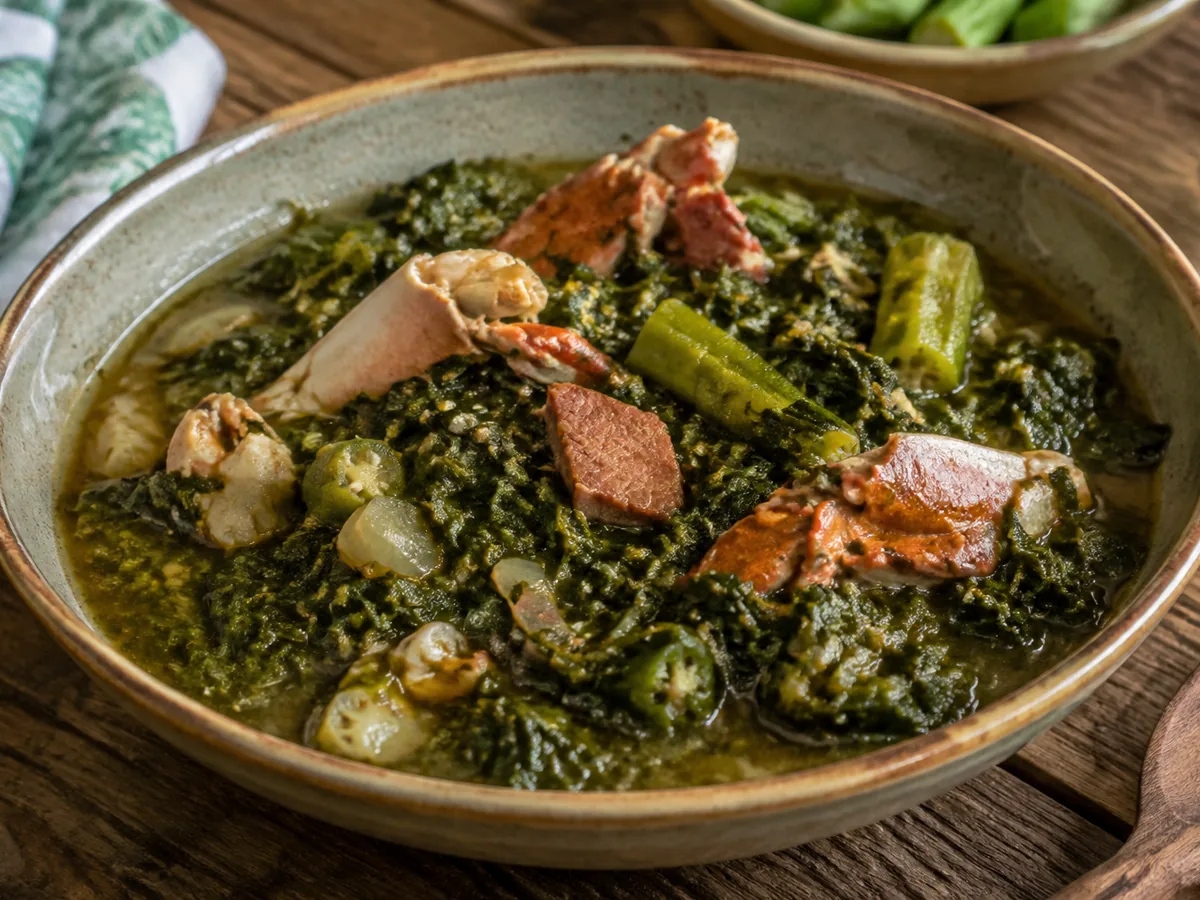
In the Virgin Islands kallaloo is a rite, eaten on Old Year’s Night and at big Sunday tables across the three islands. It descends from West African vegetable potages but is distinguished by its crowd of proteins: salt pig tail, smoked ham hock, tenderised queen conch and whole blue crab, all in one pot.
Young dasheen leaves simmer with okra, purslane and sweet seasoning peppers until they collapse, then the pot is whipped with a wooden swizzle stick into a spoonable emerald stew and crowned with a scoop of hot fungi.
- 600 g1⅓ lb, about 16 leavesCultivated edible dasheen leaves sold for cooking, prepared according to the supplier’s directions
- 300 g3 cupsOkra, in 5 mm rounds
- 150 g2 cupsPurslane or tender spinach, washed
- 400 g14 ozSalted pig tails or salt pork, in 4 cm pieces, boiled twice to desalt
- 400 g14 ozSmoked ham hock, rind scored
- 400 g14 ozQueen conch, pounded flat and cut into 3 cm ribbons
- 4 whole4 wholeBlue crabs, scrubbed, top shells removed, halved, claws cracked
- 200 g1 largeYellow onion, finely diced
- 6 cloves6 clovesGarlic, minced to a paste
- 4 whole4 wholeSweet seasoning peppers, seeded and minced
- 6 leaves6 leavesCulantro, chopped
- 4 sprigs4 sprigsFresh thyme
- 4 whole4 wholeCloves
- 1 whole1 wholeScotch bonnet, unpunctured, stem on
- 45 ml3 TbspRendered pork lard or unsalted butter
- 30 ml2 TbspWhite cane vinegar
- 1.8 L7½ cupsBeef bone stock or water
- 10 g2 tspFine sea saltonly at the end, to taste
- 3 g1 tspBlack pepper, cracked
Choose greens for the pot
Use cultivated edible taro leaves from a food supplier. Wild taro can cause mouth and throat injury even after cooking. Cook the edible leaves thoroughly before tasting.
The swizzle
Rotated between the palms, the wooden stick shears the softened greens and okra and suspends the pork fat, collagen and crab liquor into one thick emerald emulsion, without turning the meat to purée.
The five tastes on this plate
Salt is desalted pig tail, ham hock and crab shell. Fat is rendered pork. Acid is cane vinegar, which brightens the earthy greens. Heat is the Scotch bonnet's steam, garlic, pepper and cloves. Umami is crab liquor, conch, smoked pork collagen and mineral greens.
Equipment
- 8-quart enamelled Dutch oven
- 4-quart saucepan, for desalting
- Meat mallet
- Wooden swizzle stick, or a whisk or an immersion blender used sparingly
A blackened iron cauldron and a four-pronged swizzle stick, the puyol, is the tradition. Indoors, a Dutch oven and a whisk beaten hard, or an immersion blender pulsed three or four times and no more.
Method
Desalt the pork35 min
Cover the pig tails with cold water, boil hard 15 minutes, drain. Refill with fresh water and boil 15 minutes more. Drain.
Cover the pig tails with cold water, boil hard 15 minutes, drain. Refill with fresh water and boil 15 minutes more. Drain.
Tenderise the conch8 min
Between two sheets of plastic, pound the conch with the spiked face of a mallet until it flattens to 5 mm. Cut into 3 cm ribbons and toss with a tablespoon of lime juice.
Between two sheets of plastic, pound the conch with the spiked face of a mallet until it flattens to 5 mm. Cut into 3 cm ribbons and toss with a tablespoon of lime juice.
Build the stock50 min
Melt the lard in the Dutch oven over medium. Sauté the onion, seasoning peppers and garlic 5 minutes. Add the pig tails and ham hock, pour in the stock, bring to a boil, cover and simmer 45 minutes until the pork begins to soften.
Melt the lard in the Dutch oven over medium. Sauté the onion, seasoning peppers and garlic 5 minutes. Add the pig tails and ham hock, pour in the stock, bring to a boil, cover and simmer 45 minutes until the pork begins to soften.
Greens, conch, crab and vinegar45 min
Choose cultivated edible dasheen prepared according to the supplier’s directions, or use Swiss chard. Add dasheen, okra, purslane, conch, crab, thyme, cloves, culantro and vinegar. Set the whole unpunctured Scotch bonnet on top. Stir; leave lid ajar and cook at least 45 minutes, above 90 °C, until greens collapse into a dark emerald mass.
Choose cultivated edible dasheen prepared according to the supplier’s directions, or use Swiss chard. Add dasheen, okra, purslane, conch, crab, thyme, cloves, culantro and vinegar. Set the whole unpunctured Scotch bonnet on top. Stir; leave lid ajar and cook at least 45 minutes, above 90 °C, until greens collapse into a dark emerald mass.
Swizzle14 min
Lift out the pepper intact. Whip the greens and okra against the pot walls with the swizzle stick or whisk 3 to 4 minutes until velvety and cohesive around the meat and crab. Simmer uncovered 10 minutes to thicken.
Remove pepper intact. Swizzle or whisk greens and okra against the pot walls 3–4 minutes until velvety around the meat and crab, keeping meat intact. Simmer uncovered 10 minutes to thicken.
Season and serve
Taste and add salt only if needed, and the pepper. Discard the cloves and thyme stems. Ladle into deep bowls so each gets crab, conch and pork, and set a scoop of hot fungi on top.
Taste and add salt only if needed, and the pepper. Discard the cloves and thyme stems. Ladle into deep bowls so each gets crab, conch and pork, and set a scoop of hot fungi on top.
Sensory cues of doneness
- Visual: a glossy forest-green stew, thick and cohesive, holding pink ham, orange crab claws and pale conch.
- Auditory: a deep muffled bubble, and the whirr of the swizzle against the pot base.
- Olfactory: smoked pork, blue crab, sweet conch, thyme, garlic, earthy greens.
Look for thick glossy forest-green stew holding pink ham, orange crab claws and pale conch. Expect deep muted bubbles and swizzle sounds, with smoked pork, crab, conch, thyme, garlic and greens aromas.
Troubleshooting
- An itching throat.
Stop eating and set the dish aside. If the leaves cause mouth or throat irritation, contact Poison Control for advice. Seek emergency help for difficulty breathing or swallowing.
- Inedibly salty.
The pig tails went in raw. Boil and drain them twice first.
- Baby food.
An electric blender run on high. Swizzle by hand; the soup keeps shreds of green, conch and crab.
Substitutions
One-to-one swaps, with the technique change each one needs.
Ingredient substitutions
| Ingredient | Replace with | Culinary impact and technique adjustment |
|---|---|---|
| Dasheen leaves | Collard greens with baby spinach, or Swiss chard | Simmer until fully collapsed; collards need 15 minutes more |
| Queen conch | Sea scallops, pounded squid or fully cooked whelk meat from a seafood supplier | Pounded squid gives a similar chew. Add scallops near the end and poach until firm and opaque. Warm already-cooked whelk through in the finished stew. |
| Salted pig tails | Smoked ham hocks, smoked turkey necks or salt pork | The same collagen and smoke |
Scaling
Half
Halve the ingredients. Allow the same 45 minutes for the greens to become fully tender.
Double
A 16-quart stockpot for the holiday, swizzled with a long turnstick.
What to serve it with
- A scoop of okra fungi in the bowl
- Hot Crucian johnny cakes for dipping
- Cold maubi or island ginger beer
Questions
What replaces dasheen leaves?
Collards or Swiss chard work here. Allow about 15 extra minutes for collards. For frozen dasheen choose cultivated edible leaves with preparation directions and follow the label.
Why pig tails?
On the old plantations salted pig tails gave gelatin, fat and keeping power when fresh meat was scarce.
Can I leave out the conch or crab?
Yes; all-seafood and vegetarian versions exist, but the Crucian pot has both land meat and sea.