Fish and Fungi
The national dish of the territory. Whole snapper scored, washed in lime, seasoned with thyme and poached at a sub-boil in a butter-tomato Creole sauce of onion, sweet peppers, garlic and vinegar under a whole Scotch bonnet, beside fungi, fine cornmeal streamed into okra water and beaten with a wooden paddle until it pulls clean from the pot into a smooth, buttered mound.
- Prep
- 25 min
- Cook
- 30 min
- Serves
- 4
- Difficulty
- Medium
Researched · Kitchen testing pending
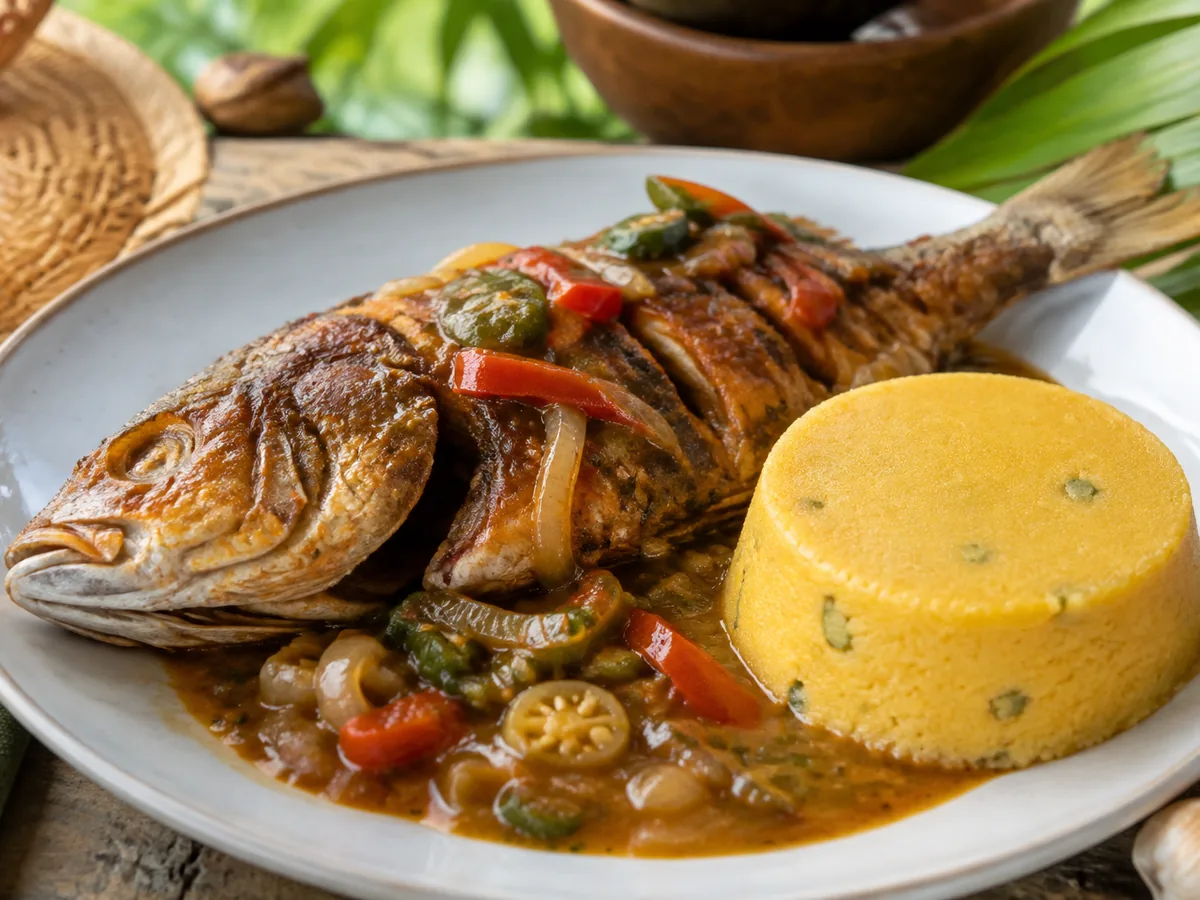
On St. Thomas, St. John and St. Croix, fish and fungi is the official national dish. It joins the ocean to the African provision grounds of the plantation era: whole reef snapper poached in a butter-and-tomato Creole sauce, beside a stiff cornmeal mash bound with okra.
Fungi, pronounced foon-gee, is beaten with a wooden stick until the okra’s mucilage and the cornmeal’s starch pull together into a pillowy mass. Spoonfuls of the pan sauce soak into it, and the plate balances sea salt, sweet corn and sharp lime.
Fish and sauce
- 4 whole, about 450 g each4 whole, about 1 lb eachRed or yellowtail snapper, scaled, gutted, gills removed
- 3 large3 largeLimes, two halved for washing, one juiced for the sauce
- 60 g4 TbspUnsalted butter
- 30 ml2 TbspExtra-virgin olive oil
- 200 g1 largeYellow onion, in thin rings
- 150 g1 largeRed bell pepper, in thin strips
- 150 g1 largeGreen bell pepper, in thin strips
- 6 cloves6 clovesGarlic, minced to a paste
- 400 g4 mediumPlum tomatoes, peeled, seeded and finely diced
- 30 g2 TbspTomato paste
- 15 ml1 TbspWhite cane vinegar or cider vinegar
- 4 sprigs4 sprigsFresh thyme, leaves strippeddivided
- 1 whole1 wholeScotch bonnet, unpunctured, stem on
- 350 ml1½ cupsSeafood stock or water
- 10 g2 tspFine sea salt6 g for the fish, 4 g for the sauce
- 3 g1 tspBlack pepper
Fungi
- 250 g1½ cupsFine yellow cornmeal
- 200 g2 cupsFresh okra, in 5 mm rounds
- 750 ml3¼ cupsCold water600 ml for the pot, 150 ml for the slurry
- 45 g3 TbspUnsalted butter
- 6 g1 tspFine sea salt
Okra binds the cornmeal
Okra simmered at 95 °C sheds its mucilage, long acidic polysaccharides, into the water. Cornmeal streamed in as a cold slurry hydrates grain by grain, and beating the paste against the pot shears it smooth as the starch gelatinises above 85 °C.
Poach, never boil
Snapper muscle contracts hard above 65 °C and wrings itself dry. Held at 85 °C in the sauce, the flesh reaches 60 to 63 °C, juicy and in whole flakes.
The five tastes on this plate
Salt seasons the scored fish, the sauce and the fungi. Fat is the butter in both. Acid is lime and cane vinegar against the butter. Heat is the Scotch bonnet's steam, garlic, thyme and pepper. Umami is bone-in snapper, tomato paste and stewed okra.
Equipment
- 12 to 14-inch heavy skillet with a tight lid
- 3-quart heavy saucepan
- Wooden fungi stick or a stiff flat wooden paddle
- Whisk
- Small bowl or ramekin, for shaping
A Dutch oven for the fish and an iron pot with a wooden turnstick for the fungi is the island setup. A wide lidded skillet and a heavy saucepan with a stiff wooden spoon do the same.
Method
Clean and season the fish20 min
Cut three diagonal slits 5 mm deep through the thick dorsal flesh on each side. Rub the fish inside and out with the cut limes, rinse, and pat dry. Season skin, cavity and cuts with 6 g salt, the pepper and half the thyme. Rest 15 minutes.
Make three diagonal 5 mm-deep cuts in the thick flesh on each side. Rub fish inside and out with cut limes, rinse and dry. Season skin, cavities and cuts with 6 g salt, pepper and half the thyme; rest 15 minutes.
Simmer the okra8 min
Bring 600 ml water to the boil in the saucepan with the okra, 45 g butter and 6 g salt. Boil over medium 6 to 8 minutes until the okra is tender and the water slightly viscous. Turn to low.
Bring 600 ml water to the boil in the saucepan with the okra, 45 g butter and 6 g salt. Boil over medium 6 to 8 minutes until the okra is tender and the water slightly viscous. Turn to low.
Beat the fungi20 min
Whisk the cornmeal into the remaining 150 ml cold water to a smooth slurry. Pour it into the okra water in a steady stream, whisking hard. Switch to the paddle and beat the mixture against the base and sides over medium-low 12 to 15 minutes until it swells, absorbs all the liquid and pulls cleanly from the pot in a glossy ball. Cover, lowest heat, 5 minutes, then off.
Whisk cornmeal with remaining 150 ml cold water; stream into okra water, whisking hard. Paddle-beat against base and sides over medium-low 12–15 minutes until liquid is absorbed and a glossy ball pulls cleanly away. Cover on lowest heat 5 minutes; turn off.
Build the Creole sauce10 min
Melt the 60 g butter with the oil in the skillet over medium. Sauté the onion and both peppers 4 to 5 minutes until soft. Stir in the garlic, tomato paste, diced tomato, remaining thyme and 4 g salt and cook 3 minutes until the tomato collapses. Add the vinegar and stock and bring to a simmer.
Melt 60 g butter with oil over medium; soften onion and both peppers 4–5 minutes. Add garlic, tomato paste, diced tomatoes, remaining thyme and 4 g salt; cook 3 minutes until tomatoes collapse. Add vinegar and stock; simmer.
Poach the snapper14 min
Nestle the fish into the sauce in one layer, spooning some over the top. Rest the whole Scotch bonnet in the middle. Lower to medium-low, cover, and poach at about 85 °C for 12 to 14 minutes until the dorsal meat flakes to the bone, 60 to 63 °C. Squeeze the lime juice over and lift out the pepper.
Set fish in one layer in sauce; spoon sauce over and add whole unpunctured Scotch bonnet. Cover; poach medium-low around 85 °C, never boiling, 12–14 minutes until flesh flakes to the bone at 60–63 °C. Add lime juice; remove pepper.
Shape and serve
Dip a small bowl in warm water, spoon in fungi, swirl and turn it out as a dome beside a whole fish. Ladle the sauce with its peppers and onion over the snapper so it pools around the fungi.
Dip a small bowl in warm water, spoon in fungi, swirl and turn it out as a dome beside a whole fish. Ladle the sauce with its peppers and onion over the snapper so it pools around the fungi.
Sensory cues of doneness
- Visual: a whole snapper in crimson sauce with pepper rings and onion strands; a smooth golden mound of fungi flecked with green okra.
- Auditory: a gentle sub-boil murmur around the fish; heavy slapping thuds of the paddle in the fungi pot.
- Olfactory: sweet fish, melting butter, thyme, sautéed peppers, toasted cornmeal, a faint Scotch bonnet fruitiness.
Check for whole snapper in crimson pepper-onion sauce and smooth golden fungi with green okra. Expect gentle poaching and heavy paddle sounds, with fish, butter, thyme, peppers, cornmeal and Scotch bonnet aromas.
Troubleshooting
- Lumpy fungi.
Dry cornmeal dumped into boiling water. Slurry it in cold water first and stream it in while whisking.
- Shredded, dry fish.
It boiled. Keep the liquid at a gentle sub-boil with the lid on.
- A blistering sauce.
The pepper broke. Float it whole with the stem on; it gives aroma only.
Substitutions
One-to-one swaps, with the technique change each one needs.
Ingredient substitutions
| Ingredient | Replace with | Culinary impact and technique adjustment |
|---|---|---|
| Red snapper | Yellowtail snapper, black sea bass or whole branzino | Whole fish gives the sauce its bone flavour |
| Fresh okra | Frozen sliced okra, or 1 Tbsp filé powder | Frozen gives the same mucilage; filé is a substitute binder |
| Fine yellow cornmeal | Fine stone-ground polenta | Must be fine; coarse polenta needs double the water and time |
Scaling
Half
Two snappers in a 10-inch skillet; fungi from 125 g cornmeal and 375 ml water, same 12 to 14 minutes.
Double
Eight fish across two 14-inch skillets; fungi in a 6-quart Dutch oven with a long paddle.
What to serve it with
- Fried sweet plantains
- Thick slices of avocado with sea salt
- A Cruzan rum punch, or cold sorrel
Questions
Other fish?
Yellowtail, silk snapper, or local pot fish such as butterfish or doctorfish are all traditional.
No fresh okra?
Frozen sliced okra, boiled from frozen, releases the same binding mucilage.
Where does the word fungi come from?
From West African fufu, remade with New World maize and okra by enslaved cooks.