Meat Pâtés
The market-square handheld, pronounced pah-tay. Ground beef simmered with onion, garlic, seasoning peppers, a little Scotch bonnet, thyme, tomato paste and Worcestershire, bound with a spoon of flour so it holds no free liquid, chilled cold, sealed inside a thin shortening pastry with a fork-crimped edge, and fried at 180 °C until the crust blisters gold.
- Prep
- 35 min
- Cook
- 20 min
- Serves
- 10 pâtés
- Difficulty
- Medium
Researched · Kitchen testing pending
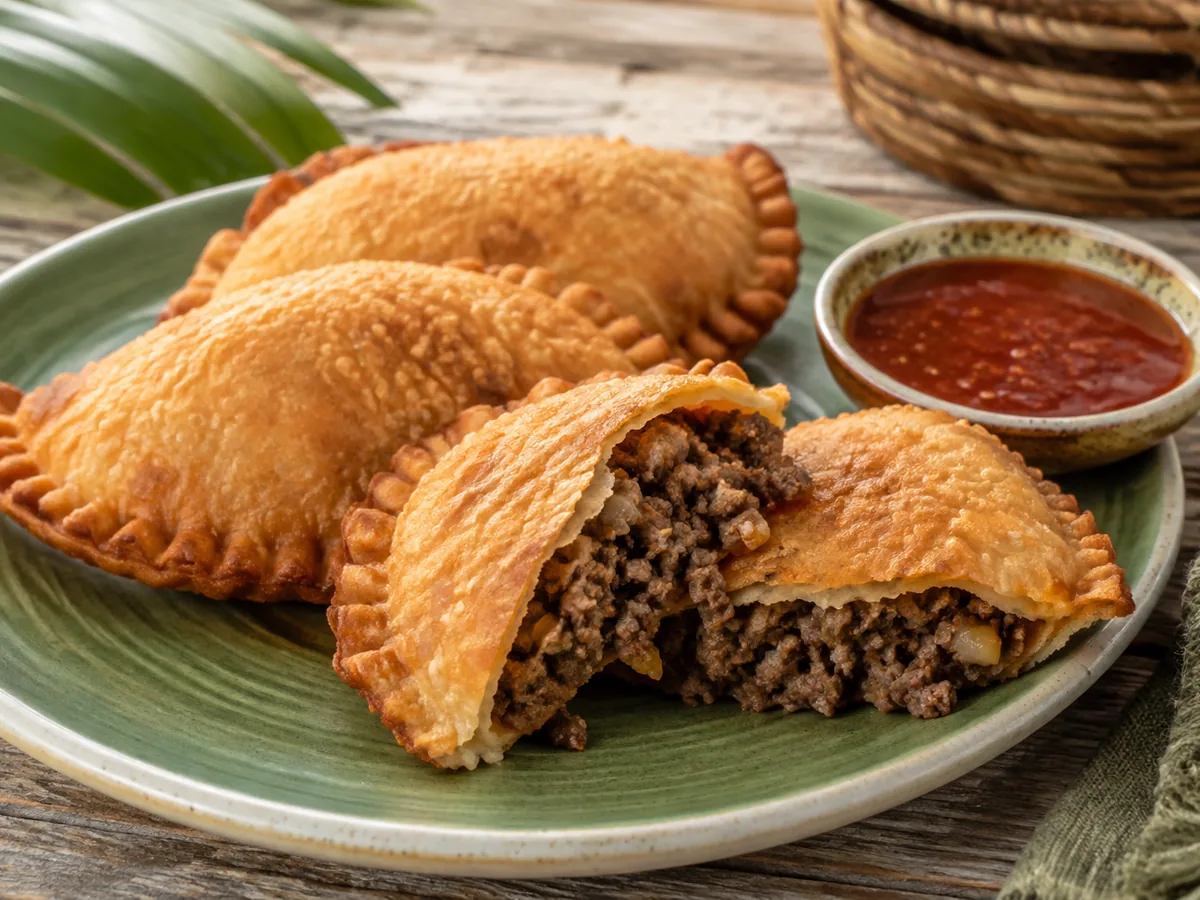
From the dawn carts at Market Square in Charlotte Amalie to the festival village booths in Christiansted, the pâté is the islands’ handheld. It is a cousin of the Jamaican patty and the French-Caribbean turnover, but its own thing: a thin shortening pastry with a touch of baking powder, folded over a spiced beef filling and fried rather than baked.
The filling is simmered with seasoning peppers, thyme, tomato paste and Worcestershire, then bound with flour so it stays moist without leaking. In the oil the pastry blisters into a crust that shatters at the first bite.
Pastry
- 500 g4 cupsPlain flour, sifted
- 10 g2 tspBaking powder
- 8 g1½ tspFine sea salt
- 10 g2 tspGranulated sugar
- 80 g6 TbspVegetable shortening or cold leaf lard, in small cubes
- 240 ml1 cupIce-cold water, plus a spoonful if needed
Filling
- 600 g1⅓ lbGround beef chuck, 85/15
- 30 ml2 TbspNeutral oil or lard
- 200 g1 largeYellow onion, in fine dice
- 4 cloves4 clovesGarlic, minced to a paste
- 4 whole4 wholeSweet seasoning peppers, seeded and minced
- ½ whole½ wholeScotch bonnet, seeded and minced very fine
- 4 sprigs4 sprigsFresh thyme, leaves stripped
- 30 g2 TbspTomato paste
- 15 ml1 TbspWorcestershire sauce
- 15 ml1 TbspCider vinegar or lime juice
- 15 g2 TbspPlain flour, to bind
- 120 ml½ cupBeef stock or water
- 8 g1½ tspFine sea salt
- 3 g1 tspBlack pepper
Frying
- 1 L4 cupsVegetable oil or lard
A dry filling or a burst seam
Two tablespoons of flour gelatinise in the meat juices and hold them. Any free liquid sealed in the pastry turns to steam at 180 °C and blows the crimp open into the oil.
Cold fat, cold water, a short rest
Shortening rubbed into the flour coats the gluten proteins; ice water hydrates without toughening; thirty minutes of rest relaxes the dough so it rolls to 2.5 mm without springing back.
The five tastes on this plate
Salt seasons pastry and filling. Fat is shortening in the crust and hot oil on it. Acid is tomato paste, vinegar and Worcestershire. Heat is Scotch bonnet, garlic, pepper and thyme. Umami is browned chuck, tomato paste and Worcestershire.
Equipment
- 12-inch skillet
- 5 to 6-quart Dutch oven with a deep-fry thermometer
- Rolling pin
- Dinner fork, for crimping
- Slotted skimmer and a wire rack
Carnival booths fry in a blackened iron dutchy. At home, a heavy Dutch oven and a thermometer held at 180 °C.
Method
Cook the filling20 min
Heat the oil in the skillet over medium and sauté the onion, garlic, seasoning peppers and Scotch bonnet 5 minutes. Add the beef and cook 6 to 8 minutes, breaking it fine, until browned. Stir in the tomato paste, Worcestershire, vinegar, thyme, pepper and salt. Sprinkle over the flour and stir 1 minute. Add the stock and simmer 6 to 8 minutes until thick and glossy with no pooling liquid. Chill completely.
Sauté onion, garlic and both peppers in oil over medium 5 minutes. Brown beef 6–8 minutes, breaking finely. Add tomato paste, Worcestershire, vinegar, thyme, pepper and salt. Stir in flour 1 minute; add stock and simmer 6–8 minutes until glossy with no pooling liquid. Chill completely.
Make and rest the dough35 min
Whisk the flour, baking powder, sugar and salt. Rub in the cold shortening until sandy with pea-sized flecks. Add the ice water and stir with a fork to a soft dough. Knead one minute only. Divide into 10 balls of about 80 g, cover with a damp cloth, and rest 30 minutes.
Mix flour, baking powder, sugar and salt. Rub in cold shortening to sandy crumbs with pea-sized flecks. Fork-mix ice water to a soft dough; knead only 1 minute. Divide into ten roughly 80 g balls, cover with damp cloth and rest 30 minutes.
Roll and fill15 min
Roll each ball on a floured board to an 18 cm circle, 2.5 mm thick. Spoon 60 g of cold filling onto one half, leaving a 1.5 cm border. Brush the border with water, fold the bare half over, and press out the trapped air.
Roll each ball on a floured board to 18 cm across and 2.5 mm thick. Place 60 g cold filling on half, leaving 1.5 cm border. Wet border, fold dough over and press out trapped air.
Crimp5 min
Crimp the curved edge twice with a floured fork for an airtight seal and trim any ragged edge. Keep the assembled pâtés cold under parchment.
Crimp the curved edge twice with a floured fork for an airtight seal and trim any ragged edge. Keep the assembled pâtés cold under parchment.
Fry15 min
Heat the oil to 180 °C. Lower in 2 or 3 pâtés at a time and fry 3 to 4 minutes, turning once, until puffed, blistered and golden, with the filling at 74 °C. Drain on the rack 2 minutes.
Heat the oil to 180 °C. Lower in 2 or 3 pâtés at a time and fry 3 to 4 minutes, turning once, until puffed, blistered and golden, with the filling at 74 °C. Drain on the rack 2 minutes.
Serve
Warm, wrapped in brown wax paper, with pepper sauce.
Serve warm, wrapped in brown wax paper, with pepper sauce.
Sensory cues of doneness
- Visual: golden-amber half-moons covered in tiny crisp blisters, with rigid deep-gold crimped edges.
- Auditory: vigorous bubbling that quiets as the pastry finishes; a brittle crackle at the bite.
- Olfactory: fried pastry, toasted onion, savoury beef, thyme, Scotch bonnet.
Look for puffed golden-amber half-moons with tiny crisp blisters and firm golden crimps. Expect frying bubbles to quiet and a brittle crust, with pastry, toasted onion, beef, thyme and Scotch bonnet aromas.
Storing it
Freeze raw assembled pâtés on a tray, then bag. Fry from frozen at 170 °C for 5 to 6 minutes.
Troubleshooting
- The dough tore while sealing.
Warm filling melted the shortening. The filling must be fridge-cold.
- Seams burst in the oil.
Trapped air. Press it out before crimping.
- Pale, heavy, greasy pâtés.
Oil under 175 °C. Hold 180 and fry no more than three at once.
Substitutions
One-to-one swaps, with the technique change each one needs.
Ingredient substitutions
| Ingredient | Replace with | Culinary impact and technique adjustment |
|---|---|---|
| Ground chuck | Desalted flaked salt cod, or minced chicken thigh | Saltfish pâtés are the island breakfast |
| Vegetable shortening | Rendered leaf lard or cold unsalted butter | Lard gives the traditional blistered flake |
| Sweet seasoning peppers | Cubanelle, or green bell pepper with a pinch of coriander | Mild herbal fruitiness |
Scaling
Half
Five pâtés, fried in two batches.
Double
Twenty, assembled in two rounds and fried three at a time so the oil holds 180 °C.
What to serve it with
- Mango-tamarind chutney or a yellow Scotch bonnet pepper sauce
- Cold coconut water from the green nut
- Passionfruit juice, or a cold Caribbean lager
Questions
Other fillings?
Saltfish with peppers and onion, spiced shredded chicken, and conch in tomato sauce are all common.
Baked?
Brush with egg wash and bake at 200 °C for 20 to 22 minutes. Frying is the street standard.
Frozen ahead?
Yes, raw and assembled. Fry from frozen at 170 °C for 5 to 6 minutes.