Spam Musubi
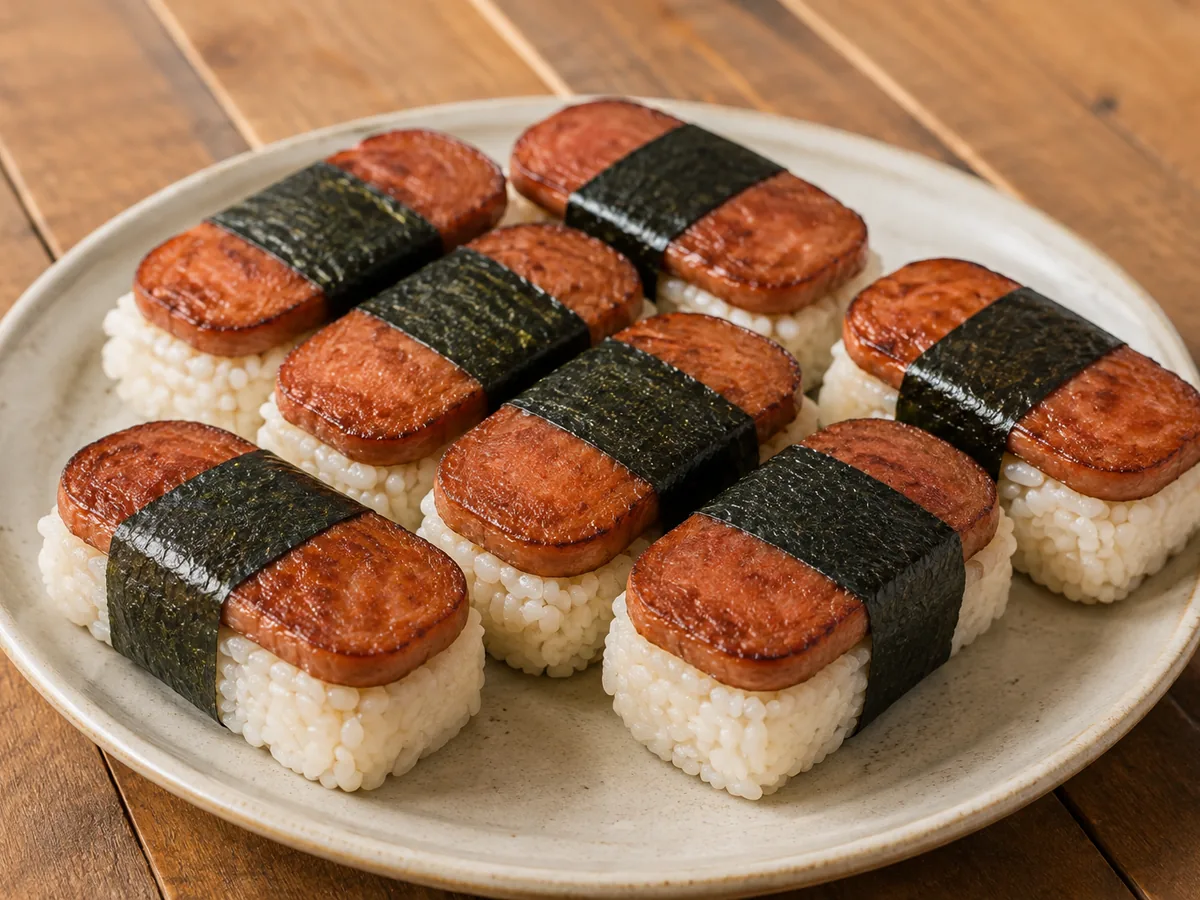
The island's handheld fuel, from surf contests to every convenience store on Oahu. Calrose rice cooked and seasoned with a little rice vinegar, slabs of Spam fried crisp and glazed in shoyu, mirin and sugar until the syrup clings, pressed onto a block of rice dusted with furikake in a musubi mould, and wrapped in a band of nori.
- Prep
- 25 min
- Cook
- 15 min
- Serves
- 8 musubi
- Difficulty
- Medium
Researched · Kitchen testing pending
Spam came to the islands with the Second World War, when civilian shipping was cut off and military rations flooded the Pacific. The mainland saw emergency food; Hawaii saw salty, shelf-stable savouriness and kept it.
The musubi is credited to Barbara Funamura of Kauai in the early 1980s, who crossed the Japanese onigiri with the local canned meat: seasoned rice pressed in a mould, a slab of Spam glazed in sweet shoyu, and a band of toasted nori. It is sold at school cafeterias, surf contests and every 7-Eleven on Oahu.
- 340 g1 can, 12 ozClassic Spam, cut into 8 equal slabs
- 45 ml3 TbspJapanese shoyu
- 30 ml2 TbspMirin
- 30 g2 TbspGranulated sugar
- 400 g2 cups dryCalrose medium-grain rice
- 480 ml2 cupsWater, for the rice
- 15 ml1 TbspRice vinegar
- 20 g2 TbspFurikake
- 4 sheets4 sheetsRoasted sushi nori, each cut lengthwise into 2 strips
- 10 ml2 tspNeutral oil
Medium-grain or nothing
Calrose is about 80 percent amylopectin, the branched starch that turns sticky when steamed and holds a pressed block together. Long-grain rice crumbles the moment you bite.
The glaze is the glue
Fried in a dry pan the Spam browns and renders. Shoyu, mirin and sugar poured over it boil down into a caramel that sticks to the meat and then to the rice.
The five tastes on this plate
Salt is the cured pork, shoyu and nori. Fat is rendered Spam fat on clean rice. Acid is a touch of rice vinegar in the rice. There is no heat. Umami is cured pork, shoyu, nori and furikake.
Equipment
- Rice cooker or lidded saucepan
- 12-inch non-stick skillet
- Musubi press mould, or a cleaned Spam can lined with plastic wrap
- Tongs
The mould is an acrylic press the size of the can. The can itself, lined with plastic wrap, works the same way. Dip the mould in water so the rice does not stick.
Method
Cook the rice30 min
Rinse the rice until the water runs clear. Cook with the 480 ml water until tender, rest 10 minutes, then fold in the rice vinegar with a damp paddle.
Rinse the rice until the water runs clear. Cook with the 480 ml water until tender, rest 10 minutes, then fold in the rice vinegar with a damp paddle.
Slice the Spam2 min
Turn the block out and cut crosswise into 8 slices about 8 mm thick.
Turn the block out and cut crosswise into 8 slices about 8 mm thick.
Mix the glaze1 min
Whisk the shoyu, mirin and sugar until the sugar dissolves.
Whisk the shoyu, mirin and sugar until the sugar dissolves.
Fry6 min
Heat the oil in the skillet over medium-high and fry the slices 2 to 3 minutes a side until browned and crisp at the edges.
Heat the oil in the skillet over medium-high and fry the slices 2 to 3 minutes a side until browned and crisp at the edges.
Glaze2 min
Pour the glaze over the sizzling slices, lower to medium, and turn them 1 to 2 minutes until it thickens to a glossy syrup that coats each one.
Pour the glaze over the sizzling slices, lower to medium, and turn them 1 to 2 minutes until it thickens to a glossy syrup that coats each one.
Set the mould1 min
Lay a nori strip rough side up on the board and set the mould across its centre.
Lay a nori strip rough side up on the board and set the mould across its centre.
Press the rice2 min
Wet the mould and press. Add about half a cup of warm rice and press firmly into an even 2.5 cm block.
Wet the mould and press. Add about half a cup of warm rice and press firmly into an even 2.5 cm block.
Top and wrap2 min
Dust the rice with half a teaspoon of furikake and lay a glazed slice on top. Press down on the Spam while lifting the frame off. Fold one side of the nori over, then the other, sealing with a drop of water.
Sprinkle rice with ½ teaspoon furikake; top with one glazed Spam slice. Press Spam down while lifting the mould. Fold each nori end over the top and seal with a drop of water.
Repeat10 min
Make the other seven. Wrap each in plastic while warm if it is going to the beach or a lunchbox.
Make the other seven. Wrap each in plastic while warm if it is going to the beach or a lunchbox.
Sensory cues of doneness
- Visual: a compact block of white rice speckled with furikake under a glossy bronze Spam slab, banded in dark nori.
- Auditory: a loud sizzle as the Spam lands, bubbling as the glaze reduces, a crackle as the nori wraps.
- Olfactory: sweet teriyaki, caramelised pork, toasted sesame, seaweed.
Check for compact rice blocks under glossy bronze Spam, wrapped in dark nori. Expect frying sizzles, glaze bubbles and nori crackle, with sweet teriyaki, caramelised pork, sesame and seaweed aromas.
Troubleshooting
- The block falls apart.
Long-grain rice, or a light press. Calrose, pressed firmly.
- Burnt glaze.
Poured into a screaming pan. Sear first, drop to medium, then glaze.
- Loose rice.
Press harder and evenly; the base has to be compact.
Substitutions
One-to-one swaps, with the technique change each one needs.
Ingredient substitutions
| Ingredient | Replace with | Culinary impact and technique adjustment |
|---|---|---|
| Classic Spam | Spam Tocino or Teriyaki, or a thick-sliced plant-based luncheon meat | Keeps the rectangle and the caramelised bite |
| Calrose rice | Koshihikari sushi rice, or sticky steamed short-grain brown rice | High amylopectin holds the block |
| Furikake | Toasted black and white sesame with crushed nori and sea salt | The nutty, seaweed crunch |
Scaling
Half
Four musubi from half a can and 200 g rice, fried in an 8-inch pan.
Double
Sixteen from two cans; fry in two batches.
What to serve it with
- Chilled papaya, pineapple and mango
- Unsweetened iced green tea or barley tea
- A passion-orange drink, the convenience-store pairing
Questions
Low-sodium Spam?
Yes; many home cooks prefer it because the glaze adds salt. The method is unchanged.
No mould?
Line the empty can with plastic wrap, press the rice in, add furikake and Spam, and lift the wrap to unmould.
Crisp nori or soft?
Fresh, it shatters. Wrapped in plastic for lunch, it softens. Both are loved.