Huli Huli Chicken
The Saturday fundraiser bird. Spatchcocked chickens marinated four hours in a cooked sauce of pineapple juice, shoyu, brown sugar, ketchup, ginger and garlic, seared briefly over kiawe coals, roasted on the cool side of the grill, then brushed and flipped every five minutes with a reduced glaze so the sugar lacquers to mahogany without burning.
- Prep
- 30 min
- Cook
- 50 min
- Serves
- 6
- Difficulty
- Medium
Researched · Kitchen testing pending
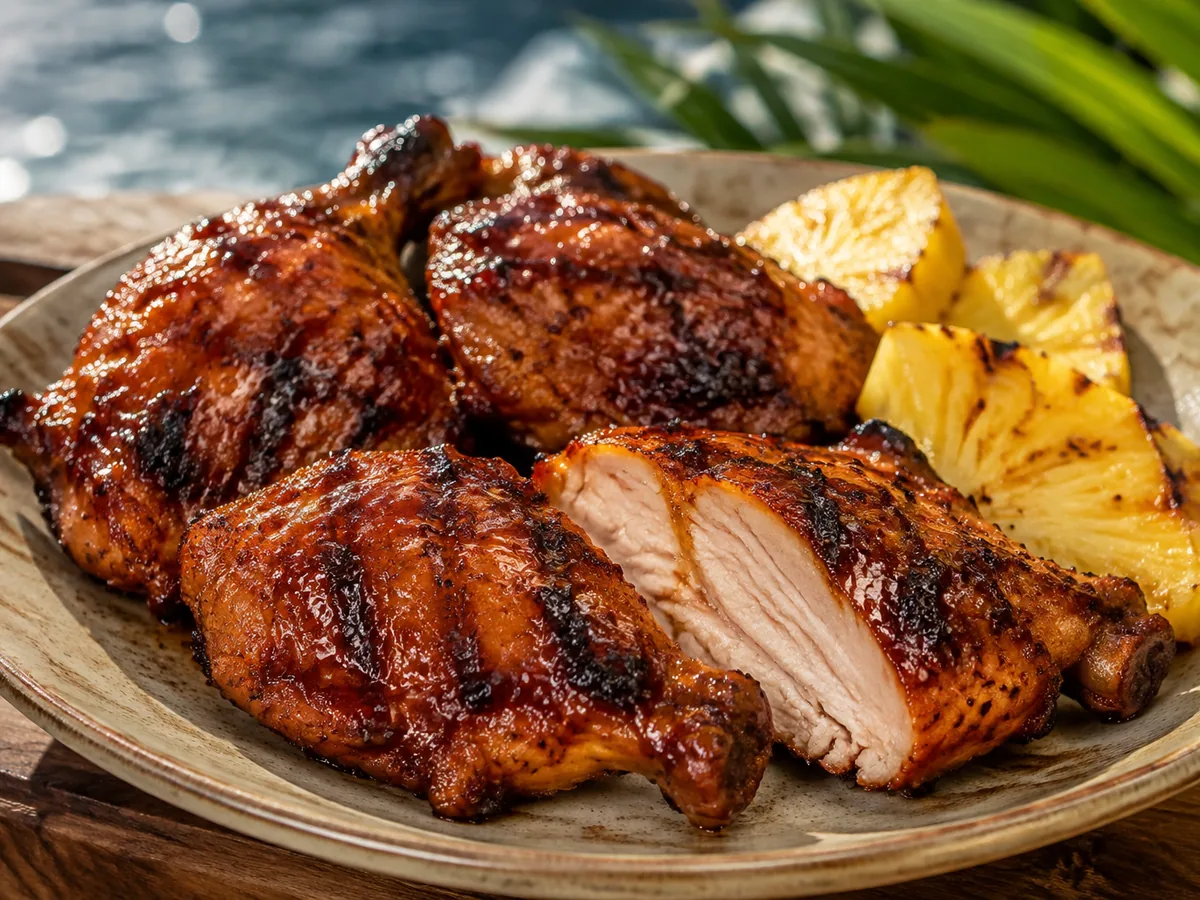
In 1955, Ernest Morgado of Pacific Poultry grilled chicken for a farmers’ meeting in Ewa, Oahu, between two wire racks over charcoal, basting with a teriyaki-style sauce. Every time the racks needed flipping someone shouted huli, turn, and the call became the name. He trademarked it in 1967.
Church fundraisers and school teams still sell it from roadside rigs on Saturdays. The chicken is marinated in shoyu, pineapple, brown sugar, ginger and garlic, then turned again and again over kiawe coals while the glaze builds into a lacquer.
- 2.5 kg2 whole, about 2¾ lb eachWhole chickens, spatchcocked or halved, patted dry
- 240 ml1 cupUnsweetened pineapple juice, canned or simmered
- 180 ml¾ cupJapanese shoyu
- 150 g¾ cup packedDark brown sugar
- 60 g¼ cupKetchup
- 60 ml¼ cupDry sherry or mirin
- 30 g2 TbspFresh ginger, finely grated
- 25 g6 clovesGarlic, finely minced
- 15 ml1 TbspToasted sesame oil
- 15 ml1 TbspWorcestershire sauce
- 30 ml2 TbspApple cider vinegar
- 10 g2 tspHawaiian coarse sea salt, for the birds
- 20 g3 TbspScallions, sliced, to finish
Cooked pineapple juice
Raw pineapple carries bromelain, an enzyme that turns chicken to mush after a few hours. Canned or simmered juice has been heated past 70 °C, so the enzyme is dead and only the sugar and acidity remain.
Why turn so often
Sugar blackens at about 160 °C. Flipping every five minutes over moderate coals lets each side caramelise a thin layer and move away before it burns, and keeps dripping fat from flaring.
The five tastes on this plate
Salt is shoyu and Worcestershire in the marinade. Fat is crisp rendered skin and sesame oil. Acid is pineapple, cider vinegar and ketchup. Heat is grated ginger and garlic. Umami is shoyu, tomato, Worcestershire and charcoal smoke.
Equipment
- Charcoal kettle grill, set for two zones
- Poultry shears
- Saucepan, for the sauce
- Basting brush and heavy tongs
- Instant-read thermometer
The original is a wide kiawe pit and hinged wire racks flipped by hand. A kettle grill with coals banked to one side, or a gas grill with one side off, gives the same direct and indirect zones.
Method
Spatchcock10 min
Cut along both sides of each backbone with shears and remove it. Turn the birds over and press the breastbone flat until it cracks. Season with the sea salt.
Cut along both sides of each backbone with shears and remove it. Turn the birds over and press the breastbone flat until it cracks. Season with the sea salt.
Cook the sauce7 min
Whisk the pineapple juice, shoyu, brown sugar, ketchup, sherry, ginger, garlic, sesame oil, Worcestershire and vinegar in a saucepan. Simmer 5 minutes until the sugar dissolves. Cool.
Whisk canned or previously simmered pineapple juice with shoyu, brown sugar, ketchup, sherry, ginger, garlic, sesame oil, Worcestershire and vinegar. Simmer 5 minutes until sugar dissolves; cool.
Marinate4 hr
Pour 240 ml of the cooled sauce over the chickens in a dish or bag and turn to coat. Refrigerate 3 to 4 hours, never more than 6. Keep the rest of the sauce clean in the pan.
Pour 240 ml of the cooled sauce over the chickens in a dish or bag and turn to coat. Refrigerate 3 to 4 hours, never more than 6. Keep the rest of the sauce clean in the pan.
Reduce the glaze8 min
Simmer the reserved sauce 6 to 8 minutes until reduced by a third to a syrupy glaze.
Simmer the reserved sauce 6 to 8 minutes until reduced by a third to a syrupy glaze.
Set the fire20 min
Bank hot hardwood coals to one side and leave the other empty. Hold the grill at 175 to 190 °C with the vents. Oil the grate.
Bank hot hardwood coals to one side and leave the other empty. Hold the grill at 175 to 190 °C with the vents. Oil the grate.
Sear6 min
Skin-side up over the coals 3 minutes, then flip skin-side down 3 minutes for light grill marks.
Skin-side up over the coals 3 minutes, then flip skin-side down 3 minutes for light grill marks.
Roast indirect20 min
Move to the cool side, skin up, close the lid and roast 20 minutes.
Move to the cool side, skin up, close the lid and roast 20 minutes.
The huli cycle20 min
Brush all over with glaze, flip, close the lid 5 minutes. Repeat every 5 minutes for 20 minutes, four flips in all, building the lacquer.
Brush all over with glaze, flip, close the lid 5 minutes. Repeat every 5 minutes for 20 minutes, four flips in all, building the lacquer.
Check and rest10 min
Thighs should read 79 to 82 °C and breasts 74 °C. Brush with a last coat of warm glaze, tent, and rest 10 minutes. Carve into legs, thighs and breast quarters and scatter scallions.
Thighs should read 79 to 82 °C and breasts 74 °C. Brush with a last coat of warm glaze, tent, and rest 10 minutes. Carve into legs, thighs and breast quarters and scatter scallions.
Sensory cues of doneness
- Visual: a glistening mahogany lacquer, amber char along the skin folds, clear juices.
- Auditory: rhythmic hissing as fat and glaze hit the coals, with short puffs of white smoke.
- Olfactory: caramelised brown sugar, woodsmoke, toasted ginger and garlic, pineapple.
Look for glossy mahogany glaze, amber char in skin folds and clear juices. Expect rhythmic hissing and brief white smoke, with caramelised sugar, woodsmoke, ginger, garlic and pineapple aromas.
Troubleshooting
- Cross-contamination.
Basting with the marinade that held raw chicken. Split the sauce first; baste only with the clean, reduced portion.
- Black, acrid glaze.
Glazed chicken left over direct coals. Once the sugar goes on, cook only on the indirect side.
- Mushy flesh.
Marinated past 8 hours. Four to six hours at most.
Substitutions
One-to-one swaps, with the technique change each one needs.
Ingredient substitutions
| Ingredient | Replace with | Culinary impact and technique adjustment |
|---|---|---|
| Whole chicken | Bone-in, skin-on thighs and drumsticks | They take the basting and the heat without drying |
| Kiawe charcoal | Lump charcoal with mesquite or applewood chunks | Sweet, clean smoke |
| Pineapple juice | Guava nectar or apple juice | Fruit sugar and acid for the caramel |
Scaling
Half
One chicken with half the marinade and glaze; still about 45 minutes.
Double
Four chickens need a 26-inch kettle or a pit with enough indirect room.
What to serve it with
- Two scoops of Calrose rice to catch the glaze
- Hawaiian macaroni salad
- Grilled pineapple spears
Questions
Indoors?
Roast the spatchcocked bird on a rack at 190 °C for 35 minutes, then baste and broil on low 5 minutes a side until caramelised.
What is kiawe?
Hawaiian mesquite, brought to the islands in 1828. It burns hot with a sweet smoke that defines local barbecue.
Why ketchup?
Cooked tomato for umami, pectin so the glaze clings, and vinegar so it does not slide off the skin.