Lomi Lomi Salmon
The cold, salty counterpoint on the luau plate. Fresh salmon packed in coarse sea salt overnight, soaked two hours to bring the salt down, shredded, then massaged by hand with diced ripe tomato and sweet Maui onion until the vegetables give up their juice and the fish oils bind it, chilled, and finished with crushed ice at the table.
- Prep
- 25 min
- Serves
- 6
- Difficulty
- Medium
Researched · Kitchen testing pending
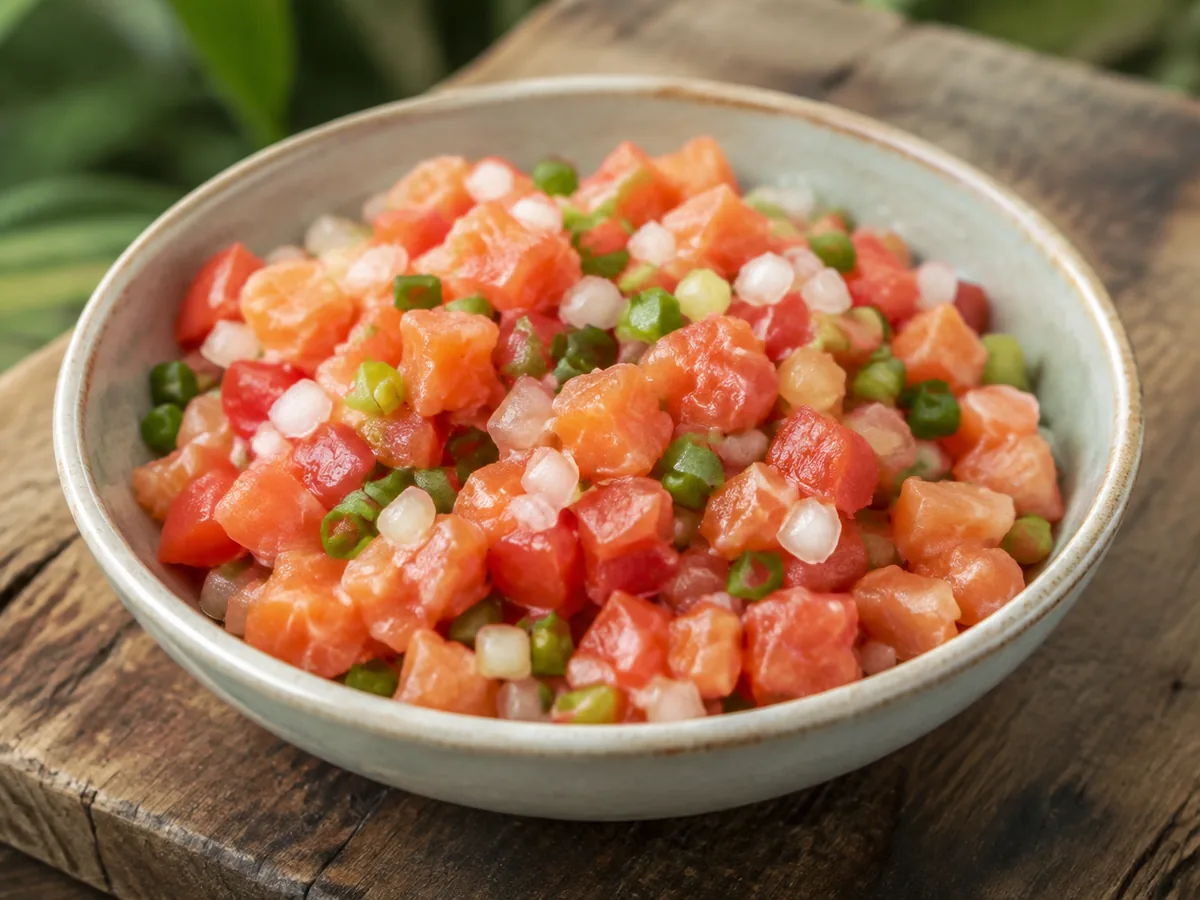
Salmon does not swim in Hawaiian waters. In the 1830s, Yankee whalers and Hudson’s Bay traders running between the Pacific Northwest and Honolulu bartered barrels of heavily salted salmon for Hawaiian salt, provisions and sandalwood, and the islands took the fish into their own kitchen.
Lomi-lomi means to massage. Desalted salmon is shredded and kneaded by hand with sweet onion and ripe tomato until the juices run, then chilled and tumbled with crushed ice. On the plate it is the cold, salty, sharp relief beside kalua pig and lau lau.
- 450 g1 lbFresh skinless salmon fillet, king, sockeye or Atlantic
- 60 g¼ cupHawaiian coarse sea salt or kosher salt, for the cure
- 450 g3 largeVine-ripened tomatoes, cored, seeded, in 6 mm dice
- 150 g1 largeMaui sweet onion, in 6 mm dice
- 30 g¼ cupScallions, thinly sliced
- 3 g½ tspHawaiian coarse sea salt, to finish if needed
- 150 g1 cupCrushed ice
- 2 g½ tspHawaiian chili pepper, seeded and mincedoptional
The cure and the soak
Dry salt pulls water from the fish and firms the protein. Two hours in fresh water, changed twice, brings it back to about 3 percent salt, seasoned through but not harsh.
Hands, not a spoon
Massaging crushes tomato and onion cells, releasing juice and pectin, and breaks the salmon along its seams so its oil emulsifies with the juices into the glossy liquid that binds the salad.
The five tastes on this plate
Salt is the cured salmon, softened by the soak. Fat is the salmon oil worked out by hand. Acid is ripe tomato. Heat is raw sweet onion, scallion and the optional chili. Umami is cured fish and tomato.
Equipment
- Rimmed plate and plastic wrap, for the cure
- Large chilled non-reactive bowl
- Clean hands
A wooden calabash worked by hand is the tradition. Chill a glass or steel bowl 15 minutes in the freezer before you start.
Method
Cure12 hr
Coat the fillet on all sides with the coarse salt, set it on a rimmed plate, cover and refrigerate 12 to 24 hours until firm and deep orange-pink.
Coat the fillet on all sides with the coarse salt, set it on a rimmed plate, cover and refrigerate 12 to 24 hours until firm and deep orange-pink.
Desalt2 hr
Rinse off the surface salt. Soak in cold fresh water 2 hours, changing the water twice.
Rinse off the surface salt. Soak in cold fresh water 2 hours, changing the water twice.
Shred5 min
Pat dry and pull or cut into 6 to 12 mm shreds.
Pat dry and pull or cut into 6 to 12 mm shreds.
Combine2 min
Put the salmon, tomato, onion and chili in the chilled bowl.
Put the salmon, tomato, onion and chili in the chilled bowl.
Lomi4 min
With clean hands, knead, squeeze and massage 3 to 4 minutes, bursting the tomato so its juice joins the fish oil and onion juice in a cloudy liquid at the bottom of the bowl.
With clean hands, knead, squeeze and massage 3 to 4 minutes, bursting the tomato so its juice joins the fish oil and onion juice in a cloudy liquid at the bottom of the bowl.
Scallions and chill1 hr
Fold in the scallions. Cover and refrigerate at least 1 hour, up to 4, to 4 °C.
Fold in the scallions. Cover and refrigerate at least 1 hour, up to 4, to 4 °C.
Ice and serve
At the table fold in the crushed ice and serve in chilled bowls.
At the table fold in the crushed ice and serve in chilled bowls.
Sensory cues of doneness
- Visual: confetti of coral salmon, scarlet tomato, translucent onion and green scallion with melting ice.
- Auditory: a wet squelch and crunch as the hands work the bowl.
- Olfactory: clean ocean, sweet ripe tomato, raw sweet onion, cold water.
Look for coral salmon, scarlet tomato, translucent onion and green scallion mixed with melting ice. Expect wet squelching during massage and clean sea, ripe tomato and raw sweet-onion aromas.
Storing it
Best the day it is made. Leftovers keep 2 days; drain the accumulated liquid before serving.
Troubleshooting
- A smoky, wrong flavour.
Smoked lox was used. Cure fresh salmon with salt only, or buy salted salmon.
- Dry, separate pieces.
Stirred with a spoon. Hands only; the pressure makes the emulsion.
- Watery and bland.
Ice went in early. Add it the moment the bowl reaches the table.
Substitutions
One-to-one swaps, with the technique change each one needs.
Ingredient substitutions
| Ingredient | Replace with | Culinary impact and technique adjustment |
|---|---|---|
| Salt-cured salmon | Salt-cured trout or Arctic char | The same fat and pink colour under the cure |
| Maui sweet onion | Walla Walla or Vidalia | Sweet crunch without burn |
| Hawaiian coarse salt | Coarse kosher salt | Draws moisture cleanly, no iodine taste |
Scaling
Half
225 g salmon cured with 30 g salt, soaked 1½ hours, with one large tomato and half an onion.
Double
Cure 900 g in a wide glass dish; massage in two batches for even pressure.
What to serve it with
- Hot kalua pig, steamed lau lau and fresh poi
- A cold Kona lager
- Chilled bowls, always
Questions
Store-bought salted salmon?
Yes. Asian and Hawaiian markets sell it as shake. Soak 2 to 3 hours to desalt before shredding.
Why the ice?
It keeps cured raw fish at a safe 4 °C in warm weather, and its meltwater tunes the salt to the right refreshing level.
How long does it keep?
Eat it the day it is made. Two days at most, drained.