Kalua Pork
The imu, brought indoors. A bone-in pork shoulder scored, pierced, rubbed with liquid smoke and coarse red ʻalaea salt, wrapped in ti and banana leaves inside a Dutch oven, sealed under foil and a heavy lid, and roasted five hours at 160 °C until it reads 95 °C and the bone slides out, then shredded in its own juices.
- Prep
- 25 min
- Cook
- 5 hr 30 min
- Serves
- 8 to 10
- Difficulty
- Medium
Researched · Kitchen testing pending
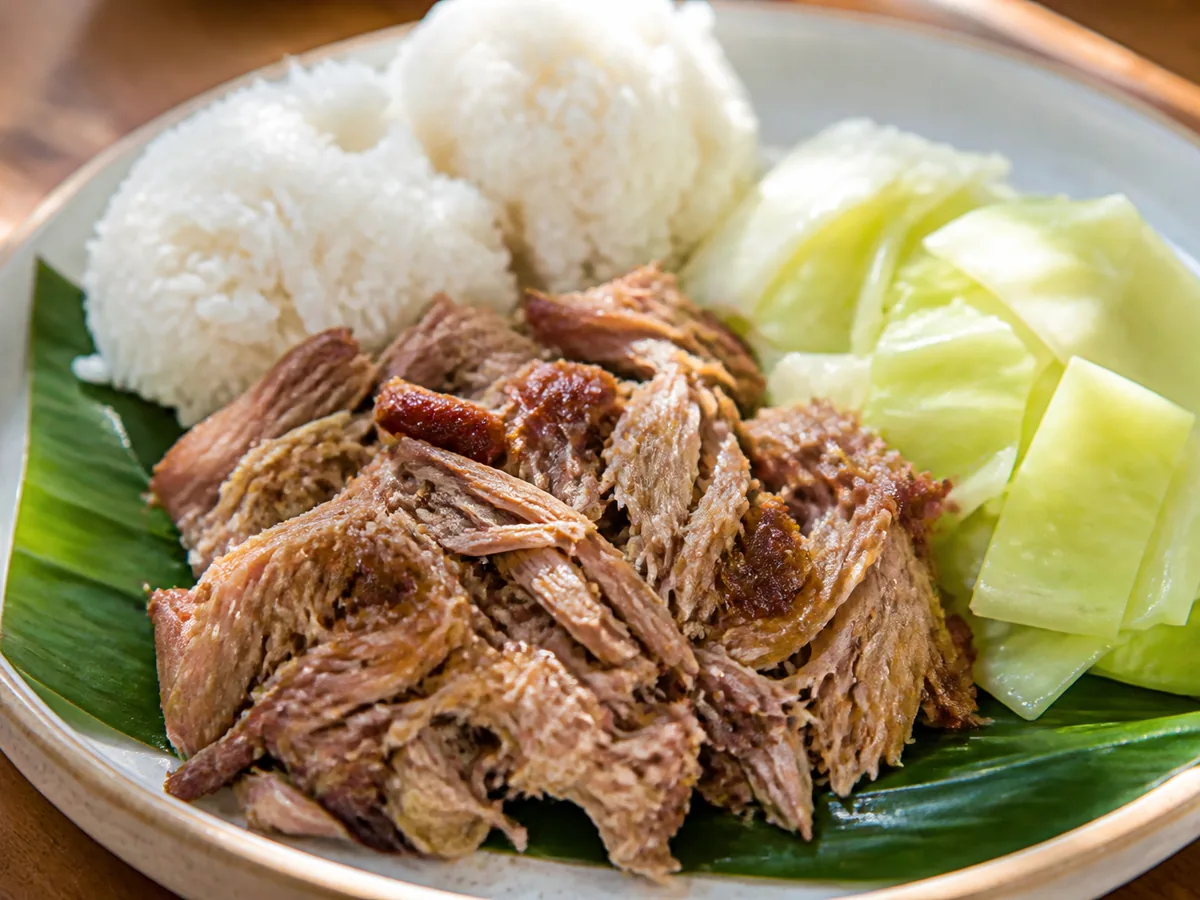
Kālua means to bake in an imu, the underground oven. A pit is dug in volcanic soil, lined with kiawe logs and porous basalt, and once the stones glow, crushed banana stumps go on to make steam. The whole pig, salted inside and out with red ʻalaea salt and wrapped in ti and banana leaves, is buried under mats and earth for eight to twelve hours.
At home the same trapped-steam physics happens in a heavy Dutch oven. Banana and ti leaves seal the shoulder in its own moisture, a measured splash of liquid smoke stands in for the kiawe, and the red salt does the seasoning. Five hours later the bone slides out and the meat falls into shreds.
- 2.7 kg6 lbBone-in pork shoulder, hard fat cap trimmed
- 30 g2 TbspCoarse Hawaiian red ʻalaea sea salt
- 20 ml4 tspNatural hickory or kiawe liquid smoke
- 6 large6 largeFresh ti leaves, central ribs shaved flat
- 3 sheets3 sheetsBanana leaves, wiped clean
- 120 ml½ cupCold water
The leaves are the imu
Wrapped in banana and ti leaves, the pork sits in a sealed microclimate at full humidity. Above 80 °C the leaves also give off the grassy, herbal aroma of pit cooking.
Collagen at 95
Shoulder collagen stays tough below 60 °C and melts into gelatin held between 75 and 90 °C in steam. At 95 °C it has all gone, and the gelatin holds ten times its weight in water in the shreds.
The five tastes on this plate
Salt is red ʻalaea salt with its volcanic clay minerals. Fat is the rendered shoulder melting into gelatin. There is no acid and no heat; the dish is round and savoury. Umami is slow-roasted pork and smoke.
Equipment
- 7 to 8-quart enamelled cast-iron Dutch oven with a tight lid
- Heavy-duty foil
- Paring knife
- Two large forks
The real thing is a pit of hot basalt and banana stumps. A sealed Dutch oven in a low oven, or a foil-wrapped slow cooker, reproduces the trapped steam.
Method
Heat the oven2 min
Heat to 160 °C with a rack in the lower third.
Heat to 160 °C with a rack in the lower third.
Score and pierce5 min
Score the fat cap in a 2.5 cm crosshatch without cutting into the meat. With a paring knife, pierce 12 to 15 slits 2.5 cm deep all over the roast.
Score the fat cap in a 2.5 cm crosshatch without cutting into the meat. With a paring knife, pierce 12 to 15 slits 2.5 cm deep all over the roast.
Smoke and salt5 min
Rub the liquid smoke into the slits and scoring. Rub the coarse red salt firmly into the meat.
Rub the liquid smoke into the slits and scoring. Rub the coarse red salt firmly into the meat.
Prepare the leaves5 min
Pass the banana leaves over a flame or hot pan 5 seconds until glossy and pliable. Shave the thick central vein of each ti leaf flat.
Pass the banana leaves over a flame or hot pan 5 seconds until glossy and pliable. Shave the thick central vein of each ti leaf flat.
Wrap6 min
Line the Dutch oven with overlapping banana and ti leaves, leaving long overhangs. Pour in the water. Set the pork fat-side up in the centre and fold the leaves tightly over it into a sealed parcel.
Line the Dutch oven with overlapping banana and ti leaves, leaving long overhangs. Pour in the water. Set the pork fat-side up in the centre and fold the leaves tightly over it into a sealed parcel.
Seal and roast5 hr 15 min
Cover the pot with foil, press the lid down over it, and roast 5 to 5½ hours undisturbed until the thickest part reads 95 °C and the bone pulls free.
Cover the pot with foil, press the lid down over it, and roast 5 to 5½ hours undisturbed until the thickest part reads 95 °C and the bone pulls free.
Rest and shred25 min
Rest covered 20 minutes. Unwrap carefully, discard the leaves, and shred the pork in the pan juices with two forks, discarding rubbery fat. Toss the shreds in the juices and serve hot.
Rest covered 20 minutes. Unwrap carefully, discard the leaves, and shred the pork in the pan juices with two forks, discarding rubbery fat. Toss the shreds in the juices and serve hot.
Sensory cues of doneness
- Visual: tender shreds tinged pink by the smoke, glistening with clear juices.
- Auditory: a muffled steady bubble inside the sealed pot.
- Olfactory: woodsmoke, roast pork fat, earthy volcanic salt, sweet steamed banana leaf.
Check for tender pork shreds glistening with clear juices and a smoke-pink tint. Expect muffled bubbling inside the sealed pot and woodsmoke, roasted pork, earthy salt and sweet banana-leaf aromas.
Storing it
Keeps 4 days in its juices. Reheat covered with a splash of water. The leftovers make kalua pork and cabbage: sauté shredded cabbage in the juices and fold the pork through.
Troubleshooting
- A chemical, bitter smoke taste.
Too much liquid smoke. Four teaspoons, measured.
- Dry pork.
The pot was opened. Sealed for the whole five hours.
- Dry after shredding.
The pan broth was thrown away. Skim the fat, keep the gelatin-rich juices, and toss the shreds in them.
Substitutions
One-to-one swaps, with the technique change each one needs.
Ingredient substitutions
| Ingredient | Replace with | Culinary impact and technique adjustment |
|---|---|---|
| Red ʻalaea salt | Coarse Maldon or kosher salt | Clean salinity; a pinch of smoked paprika restores the colour |
| Ti leaves | More banana leaves, or parchment | Banana leaves keep the steam and the aroma |
| Boston butt | Bone-in picnic shoulder or wild boar shoulder | The same collagen and fat for pulling |
Scaling
Half
A 1.35 kg butt with 15 g salt and 60 ml water; 3½ hours at 160 °C.
Double
Two roasts in two Dutch ovens, or one deep roasting pan under three layers of foil, about 6½ hours.
What to serve it with
- Two scoops of Calrose rice to catch the drippings
- Hawaiian macaroni salad
- Fresh or two-day sour poi
Questions
What is ʻalaea salt?
Unrefined sea salt mixed with iron-rich volcanic red clay. It tastes mellow and mineral in a way table salt cannot.
Slow cooker?
Line it with banana leaves, add the seasoned pork and 60 ml water, fold the leaves over, and cook on low 8 to 9 hours.
Pork loin?
Never. Loin has no collagen or fat for a long braise and turns chalky.