Ahi Poke
The original, before the mainland salad bar. Sashimi-grade yellowfin cut across the grain into 2 cm cubes in a chilled bowl, folded with coarse Hawaiian sea salt, chopped limu kohu, roasted crushed kukui nut, sweet Maui onion, scallion, shoyu and toasted sesame oil, and eaten within fifteen minutes. No citrus touches the fish.
- Prep
- 20 min
- Serves
- 4 as an appetiser, 2 as a bowl
- Difficulty
- Medium
Researched · Kitchen testing pending
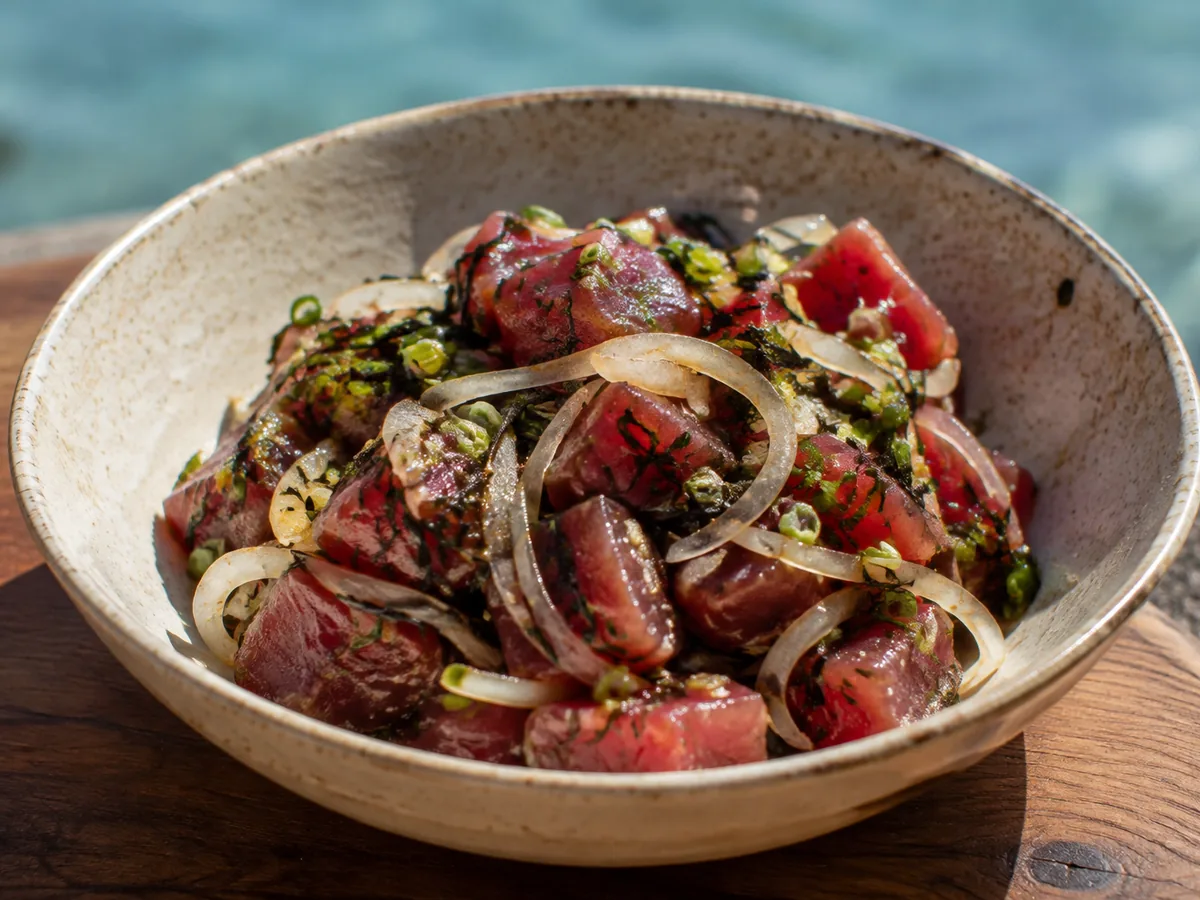
Poke means to slice or cut crosswise. Long before raw fish was buried under sriracha mayo, Hawaiian reef fishermen tossed the day’s catch with coarse sea salt, ocean seaweed and roasted crushed kukui nut and ate it on the spot.
The dish lives in its restraint. No citrus touches the tuna, which keeps the muscle intact and the flesh translucent. Shoyu and sesame oil came with Japanese and Chinese plantation workers in the nineteenth century and fitted in without a fight. With sweet Maui onion and mineral-rich paʻakai, it is Pacific tuna at its plainest and best.
- 450 g1 lbSashimi-grade yellowfin tuna, bloodline removed, well chilled
- 6 g1 tspHawaiian coarse sea salt, paʻakai
- 20 g3 TbspLimu kohu, rinsed and choppedor rehydrated ogo
- 15 g1 TbspInamona, roasted crushed kukui nut
- 60 g½ cupMaui sweet onion, in 6 mm dice
- 30 g¼ cupScallions, thinly sliced on the bias
- 15 ml1 TbspToasted sesame oil
- 30 ml2 TbspJapanese shoyu
- 2 g½ tspHawaiian chili pepper, finely mincedor red pepper flakes
Salt at the last minute
Salt pulls water out of raw tuna by osmosis. Tossed hours ahead, the fish loses its turgor and sits in a pool of its own liquid. Tossed just before eating, the surface tightens and the core stays ruby and tender.
What inamona does
Roasted candlenut is over 60 percent oil. Crushed into the fish, it coats each cut face, slows moisture loss and shields the tuna from the salt while adding a nutty roasted note.
The five tastes on this plate
Salt is paʻakai and shoyu. Fat is inamona, sesame oil and the tuna's own marbling. Acid is deliberately absent; citrus would cook the fish. Heat is raw sweet onion, scallion and a pop of chili. Umami is shoyu, raw ahi and roasted inamona.
Equipment
- Long single-stroke slicing knife
- Chilled non-reactive mixing bowl over crushed ice
- Chilled cutting board
Traditionally a shallow koa-wood calabash that keeps the fish cool. A stainless or glass bowl set over ice does the same. Chill knife, board and bowl 20 minutes first.
Method
Chill everything20 min
Refrigerate the knife, board and bowl 20 minutes. Keep the tuna between 1 and 4 °C until the moment you cut it.
Refrigerate the knife, board and bowl 20 minutes. Keep the tuna between 1 and 4 °C until the moment you cut it.
Trim3 min
Slice away any dark bloodline in single strokes. Pat the loin completely dry.
Slice away any dark bloodline in single strokes. Pat the loin completely dry.
Cube5 min
Cut across the grain into even 2 cm cubes, one clean draw of the blade per cut. Sawing bruises the cells.
Cut across the grain into even 2 cm cubes, one clean draw of the blade per cut. Sawing bruises the cells.
Combine2 min
Put the cubes in the chilled bowl with the onion, scallion and limu. Sprinkle over the sea salt and inamona. Drizzle the shoyu and sesame oil around the rim and add the chili.
Just before serving, combine tuna cubes, onion, scallion and limu in the chilled bowl. Sprinkle with salt and roasted inamona; drizzle shoyu and sesame oil around the rim, then add chili.
Fold1 min
With clean hands or a cold spatula, fold from the bottom up 15 to 20 seconds until every cube is coated, without crushing the fish.
With clean hands or a cold spatula, fold from the bottom up 15 to 20 seconds until every cube is coated, without crushing the fish.
Taste and serve
Taste one cube and adjust the salt. Serve within 15 minutes, or cover and hold on ice up to an hour.
Taste one cube and adjust the salt. Serve within 15 minutes, or cover and hold on ice up to an hour.
Sensory cues of doneness
- Visual: translucent deep-ruby cubes glistening with sesame oil, flecked with red-brown limu and ivory onion.
- Auditory: a soft slick sound as the cubes turn in the cold bowl.
- Olfactory: ocean tide, toasted sesame, roasted nut, sharp green scallion.
Look for glistening translucent ruby tuna cubes with reddish-brown limu and ivory onion. Expect a soft slick mixing sound and ocean, toasted sesame, roasted nut and scallion aromas.
Troubleshooting
- Chalky, brown, rubbery surface.
Lime or lemon got in. Poke is not ceviche; no citrus ever.
- Soft, watery poke.
Warm fish or a warm bowl, or tossed too early. Chill everything and toss right before serving.
- A pool of liquid in the bowl.
Marinated for hours. Fifteen minutes is the window.
Substitutions
One-to-one swaps, with the technique change each one needs.
Ingredient substitutions
| Ingredient | Replace with | Culinary impact and technique adjustment |
|---|---|---|
| Limu kohu | Fresh or rehydrated ogo seaweed | The same brine and crunch; rinse well |
| Inamona | Dry-roasted crushed macadamia with a drop of sesame oil | Similar oil and nuttiness, no laxative effect |
| Maui sweet onion | Vidalia or Walla Walla | Sweet, low-sulphur crunch |
Scaling
Half
225 g tuna with 3 g salt, 15 ml shoyu and 7 ml sesame oil, in a small chilled bowl.
Double
900 g. Fold in batches in a wide chilled pan so the bottom cubes are not crushed.
What to serve it with
- Hot steamed Calrose rice, for the hot-cold contrast
- Poi, whose sour note suits the rich tuna
- A Kona golden ale
Questions
What is inamona, and can I make it?
Roasted, salted kukui nut. Crack the shells, toast the kernels in a dry pan over low heat about 10 minutes until golden, and crush with sea salt. Never eat kukui raw.
Frozen ahi?
Only superfrozen or sashimi-grade. Thaw overnight in the fridge on a rack over a tray so the meltwater drains.
Why limu kohu?
Its peppery, iodine-rich bite and crunch define classic poke. Salted ogo is the clean alternative.