Lau Lau
The ancestral parcel. A chunk of salted pork shoulder and a piece of salted butterfish wrapped in five or six young taro leaves, then bundled in two ti leaves and tied, and steamed three and a half to four hours until the taro has melted into silky greens, the pork is tender and every oxalate needle in the leaves is gone.
- Prep
- 45 min
- Cook
- 4 hr
- Serves
- 6 bundles
- Difficulty
- Hard
Researched · Kitchen testing pending
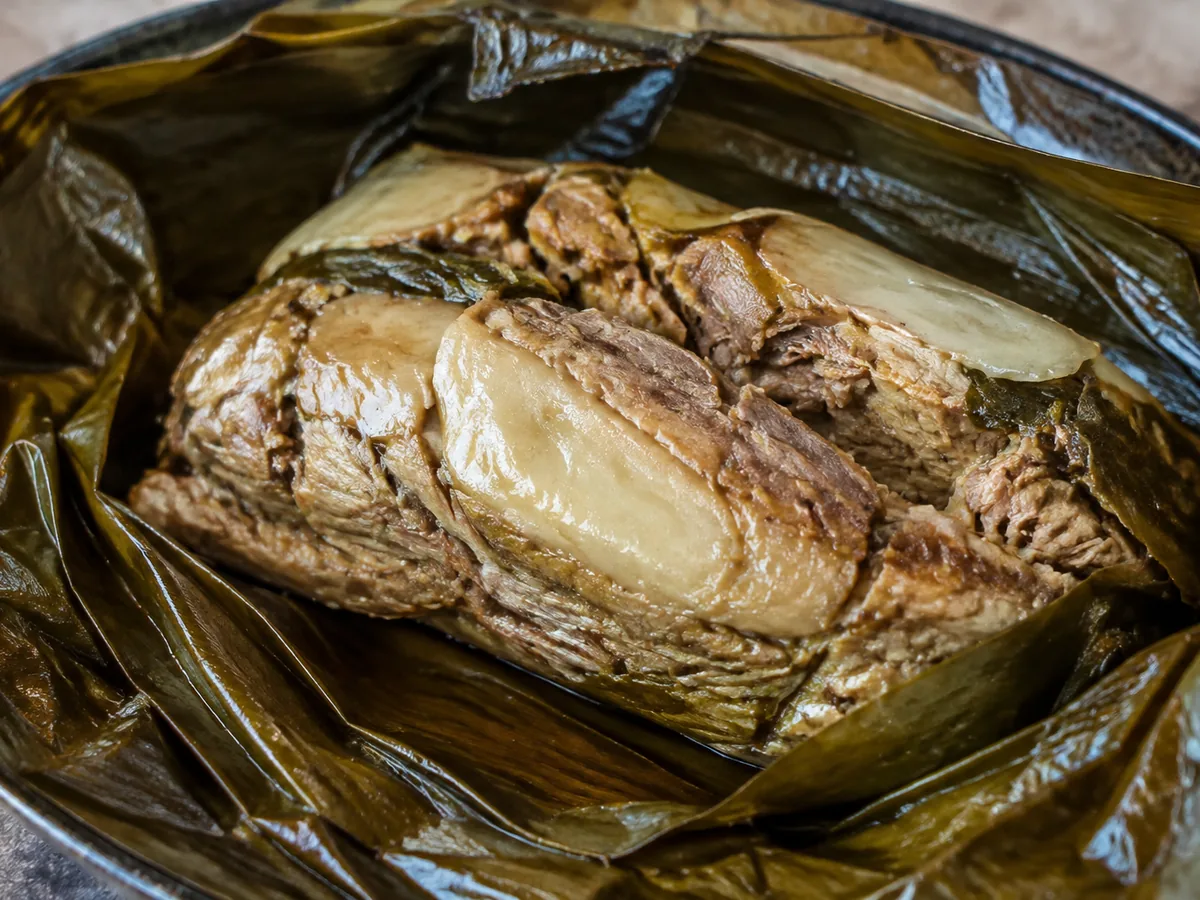
Lau lau, “leaf, leaf”, predates any European arrival. Kalo, the taro, is the elder sibling of humankind in Hawaiian tradition, and its young lūʻau leaves become silky greens when cooked with enough patience.
The bundle layers fatty pork shoulder and a piece of salted butterfish inside several taro leaves, wrapped again in tough ti leaves and tied. The ti is only a vessel. Inside, the pork fat and fish oil baste the taro for hours until it melts into mineral-rich greens, and the long steam does the essential work of destroying the leaf’s oxalate needles.
- 900 g2 lbPork shoulder, in 6 equal chunks
- 340 g12 ozSalted butterfish, black cod, in 6 pieces
- 30 to 36 leaves30 to 36 leavesFresh young taro leaves, lūʻau, stems trimmed, washed
- 12 leaves12 leavesFresh ti leaves, central rib shaved flat
- 20 g1½ TbspHawaiian coarse sea salt or red ʻalaea salt
- 6 pieces6 piecesKitchen twine, 45 cm each
The raphides
Raw taro leaves hold needle-shaped calcium oxalate crystals that sting the mouth and throat. Three and a half to four hours of moist heat above 90 °C breaks the plant cells and the crystal matrix apart. Shorter, and it scratches.
Butterfish as the baste
Sablefish is very oily. As the parcel steams, its fat renders with the pork fat and works through the taro layers, softening the leaves into something silky.
The five tastes on this plate
Salt is sea salt on the pork and the cure in the fish. Fat is pork shoulder and black cod basting the greens. There is no acid in the parcel. Heat comes only at the table, as chili pepper water. Umami is the salted fish, braised pork and mineral taro.
Equipment
- Large stockpot with a steamer rack, or a tiered steamer
- Kitchen twine
- Tongs
- Kettle, for topping up boiling water
In an imu the bundles steam eight hours. A stockpot with three inches of boiling water under a rack, covered tight and topped up every 45 minutes, does it in four.
Method
Season the proteins5 min
Salt the pork chunks well. Rinse the butterfish briefly under cold water to remove surface salt and pat dry.
Salt the pork chunks well. Rinse the butterfish briefly under cold water to remove surface salt and pat dry.
Prepare the taro leaves10 min
Trim away the tough stems, rinse the leaves thoroughly and shake dry.
Trim away the tough stems, rinse the leaves thoroughly and shake dry.
Prepare the ti leaves10 min
Holding the knife flat, shave the raised rib on the underside of each leaf so it lies flat. Steam or microwave 15 seconds to soften.
Holding the knife flat, shave the raised rib on the underside of each leaf so it lies flat. Steam or microwave 15 seconds to soften.
Build a parcel15 min
Lay two ti leaves in an X, glossy side down. Overlap 5 or 6 taro leaves in the centre into a thick bed. Set a piece of butterfish and a chunk of pork in the middle. Gather the taro leaves tightly up and over into a sealed inner parcel.
Cross two ti leaves glossy-side down. Overlap 5–6 taro leaves in the centre; add one piece each of butterfish and pork. Fold taro tightly around the filling to seal the inner parcel.
Tie2 min
Pull the bottom ti leaf up over the parcel, then the second. Gather the tips and tie snugly with twine. Repeat for six bundles.
Pull the bottom ti leaf up over the parcel, then the second. Gather the tips and tie snugly with twine. Repeat for six bundles.
Steam4 hr
Set the bundles on the rack over at least 7 cm of rapidly boiling water. Cover tightly and steam over medium heat 3½ to 4 hours, checking the water every 45 minutes and topping up only with boiling water.
Rack bundles above at least 7 cm rapidly boiling water. Cover tightly; steam over medium 3½–4 hours, checking every 45 minutes and replenishing with boiling water only. Do not shorten cooking: undercooked taro leaves irritate the mouth and throat.
Serve
Lift out with tongs, snip the twine, and unwrap and discard the outer ti leaves. Serve the taro parcel hot with rice and poi.
Lift out with tongs, snip the twine, and unwrap and discard the outer ti leaves. Serve the taro parcel hot with rice and poi.
Sensory cues of doneness
- Visual: a glossy emerald ti bundle that opens on blackish-green silky taro around tender pork and flaky ivory fish.
- Auditory: a steady hiss and bubble of the steam bath under the lid.
- Olfactory: an earthy, sweet tea-like scent of steamed ti leaf with braised pork and salt fish.
Open the ti wrapper to check for silky dark-green taro, tender pork and flaky ivory fish. Expect steady steaming and earthy, sweet leaf aromas with braised pork and salted fish.
Troubleshooting
- An itchy, scratching throat.
Under three hours of steam. Never less than 3½ hours for taro leaves.
- Guests chewing the ti leaf.
Say it at the table: the outer ti leaf is the wrapper, not food.
- The pot boiled dry.
Check every 45 minutes and refill only with boiling water so the steam never drops.
Substitutions
One-to-one swaps, with the technique change each one needs.
Ingredient substitutions
| Ingredient | Replace with | Culinary impact and technique adjustment |
|---|---|---|
| Salted butterfish | Salted salmon collar, Chilean sea bass or salt cod | The fat and salt needed to baste the greens |
| Taro leaves | Collard greens or Swiss chard, stems removed | No raphides, so 2½ hours is enough |
| Ti leaves | Heavy foil or parchment | Seals the inner parcel and traps the steam |
Scaling
Half
Three bundles. Still 3½ hours: the oxalate rule does not scale.
Double
Twelve bundles need a two-tier steamer with room for the steam to move; 4 to 4½ hours.
What to serve it with
- Fresh sweet poi
- Chili pepper water, drizzled over the opened parcel
- Lomi lomi salmon, cold against the hot greens
Questions
Spinach or collards instead of taro?
Yes. Collards, chard or whole spinach leaves work, and they cook in about 2½ hours because they carry no oxalate needles.
What is butterfish here?
In Hawaii it means sablefish, black cod, an oily deep-sea fish that stays flaky after four hours of steam. Not Atlantic butterfish.
Chicken or beef?
Both are traditional variations, with bone-in thighs or short rib. Pork shoulder stays the standard for its fat and collagen.