Beer-Battered Rockfish and Chips
Pier-shack fish and chips from Ketchikan to Homer. Strips of Pacific cod or rockfish dredged in seasoned flour, dipped in a lumpy batter of flour, cornstarch, baking powder and ice-cold amber ale, and fried at 185 °C so the dissolved gas and alcohol blow the crust into a thin blistered shell while the fish steams inside to 58 °C, drained on a rack and salted hot.
- Prep
- 20 min
- Cook
- 15 min
- Serves
- 4
- Difficulty
- Medium
Researched · Kitchen testing pending
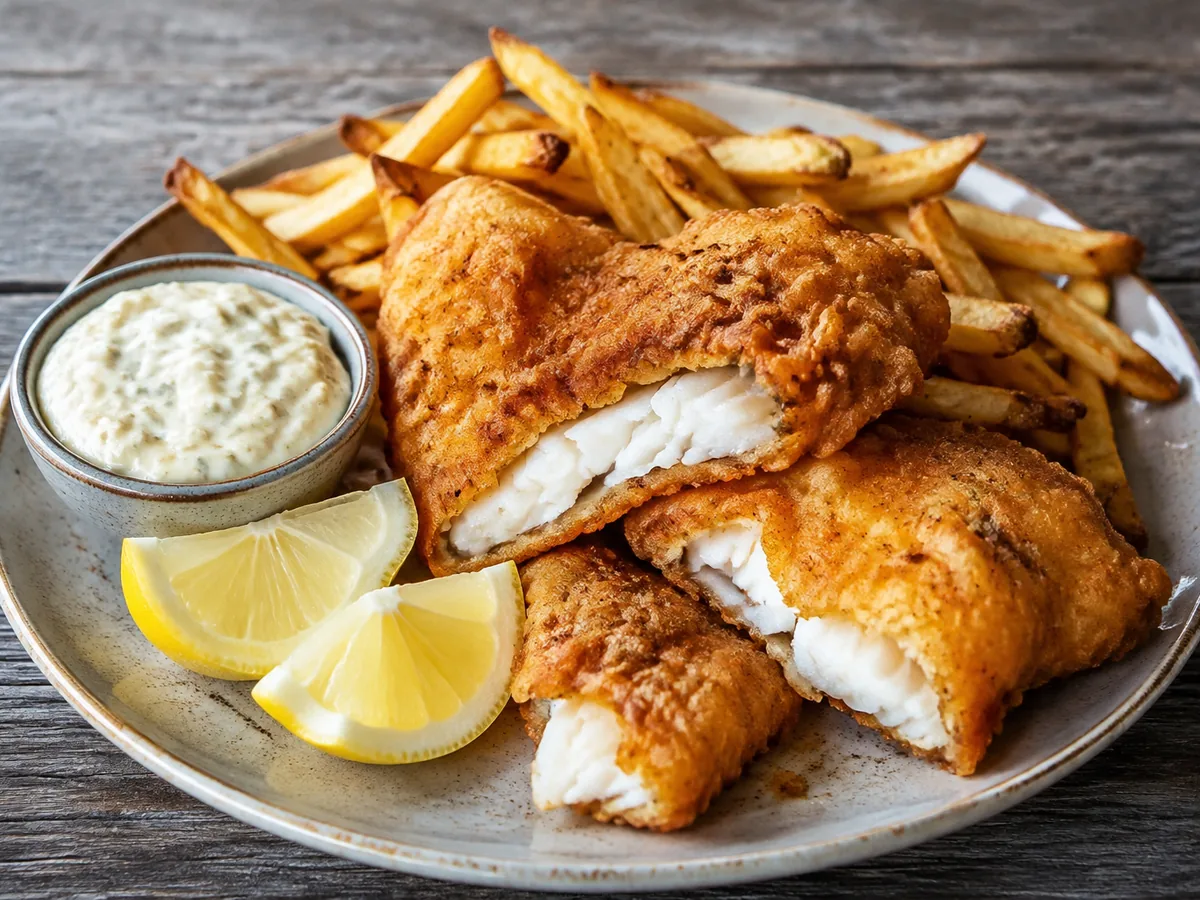
Along the piers from Ketchikan to Homer, fish-and-chip shacks turn the day’s Pacific cod and rockfish into golden comfort food. Cod gives dense, clean white flakes that stay juicy in the fryer; yelloweye and black rockfish are sweeter and more delicate.
The batter is light and airy because it is made with local craft beer, ice-cold and just opened. The carbon dioxide and alcohol in it expand and boil off the instant the fish hits 185 °C oil, inflating the flour and cornstarch into a thin honeycomb shell that seals in the steam and cooks the fish gently inside.
- 800 g1¾ lbPacific cod or rockfish fillets, skinless, in strips 10 by 4 cm
- 180 g1½ cupsPlain flour60 g for the dredge, 120 g for the batter
- 60 g½ cupCornstarch
- 5 g1 tspBaking powder
- 350 ml1½ cupsAmber ale, ice-cold and freshly opened
- 5 g1 tspGarlic powder
- 3 g½ tspSmoked paprika
- 10 g2 tspFine sea saltdivided, plus flaky salt to finish
- 3 g1 tspBlack pepper
- 1.5 L6 cupsNeutral frying oil, or beef tallow
- 150 g⅔ cupCaper-dill tartar sauce
- 2 whole2 wholeLemons, in wedges
Gas and alcohol make the crust
Cold ale holds dissolved carbon dioxide. In 185 °C oil the gas expands into millions of bubbles in the starch, and the alcohol boils off at 78 °C, drying the crust faster than water could. Warm, flat beer gives a pancake.
Cornstarch for the shatter
Cornstarch has no gluten and high amylose. A quarter to a third of it in the flour keeps the shell glassy instead of chewy.
The five tastes on this plate
Salt is the dredge, the batter and flaky salt on the hot fish. Fat is the frying oil and the tartar sauce. Acid is lemon, capers and pickle. Heat is pepper, paprika and garlic powder. Umami is the cod, the malt and the capers.
Equipment
- Heavy deep Dutch oven, or a countertop fryer
- Deep-fry thermometer
- Wire spider and tongs
- Wire rack over a sheet pan
At least three inches of oil so the temperature does not crash. Three or four pieces at a time, and let the oil recover to 185 °C between batches.
Method
Dredge5 min
Pat the fish dry and season with a teaspoon of salt and the pepper. Whisk 60 g flour with the garlic powder and paprika and dredge the strips lightly, shaking off all but a film.
Pat the fish dry and season with a teaspoon of salt and the pepper. Whisk 60 g flour with the garlic powder and paprika and dredge the strips lightly, shaking off all but a film.
Mix the batter last2 min
Whisk 120 g flour, the cornstarch, baking powder and a teaspoon of salt. Just before frying, pour in the ice-cold ale and whisk 15 seconds only. Small lumps are right.
Whisk 120 g flour, the cornstarch, baking powder and a teaspoon of salt. Just before frying, pour in the ice-cold ale and whisk 15 seconds only. Small lumps are right.
Heat the oil8 min
Heat the oil in the Dutch oven over medium-high to 185 °C.
Heat the oil in the Dutch oven over medium-high to 185 °C.
Dip and lower1 min
Three or four pieces at a time, dip the floured fish in the batter and let it drip 2 seconds. Lower each piece away from you, holding one end in the oil 3 seconds before letting go so it does not stick.
Work with 3–4 pieces at a time. Dip floured fish in batter; drip 2 seconds. Lower away from you, holding one end in the oil 3 seconds before releasing to prevent sticking.
Fry5 min
Fry 4 to 5 minutes, turning after 2, until deep golden and blistered. The fish should read 57 to 60 °C.
Fry 4 to 5 minutes, turning after 2, until deep golden and blistered. The fish should read 57 to 60 °C.
Drain on a rack1 min
Lift out with the spider, drain 5 seconds, and set on the wire rack, never paper, which traps steam. Salt at once with flaky salt.
Lift out with the spider, drain 5 seconds, and set on the wire rack, never paper, which traps steam. Salt at once with flaky salt.
Repeat10 min
Let the oil come back to 185 °C and fry the rest. Hold finished pieces on the rack in a 95 °C oven.
Let the oil come back to 185 °C and fry the rest. Hold finished pieces on the rack in a 95 °C oven.
Serve
With thick-cut fries, tartar sauce, malt vinegar and lemon wedges.
Serve with thick-cut fries, caper-dill tartar sauce, malt vinegar and lemon wedges.
Sensory cues of doneness
- Visual: a puffed golden-bronze crust with visible micro-blisters; snowy moist flakes inside.
- Auditory: a roar as the fish goes in, and a hollow crunch under the knife.
- Olfactory: toasted malt, garlic and paprika, clean fried whitefish, lemon.
Look for puffed golden-bronze, finely blistered crust and moist white flakes. Expect a frying roar, hollow crunch and aromas of malt, garlic, paprika, fried whitefish and lemon.
Troubleshooting
- Limp, greasy batter.
Oil below 170 °C or too many pieces. Hold 180 to 185 °C, three or four pieces at a time.
- Batter slid off in the oil.
Wet fish, no dredge. Dry it and dust it with flour so the batter has something to grip.
- Thick, doughy crust.
Overmixed, or warm flat beer. Ice-cold, freshly opened, 15 seconds of whisking.
Substitutions
One-to-one swaps, with the technique change each one needs.
Ingredient substitutions
| Ingredient | Replace with | Culinary impact and technique adjustment |
|---|---|---|
| Pacific cod or rockfish | Halibut, lingcod, pollock or haddock | Halibut flakes larger; fry 30 seconds less |
| Amber ale | Any amber or pale ale, or ice-cold club soda | Soda gives a paler, tempura-light crust |
| Cornstarch | Rice flour or potato starch | Rice flour makes an especially crisp, gluten-free shell |
Scaling
Half
One litre of oil; 4 to 5 minutes a batch as before.
Double
Double the fish and batter but not the oil in one pot. Fry in more batches.
What to serve it with
- Hand-cut fries and creamy coleslaw
- Caper-dill tartar sauce, malt vinegar, lemon
- The same amber ale that went in the batter
Questions
Seltzer instead of beer?
Yes. Ice-cold club soda lifts the batter the same way and gives a very pale, crisp crust without alcohol.
Why blend cornstarch into the flour?
It has no gluten, so the crust cannot toughen, and its amylose sets glassy and loud.
Keeping the first batch crisp?
On the wire rack in a 95 °C oven. Dry heat holds the crust up to 15 minutes.