Sourdough Hotcakes
The Klondike breakfast. An overnight sponge of active starter, flour, warm water and a little sugar, then eggs and melted butter in the morning and a teaspoon of baking soda dissolved in water stirred in at the last minute, so the acid and the alkali foam the batter into thin, lacy-edged hotcakes on a 190 °C griddle, served with cultured butter and wild berry syrup.
- Prep
- 15 min
- Cook
- 15 min
- Serves
- 4, about 12 to 14 hotcakes
- Difficulty
- Medium
Researched · Kitchen testing pending
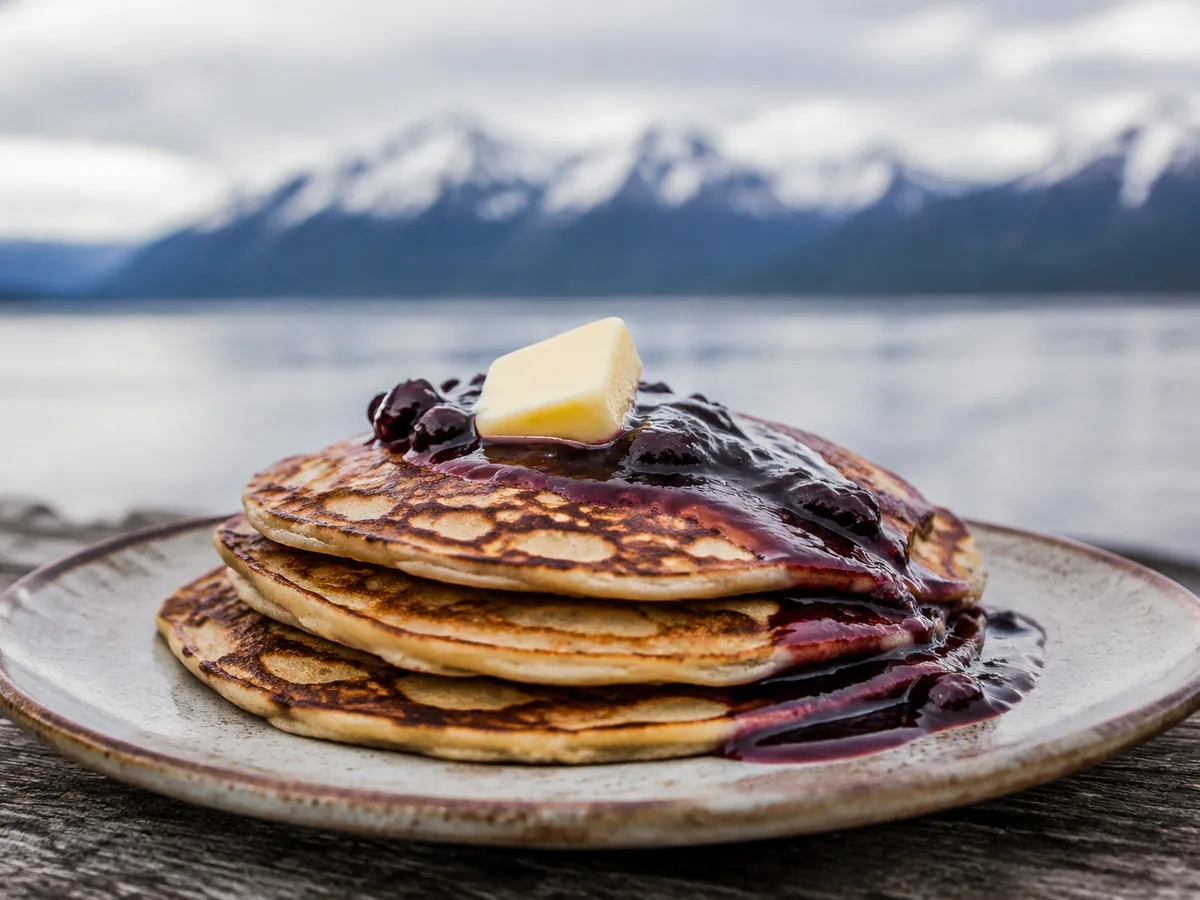
During the Klondike rush of 1897 and 1898, prospectors climbed the Chilkoot Pass into the interior with sourdough crocks tucked in their bedrolls. Commercial yeast died in the cold and baking powder spoiled, so the living culture of wild yeast and lactobacilli was the only leavening a miner could trust. An old hand became a Sourdough.
The hotcakes use a mature starter fed overnight into a sponge. In the morning a pinch of baking soda goes in, the acidic batter foams, and the cakes come off the griddle thin and tender with crisp lacy edges, for butter and wild berry syrup.
- 240 g1 cupActive 100 percent hydration sourdough starter, fed and bubbly
- 240 g2 cupsPlain flour, for the sponge
- 360 ml1½ cupsWarm water, about 32 °C
- 25 g2 TbspGranulated cane sugar
- 5 g1 tspFine sea salt
- 2 whole2 wholeLarge eggs, lightly beaten
- 45 g3 TbspUnsalted butter, melted and cooled, plus more for the griddle
- 5 g1 tspBaking soda, dissolved in 15 ml warm water
- 250 ml1 cupWarm wild berry syrup, blueberry, lingonberry or salmonberry
- 60 g4 TbspCultured butter, softened, to serve
Acid meets soda
Twelve hours of wild fermentation drops the sponge to about pH 4 and loosens the gluten. Dissolved baking soda stirred in at the last minute neutralises that acid in a burst of carbon dioxide, and the 190 °C griddle sets the bubble walls before the gas escapes.
Dissolve the soda
Dry soda leaves bitter yellow spots. Fifteen millilitres of warm water first.
The five tastes on this plate
Salt is sea salt and cultured butter. Fat is butter in the batter and on the iron, which makes the lacy edges. Acid is the lactic and acetic tang of the ferment. There is no heat. Umami is the fermented yeast and the caramelised griddle sugars.
Equipment
- Large glass or ceramic bowl
- Heavy cast-iron griddle or 12-inch skillet
- Quarter-cup ladle
- Thin metal spatula
A well-seasoned cast-iron griddle over a cabin stove, or an electric griddle set to 190 °C. Too hot and the outside burns before the bubbles pop; too cool and the cakes go heavy and soak up butter.
Method
Set the sponge the night before12 hr
In the large bowl stir the starter, flour, warm water and sugar until smooth. Cover loosely with a towel and leave at warm room temperature, 21 to 24 °C, for 10 to 12 hours until bubbly.
Mix starter, flour, water at about 32 °C and sugar until smooth. Cover loosely with a towel; ferment at 21–24 °C for 10–12 hours until bubbly.
Finish the batter6 min
Whisk the eggs, melted butter and salt into the sponge. Pour in the dissolved baking soda and whisk gently; the batter will foam and double. Rest 5 minutes.
Whisk eggs, melted cooled butter and salt into the sponge. Dissolve baking soda in 15 ml warm water, then whisk in gently; batter foams and doubles. Rest 5 minutes.
Heat the griddle4 min
Heat over medium until a flick of water dances across the metal, about 190 °C. Grease with a teaspoon of butter and wipe off the excess.
Heat over medium until a flick of water dances across the metal, about 190 °C. Grease with a teaspoon of butter and wipe off the excess.
Pour1 min
Ladle quarter-cups of batter with 5 cm between them. They spread to 10 to 12 cm rounds.
Ladle quarter-cups of batter with 5 cm between them. They spread to 10 to 12 cm rounds.
First side3 min
Cook 2 to 3 minutes undisturbed until bubbles rise and pop into open craters and the edges look dry and matte.
Cook 2 to 3 minutes undisturbed until bubbles rise and pop into open craters and the edges look dry and matte.
Flip2 min
Slide the spatula under and turn in one motion. Cook 1 to 2 minutes until golden and puffed at the centre.
Slide the spatula under and turn in one motion. Cook 1 to 2 minutes until golden and puffed at the centre.
Keep warm and repeat8 min
Stack on a warm platter under a napkin and cook the rest, wiping a little butter on the griddle between batches.
Stack on a warm platter under a napkin and cook the rest, wiping a little butter on the griddle between batches.
Serve
Three high, a pat of cultured butter, warm berry syrup, hot coffee and reindeer sausage.
Serve stacks of three hotcakes with cultured butter, warm berry syrup, hot coffee and reindeer sausage.
Sensory cues of doneness
- Visual: golden-bronze rounds with paper-thin lacy edges and a surface of tiny even bubbles; a pale airy crumb.
- Auditory: a soft hiss as batter meets buttered iron, then the popping of surface bubbles.
- Olfactory: tangy sourdough, toasted grain, sweet butter, caramel.
Look for golden-bronze rounds with thin lacy edges, fine even bubbles and a pale airy crumb. Expect a soft griddle hiss, popping bubbles and sourdough, toasted grain, butter and caramel aromas.
Troubleshooting
- Flat, heavy hotcakes.
The soda was left out, or added the night before so the gas escaped. Stir it in the morning and griddle within 15 minutes.
- Puckeringly sour.
Over-fermented past 16 hours, or a sluggish starter. Ten to twelve hours; the soda balances the acid.
- Pale rings and uneven browning.
Pooled butter on the griddle. A thin film, wiped, never a puddle.
Substitutions
One-to-one swaps, with the technique change each one needs.
Ingredient substitutions
| Ingredient | Replace with | Culinary impact and technique adjustment |
|---|---|---|
| Sourdough starter | 1 cup flour, 1 cup milk and a packet of dry yeast, fermented 2 hours | Fluffy, but without the wild sour tang |
| Wild berry syrup | Dark maple syrup or warm blackberry preserves | Caramel-maple sweetness |
| Cane sugar | Raw honey or maple sugar | Adds floral notes to the sponge |
Scaling
Half
One egg; 6 to 7 hotcakes. Times unchanged.
Double
Ferment the sponge in an 8-quart bowl to allow for the overnight rise.
What to serve it with
- Warm wild blueberry or lingonberry syrup
- Crisp reindeer sausage links or thick smoked bacon
- Dark-roast coffee, or a hot buttered rum for a frontier brunch
Questions
Discard instead of active starter?
Yes. The overnight ferment with fresh flour and warm water wakes it up and builds the acidity.
Waffles?
Add two more tablespoons of melted butter to the morning batter and cook in a hot Belgian iron until the steam stops.
Why dissolve the soda?
Dry clumps of alkali leave bitter, metallic yellow spots in the cake.