Wild Berry Grunt
The woodstove dessert of late August. Wild blueberries, lingonberries and salmonberries stewed in a cast-iron skillet with sugar, lemon and cornstarch until they burst into a glossy crimson compote, then mounds of cold-butter drop dough dolloped on top, sprinkled with turbinado, and steamed under a tight lid until the dumplings are set and the juices bubble up between them.
- Prep
- 20 min
- Cook
- 25 min
- Serves
- 6
- Difficulty
- Medium
Researched · Kitchen testing pending
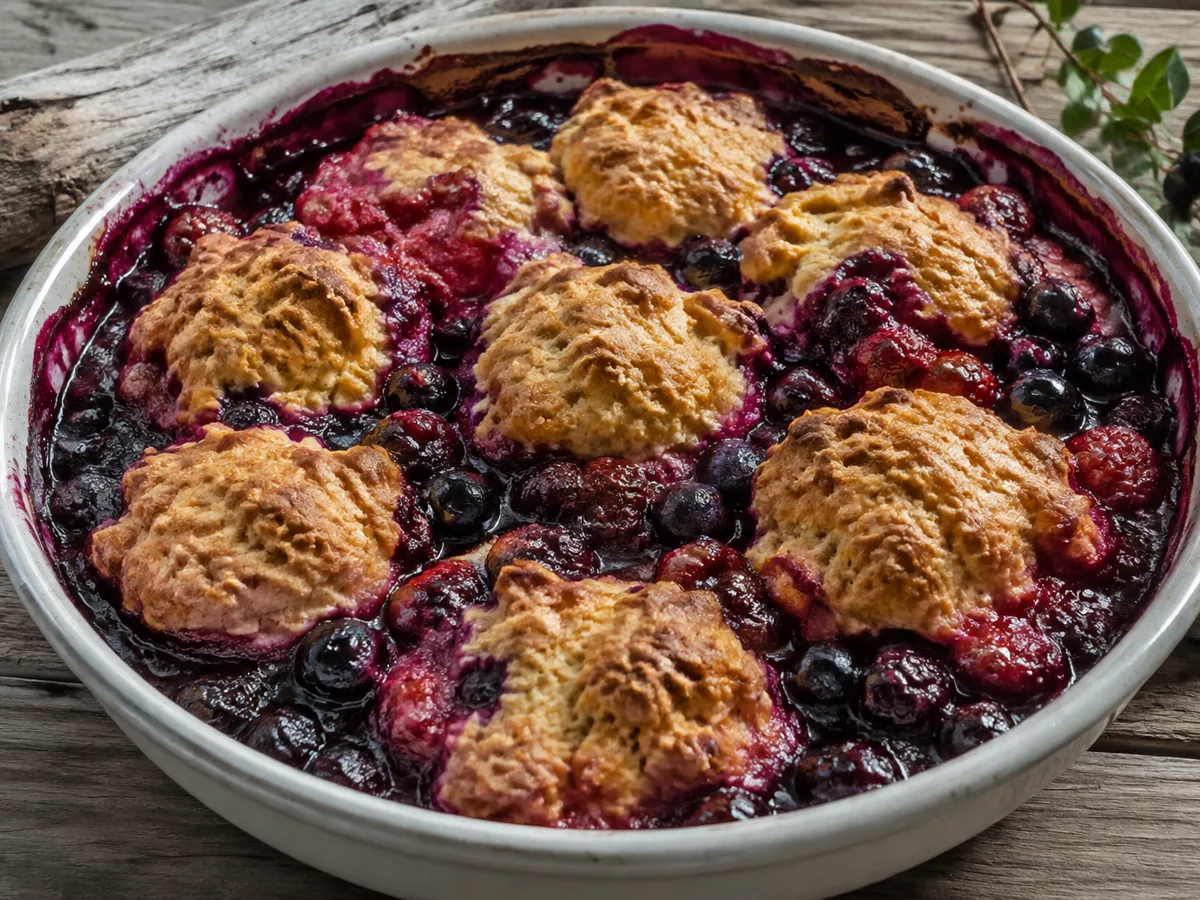
In late August the tundra ridges and coastal hillsides turn crimson as the wild berries ripen before first snow: blueberries, tart lowbush cranberries and lingonberries, salmonberries, highbush cranberries. Indigenous communities and homesteaders alike bring them in by the bucket.
A grunt is the old skillet dessert cooked on top of a cabin woodstove. The berries are stewed with sugar, lemon and a little cornstarch into a thick compote, sweet cream dumplings are dropped over the top, and a heavy lid traps the steam until the dumplings are fluffy above and soaked in juice below.
Berries
- 800 g5 cupsWild blueberries, lingonberries, lowbush cranberries or salmonberries, fresh or frozen, picked over
- 150 g¾ cupGranulated cane sugarup to 200 g for all-lingonberry
- 20 g2 TbspCornstarch or arrowroot
- 15 ml1 TbspLemon juice
- 2 g1 tspLemon zest, finely grated
- 2 g½ tspGround cinnamon
- 60 ml¼ cupWater or berry juice
Dumplings
- 200 g1½ cupsPlain flour
- 30 g2 TbspGranulated cane sugar
- 8 g1½ tspBaking powder
- 2 g½ tspFine sea salt
- 60 g4 TbspCold unsalted butter, in 6 mm cubes
- 160 ml⅔ cupCold whole milk or buttermilk
- 10 g1 TbspTurbinado sugar, for the tops
To serve
- 250 ml1 cupHeavy cream or vanilla ice cream
Pectin and starch
Lingonberries and cranberries are rich in natural pectin and benzoic acid. Heated to 95 °C with sugar they burst and gel; the cornstarch keeps the compote from running thin.
Steam does the baking
Under a tight lid, the moisture in the cold butter and the fruit turns to steam and lifts the baking powder into light dumplings without drying them. Lift the lid and the heat is gone.
The five tastes on this plate
Salt is a half teaspoon in the dough. Fat is cold butter in the biscuit and cream on top. Acid is the wild berries and lemon. Heat is cinnamon and the fruit steam. There is no umami, by design.
Equipment
- 10 to 12-inch cast-iron skillet with a heavy lid
- Silicone spatula
- Pastry blender or fingertips
- Two spoons or a small scoop
A lidded skillet on the stovetop is the grunt. An oven-safe pan lets you finish uncovered for a browned cobbler top.
Method
Coat the berries3 min
In the skillet, combine the berries, sugar, cornstarch, lemon juice and zest, cinnamon and water. Stir gently until the starch dissolves.
In the skillet, combine the berries, sugar, cornstarch, lemon juice and zest, cinnamon and water. Stir gently until the starch dissolves.
Make the compote5 min
Set over medium heat and bring to a gentle boil, stirring now and then. Cook 4 to 5 minutes until the berries burst and the juices thicken and turn glossy ruby-purple. Lower to a simmer.
Set over medium heat and bring to a gentle boil, stirring now and then. Cook 4 to 5 minutes until the berries burst and the juices thicken and turn glossy ruby-purple. Lower to a simmer.
Dry ingredients2 min
Whisk the flour, sugar, baking powder and salt in a bowl.
Whisk the flour, sugar, baking powder and salt in a bowl.
Cut in the butter3 min
Work the cold butter in until the mix looks like coarse meal with pea-sized flecks.
Work the cold butter in until the mix looks like coarse meal with pea-sized flecks.
Soft dough1 min
Pour in the cold milk and stir with a fork 20 seconds to a soft, sticky drop dough. Stop there.
Pour in the cold milk and stir with a fork 20 seconds to a soft, sticky drop dough. Stop there.
Drop the dumplings2 min
Spoon 6 to 8 golf-ball mounds onto the bubbling fruit, evenly spaced, and sprinkle with turbinado.
Spoon 6 to 8 golf-ball mounds onto the bubbling fruit, evenly spaced, and sprinkle with turbinado.
Steam15 min
Cover tightly and cook over low 15 minutes without lifting the lid. Or move the covered skillet to a 190 °C oven 15 minutes, then uncover 5 to 7 minutes until the tops are golden and a toothpick comes out clean, about 93 °C.
Cover tightly; steam on low 15 minutes without lifting the lid. Alternatively, bake covered at 190 °C for 15 minutes, then uncovered 5–7 minutes until golden, a toothpick comes out clean and dumplings reach about 93 °C.
Rest and serve10 min
Cool 10 minutes so the compote thickens. Spoon dumplings and fruit into shallow bowls with cream, crème fraîche or vanilla ice cream.
Cool 10 minutes so the compote thickens. Spoon dumplings and fruit into shallow bowls with cream, crème fraîche or vanilla ice cream.
Sensory cues of doneness
- Visual: thick crimson-violet compote bubbling up between golden, sugar-crusted dumplings.
- Auditory: the hollow bubbling "grunt" of steam escaping around the dough under the lid.
- Olfactory: stewed blueberries, tart lingonberry, cinnamon biscuit, melting butter.
Check for thick crimson-violet compote bubbling between sugar-crusted dumplings. Listen for hollow bubbling under the lid and expect aromas of cooked berries, tart lingonberry, cinnamon biscuits and melting butter.
Troubleshooting
- Gummy, raw dumpling centres.
The lid came up, or the mounds were too big. Sealed for the full 15 minutes, and two-tablespoon mounds.
- Thin, runny sauce.
No cornstarch, or frozen berries carrying meltwater. Toss with the starch and boil until thick before the dough goes on.
- Mouth-puckeringly sour.
Wild lingonberries carry more acid than cultivated fruit. Taste raw and raise the sugar to 200 g if they are all lingonberry.
Substitutions
One-to-one swaps, with the technique change each one needs.
Ingredient substitutions
| Ingredient | Replace with | Culinary impact and technique adjustment |
|---|---|---|
| Wild Alaskan berries | Cultivated blueberries with tart cranberries or blackberries | The same colour and sweet-tart balance |
| Turbinado sugar | Demerara or coarse sanding sugar | The same crunchy top |
| Buttermilk | Whole milk with 1 tsp lemon juice, rested 5 minutes | The same acid and tender crumb |
Scaling
Half
An 8-inch skillet and four dumplings; still about 15 minutes.
Double
Two 10-inch skillets, or a 23 by 33 cm dish baked uncovered at 190 °C for 25 to 30 minutes as a cobbler.
What to serve it with
- Whipped sweet cream or vanilla bean ice cream
- A wedge of sharp Cheddar, the old frontier pairing
- A late-harvest Riesling, or spruce-tip tea with honey
Questions
Grunt, slump or cobbler?
A grunt or slump steams under a lid on the stovetop. A cobbler bakes uncovered so the top browns. This recipe does either.
Store-bought frozen berries?
Yes. Half frozen wild blueberries and half raspberries or cranberries come close to the tundra mix.
Why "grunt"?
For the sound. Frontier cooks named it for the bubbling grunts of steam forcing its way out from under the lid.