Braised Moose Pot Roast
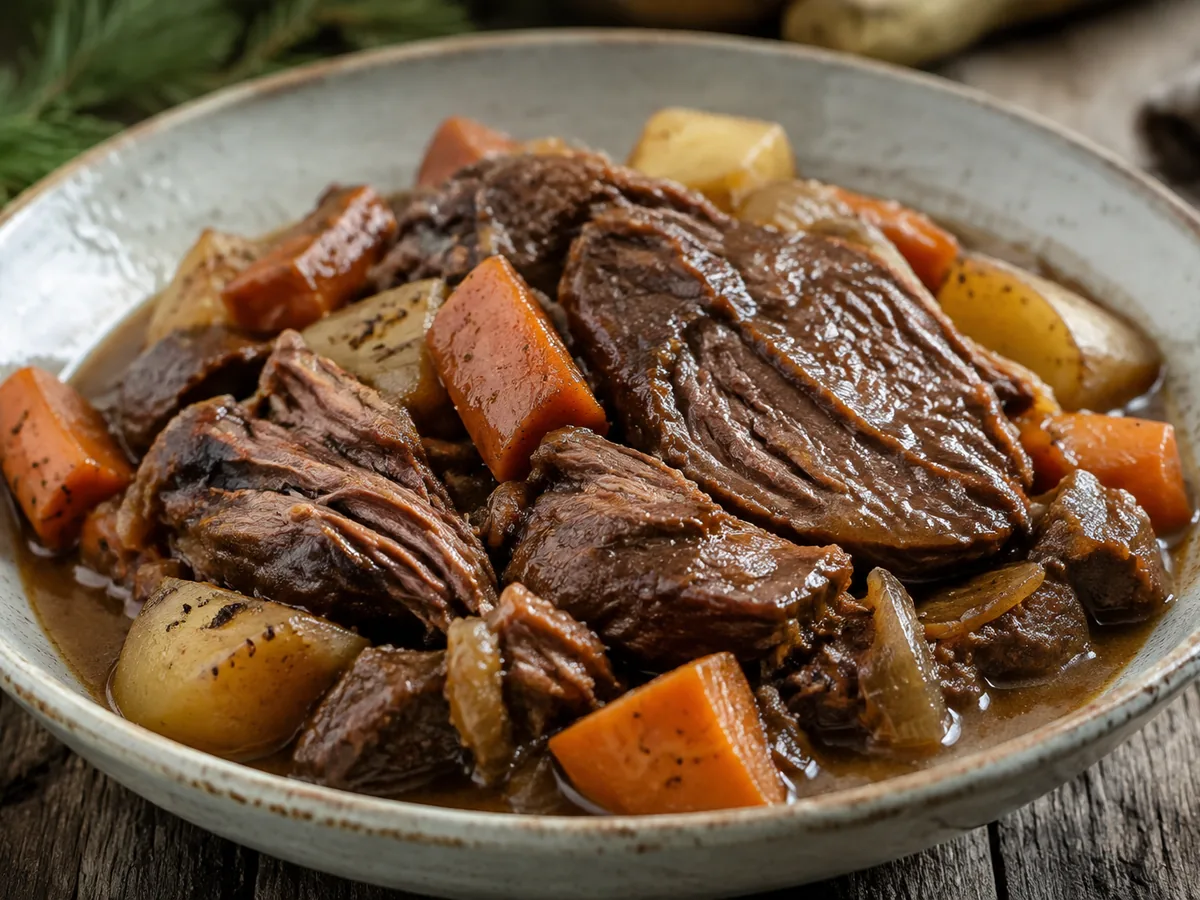
The interior cabin's answer to meat with no marbling. A tied moose or venison shoulder dusted with flour and seared in bacon fat, onions and tomato paste browned in the drippings, stout to lift the fond, then three hours sealed at 150 °C with beef stock, crushed juniper, thyme and bay, carrots, parsnips and turnips added for the last hour, until the collagen has turned to gelatin and the meat parts under a fork.
- Prep
- 30 min
- Cook
- 3 hr 15 min
- Serves
- 6 to 8
- Difficulty
- Medium
Researched · Kitchen testing pending
In interior Alaska, subsistence hunting of moose and Sitka black-tailed deer is food security and heritage at once. The animals browse willow, birch and wild cranberry across tundra and boreal forest, and the meat is lean to the point that roasting it dry makes it tough.
Cabin cooks braise instead. The shoulder is seared in bacon fat for a deep crust, then simmered for hours in dark ale and beef stock with crushed juniper and winter roots until the connective tissue has melted into gelatin and the meat is fork-tender.
- 1.6 kg3½ lbMoose, caribou or venison shoulder roast, silver skin and outer fat trimmed, tied
- 45 g3 TbspRendered bacon fat or lard
- 30 g2 TbspPlain flour, for dusting
- 300 g2 largeYellow onions, in thick wedges
- 300 g4 mediumCarrots, in 5 cm chunks
- 250 g3 mediumParsnips, in 5 cm chunks
- 200 g2 smallYellow turnips or rutabaga, in 4 cm cubes
- 25 g6 clovesGarlic, smashed
- 350 ml1½ cupsOatmeal stout or porteror a robust dry red wine
- 750 ml3 cupsUnsalted beef bone stock
- 30 g2 TbspDouble-concentrated tomato paste
- 8 g1 TbspDried juniper berries, lightly crushed
- 4 sprigs4 sprigsFresh thyme
- 2 leaves2 leavesBay leaves
- 15 g1 TbspCoarse sea salt
- 4 g1 tspBlack pepper, cracked
- 15 g¼ cupParsley, chopped
Collagen into gelatin
Wild game runs all winter and builds dense, myoglobin-dark muscle bound in tough collagen, with almost no intramuscular fat. Held at 90 to 93 °C in a sealed pot, that collagen unwinds into gelatin that coats the lean fibres and keeps them moist.
Juniper, lightly
Ten to twelve berries, cracked rather than ground. Powdered juniper turns the braise resinous and bitter.
The five tastes on this plate
Salt is sea salt in the meat and the reduced stock. Fat is bacon fat and marrow gelatin. Acid is stout and tomato paste. Heat is cracked pepper and garlic. Umami is the seared game fond, tomato paste and roasted roots.
Equipment
- 7 to 8-quart enamelled cast-iron Dutch oven with a heavy lid
- Kitchen twine
- Mortar and pestle
- Digital probe thermometer
A heavy lid with condensation nubs keeps the steam cycling over the meat for three hours. A parchment sheet under the lid seals a looser pot.
Method
Season and sear8 min
Pat the roast dry, rub with the salt and pepper, and dust with flour. Heat the bacon fat in the Dutch oven over medium-high until shimmering and sear 4 to 5 minutes on every side to a deep crust. Set aside.
Dry the roast, season with salt and pepper and dust with flour. Heat bacon fat over medium-high until shimmering; sear each side 4–5 minutes to a deep crust. Set aside.
Onions and tomato paste4 min
Add the onion wedges, garlic and tomato paste to the fat and stir over medium 4 minutes until the onions soften and the paste turns brick-red.
Add the onion wedges, garlic and tomato paste to the fat and stir over medium 4 minutes until the onions soften and the paste turns brick-red.
Deglaze3 min
Pour in the stout and scrape up the browned bits. Boil hard 3 minutes to reduce by half.
Pour in the stout and scrape up the browned bits. Boil hard 3 minutes to reduce by half.
Assemble3 min
Return the roast and its juices. Add the stock, juniper, thyme and bay. The liquid should reach halfway up the meat. Bring to a simmer.
Return roast and juices; add stock, lightly cracked—not ground—juniper, thyme and bay. Liquid should reach halfway up the meat. Bring to a simmer.
Braise2 hr
Cover tightly, with parchment and foil under the lid if it is loose, and braise in a 150 °C oven 2 hours without opening.
Cover tightly, with parchment and foil under the lid if it is loose, and braise in a 150 °C oven 2 hours without opening.
Add the roots1 hr 10 min
Turn the roast. Scatter the carrots, parsnips and turnips around it, half submerged. Cover and return to the oven 1 hour to 1 hour 15 minutes, until the vegetables are tender and the meat yields to a fork at 90 to 95 °C.
Turn roast; arrange carrots, parsnips and turnips half submerged around it. Cover and bake another 1 hour to 1 hour 15 minutes, until vegetables are tender and meat yields to a fork at 90–95 °C.
Rest and finish the sauce10 min
Move the meat and vegetables to a platter and tent with foil 10 minutes. Skim the fat from the braising liquid and simmer 5 minutes if you want it thicker. Discard the bay and thyme stems.
Move the meat and vegetables to a platter and tent with foil 10 minutes. Skim the fat from the braising liquid and simmer 5 minutes if you want it thicker. Discard the bay and thyme stems.
Carve and serve
Snip the twine, pull or slice the meat into chunks, arrange with the roots, spoon the juniper-stout sauce over and scatter parsley. Mashed potatoes or sourdough alongside.
Snip the twine, pull or slice the meat into chunks, arrange with the roots, spoon the juniper-stout sauce over and scatter parsley. Mashed potatoes or sourdough alongside.
Sensory cues of doneness
- Visual: a dark mahogany roast that parts with the side of a fork, glossy gravy on bright carrot and ivory parsnip.
- Auditory: a roaring sizzle at the sear, then a muted bubble under the heavy lid.
- Olfactory: resinous juniper, roasted game, sweet roots, dark malt, garlic.
Check that the mahogany roast parts with a fork and the gravy is glossy. Expect gentle covered bubbling after searing, with juniper, roasted game, sweet roots, malt and garlic aromas.
Storing it
Better the next day. Cool in its liquid and reheat gently, covered, at 150 °C for 30 minutes.
Troubleshooting
- Dry, stringy meat.
Too hot, or pulled too soon. 150 °C, sealed, at least three hours, until a fork slides in.
- Mushy vegetables.
They went in at the start. Add them for the last 70 minutes.
- Bitter pine flavour.
Too much juniper, or ground to powder. Eight grams, just cracked.
Substitutions
One-to-one swaps, with the technique change each one needs.
Ingredient substitutions
| Ingredient | Replace with | Culinary impact and technique adjustment |
|---|---|---|
| Moose or venison shoulder | Beef chuck, beef short ribs or bone-in lamb shoulder | Fattier; skim more from the gravy |
| Oatmeal stout | Guinness, a dark porter, or beef stock with 1 Tbsp balsamic vinegar | Malt depth without bitterness |
| Parsnips and turnips | Rutabaga, celery root or sweet potatoes | The same earthy sweetness |
Scaling
Half
A 4 to 5-quart Dutch oven; still 2½ to 3 hours for the collagen.
Double
An 11 to 12-quart oval Dutch oven or two pots. Sear the roasts one at a time.
What to serve it with
- Garlic mashed Yukon Golds and braised red cabbage
- Lingonberry preserve and buttered sourdough rolls
- A smoked porter, or a Washington Cabernet Sauvignon
Questions
Beef chuck instead of game?
Yes, chuck or brisket braises identically. It carries more fat, so skim the gravy before serving.
How do I tame the gaminess?
Trim every bit of yellow tallow and silver skin. The bacon-fat sear, stout, garlic and juniper do the rest.
Slow cooker?
Sear and sauté in a skillet, then 7 to 8 hours on low, adding the roots for the last 3.