Callaloo Trinbagonian
Not the sautéed amaranth of Jamaica but a silky green potage. Okra and dasheen leaves are full of water-soluble galacturonan gums; swizzled hard with a wooden puyol, that mucilage disperses through coconut milk and butter into a stable emulsion that will not separate.
- Prep
- 30 min
- Cook
- 45 min
- Serves
- 6 portions
- Difficulty
- Medium
Researched · Kitchen testing pending
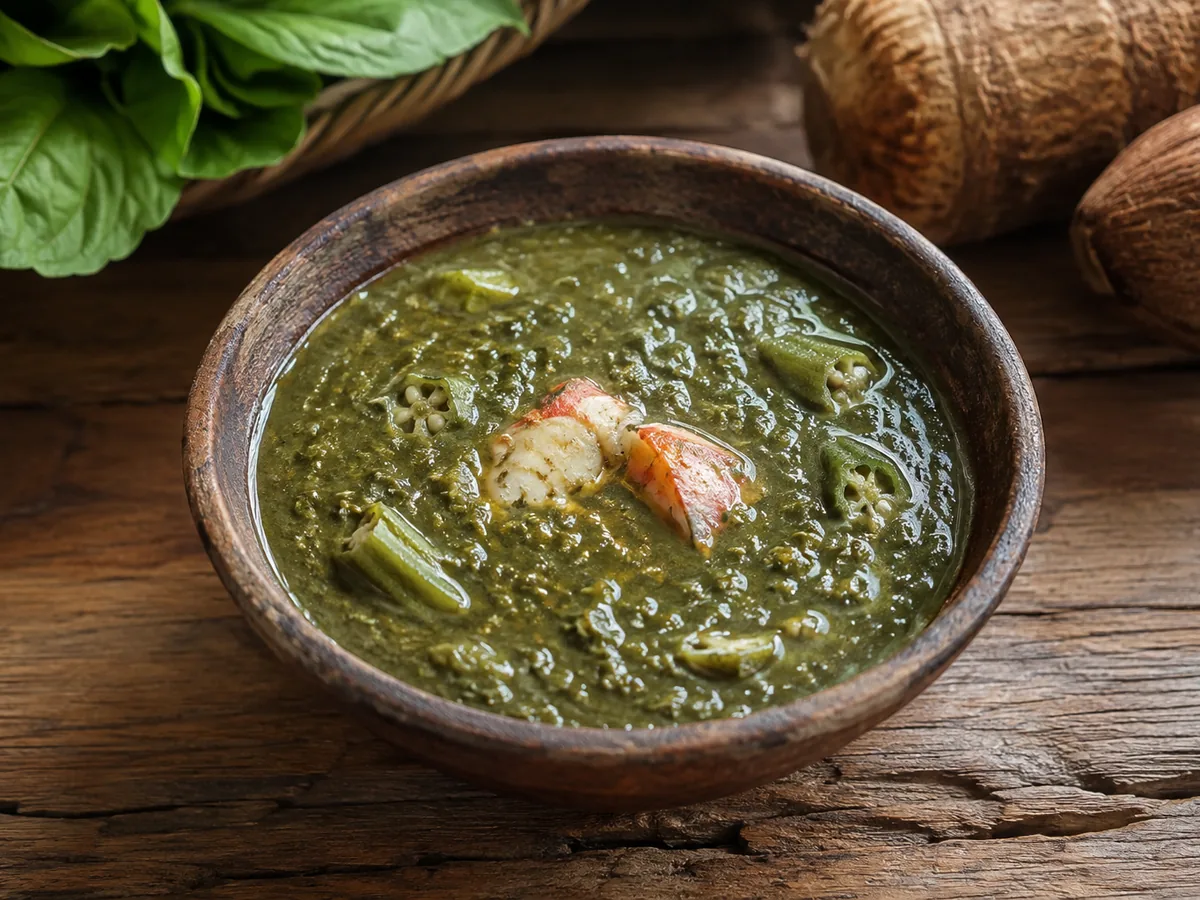
Sunday lunch in Trinidad is unthinkable without callaloo. Do not confuse it with the Jamaican dish, which is steam-sautéed amaranth. Trinbagonian callaloo is a silky, unctuous green potage.
Young dasheen leaves simmer in rich coconut milk with sliced okra, sweet calabaza pumpkin, green seasoning, garlic and salted pig tail or blue crab.
Once everything is tender, the cook swizzles the pot with a wooden puyol, beating the melting leaves and the okra mucilage into a velvety dark forest-green sauce.
The greens
- 500 g2 large bunchesFresh young dasheen leaves, stalks peeled and chopped, leaves chopped coarse
- 250 g15 podsFresh tender okra, sliced into 5 mm rounds
- 300 g2 cupsCalabaza pumpkin, or butternut squash, peeled, seeded and cut into 2 cm cubes
The liquid
- 400 ml1 tinUnsweetened full-fat coconut milk
- 500 ml2.1 cupsRich chicken bone stock, or cold filtered water
The meat
- 300 g10 ozSalted pig tail, or salted beef or smoked turkey neck, cut into 3 cm rounds
- 2 whole2 wholeFresh blue crabs, cleaned, cracked and halvedthe traditional addition
The aromatics
- 45 g3 TbspUnsalted European butter
- 1 large1 largeYellow onion, peeled and finely chopped
- 6 cloves6 clovesFresh garlic, crushed to a paste
- 4 stalks4 stalksFresh scallions, sliced fine
- 4 leaves4 leavesFresh chadon beni, chopped fine
- 4 sprigs4 sprigsFresh thyme, leaves stripped
- 1 whole1 wholeScotch bonnet pepper, stem intact and completely unpunctured
- 6 g1 tspFine sea salttaste first — the cured meat brings its own
- 2 g½ tspFreshly ground black pepper
Simmer at least 35 minutes
Raw taro leaves carry needle-like calcium oxalate raphides that scratch the throat. Cooking at 90 °C breaks the cell structures down and neutralises them — under-cooked callaloo is genuinely unpleasant.
Swizzle, do not purée
The shearing motion of a wooden puyol disperses the okra mucilage through the coconut milk and butter into a velvety suspension. A high-speed blender over-works the same gums and turns them gluey and slimy.
The pepper stays whole
Floated unpunctured with its stem on, the Scotch bonnet gives steam and aroma. Broken, it floods the entire pot.
Boil the salt meat twice
Twenty minutes, drain, fresh water, fifteen more. Pig tail is heavily cured and one boil is not enough.
Lift the solids out first
Crabs, salt meat and pepper come out before the swizzling and go back in afterwards, so they stay intact rather than being beaten to pieces.
Passive time, counted separately
The salt meat is desalinated in two boils before the dish proper begins. That sits outside the times quoted above.
The five tastes on this plate
Salt is the cured pig tail and sea salt against the earthy greens. Fat is coconut lipids, butter and rendered pork. Acid is mellow — it arrives as the stewed tomato and macaroni pie beside it. Heat is whole Scotch bonnet steam, garlic, scallion and thyme. Umami is crab juices, cured collagen and simmered dasheen minerals.
Equipment
- 6 qt enamelled cast-iron Dutch oven
- Wooden swizzle stick (puyol), or an immersion blender
- Tongs
- Separate pot, for desalinating
Traditionally a cast-aluminium Dutch pot with a carved wooden puyol spun between the palms. A 6-quart Dutch oven works in a modern kitchen — if you use an immersion blender, pulse it on low four or five times and no more.
Method
Desalinate the salt meat35 min
Boil the pig tail in 1.5 L water 20 minutes, drain, refill with fresh water and boil 15 minutes more. Drain thoroughly.
Boil salted pig tail in 1.5 L water for 20 minutes. Drain, refill with fresh water and boil another 15 minutes; drain thoroughly before adding to the stew.
Build the pot7 min
Melt the butter over medium and sauté the onion, garlic and scallion 4 minutes until soft.
Add the chopped dasheen leaves and stalks, the okra, pumpkin, chadon beni and thyme and stir 3 minutes until the leaves start to wilt.
Melt butter over medium; soften onion, garlic and scallions 4 minutes. Add chopped dasheen leaves and peeled stalks, okra, pumpkin, chadon beni and thyme; stir 3 minutes until leaves begin wilting.
Simmer40 min
Pour in the coconut milk and stock, add the blanched salt meat and the cracked crabs, and rest the whole unpunctured Scotch bonnet on top.
Bring to a gentle boil, then cover with the lid slightly ajar and simmer on low 35 to 40 minutes until the leaves and pumpkin are completely tender.
Add coconut milk, stock, blanched meat and cracked crabs; float the intact Scotch bonnet on top. Bring to a gentle boil, then simmer low around 90 °C with lid ajar for 35–40 minutes, until leaves and pumpkin are completely tender; do not undercook dasheen.
Swizzle3 min
Lift the crabs, salt meat and pepper out with tongs onto a plate.
Beat the hot vegetables vigorously in the pot with a swizzle stick 2 to 3 minutes — or pulse an immersion blender four or five times — into a thick velvety green purée with some rustic body left in it.
Carefully remove crabs, meat and intact pepper to a plate. Swizzle vegetables vigorously 2–3 minutes, or pulse an immersion blender only four or five times, to a thick, velvety mixture retaining some texture; avoid prolonged blending.
Reintegrate5 min
Return the crabs, salt meat and pepper to the purée and simmer on low 5 minutes to marry.
Taste, and season with salt and black pepper only if it needs it.
Return crabs, meat and intact pepper to the purée. Simmer low for 5 minutes, then taste before adding salt or black pepper because the meat is already salted.
Serve
Ladle the hot callaloo into bowls — the centrepiece of Sunday lunch, spooned over macaroni pie and stew chicken.
Ladle hot callaloo into bowls and serve with macaroni pie and stew chicken, spooning the greens over them as desired.
Sensory cues of doneness
- Visual: a thick velvety dark forest-green purée with orange flecks of melted pumpkin and pieces of crab shell, with no watery separation.
- Auditory: heavy muffled plopping as the thick potage simmers on low.
- Olfactory: coconut milk, earthy simmered dasheen, sweet crab, thyme and Scotch bonnet steam.
Look for thick, velvety dark-green callaloo with orange pumpkin flecks and crab, without watery separation. Expect slow, heavy bubbling and aromas of coconut, cooked dasheen, crab and thyme.
Troubleshooting
- An itchy scratch in the throat.
The dasheen leaves were under-cooked. Simmer at least 35 minutes to neutralise the oxalate crystals.
- A gluey, slimy texture.
It was over-blended. Swizzle by hand, or pulse four times at most.
- Overwhelming heat.
The Scotch bonnet was punctured. Float it whole and lift it out intact.
Substitutions
One-to-one global substitutions, with the technique adjustment each one requires.
Ingredient substitutions
| Ingredient | Replace with | Culinary impact and technique adjustment |
|---|---|---|
| Dasheen leaves | Swiss chard, or mature spinach | One-to-one, but simmer 20 minutes rather than 40 |
| Salted pig tail | Smoked turkey neck, ham hock, or salted beef | One-to-one for the savoury collagen |
| Fresh blue crab | Dungeness clusters, or lump crab meat | One-to-one |
Scaling
Half, for 3 portions
Halve everything in a 3.5-quart Dutch oven and simmer 35 minutes.
Double, for 12 portions
Double everything in an 11-to-12 quart pot, swizzling in batches if crowded.
What to serve it with
- Trinidad macaroni pie — the mandatory Sunday partner
- Trinidad stew chicken in its caramelised red gravy
- Steamed white rice, or cornmeal cou-cou
- Chilled mauby, or a sorrel shandy
Questions
Can I use spinach?
Swiss chard or mature spinach substitutes one-to-one, simmered 20 minutes instead of 40.
Can it be vegetarian?
Yes. Leave out the pig tail and crab, use vegetable stock, and add an extra tablespoon of butter with a pinch of smoked salt.
What is a swizzle stick?
A puyol — a wooden rod with three to five prongs at the base, spun rapidly between the palms to whip and crush the stewed vegetables.