Buss Up Shut with Curried Goat
Named because the shredded layers look like a torn-up shirt. Ghee spread across rolled dough and rolled into a cone traps dozens of alternating fat-and-flour sheets — and the roti must be clapped within five seconds of leaving the tawa, while the steam is still trapped between them.
- Prep
- 45 min
- Cook
- 2 hr
- Serves
- 6 portions
- Difficulty
- Hard
Researched · Kitchen testing pending
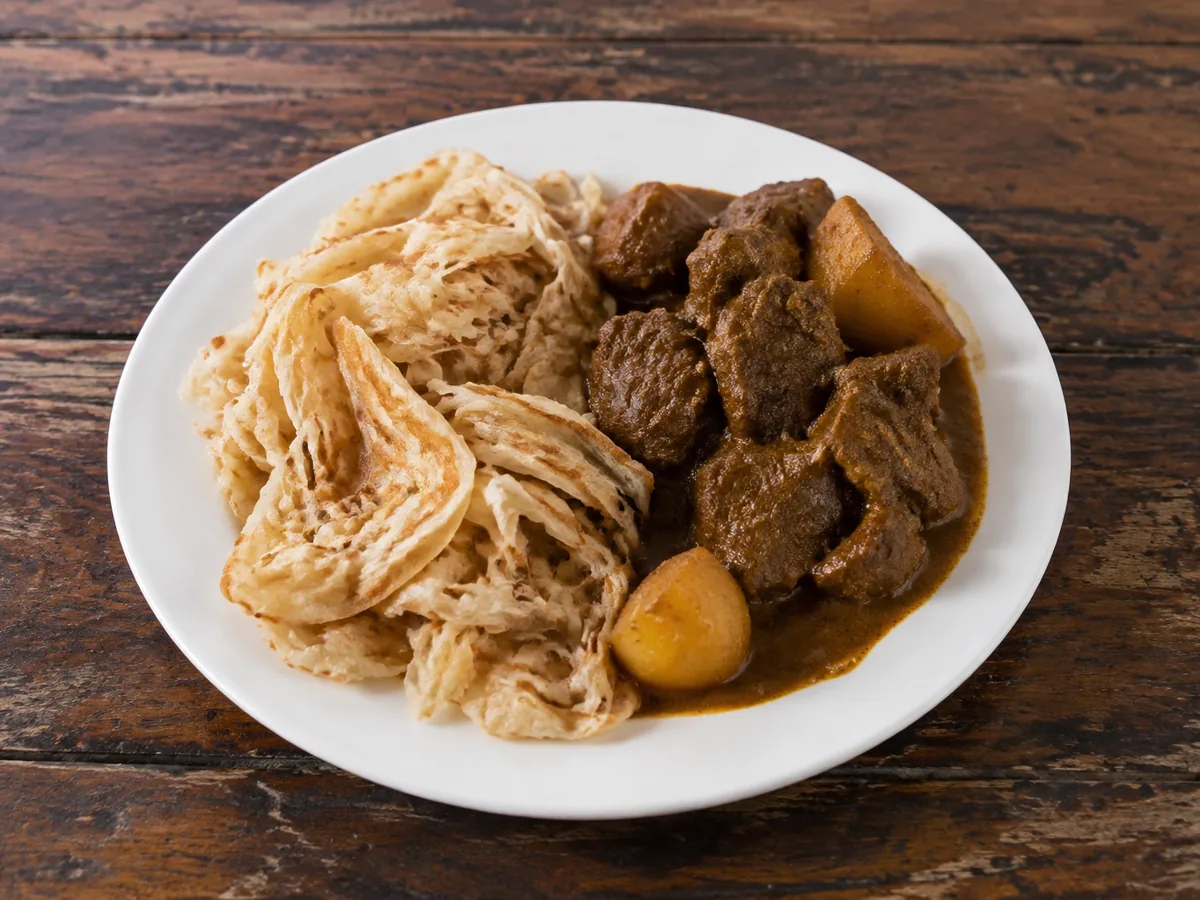
Across Trinidad, paratha roti is called buss up shut, because its shredded buttery layers look like a torn, battered shirt.
The technique is dramatic. Enriched dough is rolled thin, brushed with warm ghee, cut, rolled into cones and rested. Cooked on a smoking-hot tawa the roti puffs with steam, and the moment it leaves the iron the cook beats it violently between two wooden dablas, shattering the lamination into a pile of warm flaky rags.
Beside it sits slow-braised curried goat, simmered on the bone with toasted cumin, garlic and hot peppers until it is spoon-tender.
The goat
- 1.5 kg3.3 lbBone-in goat shoulder or leg, chopped into 4 cm chunks, rinsed in lime water and dried
- 60 ml4 TbspTrinidad green seasoning — chadon beni, scallion, garlic, thyme and pimento peppers puréed
- 45 g3 TbspTrinidadian Madras curry powder2 Tbsp into the marinade, 1 Tbsp bloomed in the oil
- 15 g1 TbspCumin (geera), freshly toasted dark and ground
- 6 cloves6 clovesFresh garlic, crushed to a paste
- 1 large1 largeYellow onion, finely diced
- 1 whole1 wholeScotch bonnet pepper, seeded and minced
- 15 g1 TbspFine sea salt
- 3 g1 tspFreshly ground black pepper
- 45 ml3 TbspHigh-smoke vegetable oil
- 750 ml3.2 cupsHot filtered water, or light stock
- 400 g2 largeYukon Gold or russet potatoes, peeled and cut into 3 cm chunks
The paratha
- 600 g4.8 cupsAll-purpose wheat flour, 11% protein, sifted
- 15 g1 TbspDouble-acting baking powder
- 5 g1 tspFine sea salt
- 10 g2 tspGranulated cane sugar
- 380 ml1.6 cupsLukewarm water
- 150 g⅔ cupGhee, or vegetable shortening, melted warm
The cone is the lamination
Ghee spread across a rolled circle, one cut from centre to edge, and the whole thing rolled into a cone traps dozens of alternating layers of dough and fat. Everything after that depends on this step.
Clap within five seconds
Off the tawa, the steam is still trapped between the hot leaves. Beating the bread immediately fractures the brittle exterior into feather-light rags. Wait, and the steam escapes and it just bends.
220 °C, under ninety seconds
High heat vaporises the water instantly and forces the ghee-separated sheets apart. On a cool griddle the roti dries out before it can puff at all.
Rest, twice
Twenty minutes after kneading, thirty after coning. Under-rested gluten snaps back and cooks tough.
Ghee, not butter
Its water and milk solids are already removed, so it takes tawa heat without burning while still giving the nutty flavour.
Bloom the curry first
Ninety seconds of stirring until it foams and turns nutty brown, before the onion or the meat go anywhere near it.
Passive time, counted separately
The goat marinates at least 4 hours, and the dough rests a total of about an hour. Neither is active work.
The five tastes on this plate
Salt penetrates the bone-in goat and seasons the dough. Fat is golden ghee through the layers and marrow fat in the gravy. Acid is the lime wash on the meat, cutting the game. Heat is Scotch bonnet, garlic, green seasoning and dark geera. Umami is seared goat fond, marrow bones and bloomed curry.
Equipment
- 6 qt heavy Dutch oven
- 12 to 14 in cast-iron tawa or flat griddle
- Rolling pin and an oiled board
- Two wooden dablas, or a clean kitchen towel
- Insulated container
Traditionally a 14-to-16 inch iron tawa and wooden dablas. A cast-iron griddle works in a modern kitchen, and if you have no dablas, wrap the hot roti in a clean towel and clap it hard between your palms.
Method
Marinate the goat10 min
Toss the goat with the green seasoning, 2 Tbsp curry powder, half the geera, the garlic, black pepper and 1 Tbsp salt.
Chill at least 4 hours, or overnight.
Coat goat with green seasoning, 2 Tbsp curry powder, half the geera, garlic, black pepper and 1 Tbsp salt. Refrigerate at least 4 hours or overnight.
Braise the curried goat2 hr
Heat the oil over medium, add the remaining 1 Tbsp curry powder and 1 tsp geera, and stir 90 seconds until it foams and turns nutty brown. Add the onion for 3 minutes.
Raise the heat, sear the marinated goat 8 minutes, pour in 750 ml hot water, and simmer covered on low 1 hour 15 minutes. Add the potato and simmer 30 minutes more, to 93–96 °C.
Heat oil over medium; stir remaining 1 Tbsp curry and 1 tsp geera 90 seconds until foamy and nutty-brown. Cook onion 3 minutes. Raise heat and sear marinated goat 8 minutes; add 750 ml hot water. Cover and simmer low 1¼ hours; add potatoes and simmer 30 minutes more to 93–96 °C.
Knead the dough10 min
Whisk the flour, baking powder, salt and sugar, add the lukewarm water gradually, and knead 4 minutes into a soft slightly sticky dough.
Divide into 6 balls of about 165 g, cover with a damp towel, and rest 20 minutes.
Mix flour, baking powder, salt and sugar; gradually add lukewarm water. Knead 4 minutes into soft, slightly sticky dough. Divide into 6 roughly 165 g balls, cover with a damp towel and rest 20 minutes.
Laminate into cones20 min
Roll a ball into a thin 25 cm circle and brush 2 Tbsp warm ghee right across it.
Cut once from the centre to the edge, roll the dough tightly around itself into a cone, tuck the base in and press the tip down into the centre to make a laminated disc. Brush with ghee, cover, and rest 30 minutes.
Roll each ball into a thin 25 cm circle and brush with 2 Tbsp warm ghee. Cut once from centre to edge; roll tightly into a cone. Tuck base inward and press tip into centre, forming a layered disc. Brush with ghee, cover and rest 30 minutes.
Roll and cook10 min
Heat the tawa to 220 °C. Roll a rested disc gently into a 30 cm circle, 2 mm thick.
Lay it on the tawa for 45 seconds until pale bubbles appear, brush with ghee, flip, brush again, and cook 40 seconds more until small toasted spots form.
Heat tawa to 220 °C. Gently roll each rested disc to 30 cm across and 2 mm thick. Cook 45 seconds until bubbles appear; brush with ghee, flip, brush again and cook 40 seconds until lightly spotted.
Buss it up5 min
Slide the roti straight off the tawa into a clean towel and within five seconds clap and beat it vigorously four or five times.
The layers shatter into shredded rags. Stack in an insulated container and repeat.
Transfer roti straight into a clean towel. Within 5 seconds, clap and beat four or five times to separate into flaky shreds. Keep in an insulated container and repeat with remaining dough.
Serve
Warm shredded roti on large plates, with bowls of curried goat, stewed channa and mango kuchela alongside.
Serve warm shredded roti on large plates with bowls of curried goat, stewed channa and mango kuchela alongside.
Sensory cues of doneness
- Visual: a mound of pale golden flaky rags flecked with toasted amber, beside dark mustard-brown goat and tender potato.
- Auditory: the sharp rhythmic slap of the dablas fracturing the hot roti, and a quiet simmer from the curry pot.
- Olfactory: browned ghee, toasted wheat, roasted cumin, bloomed curry and garlic-braised goat.
Look for pale-golden flaky shreds with amber spots, tender potatoes and dark mustard-brown goat. Expect the slap of freshly beaten roti and aromas of ghee, toasted wheat, cumin and curry.
Storing it
Wrap shredded roti in parchment and then heavy foil and keep it in an insulated cooler — it stays warm and soft for up to 2 hours.
Troubleshooting
- Tough, rubbery roti.
The dough was under-rested. Both rests matter — 20 minutes and 30.
- It bends instead of shredding.
You waited too long to clap. Within five seconds of leaving the tawa.
- A dry, unlayered flatbread.
The griddle was too cool. Hold 220 °C so the whole thing cooks in under 90 seconds.
Substitutions
One-to-one global substitutions, with the technique adjustment each one requires.
Ingredient substitutions
| Ingredient | Replace with | Culinary impact and technique adjustment |
|---|---|---|
| Bone-in goat | Bone-in lamb shoulder, or beef chuck | One-to-one. Lamb gives an identical richness |
| Ghee | Vegetable shortening with 2 Tbsp melted butter | One-to-one for the lamination |
| Chadon beni | Cilantro with stems and a crushed garlic clove | One-to-one in the green seasoning |
Scaling
Half, for 3 portions
Halve everything. The goat still braises 1 hour 45 minutes.
Double, for 12 portions
Double everything, cooking the rotis on two tawas or holding them warm in an insulated cooler.
What to serve it with
- Curried channa and aloo
- Mango kuchela
- A cold Carib, or Angostura 1919 on the rocks
Questions
Why ghee rather than butter?
Its water and milk solids are removed, so it withstands tawa heat without burning while still bringing a rich nutty flavour.
Can I use lamb or chicken?
Yes. Bone-in lamb shoulder substitutes one-to-one; chicken thighs need only 35 minutes of simmering.
How do I keep it warm for a party?
Wrap the shredded roti in parchment, then foil, and put it in an insulated cooler — up to 2 hours warm and soft.