Trinidad Doubles
Invented in Princes Town in 1936, and the whole thing turns on five seconds. A 64%-hydration yeasted dough pulled paper-thin balloons the instant it hits 190 °C oil — five to six seconds a side gelatinises the surface before the water is gone, which is why a bara stays soft as cloth instead of going cracker-hard.
- Prep
- 45 min
- Cook
- 50 min
- Serves
- 12 doubles, from 24 baras
- Difficulty
- Hard
Researched · Kitchen testing pending
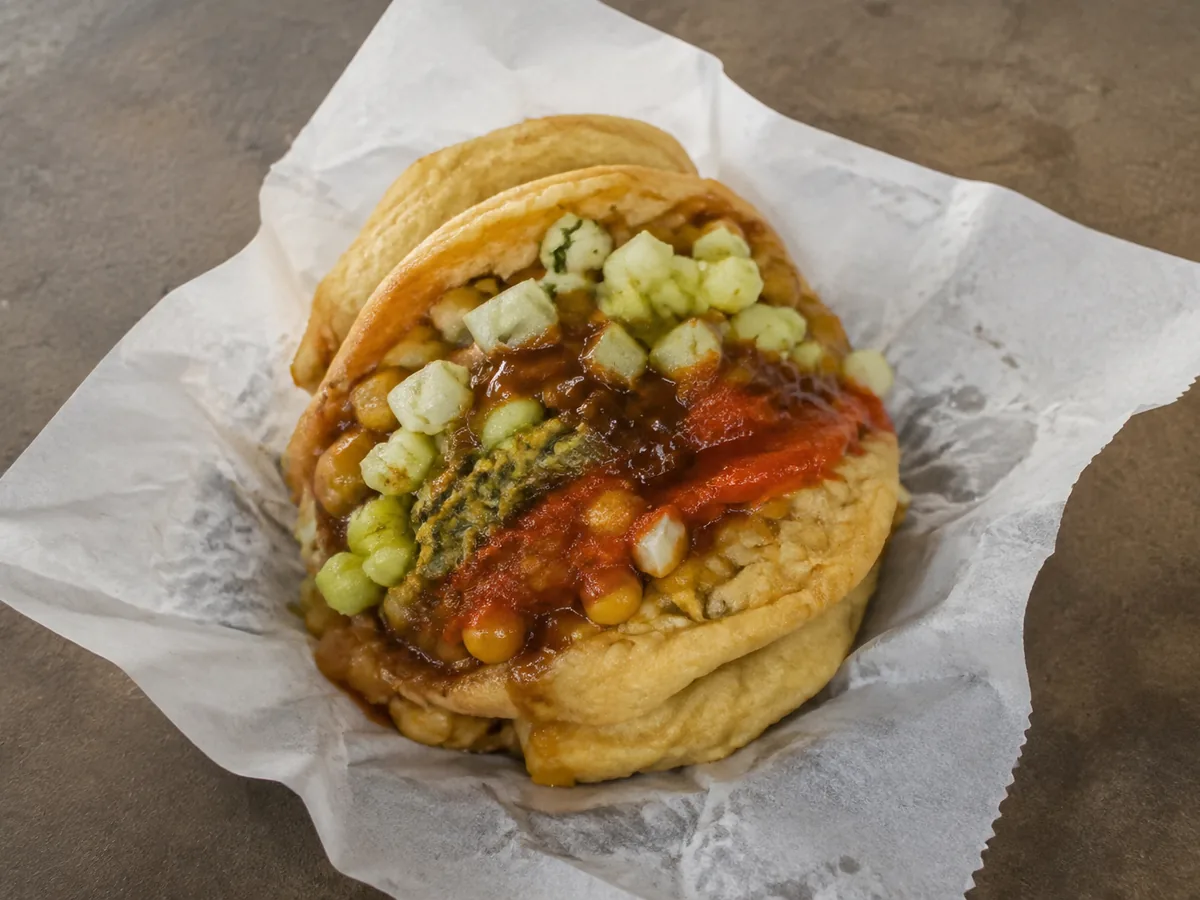
Morning street stalls in Curepe and Chaguanas open before sunrise, and lines form along the asphalt for hot paper parcels of doubles. Emamool Deen invented them in Princes Town in 1936.
Two soft thin turmeric flatbreads called baras cradle a ladle of soupy curried channa. The vendor asks: slight pepper, heavy pepper, or sweet? Then spicy green mango kuchela, grated cucumber relish and fiery chadon beni sauce go over the top.
You eat it standing up, elbows out to keep the yellow turmeric oil off your shirt.
The channa
- 500 g2.5 cupsDried chickpeas, soaked 8 hours in cold water with ½ tsp baking soda, drained
- 1.8 L7.5 cupsCold filtered water
- 45 ml3 TbspHigh-smoke vegetable oil, or mustard oil
- 30 g2 TbspTrinidadian Madras curry powder
- 10 g2.5 tspCumin seeds (geera), roasted dark in a dry pan and ground
- 1 large1 largeYellow onion, peeled and cut into fine 3 mm brunoise
- 6 cloves6 clovesFresh garlic, crushed to a fine paste
- 8 leaves8 leavesFresh chadon beni (culantro), washed and finely minced
- 1 whole1 wholeScotch bonnet pepper, seeded and minced fine
- 12 g2 tspFine sea salt, added once the beans have softened
- 2 g½ tspFreshly cracked black pepper
The bara dough
- 500 g4 cupsAll-purpose wheat flour, 11% protein, sifted
- 7 g2.25 tspInstant dry yeast
- 10 g2 tspGround turmeric
- 5 g1 tspGround roasted geera
- 10 g2 tspGranulated cane sugar
- 8 g1.5 tspFine sea salt
- 320 ml1.3 cupsLukewarm water at 38 °C
- 15 ml1 TbspVegetable oil, for the dough and your hands
To fry and top
- 1 L4.2 cupsHigh-smoke vegetable oil, for frying
- 240 ml1 cupCucumber relish — grated cucumber with culantro, garlic and lime
- 120 ml½ cupSpicy green mango kuchela
- 120 ml½ cupSweet-sour tamarind sauce
Five to six seconds a side
At 190 °C the water inside the slack dough flashes to steam in under three seconds and balloons it hollow. Longer than eight seconds and the moisture is gone and you have a crunchy tortilla instead of a bara.
Then stack them to steam
Hot baras go straight into a towel-lined closed container, where their own steam keeps them soft and foldable.
Baking soda in the soak
It weakens the hemicellulose in the chickpea skins so the beans collapse into a self-thickened gravy. No flour is used anywhere in the channa.
Mash a ladleful
Pressed against the pot wall, one ladle of soft chickpeas releases the starch that turns the liquid into a thick mustard-yellow gravy.
Bloom the curry properly
Ninety seconds of constant stirring until the powder foams and darkens to mustard-brown. Under-bloomed curry powder tastes raw and dusty through the whole pot.
Wet fingers, warm dough
Dip your hands in salted water to stretch the sticky dough to 1.5 mm without tearing. Cold or under-rested dough tears every time.
Passive time, counted separately
The chickpeas soak 8 hours, the dough proofs 2, and the portioned balls rest 15 minutes. None of that is active work.
The five tastes on this plate
Salt is in the channa and the seasoned dough. Fat is the frying oil and the mustard oil in the kuchela. Acid is tart green mango, tamarind and lime in the relish. Heat is Scotch bonnet, raw garlic, dark geera and mustard. Umami is simmered chickpea starch, toasted curry and sulfurous chadon beni.
Equipment
- 6 qt heavy Dutch oven, for the channa
- 5 to 6 qt Dutch oven with a thermometer, for frying
- Large bowl and a damp cloth
- Oiled baking sheet
- Shallow bowl of salted water
- Towel-lined container with a lid
Traditionally a deep cast-iron karahi over a gas burner. A 5-to-6 quart enamelled Dutch oven works in a modern kitchen — the thick metal is what holds 190 °C when wet dough lands in it.
Method
Simmer the curried channa55 min
Sauté the onion and garlic in the oil 5 minutes, then add the curry powder and roasted geera and stir constantly 90 seconds until the spices foam and turn dark mustard-brown.
Add the drained chickpeas, coat them, pour in 1.8 L water, and simmer partially covered 45 to 50 minutes until they yield completely. Mash a ladleful against the pot wall, stir in the chadon beni, Scotch bonnet, pepper and 12 g salt, and simmer 5 minutes more.
Use chickpeas soaked 8 hours with ½ tsp baking soda and drained. Sauté onion and garlic in oil 5 minutes; stir curry and roasted geera 90 seconds until foamy and mustard-brown. Add chickpeas and 1.8 L water; simmer partially covered 45–50 minutes until completely soft. Mash a ladleful against the pot; add chadon beni, Scotch bonnet, pepper and 12 g salt, then simmer 5 minutes.
Mix and proof the dough8 min
Whisk the flour, yeast, turmeric, geera, sugar and salt, pour in the 320 ml lukewarm water, and stir into a sticky wet dough.
Drizzle the oil over and knead in the bowl 3 minutes with oiled hands. Cover with a damp cloth and proof 1.5 to 2 hours until tripled and bubbly.
Mix flour, yeast, turmeric, geera, sugar and salt with 320 ml water at 38 °C into sticky dough. Drizzle oil over; knead in the bowl with oiled hands 3 minutes. Cover with damp cloth and proof 1.5–2 hours until tripled and bubbly.
Portion5 min
With oiled fingers, pinch off 24 balls of about 35 g, lay them on an oiled tray, rub the tops with oil, and rest 15 minutes.
With oiled fingers, divide dough into 24 balls of about 35 g. Place on an oiled tray, oil their tops and rest for 15 minutes.
Flash-fry the baras20 min
Heat the oil to 185–190 °C with a bowl of salted water beside the stove.
With wet fingertips, flatten and pull a ball outward into a translucent circle 12 cm wide, slide it in — it puffs at once — and flip after strictly 5 to 6 seconds, giving the reverse side 5.
Stack the hot baras in a towel-lined container so they steam soft.
Heat oil to 185–190 °C. With fingertips dampened in salted water, stretch each warm ball to a translucent circle 12 cm across and 1.5 mm thick. Slide in; fry strictly 5–6 seconds, flip and cook 5 seconds more. Immediately stack in a towel-lined closed container to stay soft.
Assemble
Overlap two warm baras on greaseproof paper and spoon two generous tablespoons of hot channa across the seam.
Top with cucumber relish, a dab of kuchela, a drizzle of tamarind and chadon beni pepper sauce. Wrap the paper loosely and serve piping hot.
Overlap two warm baras on greaseproof paper. Spoon two generous tablespoons hot channa across the join; add cucumber relish, a little kuchela, tamarind and chadon beni pepper sauce. Wrap paper loosely and serve piping hot.
Sensory cues of doneness
- Visual: vivid saffron-yellow baras puffed with pale blisters, soft and foldable, under chickpeas in a thick mustard-yellow gravy.
- Auditory: a violent rushing hiss as the wet dough hits the oil, calming within four seconds.
- Olfactory: bloomed curry powder, dark roasted geera, earthy turmeric, fried dough and green culantro.
Look for saffron-yellow baras with pale blisters, soft enough to fold, beneath chickpeas in thick mustard-yellow gravy. The initial frying hiss settles quickly; expect curry, roasted geera, turmeric and culantro aromas.
Troubleshooting
- Hard, cracker-like baras.
They fried too long. Five to six seconds a side, then stack them closed to steam soft.
- Tough, grainy chickpeas.
No baking soda in the soak, or the pot boiled hard. Gentle steady simmering until completely soft.
- The dough tears as you stretch it.
It was cold or under-rested. Keep it warm, rest the balls 15 minutes, and keep your fingers wet.
Substitutions
One-to-one global substitutions, with the technique adjustment each one requires.
Ingredient substitutions
| Ingredient | Replace with | Culinary impact and technique adjustment |
|---|---|---|
| Chadon beni | Fresh cilantro with a crushed garlic clove | One-to-one. Similar citrus-herbal notes, less heat tolerance |
| Trinidad curry powder | Madras curry with ½ tsp allspice and ½ tsp extra turmeric | One-to-one |
| Mango kuchela | Indian spicy green mango achar | One-to-one. The same mustard oil and fenugreek punch |
Scaling
Half, for 6 doubles
Halve everything. Frying stays 5 to 6 seconds a bara.
Double, for 24 doubles
Double everything, holding the fried baras in an insulated cooler lined with clean towels so they keep their heat and moisture.
What to serve it with
- Cucumber relish with lime and chadon beni
- Mango kuchela cured with mustard oil and amchar masala
- Tamarind chutney with brown sugar, cumin and garlic
- A cold Solo Apple J, or a Carib
Questions
Why "doubles"?
In 1936 Emamool Deen sold single baras with channa, and customers kept asking him to double the bread. The name stuck.
Can I use tinned chickpeas?
Yes — three 15 oz tins with their liquid. Sauté the aromatics with the curry, add the chickpeas, and simmer 20 minutes, mashing a ladleful.
What is chadon beni?
Culantro — long serrated leaves with an intense earthy coriander flavour that survives heat far better than cilantro.