Pelau
Central Asian pilaf by way of Indian indenture, rebuilt around African sugar browning. Dark brown sugar is left unstirred in hot oil until it foams dark mahogany, and the chicken goes in at exactly that second — the cold meat halts the temperature climb before caramel becomes carbon.
- Prep
- 30 min
- Cook
- 45 min
- Serves
- 8 hearty portions
- Difficulty
- Hard
Researched · Kitchen testing pending
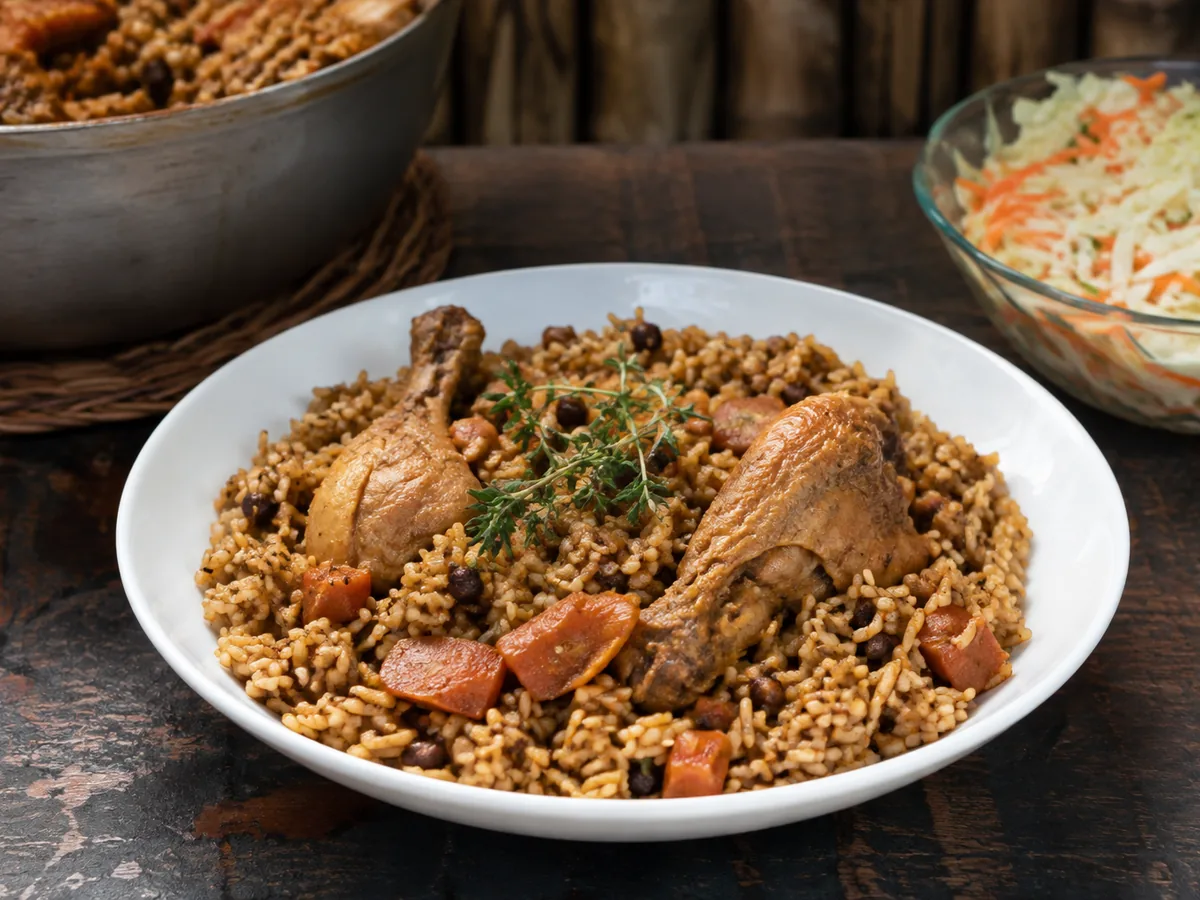
Pelau is Trinidad’s ultimate lime food. At a beach cricket match on Maracas Bay or an all-night Carnival fete, a hot pot of it feeds the crowd.
Rooted in the Central Asian pilaf brought by East Indian indentured workers and transformed by African sugar browning, it is a one-pot masterclass. The soul of it is the burnt sugar: dark brown sugar melted in smoking oil until it foams into dark mahogany caramel, at which second the chicken hits the pot and takes on a bittersweet coat.
Rice, pigeon peas, pumpkin, coconut milk and sweet peppers follow, and steam into fluffy savoury grains.
The chicken
- 1.5 kg3.3 lbBone-in chicken thighs and drumsticks, chopped into small 5 cm pieces
- 45 ml3 TbspTrinidad green seasoning — culantro, scallion, garlic, thyme and pimento peppers
- 30 ml2 TbspWorcestershire sauce
- 15 ml1 TbspDark soy sauce
- 10 g2 tspFine sea salt1 tsp onto the chicken, 1 tsp into the rice pot
- 3 g1 tspFreshly cracked black pepper
The browning
- 45 ml3 TbspHigh-smoke vegetable oil
- 50 g¼ cup packedDark brown cane sugar
The pot
- 500 g2.5 cupsParboiled long-grain white rice, rinsed and drained dry
- 400 g1 tinCooked pigeon peas, rinsed and drained
- 250 g1.5 cupsCalabaza pumpkin, or butternut squash, peeled and cut into 1 cm cubes
- 150 g1 cupCarrots, peeled and cut into 1 cm cubes
- 1 large1 largeYellow onion, peeled and diced 5 mm
- 1 large1 largeSweet red bell pepper, cored and diced 1 cm
The liquid
- 400 ml1 tinUnsweetened full-fat coconut milk
- 500 ml2.1 cupsHot chicken bone stock, or water
- 30 g2 TbspUnsalted butter
- 1 whole1 wholeScotch bonnet pepper, stem intact, unpunctured
- 4 sprigs4 sprigsFresh thyme
Watch the sugar, do not stir it
At 170–180 °C sucrose pyrolyses into caramelan, caramelen and aromatic furans. Scatter it evenly, leave it alone, and the moment the foam turns dark frothy mahogany the chicken goes in. A few seconds later it is bitter black carbon.
The cold chicken is the brake
Dropping the meat in halts the temperature rise instantly and coats every piece in a bittersweet glaze. That is why it must be ready beside the pot before the sugar goes in.
Parboiled rice is mandatory
Its starches have been hydrothermally processed and the outer kernel hardened, so it absorbs boiling coconut milk over 25 minutes without bursting. Ordinary white rice turns to mush.
Whole pepper, foil seal
The unpunctured Scotch bonnet gives aroma only. Crimped foil under the lid is what makes the steam phase actually work.
Do not open the pot
Twenty-five minutes on the lowest setting, undisturbed. Every look costs steam the rice needs.
Passive time, counted separately
The chicken marinates at least 2 hours, and the finished pot rests 5 minutes. Neither is active work.
The five tastes on this plate
Salt is sea salt, soy and Worcestershire seasoning the grains to the core. Fat is oil, coconut lipids and butter keeping the rice loose. Acid is cut in at the table with pickled chow or slaw. Heat is whole Scotch bonnet steam, garlic, black pepper and thyme. Umami is caramelised chicken fond, reduced stock and earthy pigeon peas.
Equipment
- 6 to 7 qt enamelled cast-iron Dutch oven with a tight lid
- Wooden spoon
- Heavy aluminium foil
- Large fork, for fluffing
Traditionally a heavy cast-aluminium round-bottomed Dutchie. A 6-to-7 quart enamelled Dutch oven works in a modern kitchen — even floor heat with no hot spots is exactly what the sugar stage needs.
Method
Season the chicken10 min
Toss the chicken with the green seasoning, Worcestershire, soy sauce, black pepper and 1 tsp salt, and marinate at least 2 hours, or overnight.
Coat chicken with green seasoning, Worcestershire, soy, black pepper and 1 tsp salt. Marinate for at least 2 hours or overnight before starting the caramel.
Burn the sugar9 min
Heat the oil over medium-high and scatter the 50 g dark brown sugar evenly across it. Do not stir.
Watch it melt, bubble and foam, and the instant the foam is dark frothy mahogany — about 3 to 4 minutes — drop the chicken in. It will sizzle violently. Stir rapidly for 5 minutes to coat every piece.
Have marinated chicken ready beside the pot. Heat oil over medium-high; scatter 50 g sugar evenly without stirring. At 170–180 °C, after about 3–4 minutes, add chicken as soon as foam turns dark mahogany, before blackening; expect strong sizzling. Stir rapidly 5 minutes to coat.
Aromatics and vegetables6 min
Add the onion and bell pepper and sauté 3 minutes, then the pumpkin, carrot and drained pigeon peas for 3 minutes more, scraping the fond off the bottom.
Add onion and bell pepper; sauté 3 minutes. Add pumpkin, carrot and drained pigeon peas and cook another 3 minutes, scraping the browned fond from the bottom.
Toast the rice2 min
Tip in the drained parboiled rice and stir constantly 2 minutes, until every grain glistens gold in the spiced fat and browning.
Add rinsed, dry-drained parboiled rice. Stir continuously for 2 minutes until every grain glistens golden with seasoned fat and caramel; use parboiled rice for this cooking schedule.
Coconut milk and boil-down8 min
Pour in the coconut milk and hot stock, add the butter, thyme and remaining 1 tsp salt, and stir once. Float the whole Scotch bonnet on top.
Bring to a rolling boil and boil uncovered 6 to 8 minutes, until the liquid drops below the rice and steam craters form.
Add 400 ml coconut milk, 500 ml hot stock, butter, thyme and remaining 1 tsp salt; stir once. Float the intact Scotch bonnet on top. Boil uncovered 6–8 minutes until liquid falls below rice level and steam holes form.
Foil seal and steam25 min
Turn to the absolute lowest setting, crimp foil over the pot to seal the steam, and press the lid down firmly.
Steam undisturbed 25 minutes. Do not open it.
Reduce heat to the absolute lowest setting. Crimp foil tightly over the rim and press the lid down. Steam undisturbed for 25 minutes without opening.
Fluff and rest
Lift out the Scotch bonnet and thyme stems, fluff gently from the bottom up with a fork, scatter chopped culantro over, and rest 5 minutes.
Remove the intact Scotch bonnet and thyme stems. Fluff gently from the bottom with a fork, scatter chopped culantro over the rice and rest 5 minutes.
Sensory cues of doneness
- Visual: a glistening golden-brown rice pot speckled with tender chicken, green peas, orange pumpkin and red pepper, the grains separate and fluffy.
- Auditory: a roaring hiss as cold chicken hits the molten sugar, and a quiet crackle at the pot floor during the final steam.
- Olfactory: bittersweet burnt cane sugar, roasted chicken, coconut milk, sweet pumpkin and thyme.
Look for separate fluffy golden-brown rice with tender chicken, peas, pumpkin and pepper. Expect a faint dry crackle at the end of steaming and aromas of caramelised sugar, chicken, coconut and thyme.
Troubleshooting
- A bitter, acrid pot.
The sugar went past dark foam into black carbon. The chicken must go in the second the mahogany bubbles form.
- Mushy rice.
Ordinary white rice was used. Parboiled is essential for loose grains.
- Blistering heat throughout.
The Scotch bonnet was punctured. Keep it whole on top of the grains.
Substitutions
One-to-one global substitutions, with the technique adjustment each one requires.
Ingredient substitutions
| Ingredient | Replace with | Culinary impact and technique adjustment |
|---|---|---|
| Pigeon peas | Tinned black-eyed peas, or red kidney beans | One-to-one, rinsed well |
| Calabaza pumpkin | Kabocha, or butternut squash | One-to-one. Kabocha has the same dense sweetness |
| Parboiled rice | Long-grain brown rice | Add a cup more stock and steam 35 minutes instead of 25 |
Scaling
Half, for 4 portions
Halve everything in a 4-quart Dutch oven and steam 20 minutes.
Double, for 16 portions
Double everything in an 11-to-12 quart pot, caramelising the sugar in two batches if the pot floor is narrow.
What to serve it with
- Cucumber chow with garlic, lime and chadon beni
- Crisp coleslaw, to cut the coconut rice
- Sweet fried plantain
- A cold Carib, or a fiery Solo ginger beer
Questions
Can I make it with beef?
Yes. Cube beef chuck, brown it in the caramelised sugar, and simmer 45 minutes before the rice goes in.
What if I cannot get pigeon peas?
Tinned black-eyed peas or red kidney beans, drained and rinsed.
Wet or dry pelau?
Some cooks prefer wet, with extra coconut milk and soft pumpkin. This version is the traditional dry, fluffy-grained one.