Mofongo
Fried green plantain crushed in a wooden pilón with garlic, pork, and fat while it is still hot enough to smear — served with a cup of hot broth beside it.
- Prep
- 20 min
- Cook
- 1 hr 20 min
- Serves
- 4 as a main with broth, 6 as a side
- Difficulty
- Medium
Researched · Kitchen testing pending
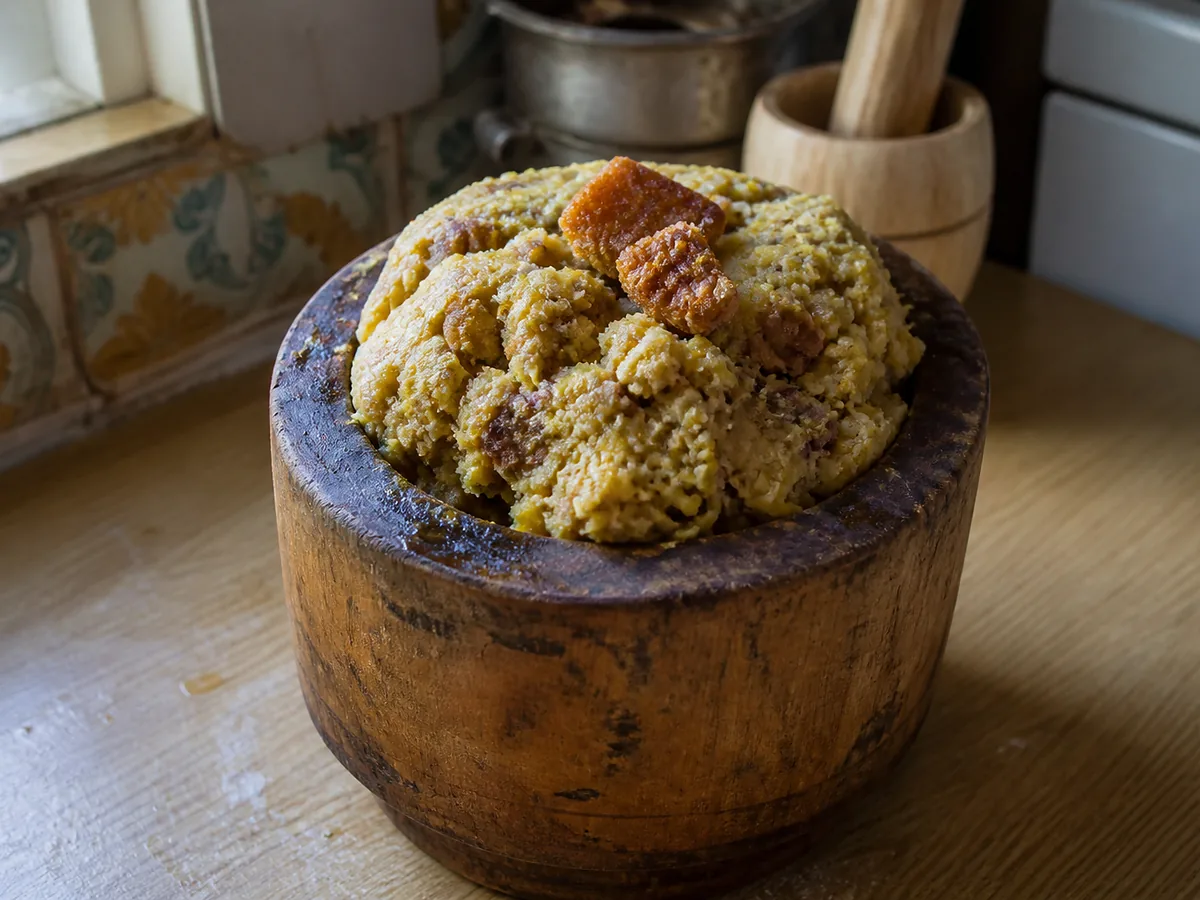
A pilón is a tall wooden mortar, and mofongo is the mash you build in it: fried green plantain crushed with garlic, chicharrón, fat, and salt while the starch is still hot enough to smear instead of crumble.
I serve it in that same pilón, or I pack it and turn it out as a dome. Either way a cup of hot broth sits next to it, because the mash sets as it cools and a dry mound is a failure of the plate, not a rustic texture.
Green plantain, not maduro. Smash while hot. The broth is part of the method, not a garnish you add if you remember.
Stuffed mofongo — shrimp, chicken, churrasco packed into the dome — is a restaurant and kiosco elaboration. I label it. It is not this recipe. Tostones are twice-fried smashed plantain and a different plate altogether; they already have their own number on the Cuban ten.
Chicken caldo — the default, and keep it hot
- 800 g1¾ lbChicken wings, backs, or necks, rinsed
- 120 g4 ozYellow onion, peeled and halved1 small
- 4 cloves4 clovesGarlic, peeled and smashed
- 2 stems2 stemsRecao (culantro), left wholeor 6 cilantro stems if recao is missing
- 100 g3½ ozCubanelle or Italian frying pepper, stemmed, left whole
- 10 g2 tspKosher salt
- 1.8 L7½ cupsWater
- 2 leaves2 leavesDried bay leaves
Shrimp caldo, if that is the plate
- 400 g14 ozRaw shrimp shells and headsskip the chicken; same onion, garlic, recao, cubanelle, salt, water, and bay
Plantains and the mash
- 1.4 kg as bought3 lb as boughtGreen plantains — deep green, firm, heavy4 large. Peeled and cut into 2.5 cm chunks, about 900–1000 g prepared
- 700–900 ml3–3¾ cupsNeutral frying oil — peanut, canola, or sunflowerenough for 3 cm depth in a wide skillet
- 24 g8 clovesGarlic, peeled
- 8 g1½ tspKosher salt, for the garlic pasteplus more to taste once the pork is in
- 120 g4 ozChicharrón — dense fried pork belly and skin with some meatchopped into 1 cm pieces. Or 150 g tocino or skin-on pork belly, diced and fried crisp
- 45 ml3 tbspLard, melted — or unsalted butter, or strained frying oil
- 0.5 ga few grindsBlack pepperoptional
Yield
4 plates as a main with broth, or 6 as a side. About 50 minutes once the caldo is underway. I do not put tomato in this mash. I do not put cheese in this mash.
On the plantain
Plátano verde is a starch. The flesh is cream-white, tight, almost squeaky when raw — enzymes have not yet turned that starch into sugar, and that conversion is what makes a maduro brown fast and taste like dessert. Buy deep green, no yellow field. A yellow tip fries darker and mashes softer; a yellow or black plantain gives you a sweet paste that is not mofongo. Starch granules gelatinise around 70–80 °C / 158–176 °F. In the oil I want chunk interiors at 90–95 °C / 194–203 °F: slightly translucent if you break one, no chalky core. Mash while hot. Gelatinised starch is plastic above roughly 60 °C / 140 °F; as it cools, amylose retrogrades and the mass firms. Cold leftover fried plantain mashed in a bowl is lumps, not mofongo.
On the pilón
The pilón is the tool and, often, the plate: a heavy wooden mortar, tall, with a pestle that crushes rather than rices. Mash garlic and salt first so the cells rupture, then add hot plantain and chicharrón in batches. The wood holds heat better than a thin metal bowl. No pilón: a heavy ceramic mortar, or a sturdy bowl and a potato masher — labelled, and you will get a looser mash. A food processor shears starch into glue. I do not use one.
On chicharrón and tocino
Chicharrón here is fried pork with skin, sometimes a ribbon of meat, salty, shattering and then chewy once it hits hot plantain. Puffed snack rinds are a diaspora stand-in: salt and crunch, less pork fat. Tocino or diced pork belly fried until the pieces render and brown is the other traditional path. Either belongs. Bacon is a known departure — it reads smoky.
On the broth — not a garnish
Dry mofongo is the common failure. Fried plantain plus garlic plus pork is a dense starch cake; as it sits, starch binds water and the fat cools. Broth — chicken or shrimp, hot, salted, with a little gelatin from bones or shells — goes in a cup on the side, or you spoon some into the mash, or you nest a well in the dome and pour. I keep 150–180 ml of hot broth per plate. It should taste like chicken or shrimp and garlic, not a heavy stew. You are moistening, not turning mofongo into soup.
On garlic, fat, and salt
Garlic is a paste, not a garnish. Mash it with salt in the pilón until sticky before any plantain goes in — raw chunks in a finished mash are hot spots of bite. Fat is lard, butter, or a few spoons of the frying oil. Butter is a real Puerto Rican house and restaurant habit; it softens the mash and carries garlic. Olive oil as the only fat is a known departure, and extra-virgin will taste of itself. Salt the paste, then taste after the chicharrón. Pork is already salty.
Equipment
- A pilón — tall wooden mortar — and pestle
- A wide heavy skillet, 30 cm, for frying
- An instant-read or frying thermometer
- A slotted spoon
- A medium pot, 4–5 L, for the caldo, and a fine-mesh strainer
- A rack for draining plantain briefly — not a long hold
Do not use a blender or food processor for the mash. Do not use an Instant Pot as the method for the plantains. A stovetop pressure cooker for the chicken caldo is a labelled island-reality shortcut in the substitutions; the mash is still fried and crushed by hand.
Method
Simmer the caldo — start this first45–60 min
Put the chicken (or shrimp shells), onion, smashed garlic, recao, cubanelle, bay, salt, and water in the pot. Bring to a boil over medium-high, then drop at once to a lazy simmer — small bubbles, not a rolling boil. Skim grey foam in the first 10 minutes. Lid slightly ajar.
Chicken parts: 45 to 60 minutes, until the broth tastes round and the bones have given some body. Shrimp shells: 25 to 30 minutes — longer and it goes bitter.
Strain. Keep the liquid hot, barely steaming, 80–90 °C / 176–194 °F. Taste for salt: it should be a little saltier than a soup you would drink in quantity, because it is seasoning a starch.
Chicken caldo is clear gold and coats a spoon lightly. Shrimp caldo is coral-gold and smells of shell, not iodine. Collagen becomes gelatin near a simmer, and that is what makes broth feel like food. A hard boil makes a cloudy pot. Tap water will not replace this.
Combine chicken or shrimp shells with onion, garlic, recao, cubanelle, bay, salt and 1.8 L water. Boil, then simmer gently with lid ajar, skimming during the first 10 minutes. Cook chicken 45–60 minutes or shells 25–30 minutes only. Strain; keep broth at 80–90 °C / 176–194 °F and taste for salt.
If you are frying tocino, do it now8–12 min
In the skillet over medium heat, cook the diced tocino or pork belly until the fat renders and the pieces are deep gold and crisp at the edges, 8 to 12 minutes.
The pork should smell roasted, not boiled; the pieces should rattle; and there should be no waxy white fat left in the centre. Undercooked tocino mashes into waxy lumps.
Lift the pieces out. Leave the fat in the pan if you like, and top up with frying oil for the plantains. If you already have chicharrón, skip this and just chop it.
If using tocino or pork belly, fry diced pieces over medium 8–12 minutes until deeply golden, crisp-edged and fully rendered, without waxy white fat inside. Remove; optionally retain fat and add frying oil. With ready-made chicharrón, simply chop it.
Peel and cut the plantains10 min
Ends off. Score the peel lengthwise in two or three lines, just through the skin. Pry under a corner and peel in strips — oil on your hands helps more than water. Trim stringy under-skin so it does not fry into a bitter thread.
Cut into 2.5 cm chunks.
Trim plantain ends and score peel lengthwise in two or three places without cutting deeply into flesh. Oil hands, peel in strips and remove stringy under-skin. Cut into 2.5 cm chunks.
Fry the plantains until mashable12–18 min, in batches
Oil to 3 cm deep, heated to 175–180 °C / 347–356 °F. Fry the chunks in a single layer, turning, 5 to 7 minutes per batch, until gold — not pale blond, not brown.
A knife or skewer should meet little resistance. Break one: the interior should look slightly translucent, not chalky white. If you check a chunk, 90–95 °C / 194–203 °F in the centre.
If the oil sits at 190 °C or above, the outside browns while the centre stays raw — drop the heat. Under 165 °C, the plantain drinks oil. Fry in batches and let the oil recover.
Drain 30 to 60 seconds. Do not hold them ten minutes. This is a single fry to gelatinise starch, not a twice-fried smash.
Heat 3 cm oil to 175–180 °C / 347–356 °F. Fry in single-layer batches 5–7 minutes, turning until golden and knife-tender, with slightly translucent centres at 90–95 °C / 194–203 °F. Avoid below 165 °C or 190 °C and above; let oil recover between batches. Drain 30–60 seconds and mash immediately, not after 10 minutes.
Mash garlic, then mash while hot8–12 min
In the pilón, mash the garlic and 8 g of salt to a sticky paste, 1 to 2 minutes. You should smell it sharply, and there should be no intact cloves.
Add a handful of hot plantain and some of the chicharrón or fried tocino. Pound and smear. Add fat a spoon at a time. More plantain, more pork, more fat. Work in batches if the pilón is small.
The mass should look like a coarse, glossy mash with visible pork bits — not a purée, and not a bowl of fried chunks with garlic on top. It should smear on the pestle and hold a dent, and smell of garlic and fried plantain, not raw starch.
Taste. Add salt only after the pork has gone in.
If it crumbles, the plantain cooled or was underfried. Sprinkle 15–30 ml of hot broth into the pilón and mash again — a rescue, not the serving broth. Too much liquid now and you get porridge.
Mash garlic with 8 g salt in a pilón 1–2 minutes until smooth and sticky. Add hot plantain, pork and fat a spoonful at a time; pound in batches to a coarse, glossy mash that holds a dent. Do not process. Taste salt after adding pork. If crumbly, add 15–30 ml hot broth and mash again.
Pack, and serve with broth5 min
Pack the mash into the pilón and serve it in the wood, or pack it into a small bowl and unmould a dome onto a plate.
Put a cup of hot caldo next to each plate, 150–180 ml. Eat at once. The dome should still steam. A well in the top of the dome is for spooning broth; it is not required.
Mash hot, slightly elastic, glistening, not a dry crumb; broth steaming; garlic present in every bite rather than in isolated pockets.
Pack the hot mash into a pilón or mould in a small bowl and turn out as a dome. Serve immediately with 150–180 ml hot broth per plate, alongside or spooned into an optional well; keep the mash steaming and moist.
Storing it
A now food
Leftover mash refrigerates for 1 day at 4 °C / 40 °F or below, tightly covered, but it firms and dulls. Reheat in a covered skillet with a spoon of broth until the centre of the mass is 74 °C / 165 °F. It will never be as good as the first mash. Do not leave mash in the wooden pilón overnight — wood holds moisture and the mash sours.
The caldo and the oil
Caldo keeps 3 to 4 days refrigerated, or freezes for 2 to 3 months. Reheat to a boil. Strain it, cool with the lid off, and get it into the fridge within 2 hours. If you pick the chicken meat for another use, it must reach 74 °C / 165 °F. If the frying oil still smells clean, strain it for another plantain fry. Discard it if it smells of fish or has gone dark.
Troubleshooting
- The mash is dry and crumbly.
The plantain cooled, or you skimped on fat, or you overfried until the chunks were hard. Mash in hot broth a spoon at a time, plus more fat, and serve extra caldo. Next time, fry to gold not brown, and mash immediately.
- The mash is greasy and heavy.
Oil too cool, or you dumped frying oil in instead of measuring about 45 ml of fat. Drain the plantain better. Broth will not fix a grease sponge.
- The mash is gritty or squeaky.
Underfried plantain — the starch never gelatinised. If you caught it before mashing, return the chunks to 175 °C oil.
- Raw garlic in places, bland in others.
The garlic was sliced or left in cloves rather than mashed to a paste first. For this batch: mash extra garlic with salt and a spoon of fat, and fold it through while still hot.
- It tastes only of salt.
The chicharrón was very salty and you salted the paste as if the pork were plain. Unsalted broth, or lime at the table. Next time, salt after the pork.
- It tastes sweet.
You bought plantains that had started to yellow. Start over with green fruit.
Substitutions
Traditional versus known departure
| Traditional | Known departure |
|---|---|
| Green plantain, deep green | Slightly yellow-tipped is softer, sweeter, and browns faster. Maduro is a different fruit and a different plate |
| Pilón | A heavy mortar, or a bowl and masher. Not a food processor |
| Chicharrón with meat and skin | Tocino or pork belly diced and fried; puffed snack rinds for salt and crunch; bacon, which reads smoky |
| Lard or frying oil in the mash | Butter, a common house habit. Olive oil tastes of itself |
| Chicken caldo | Shrimp caldo, or a light garlic broth. Not gravy, not cheese sauce |
| Unstuffed mash with broth | Mofongo relleno — shrimp, chicken, or churrasco in a well. A restaurant and kiosco elaboration, with the filling cooked separately |
| A one-fry mash of plantain | Trifongo, with yuca and yautía, is a known restaurant mash and not this page |
| Stovetop caldo | Island pressure cooker for the chicken parts: about 20–25 min at pressure, natural release, still strained and kept hot. Do not pressure-cook the plantains |
Scaling
Mash in waves so nothing sits fried and cooling. Caldo scales easily; keep the same salt level.
Smaller and larger
Two plantains make a tight dinner for 2 with broth. Six plantains need a second skillet or patient batches — crowding drops the oil under 165 °C. A tray of mofongo held under foil is steam, then cardboard. Fry, mash, serve.
What to serve it with
The caldo is the first companion, and it is not optional.
- A simple salad, or sliced avocado
- Fried fish, if the mofongo is the starch
- Lime at the table
Christmas pork belongs on its own page; I do not pile pernil into this mash unless I am labelling a leftover plate. Ketchup is not a companion.
Questions
Do I have to use a pilón?
It is the right tool and the traditional serving vessel. A heavy bowl will mash. A processor will glue.
Why is my mofongo dry?
You skipped the broth, or you mashed cold plantain, or you overfried. Broth on the side is not optional for this plate.
Can I use maduros?
No. You will make a sweet mash. Cook maduros as maduros.
Is stuffed mofongo the real one?
The base is mash plus broth. Relleno de camarones, pollo, or churrasco is a restaurant and kiosco elaboration. Cook the filling separately.
Chicharrón or tocino?
Either. I like chicharrón for the shatter, and tocino when I am frying the pork from scratch in the same pan.
How green is green?
Deep green skin, firm, no yellow field. If it peels like a banana, it is too ripe.
Can I freeze it?
Freeze the caldo. Do not freeze the mash — starch retrogrades into a dry brick.