Anticuchos
Beef heart cubed onto skewers, bathed in ají panca, vinegar and garlic, then grilled hard enough that the edges char while the centre stays juicy. Potato and choclo on the side are not decoration — they cool the spice and catch the drips.
- Prep
- 45 min
- Cook
- 8 min
- Serves
- 4 as a main with sides, or 6–8 as snack skewers
- Difficulty
- Medium
Researched · Kitchen testing pending
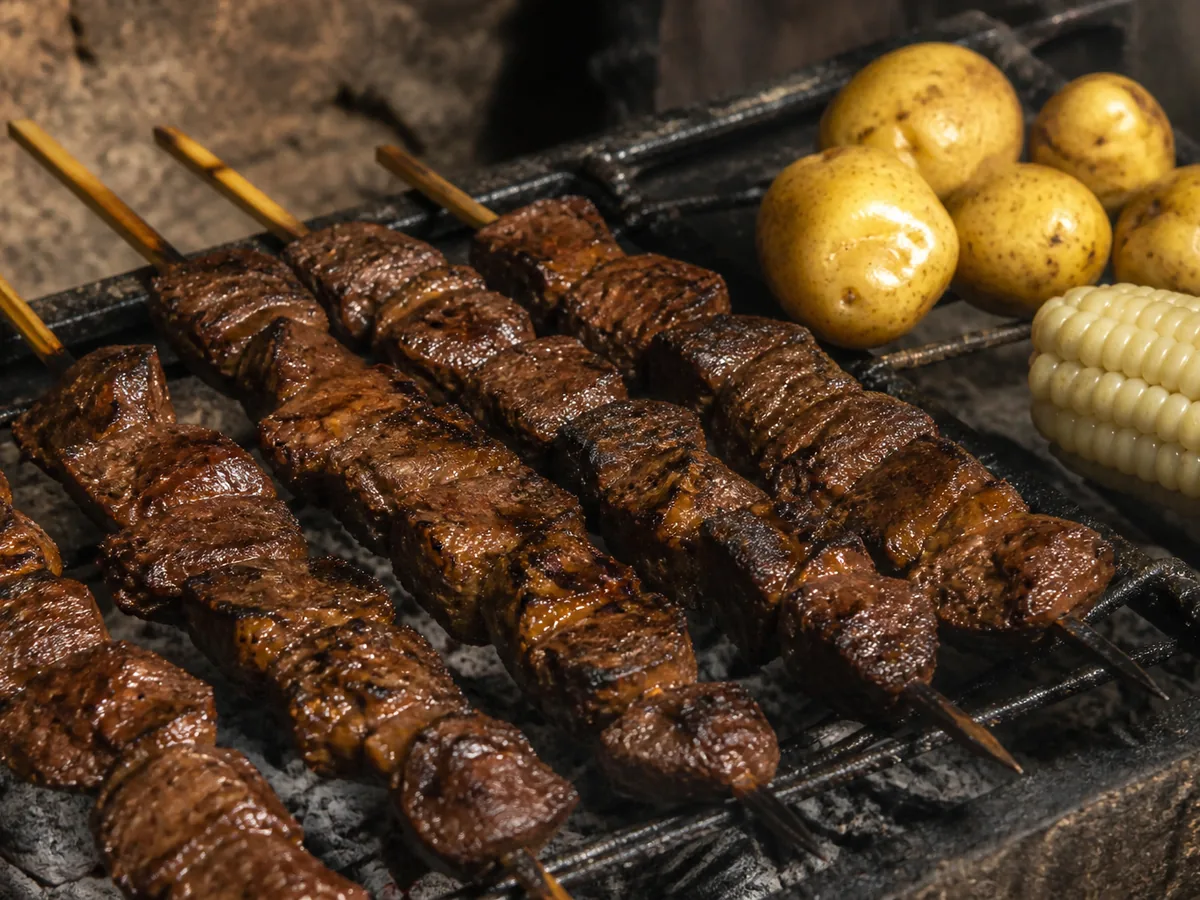
Smoke hits before the first bite. Anticuchos are beef heart on skewers, bathed in ají panca, vinegar and garlic, then grilled hard enough that the edges char while the centre stays just cooked through.
The marinade works as both cure and glaze: long enough for colour and perfume to move inward, and hot enough on the grate that chile and spice toast without turning the meat into shoe leather. The goal is mahogany edges, hot chile perfume, and a centre that is cooked but still juicy — not grey and dry all the way through.
Potato and choclo on the side are not optional decoration. They cool the spice and catch drips of the same sauce.
Meat
- 900 g2 lbBeef heart, trimmed of silver skin, fat caps and tubesor see the substitutions section for a labelled steak version
- Metal or bamboo skewers — soak bamboo for 30 minutes in water first
Marinade and baste
- 60 ml¼ cupAjí panca paste
- 45 ml3 TbspRed wine vinegar or distilled vinegar
- 45 ml3 TbspNeutral oilplus more for the grill grates
- 4 cloves4 clovesGarlic, minced or grated to a paste
- 10 ml2 tspGround cumin
- 5 ml1 tspDried oregano, crumbled
- 8 g1½ tspFine sea salt
- 3 g1 tspFreshly ground black pepper
- 5 ml1 tspSmoked paprikaoptional, only if your panca tastes flat
- 15 ml + 15 ml1 Tbsp + 1 TbspOil mixed with reserved clean marinade, for basting at the end
Sides
- 700 gabout 1½ lbYellow or white potatoes
- 300 gabout 2 cupsChoclo (Peruvian giant corn) or large white corn kernelsfrozen is fine
- Salt for the boiling water
- Optional — a few tablespoons of leftover thinned marinade boiled hard as a table drizzle, or a simple ají cream
Why heart, and why ají panca
Beef heart is dense muscle with a clean, mineral beef taste and almost no intramuscular fat. Cubed and skewered, it needs marinade acid and oil to season deep and keep the surface from drying on high heat. Ají panca is deep red, mild to medium, smoky-fruity rather than sharp like ají amarillo. Cumin and garlic are not tourists here; they are the street-stall signature, and vinegar brightens and helps the paste cling.
Never baste with what touched the raw meat
Reserve 30 ml (2 Tbsp) of the marinade in a separate clean container before the meat goes anywhere near it. Anything that touched raw heart is not a finishing sauce unless it is boiled at a full rolling boil, 100 °C / 212 °F, for at least one full minute.
Passive time, counted separately
The cubes need 2–8 hours in the fridge, and overnight is fine. That is hands-off and sits outside the times quoted above. Two hours gives surface seasoning; closer to 8 deepens colour and cumin. Beyond about 12 hours the vinegar firms the exterior too much.
Equipment
- Charcoal or gas grill, or a cast-iron grill pan indoors
- Metal or soaked bamboo skewers
- Sharp knife and a stable board
- Tongs and a clean basting brush
- Instant-read thermometer
- Saucepans for the potatoes and choclo
Method
On the heart — trim and cube
Rinse the heart under cold water and pat dry. Work on a stable board.
Cut away the tough white connective tissue, the valves and any dark clots. You want deep-red meat that feels firm, not slippery with excess membrane. Trimming carefully matters more than fancy knife work — leftover silver skin shrinks and toughens on the grill.
Cut into cubes about 2.5–3 cm (1–1¼ in). Smaller cubes overcook before the surface chars; larger ones stay raw in the centre unless you drop the heat and wait too long. Uniform size is the whole timed method's friend.
Weigh the meat after trimming. If you started at 900 g (2 lb) and lost a lot, adjust the salt in the marinade slightly downward so the smaller mass does not taste oversalted.
Hold the cubes cold, at or below 4 °C / 40 °F, while you mix the marinade. Do not leave raw heart at room temperature for the whole prep.
Rinse and dry the heart; trim membranes, valves, fat and clots. Cut uniform 2.5–3 cm (1–1¼ in) cubes. Weigh after trimming and reduce marinade salt if much of the 900 g (2 lb) was lost. Keep at or below 4 °C / 40 °F.
On the marinade — paste, acid, spice
Whisk the ají panca paste, vinegar, oil, garlic, cumin, oregano, salt and pepper until smooth. Taste a dab on a clean spoon: it should be salty, garlicky, gently smoky-chile and sharp from the vinegar. If it tastes dull, add a pinch more salt or 5 ml (1 tsp) vinegar. If it tastes only of raw garlic, give it 5 minutes to marry before judging again.
Reserve 30 ml (2 Tbsp) now, in a separate clean container, for basting. Keep that portion uncontaminated by raw meat.
Toss the cubes in the remaining marinade until every face is coated. The paste should cling in a red film, not pool as watery sludge — if it looks thin, your paste was loose, so add another spoon of panca.
Cover and refrigerate 2–8 hours, flipping the bag or stirring once halfway if you remember.
Whisk panca, vinegar, oil, garlic, cumin, oregano, salt and pepper; taste before adding meat. If dull, add salt or 5 ml (1 tsp) vinegar; if sharply garlicky, wait 5 minutes and taste again. Reserve 30 ml (2 Tbsp) separately for clean basting. Coat cubes in the remainder; add a spoon of panca if watery. Cover and refrigerate 2–8 hours, turning halfway. Raw-contact marinade requires a full 100 °C / 212 °F boil for at least 1 minute before reuse.
On the sides — potato and choclo before the fire20–30 min
Potatoes: scrub, cover with cold salted water, bring to a boil, then simmer until a knife slides through with a hint of resistance — typically 20–30 minutes. Centres near 95–98 °C / 203–208 °F are done. Drain, and keep whole or halve. Hold warm in a low oven at 95 °C / 200 °F loosely covered, or rewarm in simmering water for 2 minutes before serving.
Choclo: boil in salted water until the big kernels are tender and starchy-sweet, 15–25 minutes from frozen, then drain. The chew should be substantial — not popcorn-crisp, not mush.
Time these so they are ready when the skewers come off. Cold potato next to a hot anticucho is a missed contrast.
Start potatoes in cold salted water; simmer 20–30 minutes until tender, centres 95–98 °C / 203–208 °F. Drain and halve; hold loosely covered at 95 °C / 200 °F. Boil frozen choclo in salted water 15–25 minutes until tender; drain. Serve both hot. Alternatively, rewarm the potatoes in simmering water for 2 minutes before serving.
On the skewers — load for even heat
Thread the cubes snugly but not crushed, leaving a hairline gap so hot air and flame lick more than one face. Packing them like a solid brick steams the centres.
Aim for 4–5 cubes per snack skewer, or 6–7 for a fuller stick, depending on cube size. Pat off only the thickest drips of marinade so the grill does not become a flare-up factory — leave the coating on.
Oil the grates. Have tongs, a clean basting brush and the reserved clean marinade ready. Preheat the grill while you skewer.
Soak bamboo skewers 30 minutes first. Thread 4–5 cubes for snacks or 6–7 for larger portions, leaving tiny gaps. Remove thick marinade drips but retain the coating. Preheat and oil grates; prepare tongs, a clean brush and reserved clean marinade.
On the grill — timed method6–10 min
Heat a charcoal or gas grill to high. You want the grate screaming: hold a hand about 10 cm (4 in) above and pull away in 1–2 seconds. A hot grate often sits in the 260–290 °C / 500–550 °F range. Medium heat will grey the meat before it chars.
Lay the skewers on the clean oiled grate and do not move them for 2–3 minutes. You are building a deep red-brown crust. Listen for a steady sizzle — if you hear only a soft hiss and see steam puddles, the grate was not hot enough or the meat was wet.
Turn a quarter turn and grill another 2–2.5 minutes. Repeat until all four sides have colour. Total time for 2.5–3 cm (1–1¼ in) cubes on true high heat is usually 6–10 minutes.
In the last 2 minutes, brush with the reserved clean marinade. The paste should sizzle and darken slightly, not turn black and bitter. If flames leap, move the skewers to a cooler zone for 20 seconds, then return them.
Doneness for heart: cooked through with a hot centre. Because heart is lean and usually eaten well past raw, aim for around 70–74 °C / 160–165 °F in the centre of a cube. Slightly pink can be acceptable for very fresh heart handled carefully, but street style is typically fully opaque and juicy, not bleeding. If the exterior is blackening before the centre climbs, shift to indirect heat and close the lid for 1–2 minutes.
Rest the skewers on a warm platter for 3 minutes. The juices settle and the surface stays lacquered.
Grill on oiled grates at 260–290 °C / 500–550 °F: sear 2–3 minutes, then quarter-turn every 2–2.5 minutes until all sides brown, usually 6–10 minutes total. Baste with clean marinade during the last 2 minutes. Move away from flare-ups for 20 seconds. Aim for 70–74 °C / 160–165 °F centres; finish blackening cubes indirectly, covered, 1–2 minutes. Rest 3 minutes.
If you cannot cook outdoors
Charcoal gives better smoke; gas is fine if you keep the lid open for the sear and watch for flare-ups.
A cast-iron grill pan indoors works when outdoor fire is impossible. Heat the pan until water droplets skitter — often above 230 °C / 450 °F at the surface — oil lightly, and follow the same turn timing. Expect more smoke in the kitchen, and use a fan.
On gas, keep the lid open while searing and watch flare-ups. Indoors, heat a cast-iron grill pan until water skitters, often above 230 °C / 450 °F; oil lightly and use the same turning schedule with ventilation.
Sensory checkpoints and temperatures
- Raw trimmed heart: deep red, firm, clean-smelling. Any sour or ammonia note means discard it.
- Marinated cubes: coated brick-red, smelling of garlic, cumin and dried-chile fruit.
- On the grill: aggressive sizzle on contact, edges charring in spots, marinade smelling toasty rather than acrid.
- A done cube: mahogany exterior with darker tips, hot centre, juices clear to pale pink, around 70–74 °C / 160–165 °F.
- Potato and choclo: steaming, salted, soft enough to cut with the side of a fork.
- Plate aroma: smoke, ají panca, garlic. If you only smell vinegar, the paste underperformed or burned off.
Discard heart that smells sour or of ammonia. Check for brick-red marinade, a strong grill sizzle and mahogany crust without acrid burning. Centres should be hot, around 70–74 °C / 160–165 °F; serve with steaming, fork-tender potato and choclo.
Storing it
Marinate in the fridge at or below 4 °C / 40 °F, never on the counter. Raw marinated heart keeps up to 24 hours refrigerated; after that the quality drops and the acid firms the exterior. Cooked anticuchos refrigerate in a covered container up to 3 days. Reheat on a hot grill or in a 190 °C / 375 °F oven for 6–8 minutes, until the centre of a cube reaches at least 74 °C / 165 °F again — a microwave softens the crust. Potato and choclo store separately and rewarm better than sitting in meat juices overnight. Freezing raw cubed heart without marinade is fine for up to 2 months; thaw in the fridge, then marinate. Freezing cooked skewers works, but the texture dries, so baste when reheating.
The marinade is not a table sauce
Do not reuse raw marinade as a drizzle unless you boil it at a full rolling boil, 100 °C / 212 °F, for at least one minute.
Troubleshooting
- Tough or rubbery.
Overcooked, or the cubes were cut across membrane that was not trimmed. Pull earlier next time, trim more aggressively, and cut slightly larger cubes so you have a margin before dryness.
- Burned outside, raw inside.
Heat too high with cubes too large, or constant flare-ups. Move to indirect heat to finish, cut closer to 2.5 cm (1 in), and pat off excess marinade.
- Pale and steamed.
The grill was not hot enough, or it was overcrowded. Preheat longer, cook in batches, and dry the surface slightly before the meat hits metal.
- Bland.
Under-salted marinade, or too short a rest in the paste. Salt the marinade until it tastes vivid before the meat goes in, and give it at least 2 hours.
- A bitter black coating.
Sugar in a sweetened paste burned. Use pure ají panca without sweet chilli sauce additions, baste only at the end, and control the flames.
- Endless flare-ups.
Too much oil dripping. Wipe thick globs before grilling, keep a cool zone, and trim the fat more thoroughly.
- The steak version comes out dry.
Steak needs a shorter time and can stay medium. Do not cook it like heart.
Substitutions
Traditional: anticuchos de corazón — beef heart cubes in an ají panca-heavy marinade with vinegar, garlic and cumin, grilled on skewers and sold from street carts with potato and often choclo, sometimes with a spicy dipping sauce. The heart is the point, not a substitute protein.
Labelled departure — steak
Replace the heart with beef sirloin, flap or hanger cut to the same cube size when heart is unavailable or unwanted, and call it anticucho-style beef skewers. Steak is more forgiving and can be served medium: pull at about 57–60 °C / 135–140 °F for medium-rare to medium after a short rest. Marinate only 1–3 hours so the acid does not mute the steak's own flavour. Grill time often drops to 5–8 minutes.
Departures that are not anticuchos
Chicken cubes in bottled barbecue sauce. A sweet sticky glaze with no ají panca. Baking only, with no char. Those may be fine skewers; they are not anticuchos in the Lima street sense.
Scaling
For 2
450 g (1 lb) trimmed heart and half the marinade. Keep the full salt intensity in the half batch by tasting, rather than blindly halving and under-salting.
For 8
Double or triple the meat and mix the marinade in a big bowl. Grill in batches so the grate stays hot — a crowded grill is a steamer. Soak extra bamboo sticks. Hold finished skewers on a rack over a sheet pan in a 95 °C / 200 °F oven for up to 20 minutes; longer and they dry.
Sides
Scale linearly: about 150–180 g (5–6 oz) potato and a generous scoop of choclo per person.
What to serve it with
- Boiled yellow potatoes, halved, on the same plate
- Choclo or large-kernel corn
- A small bowl of ají amarillo cream or rocoto sauce for anyone who wants more heat
- Soft rolls, or nothing else starchy if potato already fills the plate
- Ice-cold beer, chicha, or lime soda — the fat is low, but smoke and spice want something cold
As an appetiser round, serve shorter skewers before a ceviche or lomo course.
Questions
Where do I buy beef heart?
Butchers and some Latin markets. Call ahead. Ask for whole or halved heart so you can trim it yourself; pre-cubed saves time but check for leftover membrane.
Can I use a broiler?
Yes. Set the rack about 10–12 cm (4–5 in) from the element, preheat on high, and use a foil-lined tray with a rack. Turn every 2 minutes and watch closely — broilers burn paste fast. The same internal temperature targets apply.
Bamboo or metal skewers?
Metal conducts heat and helps cook the centre; bamboo is fine if soaked. Double-skewer wide pieces if they spin on a single stick.
How spicy is ají panca?
Milder than many fresh red chiles — more about colour and dried-fruit smoke than face-burning heat. Add a little ají amarillo paste or minced fresh chile to the marinade if you want a hotter stick.
Do I need charcoal?
No. Gas or a grill pan works. Charcoal adds the smoke that makes outdoor anticuchos smell like the street cart; indoors you trade some aroma for convenience.
Is pink in the centre safe for heart?
Treat heart like other muscle meat from a trusted source. Many cooks prefer it fully opaque and hot through, around 70–74 °C / 160–165 °F. When in doubt, cook it through. For the steak departure, standard steak doneness guidelines apply.
Can I marinate overnight?
Yes, up to about 8–12 hours. Past that, the vinegar toughens the outside. Always refrigerate.
What if I only have ají amarillo paste?
A different chile — brighter, fruitier, less dark-smoky. You can make a skewer, but it will not taste like classic panca anticuchos. Mix in a little paprika and cumin and call it a departure.