Ají de Gallina
Poached chicken shredded into a warm emulsion of milk-soaked bread, ground nuts and bloomed ají amarillo. The sauce should coat a spoon and still ribbon off it — marigold yellow over rice, potato, egg and botija olives.
- Prep
- 1 hr
- Cook
- 40 min
- Serves
- 4–5 servings
- Difficulty
- Medium
Researched · Kitchen testing pending
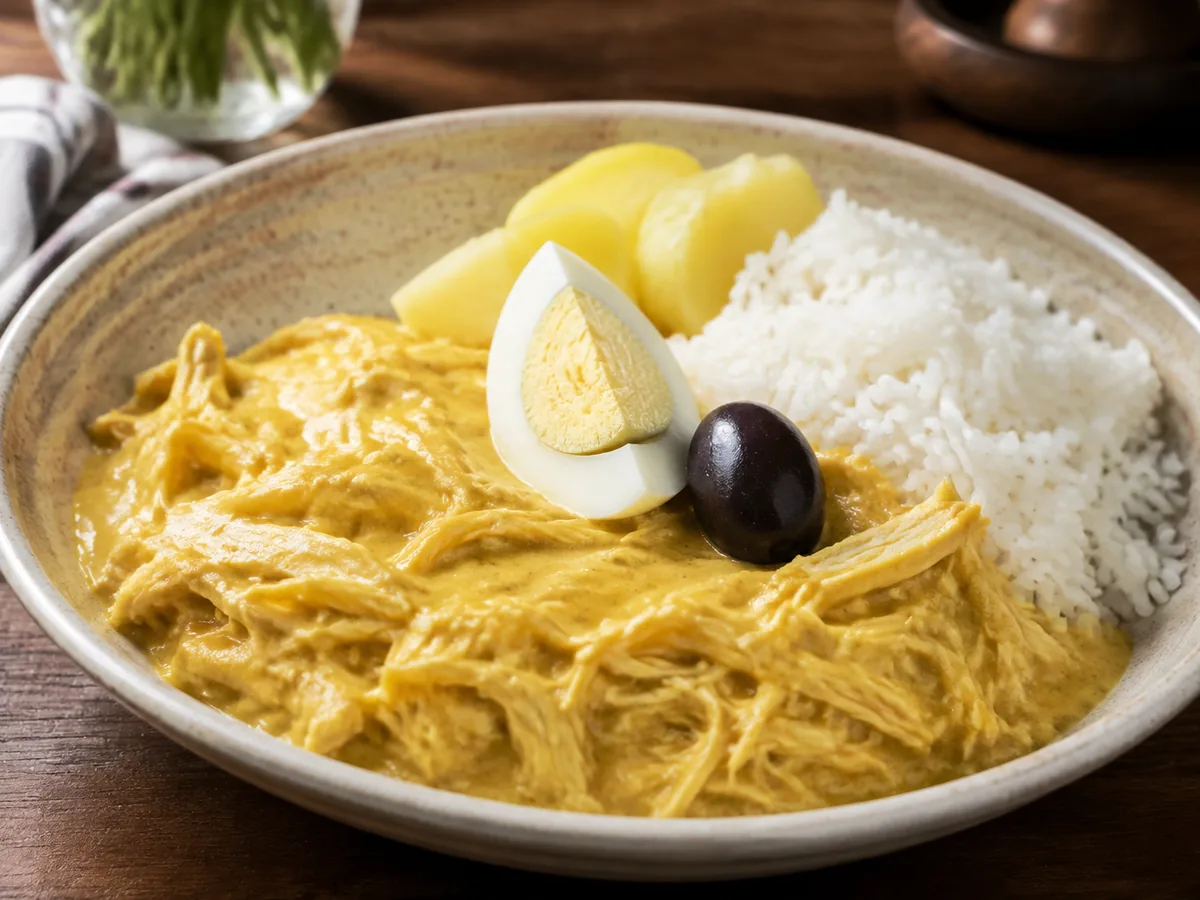
The sauce has to coat a spoon and still pour in a slow ribbon. If it breaks into oily puddles, or sits chalky and thick like cold paste, the plate fails before the chicken even lands.
Ají de gallina is built as a warm emulsion: soaked bread, ground nuts, dairy and ají amarillo cooked gently until the heat blooms and the colour turns that deep marigold yellow that belongs on rice, potato, egg and olives.
Chicken and poaching liquid
- 1.5–1.8 kg3½–4 lbWhole chickenor 1.2 kg / about 2¾ lb bone-in breasts and thighs
- 1 medium1 mediumOnion, halvedabout 150 g / 5 oz
- 2 cloves2 clovesGarlic, smashed
- 1 leaf1 leafBay leaf
- 8 g1½ tspFine sea salt
- Water to cover by about 3 cm / 1¼ in
Sauce base
- 4–54–5Ají amarillo peppers, fresh and seededor 80–100 ml / ⅓–scant ½ cup ají amarillo paste
- 60 ml¼ cupNeutral oil
- 1 medium1 mediumOnion, finely dicedabout 150 g / 5 oz
- 3 cloves3 clovesGarlic, minced
- 4 slices4 slicesDay-old white sandwich bread, crusts removedabout 100 g / 3½ oz
- 360 ml1½ cupsWhole milkplus more as needed
- 70 g½ cupWalnuts or pecans, lightly toasted
- 40 g⅓ cupParmesan or similar hard cheese, gratedoptional, but traditional in many Lima kitchens
- 5 ml1 tspGround turmericonly if your paste is pale and you need colour help — not a flavour substitute for ají
- Salt and freshly ground black pepper
Plate
- 600 gabout 1⅓ lbYellow potatoes, boiled and halved or sliced
- 44Hard-boiled eggs, halved
- 12–1612–16Botija or kalamata olives
- 300 g1½ cupsRaw long-grain rice, cooked
- Fresh parsley or cilantro for a small scatter, optional
Why bread, nuts and milk — not cream alone
Ají de gallina is a shredded-chicken stew in a chile-thickened sauce, not a cream-of-chicken shortcut. Bread soaked in milk softens into a binder that thickens without flour paste. Nuts add body and a faint toasted sweetness that stands up to ají amarillo's fruity heat. Milk — sometimes evaporated milk in home versions — keeps the sauce pale-gold and silky.
Why temperature matters more than speed
High heat splits dairy; a low simmer after blending keeps the emulsion intact. That is why the numbers later in the method matter more than hurrying.
On the reserved stock
Keep at least 480 ml (2 cups) of the poaching liquid. It should taste lightly salty and chicken-forward. The sauce is thinned with this, not with plain water.
Equipment
- Large pot for poaching
- Blender
- Wide, heavy pan for the sauce
- Dry pan for toasting the nuts
- Saucepans for potatoes, eggs and rice
- Instant-read thermometer
- Gloves, if fresh ají irritates your skin
Method
On the bird — poach, shred, reserve stock35–45 min
Place the chicken in a pot with the halved onion, smashed garlic, bay leaf and salt. Cover with cold water by about 3 cm (1¼ in) — a cold start extracts cleaner flavour than dropping meat into a rolling boil.
Bring toward a simmer over medium heat. When small bubbles break at the edges, with the liquid around 90–95 °C / 194–203 °F and not at a hard boil, skim the foam. Hard boiling tightens the meat and muddies the stock.
Maintain a gentle simmer. Bone-in pieces usually need 35–45 minutes. Breast meat is done when the thickest part reads 74 °C / 165 °F and the juices run clear; thighs can sit a few degrees higher without drying the same way.
Lift the chicken onto a tray. Strain and reserve at least 480 ml (2 cups) of the poaching liquid.
When the meat is cool enough to handle, about 10 minutes, discard the skin and bones. Shred into medium strands — not minced dust, not huge chunks. Strands catch sauce; dust turns the stew pasty. Spread the shreds so they do not steam into a clump. A whole bird gives roughly 600–700 g (1⅓–1½ lb) meat.
Cover chicken, onion, garlic, bay and salt with cold water by 3 cm (1¼ in). Skim and poach at 90–95 °C / 194–203 °F until meat reaches 74 °C / 165 °F. Reserve 480 ml (2 cups) strained stock; cool 10 minutes, skin, debone and shred.
On the bread and nuts — soak and grind10–15 min
Tear the bread into a bowl and cover with the 360 ml (1½ cups) milk. Press down so every piece wets. Soak 10–15 minutes until the crumb collapses when pressed — dry centres leave lumps in the blender.
Toast the walnuts or pecans in a dry pan over medium heat for 4–6 minutes, shaking often, until fragrant and a shade darker. Cool for 2 minutes; hot nuts can seize the milk mixture if you blend immediately at full speed.
Blend the bread and milk with the nuts until smooth. The mixture should look like a thick shake, not cottage cheese. Scrape the jar — grit means more blending time.
Soak torn bread in 360 ml (1½ cups) milk for 10–15 minutes, pressing until fully softened. Dry-toast nuts over medium heat 4–6 minutes, shaking; cool 2 minutes. Blend everything until completely smooth, scraping the jar.
On the ají — bloom without scorching12–16 min
If you are using fresh ají amarillo, blister it briefly over a flame or in a dry pan, peel if the skin is tough, then seed and chop. Paste skips this step. Wear gloves if your skin is sensitive; the oil clings.
Warm 60 ml (¼ cup) oil in a wide, heavy pan over medium heat until it shimmers, a surface feel of about 160–170 °C / 320–340 °F — hot enough to soften onion, not smoking.
Add the diced onion with a pinch of salt and cook 8–10 minutes, stirring, until translucent and sweet-smelling with the edges just turning gold. Rushing leaves raw onion bite in a sauce that should taste round.
Stir in the garlic for 60 seconds, then add the ají, fresh or paste. Cook 4–6 minutes, stirring often. The oil should tint yellow-orange and smell fruity and warm, not bitter or scorched. If the paste darkens toward brown or smells acrid you overshot the heat — pull the pan off, add a splash of stock, and lower the flame before continuing.
Blister fresh ají, peel tough skin, seed and chop; use gloves if sensitive. Heat 60 ml (¼ cup) oil to 160–170 °C / 320–340 °F. Soften salted onion 8–10 minutes; add garlic for 60 seconds, then ají for 4–6 minutes. If scorching, remove, splash with stock and lower heat.
On the sauce — timed method20–25 min
Pour the bread-nut-milk purée into the ají-onion base and stir hard. It will seize slightly at first; keep stirring over medium-low heat for 2–3 minutes until it loosens and looks unified.
Add about 240 ml (1 cup) warm reserved stock and stir. The sauce should go from paste to ladleable. Simmer gently 8–10 minutes, stirring every minute so the bottom does not catch. Keep a soft bubble — if it boils hard, above roughly 100 °C / 212 °F at the surface, the dairy can split and the bread can scorch.
Fold in the shredded chicken. Add more stock in 60 ml (¼ cup) splashes until the sauce coats the meat and still ribbons off a spoon. Simmer 8–12 minutes after the chicken goes in, so the strands warm through and drink the sauce. The meat should return to at least 74 °C / 165 °F for service, and the pot should sit near 85–90 °C / 185–194 °F so it does not cool dead on the plate.
Stir in the grated cheese if using, off the heat or on very low, for 1 minute. Taste, and salt carefully — the cheese and stock already contribute. Black pepper at the end. If the colour is timid and you used a mild paste, a scant ½ tsp turmeric can help the hue; it will not replace missing chile flavour.
Consistency check: drag a spoon across the pan bottom. The path should close slowly — not snap shut like water, not stay open like mashed potato. Too thick, add stock; too thin, simmer uncovered 3–5 minutes more, stirring.
Total active sauce time after the onion is soft is about 20–25 minutes. Do not walk away during the simmer; bread sauces stick.
Stir purée into ají base over medium-low heat 2–3 minutes. Add 240 ml (1 cup) warm stock; simmer gently 8–10 minutes, stirring each minute. Add chicken and stock in 60 ml (¼ cup) increments; simmer 8–12 minutes until chicken reaches 74 °C / 165 °F, sauce 85–90 °C / 185–194 °F. Stir optional cheese in off heat for 1 minute; season. For colour, optionally add scant ½ tsp turmeric. Thin with stock or reduce 3–5 minutes until slowly ribboning.
On the sides — potato, egg, rice, olives18–25 min
Potatoes: cover yellow potatoes with cold salted water, bring to a boil, then simmer until a knife meets slight resistance at the centre — usually 18–25 minutes depending on size. Done interiors sit near 95–98 °C / 203–208 °F. Drain, then halve or thick-slice. They should be creamy, not waterlogged.
Eggs: cover with cold water by 2 cm (¾ in), bring to a boil, then remove from the heat, cover and hold 10–12 minutes for firm yolks. Shock in cold water, peel and halve. The yolks should be set and crumbly-moist, with no grey-green ring.
Rice: rinse 300 g (1½ cups) long-grain rice until the water runs clearer. Cook in about 540 ml (2¼ cups) water with a pinch of salt — bring to a boil, lid on, low heat 15–18 minutes, then rest 5 minutes and fluff. Hot rice matters; cold rice steals heat from the sauce.
Olives: drain and keep them whole. Their salt and purple-black colour cut the rich yellow sauce.
Simmer potatoes from cold salted water 18–25 minutes until tender, 95–98 °C / 203–208 °F; drain and slice. Cover eggs with cold water by 2 cm (¾ in), boil, remove, cover 10–12 minutes; chill, peel and halve. Boil rinsed 300 g (1½ cups) rice with 540 ml (2¼ cups) salted water; cover, cook low 15–18 minutes, rest 5 minutes and fluff. Drain olives.
Plate it
Mound the rice, lean the potato halves against it, and ladle a generous valley of ají de gallina over and beside the starch. Crown with the egg halves and olives.
The sauce should look glossy and continuous, not broken into oil dots. A little green herb is optional; the plate already carries colour from chile, olive and yolk.
Mound hot rice beside potato halves and ladle the chicken sauce over and alongside them. Top with egg halves and whole olives, adding herbs if desired. Check that the sauce looks glossy without separated oil.
Sensory checkpoints and temperatures
- Poaching liquid: a gentle simmer at 90–95 °C / 194–203 °F, smelling of clean chicken rather than the sulphur of a violent boil.
- Chicken done: 74 °C / 165 °F at the thickest bone-in point, shreds moist rather than stringy-dry.
- Ají bloom: the oil goes yellow-orange, the aroma fruity and warm. Bitterness means scorched paste.
- Finished sauce: coats a spoon and ribbons slowly; tastes of ají first, then nut and dairy, then chicken. In the pot, around 85–90 °C / 185–194 °F.
- Potato: tender, steaming, no raw core crunch.
- The look: a marigold-yellow blanket on white rice, with olive and egg as contrast rather than buried garnish.
Check gentle poaching at 90–95 °C / 194–203 °F and chicken at 74 °C / 165 °F. Keep finished sauce around 85–90 °C / 185–194 °F, spoon-coating and slowly ribboning. Ají should smell fruity, potatoes tender without a raw core.
Storing it
Cool leftovers within 2 hours. Store the sauce with the chicken in a shallow covered container in the fridge at or below 4 °C / 40 °F for up to 3 days. Keep potatoes and rice separate if you can; they soften in the sauce overnight. Reheat gently in a saucepan over low heat with a splash of milk or stock, stirring until steaming hot throughout and at least 74 °C / 165 °F. In a microwave, work in short bursts, stirring between, to avoid hot edges and a cold centre. The chicken sauce freezes for up to 1 month; thaw overnight in the fridge, and expect it to thicken — loosen with stock. Hard-boiled eggs and olives are best added fresh at serving, after reheating.
Troubleshooting
- The sauce broke, with an oily surface.
The heat was too high, or the cheese went in while it was boiling. Pull it off the heat, whisk in a spoon of cold milk, and stir vigorously over low heat. Prevention is a soft simmer only.
- The sauce is pasty or gluey.
Too much bread, or not enough liquid. Whisk in warm stock 60 ml (¼ cup) at a time. Next time weigh the bread closer to 100 g / 3½ oz.
- The sauce is thin and sad.
Simmer uncovered, stirring, for 5 minutes more. Or blend 2 tablespoons of the sauce with a few extra nuts and return it to the pan.
- Bland yellow colour, no chile perfume.
Weak paste, or under-bloomed ají. Cook another tablespoon of paste in a little oil in a side pan for 2–3 minutes, then stir it in. Turmeric alone will not fix flavour.
- Dry chicken strands.
The bird was boiled hard, or held too long without sauce. Moisten with hot stock, keep future poaches at a bare simmer, and shred only when needed so the meat warms in sauce.
- A bitter edge.
Scorched garlic or ají. It cannot be fully erased; balance with a splash of milk and a pinch of sugar as an emergency measure, and scrape any dark stuck bits out of the pan before they dissolve.
- Lumpy bread.
Under-soaked or under-blended. Press the lumps against the pan wall with a spoon, or blitz briefly with an immersion blender off the heat.
Substitutions
Traditional: poached hen or chicken shredded into an ají amarillo sauce thickened with milk-soaked bread, ground nuts and often cheese, plated with potato, rice, hard-boiled egg and botija olives. Mild fruity heat, creamy body — a home and fonda classic across Peru.
Accepted departures
Evaporated milk in place of part of the whole milk for richer body. Pecans instead of walnuts. Store-bought ají amarillo paste when fresh peppers are unavailable. Leftover roast chicken refreshed in the sauce if you skip poaching — use good stock in that case.
Departures that should not be called traditional
Heavy cream as the only thickener with no bread or nuts. Curry powder standing in for ají. Canned chicken with unseasoned water. Serving without potato or olive while still claiming the classic plate. Those are other dishes wearing the name.
Scaling
For 2
Halve the chicken — two large bone-in breasts, or 650–700 g (about 1½ lb) of pieces — along with the bread, milk, nuts and ají, keeping enough stock to adjust. The sauce reduces faster in a small pan, so watch the simmer.
For 8
Double everything and use a wide Dutch oven so the sauce reduces evenly. Bloom the ají in batches if the pan crowds. Do not double the salt automatically; season at the end. A larger bird adds poaching time, not a higher temperature — still aim for 74 °C / 165 °F in the thickest meat.
Holding it
Keep the finished sauce on the lowest burner and loosen it with stock as it sits. Bread sauces tighten while they wait.
What to serve it with
- White rice as the default starch bed
- Boiled yellow potatoes on the same plate
- Botija olives and hard-boiled egg as the standard garnish
- A small lettuce and tomato salad with lime, for freshness against the richness
- Chicha morada, or a cold lager — the sauce is mild-hot and dairy-rich, so sharp drinks help
Skip heavy fried appetisers right before; this plate is already substantial.
Questions
Can I use only breast meat?
Yes. It shreds cleanly but dries faster. Poach gently and keep plenty of sauce. A mix of thigh and breast tastes more forgiving.
Fresh ají amarillo or paste?
Both work. Paste is consistent and common outside Peru. Bloom it in oil either way so it tastes cooked, not raw-sharp.
What if I cannot find ají amarillo?
There is no perfect substitute. A blend of yellow bell pepper plus a little habanero can approximate the colour and heat in a pinch, but the fruitiness will differ — call it a departure.
Is the cheese required?
No. Many home versions include it for savour and body; others skip it. Taste before and after if you add it.
Can I make the sauce ahead?
Yes. Sauce without potato or egg keeps 2–3 days refrigerated. Reheat gently and fold in the chicken to warm through. Add eggs and olives when plating.
Why bread instead of flour?
Bread soaked in milk is the classic thickener. It gives soft body without the raw flour taste a quick roux can leave if undercooked.
How hot should leftovers get?
Reheat until steaming throughout, at least 74 °C / 165 °F in the centre of the mass, stirring so cold pockets disappear.
Is there a gluten-free path?
Use gluten-free sandwich bread for the soak, or thicken carefully with extra nuts and a small potato blended into the sauce. The texture shifts; treat it as a departure.