Causa Limeña
A cold layered potato cake — lime-bright, yellow from ají amarillo, filled with tuna or chicken. Causa is architecture, and the whole point is that first slice standing upright with distinct bands you can see from across the table.
- Prep
- 50 min
- Serves
- 6–8 appetizer slices, or 4 generous plated portions
- Difficulty
- Medium
Researched · Kitchen testing pending
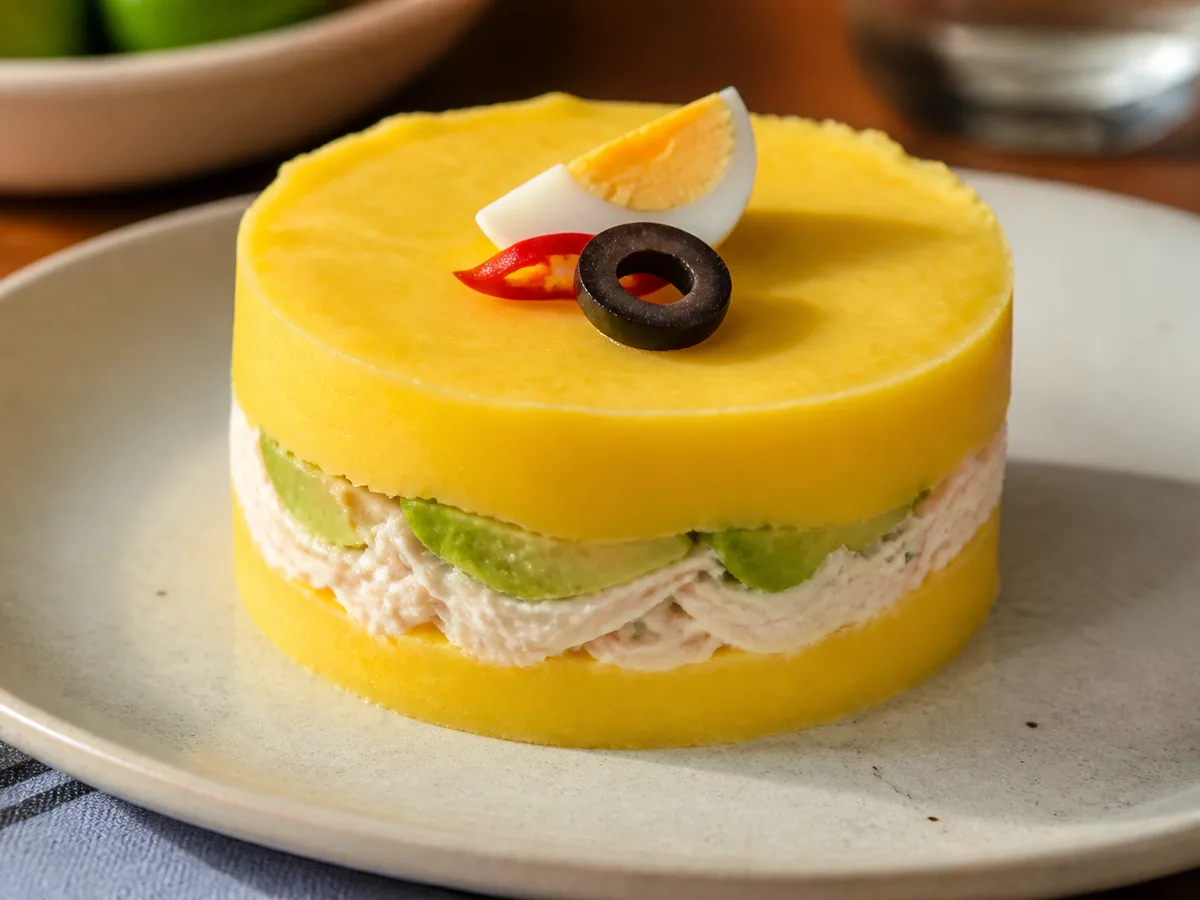
The potatoes get mashed while they are still warm enough to take the ají paste without turning gluey, then the masa chills until it holds a clean cut.
Causa limeña is a cold, layered potato cake — lime-bright, yellow from ají amarillo, filled with tuna or chicken — and the whole point is that first slice standing upright on the plate with distinct bands you can see from across the table.
Potato masa (the yellow layers)
- 1.2 kgabout 2¾ lbYellow potatoespapa amarilla if you can find them; Yukon Gold is the practical substitute
- 80–100 g⅓–½ cupAjí amarillo pastestore-bought Peruvian paste, or homemade from fresh or frozen peppers
- 60–80 ml¼–⅓ cupFreshly squeezed lime juicefrom 3–4 limes
- 45 ml3 TbspNeutral oil, vegetable or light oliveplus more if the mash feels dry
- 10 g2 tspFine sea saltplus more to taste
- 1 small clove1 small cloveGarlic, mashed to a pasteoptional
- A pinch of turmeric, only if your ají paste is pale and you want deeper colour — not traditional, but honest
Tuna filling (classic cold version)
- 280–320 g10–11 ozSolid tuna in water or oil, drained wellabout 2 cans, drained weight
- 80–100 g⅓–½ cupMayonnaise
- 1 small1 smallRed onion, minced fineabout 80 g / 3 oz
- 1 stalk1 stalkCelery, mincedabout 40 g / 1½ oz; optional, for crunch
- 15 g1 TbspLime juice
- Salt and black pepper to taste
- Optional — 1 hard-boiled egg chopped into the mix, and a few chopped olives
Chicken filling (alternate)
- 400 g14 ozCooked chicken breast, shredded fine while still slightly warm
- 100 g½ cupMayonnaise
- 50 g¼ cupRed onion, minced and rinsed in ice water, then drained
- 15 ml1 TbspLime juice
- Salt, pepper, and a spoon of ají amarillo paste if you want heat in the centre too
Assembly and garnish
- 2 ripe2 ripeAvocados, sliced or lightly mashed with salt and limeabout 300–350 g / 10–12 oz flesh
- 2–32–3Hard-boiled eggs, sliced into rounds
- Black olives, halved
- Lettuce leaves for the plate
- Fresh cilantro or parsley
- Thin tomato slices, optional
Why the potato and the paste matter more than the mould
Causa is architecture. If the masa is watery, the tower slumps. If it is gluey from overworked starch, the mouthfeel goes pasty and the lime never sings. If the ají paste is bland or mostly oil, you get yellow cardboard. Treat the potato layer as a seasoned dough that happens to be cold, not as leftover mash dressed up for company.
Choosing the potato
Papa amarilla has a dense, dry crumb and a natural golden tone that takes lime and chile cleanly. Yukon Gold works if you boil or steam carefully and dry the flesh. Avoid waxy red potatoes, which fight the mash, and be careful with very floury russets — they go either gorgeous or gluey depending on how much you work them.
On ají amarillo
Fruity and medium-hot, not the same as ají panca, which is deeper and smokier, and nothing like Mexican chile powders. Use a Peruvian paste when you can. From fresh or frozen peppers, blend seeded pods with a little oil and salt until smooth, and cook the paste gently for a few minutes to take off the raw edge if it tastes grassy.
Passive time, counted separately
The masa needs 30–40 minutes in the fridge before shaping, and the assembled causa at least 1 hour — overnight is better for clean slices. That chilling is hands-off and sits outside the time quoted above. The whole thing runs about 2½–3 hours of clock time, with under an hour of hands-on work if the chicken is already cooked.
Equipment
- Large pot for boiling the potatoes
- Potato ricer or food mill — a masher works, a food processor does not
- Wide mixing bowl
- Springform pan 18–20 cm / 7–8 in, a loaf pan lined with plastic wrap, or individual ring moulds
- Plastic wrap
- Thin sharp knife
Method
On the potatoes — cook dry, mash warm20–30 min
Scrub the potatoes and leave the skins on for boiling so they absorb less water. Cover with cold salted water, bring to a gentle boil, and cook until a knife slides through the centre with almost no resistance — usually 20–30 minutes depending on size.
Drain thoroughly. Return the potatoes to the hot pot over low heat for 1–2 minutes, shaking, to drive off surface moisture. Wet potatoes ruin causa.
Peel while they are still hot enough to handle with a towel, and pass through a ricer or food mill into a wide bowl. A ricer gives the silkiest masa; a masher works if you are patient and refuse lumps. A food processor turns starch into wallpaper paste — do not do that.
While the mash is still warm, roughly hand-hot at 50–60 °C / 120–140 °F, work in the ají amarillo paste, lime juice, oil and salt. Taste. You want bright lime, clear chile fruit, and enough salt that a cold bite will still taste seasoned — warm mash tastes saltier than cold mash, so season a touch past what feels perfect now.
If the masa cracks when pressed, add oil a teaspoon at a time. If it feels slack or shiny-wet, spread it on a tray and chill 15 minutes before shaping; you cannot fix watery masa with more potato once everything is mixed.
Cover and refrigerate until cool and firm, at least 30–40 minutes. Cold masa layers cleanly.
Simmer skin-on potatoes from cold salted water 20–30 minutes until tender. Drain; dry in the pot on low 1–2 minutes. Peel hot using a towel and rice or mash; never process. At 50–60 °C / 120–140 °F, mix in ají, lime, oil and salt. For homemade ají paste, blend seeded peppers with oil and salt; gently cook a few minutes if grassy. Add oil teaspoonwise if masa cracks; spread and chill 15 minutes if wet. Cover and refrigerate at least 30–40 minutes until firm.
On the filling — moist but not soupy
Tuna method: drain the tuna hard, pressing it with a fork in a sieve if the cans were packed in water. Excess liquid bleeds into the potato and muddies the layers. Flake into a bowl and fold in the mayonnaise, minced onion, celery if using, lime juice, salt and pepper. The mix should hold a soft spoonful without puddling oil or water at the bottom. Add mayonnaise only until it binds — causa filling is not tuna salad for sandwiches. Optional chopped egg or olives go in now. Taste it cold, and adjust the lime and salt.
Chicken method: poach or roast the chicken earlier so it is ready. Shred it fine — large shreds make the slice tear when you cut. Fold with mayonnaise, drained minced onion, lime, salt, pepper and optional ají paste. Same rule: cohesive, not wet.
Chill the filling while the masa firms. Cold filling against cold masa keeps the layers from sliding.
For tuna, drain thoroughly, flake and bind with mayonnaise, onion, optional celery, lime, salt and pepper; add optional chopped egg or olives. Alternatively, finely shred cooked chicken and combine with mayonnaise, rinsed drained onion, lime, seasoning and optional ají. Avoid free liquid; chill filling.
On avocado — the middle green band
Avocado works as its own thin layer between potato and protein, or as a smear on top of the filling.
Mash it lightly with salt and a squeeze of lime so it does not brown as fast, or slice it neatly if the fruit is firm-ripe. Overripe avocado turns the cut face grey within an hour; use fruit that yields gently to thumb pressure but is not collapsing.
Choose firm-ripe avocados that yield gently without collapsing. Slice neatly or lightly mash with salt and lime to slow browning. Use as a thin layer between potato and filling or spread over the filling.
Assembly — layers you can see
You can use a springform pan (18–20 cm / 7–8 in), a rectangular loaf pan lined with plastic wrap, individual ring moulds, or free-form rectangles shaped by hand on plastic wrap. Rings give the cleanest restaurant look.
Line the mould with plastic wrap, leaving an overhang, if you plan to unmould it. Lightly oil the wrap if your masa is sticky.
Press in one-third to one-half of the potato masa as the base, using damp fingers or the back of a wet spoon to pack it evenly without air pockets — about 1.5–2 cm (⅝–¾ in) thick.
Add a thin avocado layer if using, leaving a narrow potato border so the green does not smear the outer wall.
Spoon in the tuna or chicken filling in an even band, again leaving a slight border. Do not overfill; a fat filling layer squeezes out when you slice. Another whisper of avocado is optional.
Cover with the remaining masa. Seal the edges by pressing the potato down against the mould wall so the filling is fully enclosed, and smooth the top.
Fold the plastic over, weight lightly with a flat plate, and refrigerate at least 1 hour. Overnight, covered, gives the cleanest cut and lets the lime settle into the potato.
For individual causas: divide the masa into portions, press the base into rings on a tray, fill, cap, chill on the tray, then lift the rings away.
Line a mould with overhanging plastic; oil lightly if needed. Press one-third to one-half of masa into a 1.5–2 cm (⅝–¾ in) base without air pockets. Layer avocado and filling, leaving potato borders. Cover with remaining masa, seal edges and smooth. Fold plastic over, weight lightly with a plate and chill at least 1 hour, preferably overnight. For individual portions, layer in rings and remove after chilling. If using a springform pan, choose 18–20 cm / 7–8 in diameter.
Unmould, slice, plate
Peel back the plastic and invert onto a board, or lift out if you used rings.
Use a thin sharp knife, wiped clean between cuts — sawing crushes the layers. Aim for slices 2–3 cm (¾–1¼ in) thick for a loaf, or serve individual towers whole.
Plate on lettuce and top with egg rounds, olive halves, a small cilantro sprig, and maybe a thin tomato slice. A dot of mayonnaise or a thin zigzag of ají cream is fine if you want shine; it is not required.
Serve cold. Room-temperature causa softens and the lime dulls. If it sat out during plating, 10 minutes back in the fridge firms the cut face.
Unwrap and invert or remove rings. Slice loaves 2–3 cm (¾–1¼ in) thick with a sharp knife, wiping between cuts. Plate on lettuce with egg, olives, cilantro and optional tomato, mayonnaise or ají cream. Serve cold; rechill 10 minutes if softened while plating.
Sensory checkpoints and temperatures
- Boiled potato: tender centre, skins loosening, no waterlogged feel after the dry-off in the pot.
- Warm masa: smells of ají and lime, colour an even yellow-orange, texture like soft play-dough that holds a thumbprint with clean edges.
- Cold masa: firm enough to slice, not rock-hard. Fridge at or below 4 °C / 40 °F.
- Filling: moist and seasoned, with no free liquid in the bowl.
- The finished slice: distinct potato, filling and potato bands, avocado visible if used, no grey weeping at the edges.
- Taste: first lime and potato, then chile fruit, then the savoury centre. If you only taste mayonnaise, the masa was underseasoned or the filling overmayo'd.
Check that cooked potatoes are dry and tender, and masa is evenly yellow-orange and holds a thumbprint. Refrigerate at or below 4 °C / 40 °F until sliceable. Filling should be moist without pooling; cut layers must remain distinct without weeping.
Final cues before you cut
The top should look smooth and evenly yellow. The mould should feel dense when you tap the side — hollow spots mean air you should have pressed out.
When the knife comes down you should hear a quiet, clean resistance, not a squash. If the first slice looks right, with tight bands and no slide, the rest will follow.
Serve at once on cold plates, and keep the rest of the loaf chilled until the next cut.
Check a smooth, evenly yellow top and densely packed layers without hollow pockets. Cut cleanly without crushing; the first slice should hold without sliding. Serve immediately on cold plates and refrigerate the remaining loaf between cuts.
Storing it
Assemble up to 24 hours ahead and keep it covered in the fridge at or below 4 °C / 40 °F. Add the egg and herb garnish just before serving so they stay bright. Avocado browns over time — if you need more than a day, assemble potato and protein only and add the avocado at plating.
Leftover slices keep 1–2 days covered and cold. The potato firms further and the lime softens; still good, not peak. Do not freeze — thawed potato turns watery and grainy. To take causa elsewhere, transport it in the mould on ice packs and unmould on site.
Troubleshooting
- The tower slumps.
The masa was too wet, or the filling too loose. Next time dry the potatoes longer and drain the tuna harder. For this batch, chill longer and slice thicker, or serve it in the ring.
- Gummy potato.
Overworked, or put through a processor. There is no full rescue — lean harder on lime and ají in the seasoning, and keep the portions smaller.
- A bland yellow layer.
Weak paste, or shy salt and lime. If you catch it before assembly, work more paste and lime into a reserved warm spoonful of mash and knead that back through. After chilling, brush the cut faces with a little seasoned lime oil as a patch.
- Smeared layers.
The knife was not wiped, or the avocado was too soft. Chill longer, use firmer fruit, and wipe the blade every cut.
- Heat without flavour.
You used a hot chile that is not ají amarillo. Swap the paste; do not "fix" it with cayenne.
Substitutions
Substitutions that stay honest — the masa recipe does not change for any of them.
No ají amarillo paste
Blend roasted yellow bell pepper with a little habanero or Scotch bonnet for fruit and heat, plus oil and salt. Approximate, not identical. Do not use turmeric alone for colour; that fools the eye and betrays the tongue.
Vegetarian centre
Mashed avocado with chopped tomato, olive and egg, or a thick avocado-egg salad bound with mayonnaise and lime. Keep it drier than you think.
Potatoes and oil
No yellow potatoes — Yukon Gold as above, steamed instead of boiled if yours run wet. Light olive oil is fine in the masa; strong extra-virgin can fight the ají.
Tuna or chicken
Lima home tables and cebicherías both claim versions. Tuna, or canned salmon in some houses, keeps everything no-cook after the potato, and gives speed and a sharper contrast with the lime. Chicken feels more Sunday lunch, and makes a softer, rounder centre.
Scaling
Eight appetizer slices from a loaf
Start the potatoes first. While they boil, mix the filling and boil the eggs. Mash and season, chill the masa 40 minutes, assemble, then chill at least 1 hour and garnish at the last minute.
Drinks
Keep them simple — a cold lager, a pisco cocktail that is not too sweet, or limeade. Heavy red wine fights the cold lime-chile profile.
What to serve it with
- Lettuce leaves under the slice
- Egg rounds, olive halves and a cilantro sprig on top
- A thin zigzag of ají cream, if you want shine
- Cold lager, a pisco cocktail that is not too sweet, or limeade
Serve cold, on cold plates. Heavy red wine fights the lime-chile profile.