Rocoto Relleno
Arequipa's baked stuffed pepper — thick-walled rocoto seeded and blanched to tame the fire, filled with a beef-and-pork picadillo of raisins, olives and peanuts, blanketed with cheese and set in a savoury milk-egg bath. Not a Mexican chile relleno.
- Prep
- 1 hr 15 min
- Cook
- 30 min
- Serves
- 6 stuffed rocotos — 6 mains, or 6 shared plates
- Difficulty
- Hard
Researched · Kitchen testing pending
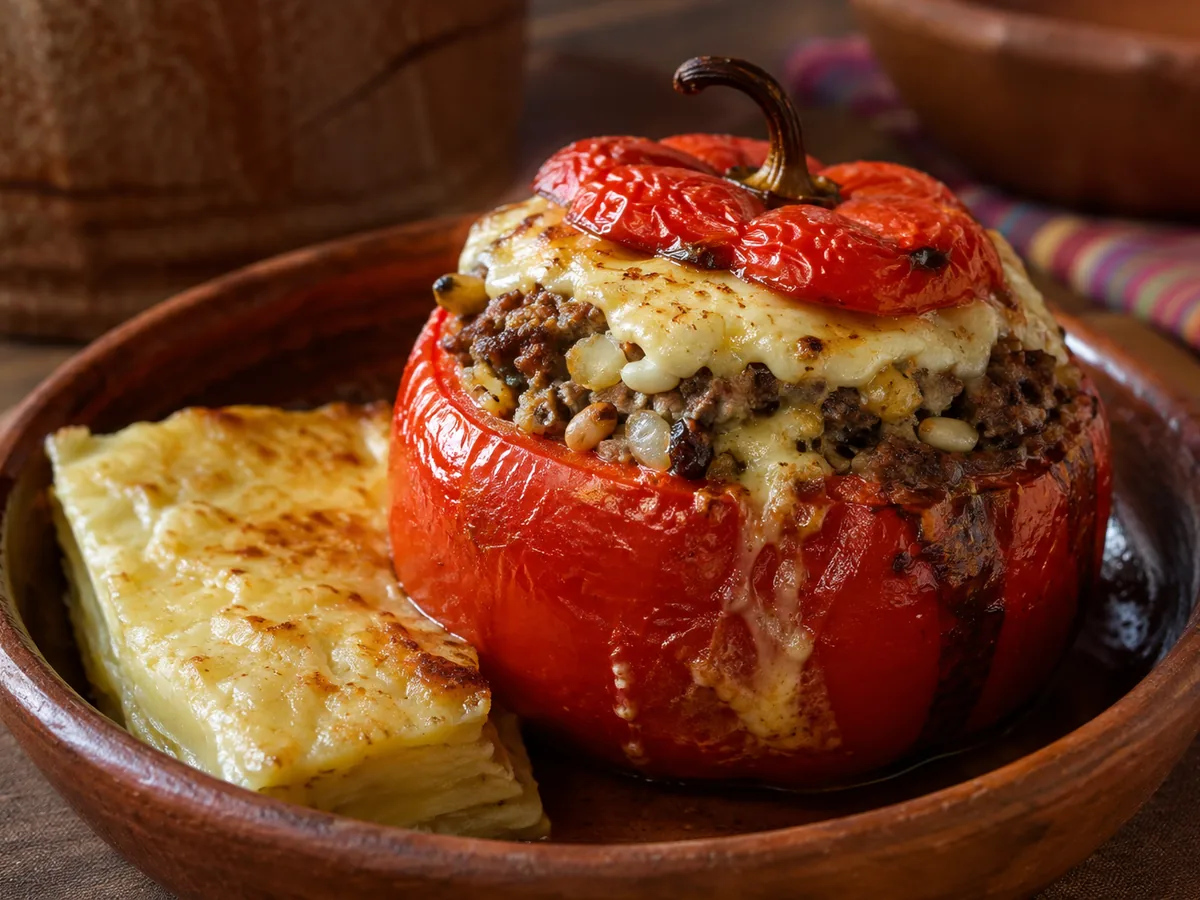
The first job is respecting the rocoto: thick walls, black seeds, heat that sits in the membranes, and a round apple shape that was never meant to impersonate a Mexican chile relleno.
In Arequipa this is a baked stuffed pepper with a meat-and-fruit picadillo, blanketed with cheese and often set in a savoury milk-egg bath. Seed the pepper and blunt the fire first, then build the filling so sweet raisins and olives play against beef and pork — and only then think about the oven.
Rocotos
- 6 medium6 mediumRocoto peppers (rocoto or locoto)about 150–200 g / 5–7 oz each; red or orange, firm, with intact stems if possible
- Water, white vinegar and salt, for the blanching baths
- 1 tsp1 tspSugar, for the last soakoptional, if the peppers taste harshly bitter after seeding
Picadillo filling
- 300 g10½ ozGround beef, around 85% lean
- 200 g7 ozGround pork
- 1 large1 largeRed onion, finely dicedabout 200 g / 7 oz
- 3 cloves3 clovesGarlic, minced
- 2 medium2 mediumTomatoes, peeled and dicedabout 250 g / 9 oz, or 200 g / 7 oz canned crushed tomato
- 40 g¼ cupRaisins
- 40 g¼ cupBotija or Kalamata olives, pitted and chopped
- 30 g2 TbspPeanuts, toasted and roughly choppedArequipa often uses maní
- 11Hard-boiled egg, choppedplus more eggs for the bath and garnish
- 1 tsp1 tspGround cumin
- 1 tsp1 tspDried oregano
- ½–1 tsp½–1 tspAjí panca paste or paprikafor colour and mild depth — not to replace rocoto heat
- 15 ml1 TbspOil, or a spoon of pork fat, for the pan
- Salt and black pepper
- 1 small1 smallApple or pear, peeled and mincedoptional — about 100 g / 3½ oz; a classic fruit note in many Arequipa houses
- 1 tsp1 tspSugaroptional, if the tomato is very acidic
Cheese and bake
- 200–250 g7–9 ozMelting cheesequeso fresco that softens, mozzarella, or a mild Andean melting cheese; some cooks use a mix of fresh cheese and a stretchier melt
- Butter or oil for the baking dish
Milk-egg bath (common Arequipa finish)
- 350 ml1½ cupsWhole milk
- 2 large2 largeEggs
- Salt, pepper, and a pinch of cumin
- 50 g½ cupGrated cheese, stirred into the bathoptional
Rocoto is not poblano, and this is not chile relleno
Rocoto has black seeds and meaty fruit walls, and the heat is serious. Poblano is milder and thinner-walled in many markets, and belongs to a different stuffed-pepper tradition — egg-battered and fried in the Mexican relleno style. Rocoto relleno is filled, often bathed, and baked. Swap in poblano and you get a different dish; beer-batter and fry a rocoto and you have left Arequipa. Say what you are cooking, and cook that.
Sourcing, and gloves
Fresh rocoto can be scarce outside the Andes. Frozen seeded rocotos from Latin markets are legitimate — thaw and pat dry. If you only find whole frozen with seeds, thaw and seed carefully. Wear gloves either way. Capsaicin on bare fingertips transfers to eyes hours later.
The raisins and olives are structural
They are not optional garnish in the classic profile; they are contrast against the meat. Peanuts nod to Arequipa's maní habit. If someone hates raisins, mince them finer so they melt into the meat rather than deleting them entirely.
Equipment
- Gloves
- Large pot for the blanching baths
- Wide skillet for the picadillo
- Baking dish that holds six peppers snugly
- Whisk and a jug for the bath
- Instant-read thermometer
Method
On the peppers — seed, boil, tame20–30 min
Put on gloves. Cut a lid around the stem of each rocoto as you would a jack-o'-lantern top, or cut a lengthwise slit and keep the pepper whole as a canoe — lids look more traditional on the plate.
Pull out the seeds and pale membranes. The membranes hold much of the heat, so scrape them out thoroughly if your guests are heat-shy. Leave enough wall thickness that the pepper still stands. Rinse the cavities under cold water.
Blanch to take the edge off: bring a large pot of salted water to a boil, about 10 g salt per litre (2 tsp per quart). Some Arequipa cooks add a splash of vinegar. Boil the hollowed rocotos, and the lids, for 2–3 minutes, then drain.
Repeat with fresh boiling water once or twice more if you want milder heat — two or three changes of water is common practice. Taste a tiny scrap of wall after the second boil. You want chile flavour and a manageable burn, not numbness.
Optional soak: rest the peppers 10–15 minutes in cold water with a splash of vinegar and a pinch of sugar, then drain and pat very dry inside and out. Water left in the cavity dilutes the picadillo.
Set the peppers cut-side up in a buttered baking dish that holds them snugly so they do not tip.
Never skip the drying. A wet rocoto steams instead of baking, and the cheese slides into a puddle.
Wear gloves; thaw frozen rocotos first. Cut lids, remove seeds and membranes without weakening walls, and rinse. Boil peppers and lids 2–3 minutes in water with 10 g salt per litre (2 tsp per quart), optionally vinegar; drain. Repeat once or twice in fresh water for milder heat, cautiously tasting after the second boil. Optionally soak 10–15 minutes in cold water with vinegar and a pinch of sugar. Dry thoroughly inside and out; stand snugly in a greased dish.
On the picadillo — meat, fruit, brine, crunch25–30 min
Heat the oil in a wide skillet over medium — a pan surface around 160–170 °C / 320–340 °F, just a lively medium. Soften the onion with a pinch of salt until translucent and sweet, 6–8 minutes. Add the garlic and cook 30–60 seconds until fragrant, not browned.
Add the beef and pork. Break up the meat and cook until no longer pink and some fond forms on the pan, 8–10 minutes. Spoon off excess fat if the pan is swimming, but leave a little for flavour.
Stir in the cumin, oregano, ají panca or paprika, salt and pepper. Add the tomato and cook down until the mixture looks saucy but not watery, 5–8 minutes. If you are using minced apple or pear, add it with the tomato so it softens into the mix.
Off the heat or on low, fold in the raisins, chopped olives, peanuts and chopped hard-boiled egg. Taste: you want savoury meat, pops of sweet raisin, salty olive and nut crunch. Adjust the salt. The filling should be moist enough to spoon but thick enough to mound — loose taco meat that holds a pile, not soup.
Cool 5–10 minutes so you do not steam the pepper walls from the inside when you stuff.
Heat oil over medium, 160–170 °C / 320–340 °F. Soften salted onion 6–8 minutes; add garlic 30–60 seconds. Break up beef and pork; cook 8–10 minutes until no longer pink, removing excess fat. Add cumin, oregano, panca or paprika, salt, pepper, tomato and optional fruit; reduce 5–8 minutes until moist but moundable. Off heat or on low, fold in raisins, olives, peanuts and chopped egg; adjust salt. Cool 5–10 minutes.
Stuff, cheese, bath, bake25–35 min
Heat the oven to 190 °C / 375 °F with a rack in the middle.
Spoon the picadillo into each rocoto, filling to the rim without compressing it into a dense brick — leave a little room for cheese. Seat the lids at an angle, or beside the peppers.
Lay thick slices or a generous handful of cheese over each open top. The cheese should cover the meat, and some will melt down the sides, which is welcome.
Whisk the milk, eggs, salt, pepper and a pinch of cumin for the bath. Pour it around — not over — the peppers so they sit in liquid about 1–1.5 cm (⅜–½ in) deep. The bath sets into a soft custard that keeps the bottoms moist and gives the tray its Arequipa identity. If you skip the bath, still bake the stuffed peppers with cheese until hot and browned; that is a valid home shortcut, just say you skipped it.
Bake 25–35 minutes, until the cheese is melted and spotted gold, the bath is set, and the filling is hot in the centre — at least 74 °C / 165 °F in the meat if you are checking. If the cheese browns before the centre is hot, tent loosely with foil for the last minutes.
Rest 5–10 minutes before serving so the custard firms and the peppers do not scald the first bite.
Heat oven to 190 °C / 375 °F, middle rack. Fill peppers loosely, leaving cheese space; cover with cheese and position lids askew. Whisk milk, eggs, salt, pepper and cumin; pour around peppers 1–1.5 cm (⅜–½ in) deep. Bake 25–35 minutes until cheese is golden, bath set and meat centre at least 74 °C / 165 °F. Tent if browning early. Rest 5–10 minutes.
Heat management for different tables
Three water changes leave a friendlier pepper for mixed company. One quick blanch keeps more of the rocoto's pride and will challenge people who do not eat spicy food.
Always warn guests. Offer plain potato or rice and a cool drink — chicha, beer or yoghurt-based sips help more than ice water alone.
If a stuffed rocoto still eats too hot after baking, open it and scoop the meat onto rice, leaving some of the wall behind. The filling carries less burn than the pepper flesh.
Use three blanching-water changes for milder peppers; one leaves stronger heat. Warn guests and offer plain potato or rice and a cool drink. If a baked rocoto is still too hot, scoop its filling onto rice, leaving some pepper wall behind.
Sensory checkpoints and temperatures
- Raw rocoto: firm, glossy, heavy for its size, smelling green-fruity rather than rotten.
- After blanching: walls slightly softer but still holding shape, with the heat reduced on a cautious taste of the rim.
- Picadillo in the pan: glossy and spoonable, raisins plump, no grey boiled-meat look.
- In the oven: cheese bubbling, bath jiggling and then setting, the kitchen smelling of cumin, onion and roasted chile.
- Done: filling steaming when nudged with a fork, cheese browned in spots, bath set like a soft flan around the bases.
- On the plate: pepper upright or gently leaning, lid askew, custard spooned alongside, potato or rice to catch the heat.
Check that blanched peppers soften but hold shape and filling stays glossy and spoonable. Bake until cheese bubbles and browns, filling steams and the bath sets like soft custard. Serve peppers upright with lids angled, custard alongside and potato or rice.
Final cues before it leaves the oven
The cheese should show bronze freckles, not pale rubber. The bath should not still look like raw milk. When you nudge a pepper with a spoon it should feel hot and settled, not sliding in a flood of thin liquid.
Open one test pepper at the table edge if you need proof the centre is steaming. Then serve at once — rocoto relleno waits poorly under a cold draft, and the best bite is the first one while the cheese still stretches.
Before removing from the oven, check bronze spots on the cheese and a set bath without thin milky pooling. Open a test pepper if needed to confirm a steaming centre. After the prescribed rest, serve promptly while the cheese still stretches.
Storing it
Make-ahead
Blanch and seed the rocotos a day ahead and keep them refrigerated in a covered container lined with paper towel. The picadillo keeps 2 days cold, at or below 4 °C / 40 °F, and actually stuffs better slightly chilled. Assemble in the baking dish, add cheese and bath, and bake when guests are close.
Leftovers
Baked rocotos keep 2 days covered and cold. Reheat covered at 160 °C / 320 °F until hot in the centre, 15–25 minutes depending on size, or microwave gently with a splash of milk around the base. Freezing is acceptable for the filling alone; stuffed baked leftovers freeze with some texture loss in the pepper wall — edible, not ideal.
Troubleshooting
- The pepper collapses.
Overboiled walls, or overfilled with a wet mix. Blanch shorter next time, and thicken the picadillo by cooking off the tomato moisture.
- Still brutally hot.
Membranes left in, or only one water change. Serve with extra dairy and starch, and scrape residual membrane from leftovers before reheating.
- A watery tray.
The peppers were not dried, or the tomato was not reduced. Bake uncovered a few extra minutes; next time pat dry and cook the filling thicker.
- Dry filling.
Meat too lean, and no tomato moisture. Fold in a spoon of stock, or a bit more tomato and a teaspoon of oil, while reheating the picadillo.
- Cheese that will not brown.
The oven is too cool, or the cheese is piled under a lid. Finish under a brief broil for 1–2 minutes — watch it constantly.
- It came out like a Mexican relleno.
Egg batter and frying is a different recipe. Do not hybridise unless you are inventing on purpose and saying so.
Substitutions
Substitutions that stay in spirit. The first one is not really a substitution at all.
No rocoto
The dish stops being rocoto relleno. For practice of the method only, a thick-walled red pepper can hold the picadillo and the bath — but call it a stuffed pepper in Arequipa style, not rocoto relleno.
Meat, nuts and bath
No pork: all beef works, with a spoon of oil so the mix does not go dry and crumbly. No peanuts: toasted walnuts, or simply omit them, since olives and raisins still carry the sweet-salty idea. No milk bath: bake with cheese only and serve with a spoon of the pan juices.
Cheese
Avoid extremely salty aged cheeses that fight the raisins. A mild melt is the goal.
Scaling
Timing plan for a clean service
The morning or night before, seed and blanch the peppers, cook the picadillo and boil the eggs. On the day, bring the filling near room temperature, stuff, cheese, pour the bath, bake 30 minutes, rest 10, and plate. From an empty board to the table with no make-ahead is about 2 hours.
Drinks
Something with fruit and moderate alcohol stands up to spice better than a tannic heavy red. In Arequipa, cold beer next to rocoto is not an accident.
What to serve it with
This is a full plate — do not treat it as a side. Set each rocoto on a warm plate with the lid leaning against it and a spoon of the set milk bath alongside.
- Pastel de papa (potato cake), or a few boiled potato chunks
- White rice, when potato cake is not happening
- A simple lettuce salad with vinegar, to cut the richness
- Cold beer, chicha, or another drink with fruit and moderate alcohol