Vori Vori de Pollo
The name is Guaraní, a diminutive of "ball" said twice to mean many of them — thirty-five or forty cornmeal-and-cheese dumplings dropped into a golden chicken broth. As they poach they shed starch into the pot, and a clear soup turns velvety without a spoonful of flour.
- Prep
- 35 min
- Cook
- 50 min
- Serves
- 6 hearty bowls, about 35 to 40 dumplings
- Difficulty
- Medium
Researched · Kitchen testing pending
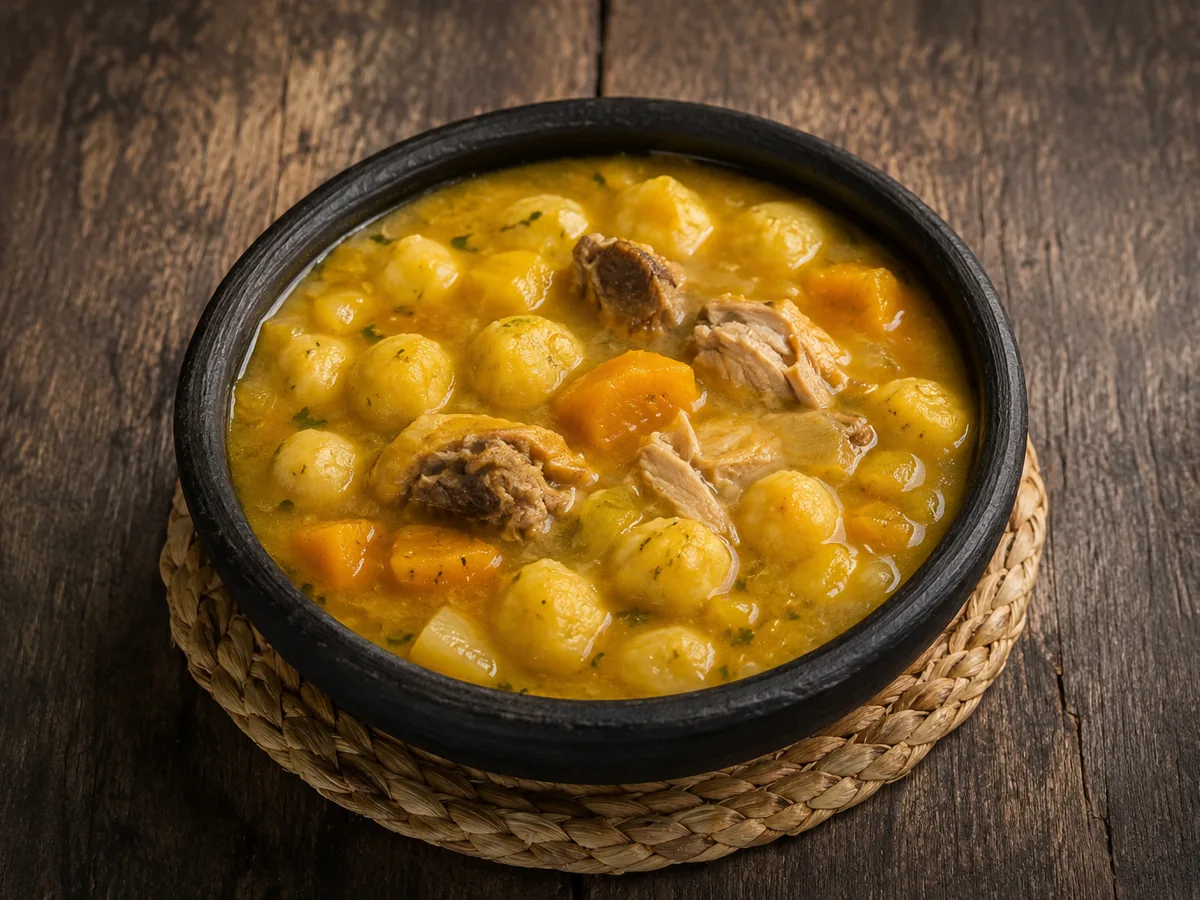
Vori vori is the pride of Paraguayan home kitchens. The name comes from the Guaraní vorí, a diminutive of the Spanish bola, said twice to mean many of them.
A bone-in country chicken is browned in hot fat and simmered into a golden broth with sweet onion, garlic, tomato, bell pepper and tender kurapepẽ. Then dozens of small cornmeal-and-cheese dumplings go into the bubbling pot.
As they cook they drink up the broth and shed starch back into it, turning the soup into a velvety, sun-coloured elixir.
The stew
- 1.5 kg3.3 lbBone-in, skin-on chicken thighs and drumsticks, trimmed and patted dry
- 45 ml3 TbspRendered pork lard, or neutral high-smoke-point oil
- 2 large2 largeYellow onions, peeled and cut into 6 mm brunoise
- 4 cloves4 clovesFresh garlic, minced to a paste
- 1 large1 largeRed bell pepper, cored, seeded and diced into 1 cm pieces
- 3 large3 largeRipe plum tomatoes, peeled, seeded and chopped coarse
- 400 g3 cupsKurapepẽ or kabocha squash, peeled and cut into 3 cm chunks
- 2 large2 largeCarrots, peeled and sliced into 1 cm rounds
- 2 stalks2 stalksCelery with its leaves, sliced thin
- 8 g2 tspGround cumin seeds, freshly toasted in a dry skillet
- 4 g1½ TbspDried wild oregano, hand-crushed
- 15 ml1 TbspAchiote oil, for the warm golden colour
- 2 L8.5 cupsRich chicken bone broth, or cold filtered water
- 18 g1 Tbsp + 1 tspFine sea salt12 g for the soup, 6 g for the dumplings
- 3 g1 tspFreshly ground black peppercorn
The vorí dumplings
- 350 g2.8 cupsHarina de maíz paraguaya — fine yellow corn flour
- 250 g2 cupsQueso Paraguay, grated fine on the small holes of a box grater
- 120 ml½ cupHot broth, ladled from the simmering pot
To finish
- 30 g½ cupScallions and flat-leaf parsley, chopped fine
The dumplings need no flour or egg
Harina de maíz paraguaya is pre-gelatinised. Worked with finely grated cheese and moistened with hot broth, the cheese melts slightly and binds alongside the corn starch — that is the whole structure.
They thicken the soup as they cook
Dropped into a 88–90 °C simmer, the dumplings' surface starches swell and firm while microscopic particles shed into the broth. The soup goes from clear to golden and lip-coating on its own.
Never a rolling boil
Turbulence shatters them. Hold a gentle sub-boil and nudge the bottom with a wooden spoon rather than stirring.
Brown the chicken properly
Raw chicken straight into water gives a pale, bland broth. Searing the skin in hot lard at about 180 °C lays down the caramelised fond that the stock later dissolves.
Dense dough, or they dissolve
Coarse polenta or too much liquid and they fall apart. The dough should be firm and pliable, made with fine corn flour and hot broth.
Passive time, counted separately
The finished pot rests 5 minutes off the heat before serving. That is not active work and sits outside the times quoted above.
The five tastes on this plate
Salt seasons the seared fond, the broth and the cheese dumplings. Fat is rendered chicken skin and lard carrying the fat-soluble cumin and achiote carotenoids. Acid is low, brightened with lime at the table. Heat is toasted cumin, garlic, black pepper and scallion. Umami is chicken marrow, cooked tomato and aged cheese.
Equipment
- 7 to 8 qt enamelled cast-iron Dutch oven
- Mixing bowl
- Small-holed box grater
- Ladle and wooden spoon
- Deep warm bowls
Traditionally a wide iron caldero or clay olla over outdoor wood coals. A heavy 7-to-8-quart enamelled cast-iron Dutch oven works in a modern kitchen — the thick base is what keeps the cornmeal dumplings from sticking and scorching on the floor of the pot.
Method
Sear the chicken12 min
Heat 45 ml lard in the Dutch oven over medium-high until shimmering. Season the chicken with 1 tsp salt and the black pepper.
Sear in two batches, 4 to 5 minutes a side, until the skin is deeply browned and crisp. Onto a plate.
Heat 45 ml lard over medium-high to about 180 °C. Season chicken with 1 teaspoon salt and pepper. Sear in two batches, 4–5 minutes per side until skin is deeply browned and crisp; transfer to a plate.
Sweat the aromatics14 min
Drop to medium and add the onions, garlic, bell pepper and celery to the drippings. Sweat 8 to 10 minutes until soft and translucent.
Add the tomatoes, toasted cumin, oregano and achiote oil and cook 5 minutes more, scraping the fond off the bottom until it forms a glossy paste.
Lower to medium; sweat onion, garlic, bell pepper and celery in drippings 8–10 minutes until soft and translucent. Add tomato, toasted cumin, oregano and achiote oil; cook 5 minutes, scraping the fond into a glossy paste.
Simmer the stew25 min
Return the chicken and its resting juices, and add the squash and carrots.
Pour in the 2 litres of broth with 12 g salt, bring to a gentle boil, then drop to low, cover partially and simmer 25 minutes, until the chicken reads 77 °C / 170 °F at the thickest point.
Return chicken and juices; add squash and carrots. Pour in 2 litres broth and 12 g salt; bring to a gentle boil. Partly cover and simmer on low 25 minutes until the thickest chicken reaches 77 °C / 170 °F.
Mix and roll the vorí14 min
While the soup simmers, rub the corn flour, grated cheese and 6 g salt together with your fingertips.
Ladle 120 ml of hot broth over it and knead 2 minutes into a warm, soft, cohesive dough that holds its shape.
Pinch off marble-sized pieces of about 15 g and roll them between damp palms into tight 2 cm balls — 35 to 40 of them.
Rub fine corn flour, grated cheese and 6 g salt together. Add 120 ml hot broth; knead 2 minutes until cohesive and shape-holding. With damp palms, roll 35–40 tight balls, about 15 g and 2 cm each.
Poach and thicken12 min
Uncover, and check the liquid is at a gentle roll, about 90 °C / 194 °F.
Drop the dumplings in one by one and simmer uncovered 10 to 12 minutes without stirring — nudge the bottom gently so nothing settles.
They firm, turn deep golden and float, and the broth thickens to silk.
Hold uncovered soup at a gentle simmer, about 90 °C / 194 °F. Add dumplings individually; simmer 10–12 minutes without stirring or boiling hard. Gently nudge the base to prevent sticking; dumplings should firm, turn golden and float as broth thickens.
Garnish and serve
Off the heat, scatter the scallions and parsley over the top and rest 5 minutes.
Ladle into deep warm bowls so everyone gets chicken, vegetables and 6 to 8 dumplings. Boiled mandioca and lime wedges alongside.
Off the heat, scatter the scallions and parsley over the top and rest 5 minutes.
Ladle into deep warm bowls so everyone gets chicken, vegetables and 6 to 8 dumplings. Boiled mandioca and lime wedges alongside.
Sensory cues of doneness
- Visual: an opaque, glowing sunburst-yellow broth, chicken pulling from the bone, and dozens of smooth intact golden balls suspended through it.
- Auditory: a gentle heavy murmur, and soft thuds as cooked dumplings bob to the surface.
- Olfactory: roasted chicken fond, toasted cornmeal, sweated garlic, sweet squash and melted country cheese.
Look for opaque golden-yellow broth, chicken releasing from bones and smooth intact golden dumplings. Expect gentle thick bubbling as the dumplings rise and aromas of browned chicken, toasted corn, garlic, squash and melted cheese.
Storing it
The dumplings can be rolled ahead: arrange them on a parchment-lined tray, cover, and refrigerate up to 12 hours before poaching.
Troubleshooting
- The dumplings dissolve into the soup.
Coarse polenta, or too much liquid in the dough. Use fine corn flour and hot broth, and keep the dough dense and pliable.
- They shatter.
The pot was at a rolling boil. Hold a gentle 90 °C sub-boil the whole time they cook.
- A pale, bland broth.
The chicken went in unbrowned. Deep-brown the skin in lard first — it is where the golden fond comes from.
Substitutions
One-to-one global substitutions, with the technique adjustment each one requires.
Ingredient substitutions
| Ingredient | Replace with | Culinary impact and technique adjustment |
|---|---|---|
| Harina de maíz paraguaya | Masa harina or fine yellow cornmeal — never cornstarch | One-to-one. Masa harina binds well, being pre-gelatinised |
| Queso Paraguay | Half fresh mozzarella, half queso fresco | One-to-one. Grate it fine so it melts evenly into the corn dough |
| Kurapepẽ | Kabocha, butternut or buttercup squash | One-to-one, cut into 3 cm chunks |
Scaling
Half, for 3 bowls
Halve everything in a 4-to-5 quart Dutch oven. The dumplings still poach strictly 10 to 12 minutes.
Double, for 12 bowls
Double everything in an 11-to-12 quart stockpot and drop the dumplings in two staggered waves so the broth temperature does not fall.
What to serve it with
- Mandioca hervida — boiled cassava with sea salt, the universal companion
- Fresh lime wedges squeezed into the broth at the table
- A cold lager, or icy tereré
Questions
Can I make it with beef?
Yes — that is vori vori de carne, made with bone-in beef shank or short ribs, simmered an hour before the dumplings go in.
What is vori vori morotĩ?
"White vori" — a meatless, dairy-forward version cooked with milk, extra cheese and vegetables, traditionally eaten on Fridays and in Holy Week.
Can the dumplings be rolled in advance?
Yes. Roll them, lay them on a parchment-lined tray, cover, and refrigerate up to 12 hours before poaching in the hot soup.