Chipa Almidón
Chipa is life in Paraguay — kneaded by whole families around wood-fired tatakuás at Easter and sold from linen-wrapped baskets balanced on chiperas' heads. Pure cassava starch, lard, eggs and cheese, scented with crushed anise and blasted at 230 °C so the shell crisps before the centre can dry.
- Prep
- 30 min
- Cook
- 18 min
- Serves
- 16 rings
- Difficulty
- Medium
Researched · Kitchen testing pending
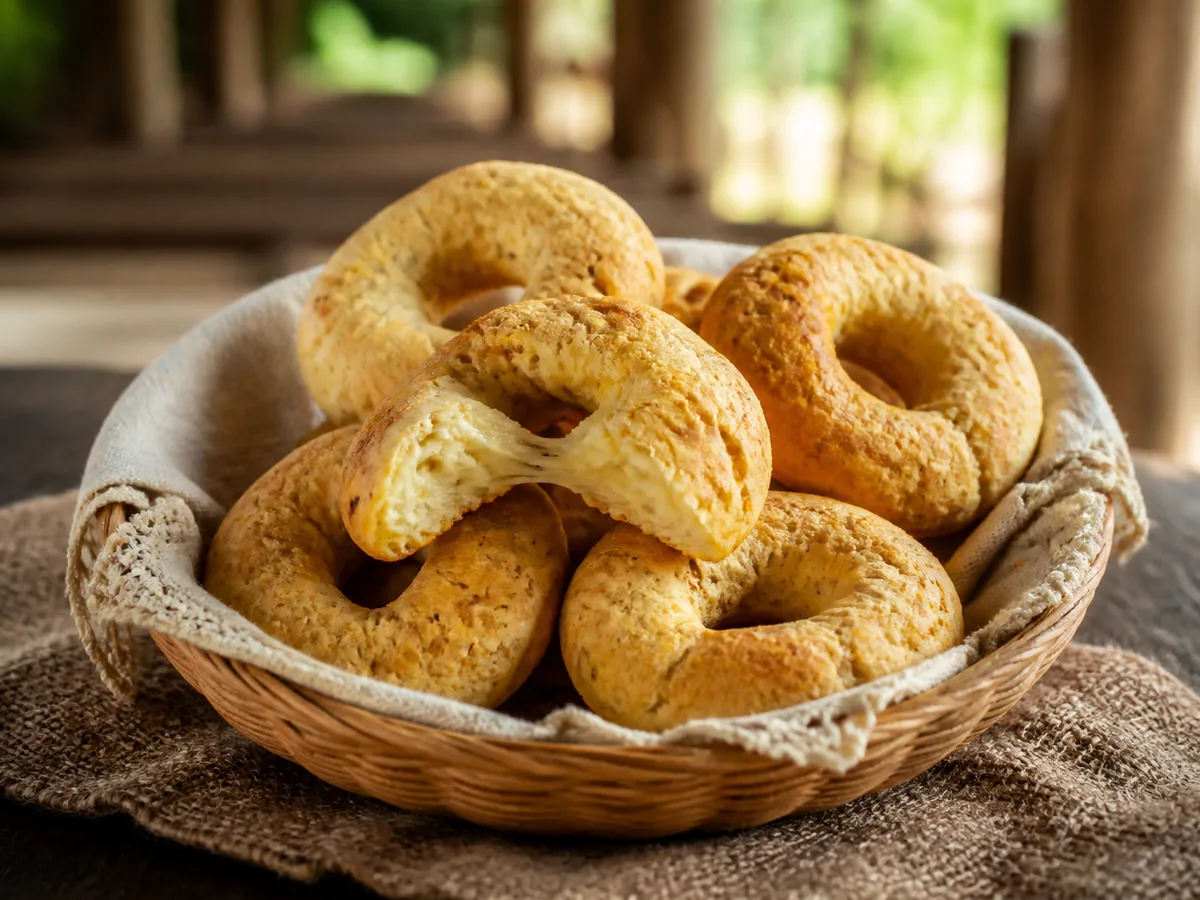
Chipa is life in Paraguay. During Semana Santa whole families gather around wood-fired clay tatakuás to knead hundreds of these rings, and chiperas balance enormous linen-wrapped baskets on their heads to sell them hot at bus stops and highway crossroads.
It is made from pure cassava starch, rendered pork lard, eggs and aged Queso Paraguay, scented with whole crushed anise seeds and coarse salt. Baked in a blazing oven it puffs into a crisp golden shell over a stretchy, chewy, cheese-strung centre.
Eaten hot with bitter mate or sweet cocido quemado.
Dough
- 500 g4.2 cupsCassava starch (almidón de mandioca / sweet tapioca starch), sifted
- 150 g⅔ cupRendered pork lard, or unsalted European butter, at room temperature
- 3 large3 largeEggs, at room temperature
- 300 g2.5 cupsQueso Paraguay, crumbled coarse
- 100 g1 cupHard grating cheese — Reggianito, Parmesan or Sardo — finely grated
- 80 ml⅓ cupWhole milk, at room temperatureadded only as needed to bind
- 10 g1½ tspCoarse sea salt, dissolved into the milk
- 5 g1½ tspWhole anise seeds, lightly crushed between the palms
The dough lies to you
Cassava starch is high-purity amylopectin that gelatinises at only 60–65 °C. Creaming lard with eggs makes an emulsion that coats each starch grain; when the salted milk goes in, the mass feels dry and crumbly and looks wrong. Vigorous kneading shears the fat and water into the granules and it turns suddenly into supple, putty-like dough.
Blazing heat, short blast
230 °C for 15 to 18 minutes. The water in the dough flashes to steam and expands the starch matrix into a chewy interior while the fat on the outside dehydrates into a rigid golden shell. Thirty minutes at 180 °C gives you rocks.
Do not skip the anise
Crushed anise is the aromatic signature of real chipa. Without it this is just cheese bread.
Starch, not flour
Almidón de mandioca and tapioca starch are the same thing. Cassava *flour* — harina de mandioca — is not, and will not work.
If it cracks, it is thirsty
Dough that splits when rolled into a rope is under-kneaded or dry. Work in 15 ml more warm milk and keep going.
The five tastes on this plate
Salt is coarse salt dissolved in the milk, the aged grating cheese and the curds. Fat is pork lard creamed into eggs, lubricating the starch and crisping the shell. Acid is a subtle lactic tang from the starch and fresh curd. Heat is the liquorice-like perfume of crushed anise. Umami is aged dairy peptides and toasted cassava.
Equipment
- Stand mixer with paddle, or a large wooden bowl
- Microplane
- Half-sheet pan and parchment
- Baking stone or steel
- Linen-lined basket
Traditionally unglazed tiles or iron sheets straight on the stone floor of a mud-brick tatakuá at 250 °C. A heavy half-sheet pan on parchment works in a modern kitchen, with a pizza stone or steel preheated at 230 °C for 45 minutes to mimic the tatakuá's fierce bottom heat.
Method
Cream the fat and eggs6 min
Beat the 150 g soft lard 3 minutes until pale and creamy.
Add the eggs one at a time, beating hard after each, until the mixture is a smooth, emulsified, mayonnaise-like cream.
Beat 150 g soft lard 3 minutes until pale and creamy. Beat in eggs one at a time until smooth and emulsified, like mayonnaise.
Anise and salted milk2 min
Rub the anise seeds between your palms to crack the husks and release the oils, and add them to the cream.
Dissolve the 10 g coarse salt completely into the 80 ml milk.
Rub the anise seeds between your palms to crack the husks and release the oils, and add them to the cream.
Dissolve the 10 g coarse salt completely into the 80 ml milk.
Work in the cheeses3 min
Add the crumbled Queso Paraguay and the grated hard cheese to the cream and mix thoroughly by hand so they distribute through the fat.
Add the crumbled Queso Paraguay and the grated hard cheese to the cream and mix thoroughly by hand so they distribute through the fat.
Bring the dough together10 min
Mound the sifted cassava starch over the mixture and rub the fat and starch together with your fingertips. It will look like coarse dry sand.
Drizzle in half the salted milk and knead firmly against the bowl. The dough comes together suddenly into a dense, smooth, elastic mass like warm modelling clay that cleans the sides.
Add the rest of the milk a tablespoon at a time only if it cracks. Knead 5 minutes until completely smooth.
Rub sifted cassava starch, not cassava flour, into the fat until sandy. Add half the salted milk; knead firmly 5 minutes until smooth, elastic and bowl-clearing. Add remaining milk by tablespoons only if cracking; work in 15 ml warm milk if still dry.
Shape the rings9 min
Preheat the oven to 230 °C / 450 °F with the stone on the centre rack.
Divide into 16 portions of about 70 g. On an unfloured surface roll each under your palms into a smooth rope 20 cm long and 2 cm thick, then bring the ends together with a 1.5 cm overlap and press firmly to seal.
Onto a parchment-lined sheet, 4 cm apart.
Preheat oven and centre-rack stone to 230 °C / 450 °F. Divide into 16 portions, about 70 g. On an unfloured surface, roll 20 cm ropes, 2 cm thick; overlap ends 1.5 cm and seal firmly. Space 4 cm apart on parchment-lined sheet.
Blast-bake15–18 min
Slide the sheet straight onto the preheated stone and bake 15 to 18 minutes.
They will puff, rise and take toasted golden spots. The crust should feel firm and crisp to a tap and the bottoms deeply browned. Do not overbake or the inside dries out.
Set the sheet on the hot stone; bake 15–18 minutes until puffed with toasted gold patches, firm crisp crusts and deeply browned bases. Do not overbake; the centres must stay chewy.
Serve at once
Into a linen-lined basket and straight to the table, while the cheese inside is still hot and stretchy.
Serve immediately in a linen-lined basket while the cheese is hot and stretchy.
Sensory cues of doneness
- Visual: rings puffed to about 1.5 times their raw size, pale biscuit-gold with toasted amber patches and tiny blisters, and deep chestnut bottoms.
- Auditory: a crisp dry hollow snap under a fingernail, then a silent elastic pull when torn.
- Olfactory: warm lard pastry, melted aged cheese, and the sweet perfume of hot crushed anise.
Look for rings puffed to 1.5 times their raw size, pale gold with amber blisters and chestnut bases. The crust should snap hollow and the centre stretch; expect warm lard pastry, melted cheese and anise aromas.
Storing it
Freeze the shaped raw rings on a parchment tray until solid, then bag them. Bake straight from frozen at 220 °C / 425 °F for 20 to 22 minutes.
Troubleshooting
- Dry, rock-hard chipas.
Too long at too low a heat. It needs 230 °C for a short 15-to-18-minute blast so the shell crisps while the core stays chewy.
- The dough cracks while shaping.
Under-kneaded, or too dry. Cassava starch needs firm hand-kneading — work in 15 ml warm milk and continue.
- It tastes like ordinary cheese bread.
The anise was left out. It is the signature aromatic of authentic chipa.
Substitutions
One-to-one global substitutions, with the technique adjustment each one requires.
Ingredient substitutions
| Ingredient | Replace with | Culinary impact and technique adjustment |
|---|---|---|
| Almidón de mandioca | Tapioca starch or tapioca flour | One-to-one. Fine white starch only, never pearls or cassava flour |
| Queso Paraguay | Half low-moisture mozzarella, half sharp white cheddar or provolone | One-to-one. Matches the elastic stretch and the sharp dairy tang |
| Rendered pork lard | Unsalted European butter | One-to-one, softened to room temperature before creaming |
Scaling
Half, for 8 rings
Halve everything. The bake stays 15 to 18 minutes at 230 °C.
Double, for 32 rings
Double everything and bake one sheet at a time on the stone, so the oven keeps its heat.
What to serve it with
- Cocido quemado con leche — mate leaves caramelised with sugar over live embers, simmered with hot milk
- Mate amargo from a cured gourd with a silver bombilla
- Café con leche
Questions
Can I use tapioca flour from an Asian grocer?
Yes — tapioca starch and almidón de mandioca are chemically identical. Just make sure it is pure starch, not cassava flour (harina de mandioca).
How do I store and reheat them?
Chipa is best within four hours. If you must keep it, bag it once cold and reheat at 200 °C / 400 °F for 3 to 4 minutes to bring back the crisp shell and the stretchy centre.
Can I freeze them raw?
Yes. Freeze the shaped rings on a tray until solid, then bag, and bake from frozen at 220 °C / 425 °F for 20 to 22 minutes.